Reading JournalStudy & Learning · ~4 min
About this template · Updated September 2026
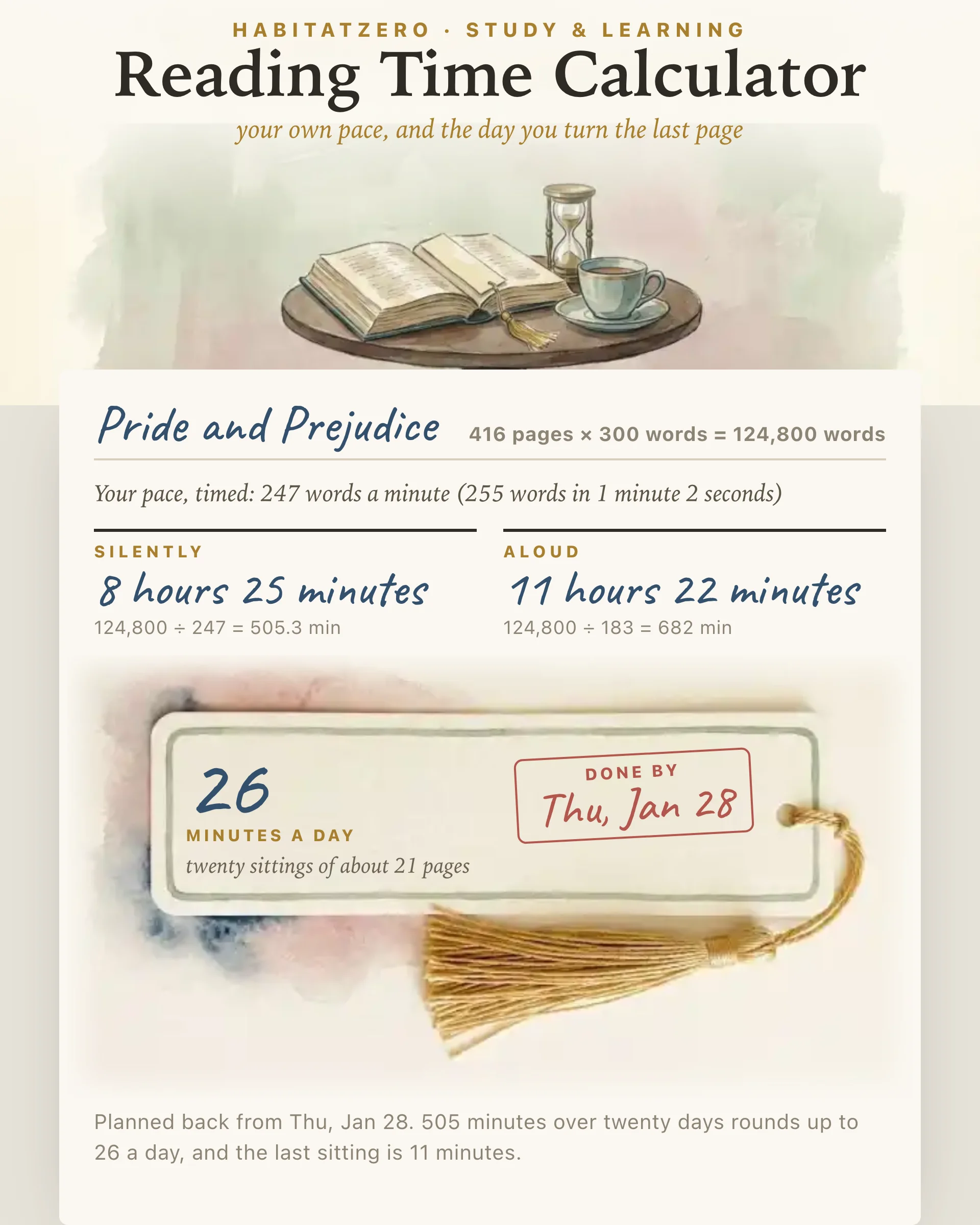
A reading time calculator does one small division: the words in front of you divided by the words you read in a minute. The hard part is the two inputs. Most books never print a word count, and most people have never measured their own pace, so they borrow a figure from somewhere and plan around a stranger's speed. This page settles both inputs, then turns the answer into something you can keep: how many minutes a day the reading needs, and the day you turn the last page.
Start with what you're reading. For a book, enter the page count and roughly how many words sit on a page. If you aren't sure of the second number, count five full lines, divide by five, and multiply by the lines on one page; that beats a guess. For an article, an essay or a speech script, switch to words and type the count, or paste the text into the box. The words are counted right there on the page and only the number is kept. The text itself is never saved or sent anywhere.
Then set your pace. The quickest honest way is the one-minute read: a short passage of two hundred fifty-five words, timed from the moment you tap start to the moment you tap done. Read it the way you usually read, for meaning rather than speed. One question afterward checks that you read the passage instead of skimming it. If you would rather not time yourself, begin from the typical adult rates of 238 words a minute for nonfiction or 260 for fiction.
The sheet then gives you two times: silently at your pace, and aloud at 183 words a minute, which you can change to your own speaking pace. Under each answer the division is written out, so you can check every figure yourself.
Last comes the plan. Tell it the minutes you have each day and the bookmark shows your finish date. Or step to the date you need, a book club or a class discussion, and it shows the minutes a day that get you there. Change the pages, the pace or the date and every number follows. Times round to the nearest minute, or to the second for anything under an hour, and minutes a day round up, so the plan never runs past its date. That's why the last sitting is usually the short one.
The default rates come from Marc Brysbaert's meta-analysis of reading rate, which pooled 190 studies and more than eighteen thousand readers. Adults reading English silently averaged about 238 words a minute on nonfiction and 260 on fiction, a gap that tracks the longer words nonfiction tends to use. Reading aloud averaged about 183. Most adults fell between 175 and 300 words a minute on nonfiction, and rates ran lower for children, older adults and people reading in a second language. Brysbaert also points out that these estimates sit below the figures often repeated in popular writing, which is one reason a borrowed number tends to make a plan look easier than it is.
That spread is the case for timing yourself. A reader at 180 words a minute and a reader at 300 facing the same 400-page novel finish hours apart, and only one of those speeds is yours.
People are reliably optimistic about how long their own work will take. In a classic set of studies on the planning fallacy, students predicted completion times that were too hopeful for academic and everyday tasks alike, and the bias disappeared when they were asked to connect the prediction to how similar tasks had gone before. The one-minute read is a small piece of that past experience, measured instead of remembered, so your plan starts from what you actually do on the page.
A single passage is a sample, not a verdict. Dense textbooks, unfamiliar subjects and small print will run slower than a light novel, so if the estimate feels off, read one page of the real book against a clock and type that pace in yourself. The times also assume reading straight through; notes, rereading and breaks come on top.
There is no shortcut to doubling your speed, either. A review of speed-reading research found a firm trade-off between speed and accuracy: going from around 250 words a minute to 500 or more is unlikely to leave your understanding intact. The route to reading faster with full comprehension is the slow one, more reading and a bigger vocabulary.
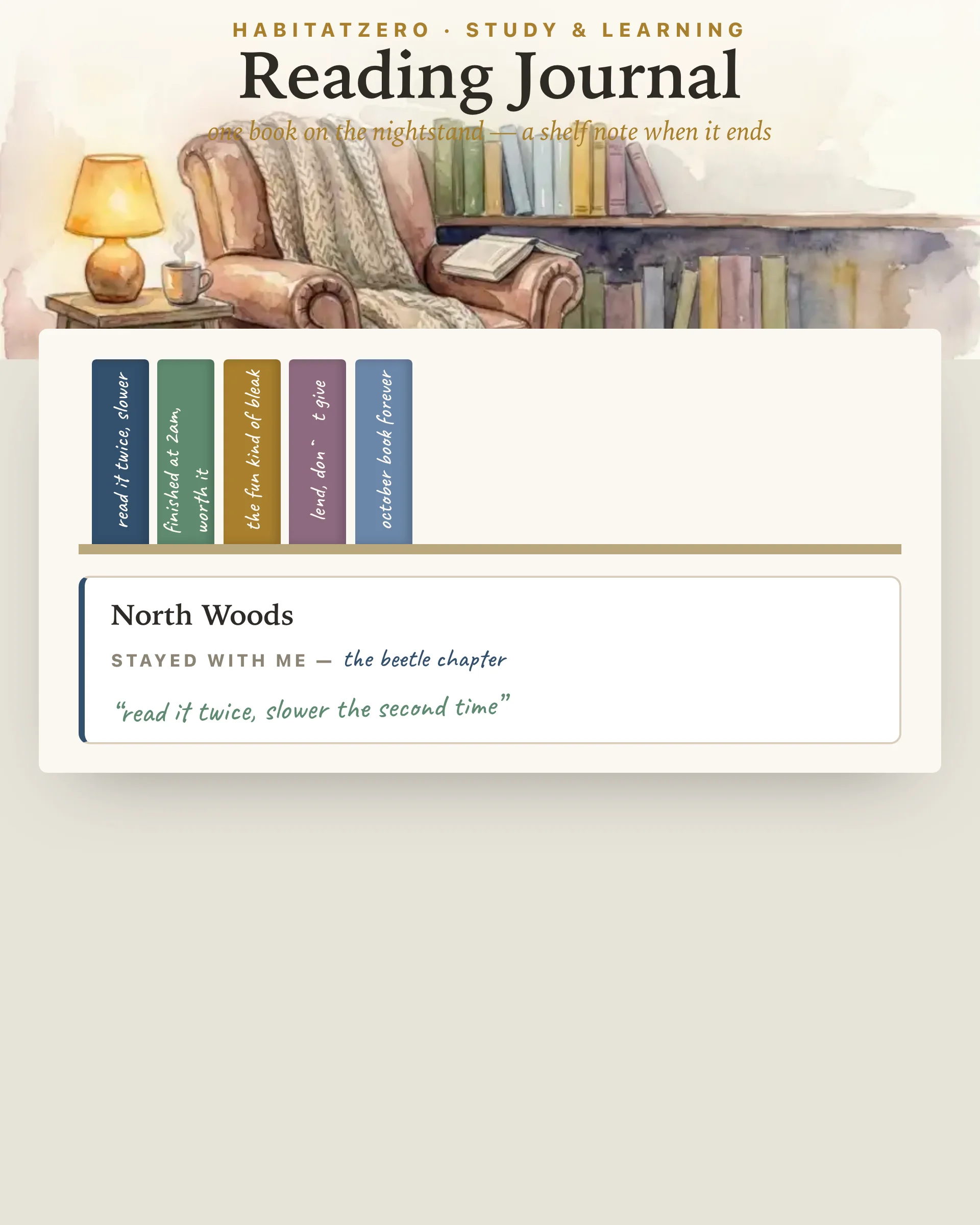
Open the calculator before a long book, a reading assignment with a due date, or a speech that has to fit a time limit. Once the plan is set, keep track of the book in the Reading Log as you go. If the reading belongs to exam preparation, fold the daily minutes into your Exam Planner, and when you finish, the Reading Journal is a good home for whatever stayed with you.
At 300 words a page, 100 pages hold 30,000 words. At the adult nonfiction average of 238 words a minute that comes to about two hours and six minutes, and at the fiction average of 260 it is closer to one hour and fifty-five minutes. Across the usual adult range of 175 to 300 words a minute, the same pages take anywhere from one hour and forty minutes to nearly three hours.
A 2019 meta-analysis of 190 studies put adults reading English silently at about 238 words a minute for nonfiction and 260 for fiction, with most people between 175 and 300 on nonfiction. Reading aloud averaged about 183 words a minute.
Divide the word count by your speaking pace. At the read-aloud average of 183 words a minute, a 1,000-word script runs about five and a half minutes before any pauses. Reading one page of your own script aloud against a clock gives a truer pace to plan with.
Not by much, and not quickly. A major review of speed-reading research found that doubling or tripling a normal pace of around 250 words a minute is unlikely to leave understanding intact. Steady reading and a growing vocabulary are what raise speed while comprehension holds.
The filled-in bookmark on this page shows the whole idea without an account. To time your own one-minute read and keep your plan and finish date, personalize the calculator in HabitatZero, which costs nothing.
By the team behind Fabulous, the science-based self-care app used by over 30 million people.