The Overwhelm Recovery ProtocolWellness & Routines · ~5 min
About this template · Updated September 2026
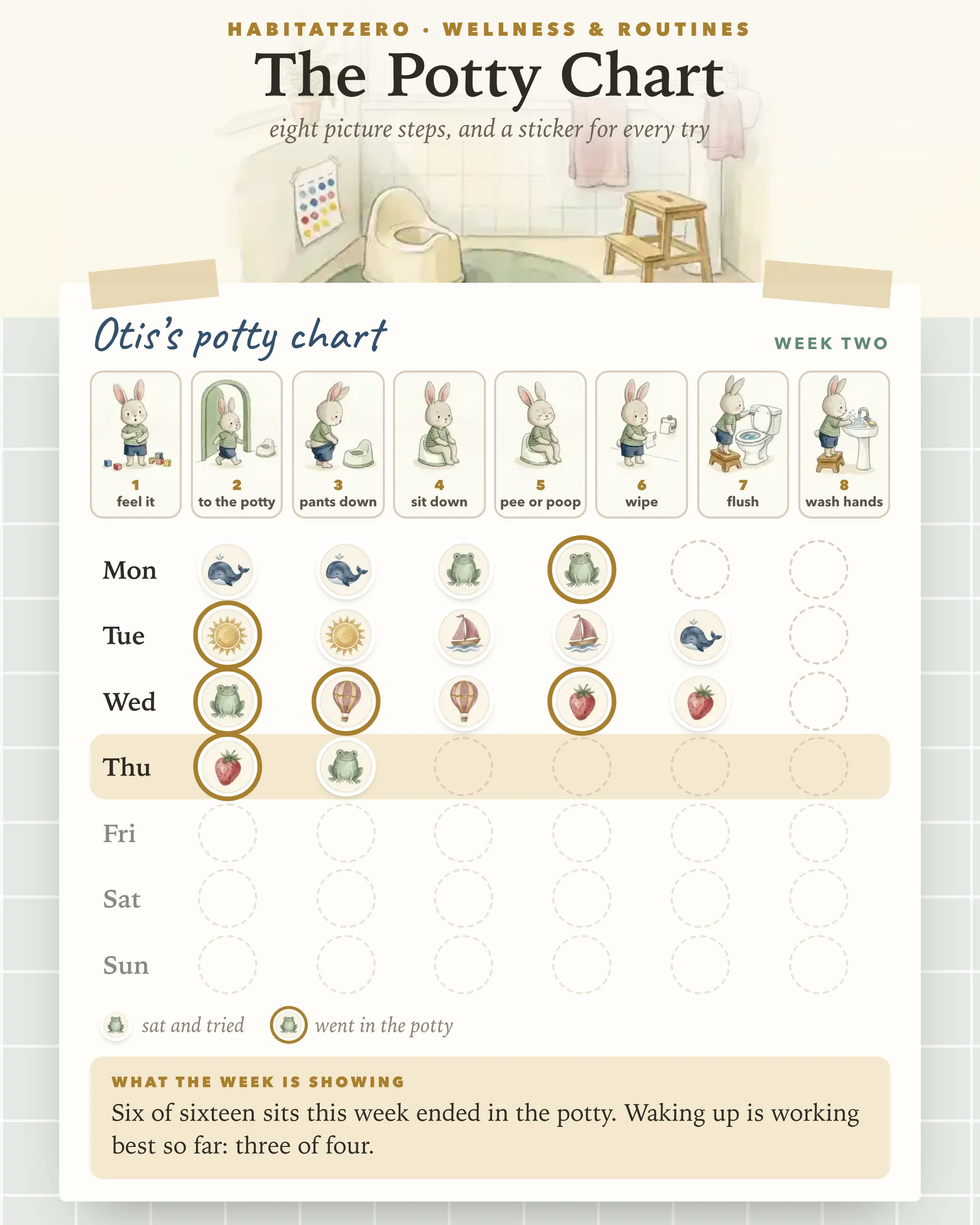
A potty chart has two readers. Your toddler reads the pictures, looking for what comes next and whether a new sticker has landed on today's row. You read the pattern: which sits end in the potty, and when the accidents tend to happen. This page gives each of you your own half of the same sheet.
Across the top of the chart runs a strip of eight painted cards, with a small bunny doing each step: feel it, walk to the potty, pants down, sit down, pee or poop, wipe, flush, wash hands. A two-year-old can follow pictures long before reading a word, and the order never changes. The American Academy of Pediatrics suggests keeping the bathroom routine as consistent as you can, with the potty in the same spot and the sequence, wiping and hand washing included, unchanged from one sit to the next.
Many toddlers go still, grunt or squat just before a pee or poop arrives, and naming that moment out loud ("you stopped playing, do you feel it?") helps the signal become theirs.
On a screen, your child taps each card as it is done, and after the eighth the chart asks for the sticker.
Below the steps sits the week, Monday to Sunday, with six sticker spots per day. After each sit you answer three quick questions:
A row holds six sits and turns away a seventh, since six is already a busy practice day. Forgot to log yesterday? Tap the plus on yesterday's row. A mistaken tap comes back off with undo the last one, which asks twice first.
Accidents get their own small button. They count in the reading underneath, never on your child's row, and nothing earned comes off because of one.
Pediatric advice on rewards is split, even within one organization. The same AAP planning guide says children learn best when they are praised for their progress rather than punished for their mistakes, and it allows perhaps a small tangible reward. The AAP's list of tips is stricter and advises skipping treats and punishments altogether, since both distract a child more than they encourage.
A sticker your child picks sits in the honest middle. It is small, it arrives right away, and it marks the practice instead of paying for it. Say exactly what they did ("you felt it and walked right in"), let them be the one who flushes, and keep bigger prizes off this chart. For a reward system aimed at a different behavior, the Token Board is built for that job.
Under the chart, a short reading turns the week into plain sentences: how many sits ended in the potty, which time of day is working best, and where accidents bunch together. If both of this week's accidents came in the afternoon and every afternoon sit so far has been a try, it suggests one extra, unhurried sit then. It never puts a label on your child or grades a day as good or bad.
Nobody can promise a number of days. In a study that followed nearly four hundred toddlers until they were dry during the day, children finished anywhere from twenty-two to fifty-four months of age, a spread of close to three years. The same study found that when children refusing to poop on the potty also had hard stools, the constipation had almost always come first. A child who will pee in the potty but holds back poop may be avoiding pain, not being stubborn.
A good week followed by a messy one is ordinary, which is why the reading looks at a whole week, never a single day.
Talk with your pediatrician if peeing or pooping hurts, if poops are hard or held in, or if a child who was dry starts having lots of accidents. For a child who slips back after being trained, the AAP's first step is to have them examined by their pediatrician to rule out a physical cause, such as constipation or a urinary tract infection.
Most children in the United States start somewhere between their second and third birthdays, but readiness matters more than the date. Common signs include staying dry for a couple of hours at a time, pausing or squatting when a pee or poop is on its way, following simple instructions, and helping to pull their own pants down. Once a few are in place, tape the chart up low and log the first sit, whatever happens.
If leaving play is the hard part, a First-Then Board (first the potty, then the blocks) can carry your child across.
Two things: the steps your child follows every time, shown in pictures, and a place to mark each sit. This chart has eight painted steps, from noticing the urge to washing hands, and a Monday to Sunday grid with six sticker spots per day.
Both. Sitting down and trying is the first skill a toddler builds, so every sit earns a sticker here, and a sit that ends in the potty gets a gold ring around its sticker. Once a sticker is on the row, no accident ever takes it back off.
The research on reward charts for toilet training is thin. The American Academy of Pediatrics notes that some parents feel gold stars on a chart work best, while its own tips suggest skipping treats and punishments. A small sticker the child picks, paired with specific praise, sits between those two views.
There is no set number of days, and the range is wide. In a study that followed nearly four hundred toddlers, daytime training finished anywhere from just under two to four and a half years of age. The same group showed that starting intensive practice before about twenty-seven months stretched training out without bringing the finish any earlier.
No account is needed to look over the painted example on this page. Keeping your own child's week, with their stickers saved between sits and the time-of-day reading, happens once you personalize the chart in HabitatZero, which is free. It prints on a single page, without the painting, for the bathroom wall.
By the team behind Fabulous, the science-based self-care app used by over 30 million people.