
The Overwhelm Recovery ProtocolWellness & Routines · ~5 min
About this template · Updated September 2026
Credit first. The parenting styles most quizzes sort you into come from developmental psychologist Diana Baumrind, whose 1966 paper described and contrasted three models of parental control: permissive, authoritarian and authoritative. In 1983, the psychologists Maccoby and Martin laid those patterns out along two dimensions, responsiveness and demandingness, and named a fourth combination, now called uninvolved or neglectful. This page is an independent tool built on that published work, and none of those researchers, nor anyone speaking for them, has reviewed or endorsed it.
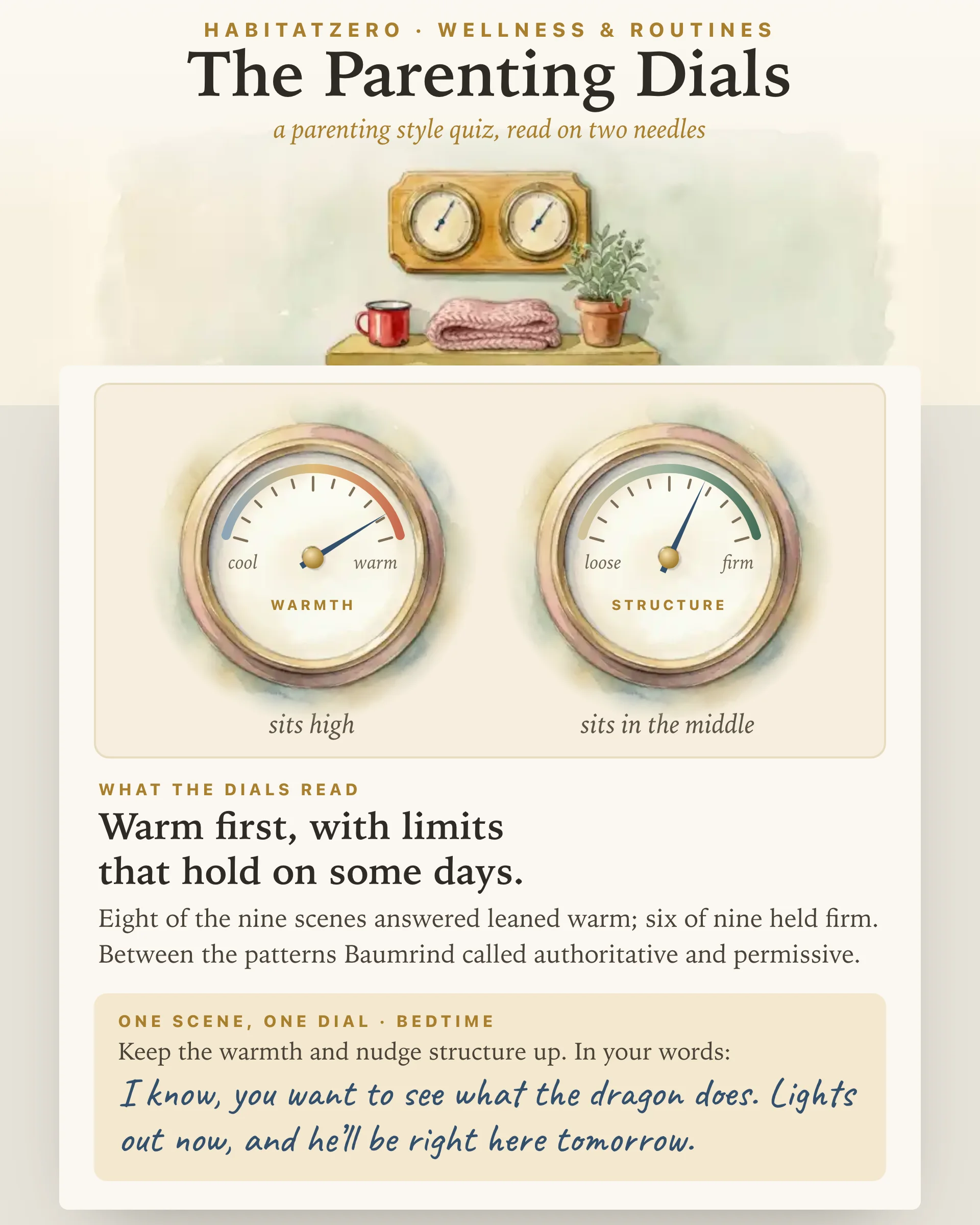
A typical parenting style quiz ends by filing you into one box. The research underneath it works differently. It measures two things separately: warmth, meaning how readily you respond to a child's feelings and needs, and structure, meaning how clearly limits and expectations are set and then kept. The four styles are simply the four ways those two dials can sit:
Seeing them as dials changes the question you ask yourself. The useful move is rarely switching styles wholesale. It is turning one dial up without turning the other one down.
You answer ten scenes from ordinary family life: lights-out, tears at the checkout, homework at seven, a slammed door, a sibling fight, chores left undone, a first outing alone, the morning rush, a rolled-eye "whatever," and a long story told while you cook. Pick whether you're answering for a child or a teen, and the wording shifts to fit. In each scene, tap the response closest to what you usually do on an unremarkable Tuesday. If a scene doesn't fit your family, skip it; three skips is the limit, so at least seven scenes reach the dials.
Each answer counts as warm or not, and as holding a limit or not. While you go, a warmth needle and a structure needle swing to show the share of each. Once all ten are in, you read the dials: the page says where each needle sits and which pattern your answers lean toward, then chooses one scene where only one dial was missing. You see what you picked, a sample of how warm and firm could sound in that moment, and a line to write it in your own words. You can move to another scene, and each one keeps its own line.
The direction is consistent and the effects are small. A 2017 meta-analysis pooling 1,435 studies found that warmth, behavioral control and authoritative parenting had very small to small links with fewer externalizing problems, the acting-out kind such as aggression and rule-breaking, while harsh control and psychological control had the strongest links with more of them. Several of those links also ran both ways over time, so a child's behavior shapes the parenting they receive, not only the reverse.
Almost all of this research is correlational. Families are not randomly assigned a style, which means the studies cannot show that a style caused an outcome.
Culture shapes the picture as well. A meta-analysis of 428 studies found more similarities than differences across ethnic groups and world regions, with authoritative parenting tied to at least one good outcome in every region it examined. The size of those links varied, though. In Western countries, for example, the tie between authoritative parenting and school achievement was weaker in Asian minority families than in non-Hispanic white families. What counts as warmth, and how a limit gets expressed, differs from one household and tradition to the next, so read your dials against your own family's values rather than a single ideal.
Take it during an ordinary week, not in the middle of a crisis, and answer for your usual response rather than your finest one. Practice the one scene for a month, then answer the ten again and see whether a needle has moved. Co-parents can each take it and compare where their needles land. Differences are normal, and the conversation worth having is about which limits you both keep.
If structure is the dial you want to raise, a Kids Daily Routine Chart puts limits on the wall before anyone has to say them out loud. If big feelings are what knock warmth down, The Calm Down Jar gives your child something to do with a storm while you stay close. And if both needles sit low because you are running on empty, the Caregiver Burnout Quiz looks at your own load first.
If you ever fear you might hurt your child, call or text the Childhelp National Child Abuse Hotline at 1-800-422-4453 at any hour, and raise it with your pediatrician as well. Its counselors talk with parents who are struggling, not only with children, and reaching out early is part of keeping everyone safe.
Diana Baumrind described three in the 1960s: authoritative, which pairs warmth with clear limits; authoritarian, with firm limits and little warmth; and permissive, with warmth and few limits. In 1983 Maccoby and Martin added a fourth, uninvolved or neglectful, where both are low. All four are combinations of two dials, warmth and structure.
The warm and firm pattern Baumrind called authoritative is linked most often with good outcomes, and a meta-analysis of 428 studies tied it to at least one good outcome in every world region it examined. The links are modest, though, the studies are correlational, and their size varies by culture, so read it as a direction to lean toward rather than a grade.
It is a reflection, not a validated test. The ten scenes were written for this page, and the dials only show how you answered today. Parents shift with the day, the child and the season, which is why the most useful part is the single scene you choose to practice.
Yes. A style is a pattern of everyday responses, and responses can be practiced one scene at a time. Studies that follow families also find the influence runs in both directions, since a child's behavior shapes the parenting they receive. Answer again after a month of practice and see whether a needle has moved.
What shows on this page is a sample reading with the needles already set. Answering the ten scenes yourself, and keeping your dials and the words you write for next time, happens when you personalize it in HabitatZero, which costs nothing.
By the team behind Fabulous, the science-based self-care app used by over 30 million people.


