
The Overwhelm Recovery ProtocolWellness & Routines · ~5 min
About this template · Updated November 2026
Credit where it belongs first. The PAR-Q+, the Physical Activity Readiness Questionnaire for Everyone, is the work of the PAR-Q+ Collaboration, who publish the current form at eparmedx.com. This page is independent of them: it is not affiliated with or endorsed by the Collaboration, and it never reproduces, paraphrases or rewords a single one of the form's questions. It is also not a medical assessment, and it does not replace the official form. What it holds is your side of the process: when a new client fills the form in, what you do after any yes, and what you write in your own paper file.
A PAR-Q is a short questionnaire a person completes about their own health before they become more active. The older name is still the common one, as in PAR-Q or PAR-Q form, but the version to hand over today is the PAR-Q+.
The plus came out of a systematic review of the old PAR-Q and its medical follow-up, the PARmed-X, which the authors introduced in a 2011 special issue of Applied Physiology, Nutrition, and Metabolism. That review found that the health benefits of physical activity far outweigh its risks for the vast majority of people, with or without symptoms. It built a new decision process meant to cut needless barriers to getting active, and it moved the follow-up online as the ePARmed-X+.
In the United States, the American College of Sports Medicine moved the same way a few years later. Its 2015 update to exercise preparticipation screening noted that its earlier guidance could lead to excessive physician referrals. The update now weighs three things: how active someone already is, any signs or symptoms or known cardiovascular, metabolic or renal disease, and how hard they want to train. Risk factor profiling is no longer part of the screening step itself.
Neither paper turns a questionnaire into a verdict on one person. A form a client completes tells you when to stop and send them to someone qualified. It cannot tell you, or them, what is safe for their body, and nothing on this page tries to.
The Collaboration holds the copyright. Its terms and conditions let authorized users download, print and administer the official instruments, and they ask for written permission before anyone changes question wording or order, adapts a form, translates it or builds it into something else. So this planner names the form and leaves its words where they live. Print the current version from eparmedx.com whenever you run low, and hand it over exactly as it comes.
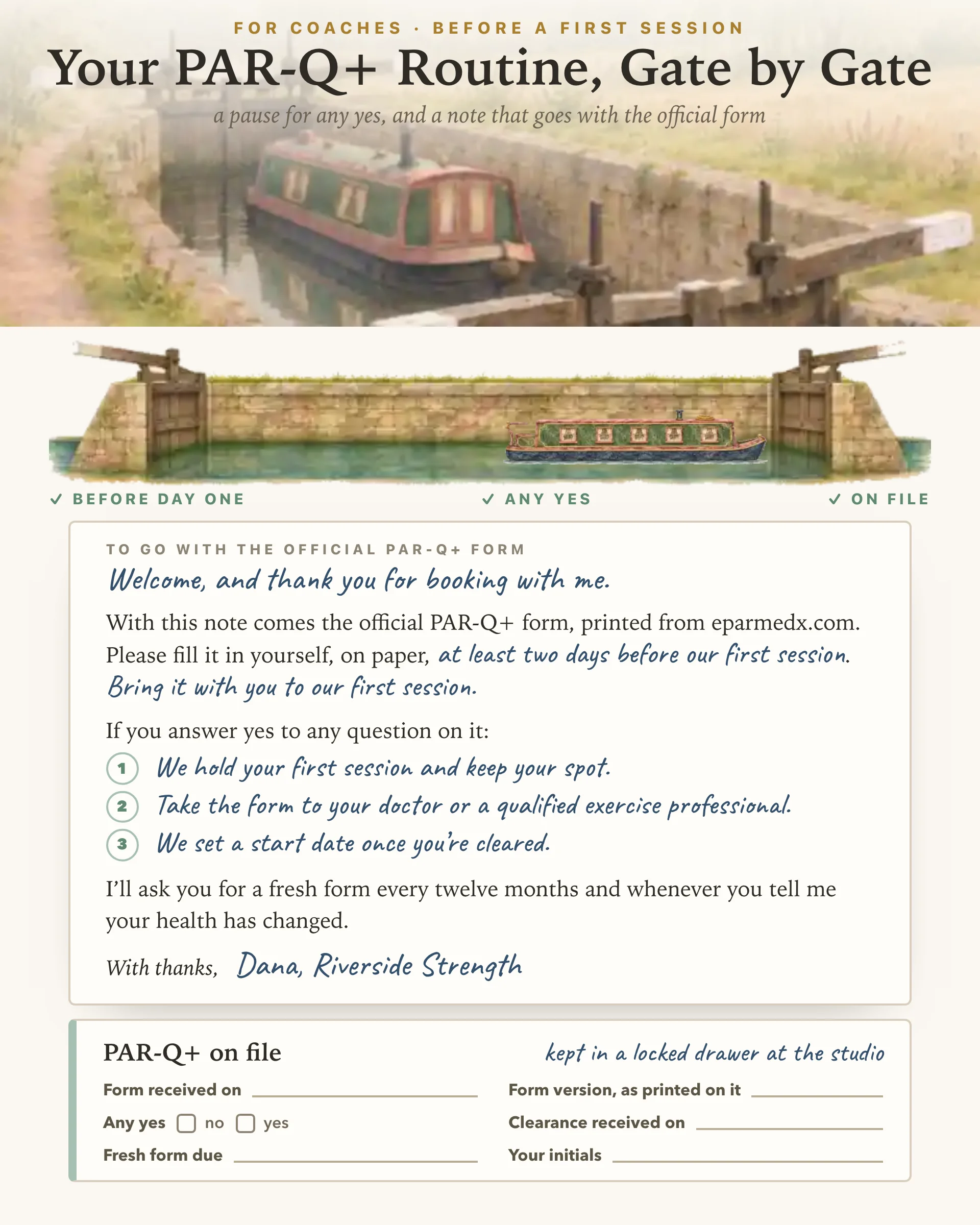
A canal lock holds a boat between two gates until the water is level on both sides, then lets it through. Nobody gets turned away; they wait. Your routine works the same way, in three gates.
Each gate you set moves the boat further along, and the line above the lock names whatever is still open. Further down the page, the cover note writes itself from your choices: a request to complete the official form by hand, your three steps for any yes, a plain line saying you can't interpret anyone's answers, and when a fresh form will be due. Sign it, print it beside the strip, and it goes out with each copy of the form.
No field here takes a client's name, contact details, health details or answers, not even as a note. Completed forms and any clearance letters stay on paper in files you control, and the strip prints blank so you fill it in by hand. How long you keep health records, and who may see them, depends on the state or country where you coach and on what your insurer expects. Nothing here is legal advice, so check those rules locally, with your insurer or with a lawyer who practices there.
Do it before the next new client books, and again whenever you change a step, so every note you hand out matches what you actually do. If you are still sketching the business itself, a one-page plan for your coaching business gives the intake step a place among the others. And before a fourteen-day challenge for your members kicks off, it's a natural moment to hand the official form and this note to everyone joining.
PAR-Q is short for Physical Activity Readiness Questionnaire, a form a person fills in about their own health before becoming more active. It is a screening step, not a diagnosis. Its current version, the PAR-Q+, comes from the PAR-Q+ Collaboration at eparmedx.com.
The PAR-Q+ took over from the original PAR-Q after its authors reviewed the old screening process and published the result in 2011. The new version added a decision process meant to stop sending people away from activity without need, and an online follow-up called the ePARmed-X+ took the place of the paper PARmed-X.
From eparmedx.com, the official site of its authors, which offers the current form as a PDF you can print. They ask people to use the official version rather than an edited copy, which is why this planner points you there and leaves the questions out.
Do what the form itself says comes next, and leave the meaning of the answer to a clinician. This planner sets that out as three steps you word yourself: a pause, a referral to a doctor or a qualified exercise professional, and a start only once the client is cleared. It is not legal advice about what your insurer or local rules expect.
No. This page is independent and has no affiliation with, or endorsement from, the PAR-Q+ Collaboration. It names their form and sends you to their site, but none of its questions are copied, summarized or reworded here.
Yes. Setting it up here costs nothing, and the Personalize button carries your routine and your wording into a free Salon account from the team behind Fabulous, ready for the next client who books.
By the team behind Fabulous, the science-based self-care app used by over 30 million people.


