ADHD Daily Task OrganizerFocus & ADHD · ~10 min
About this template · Updated September 2026
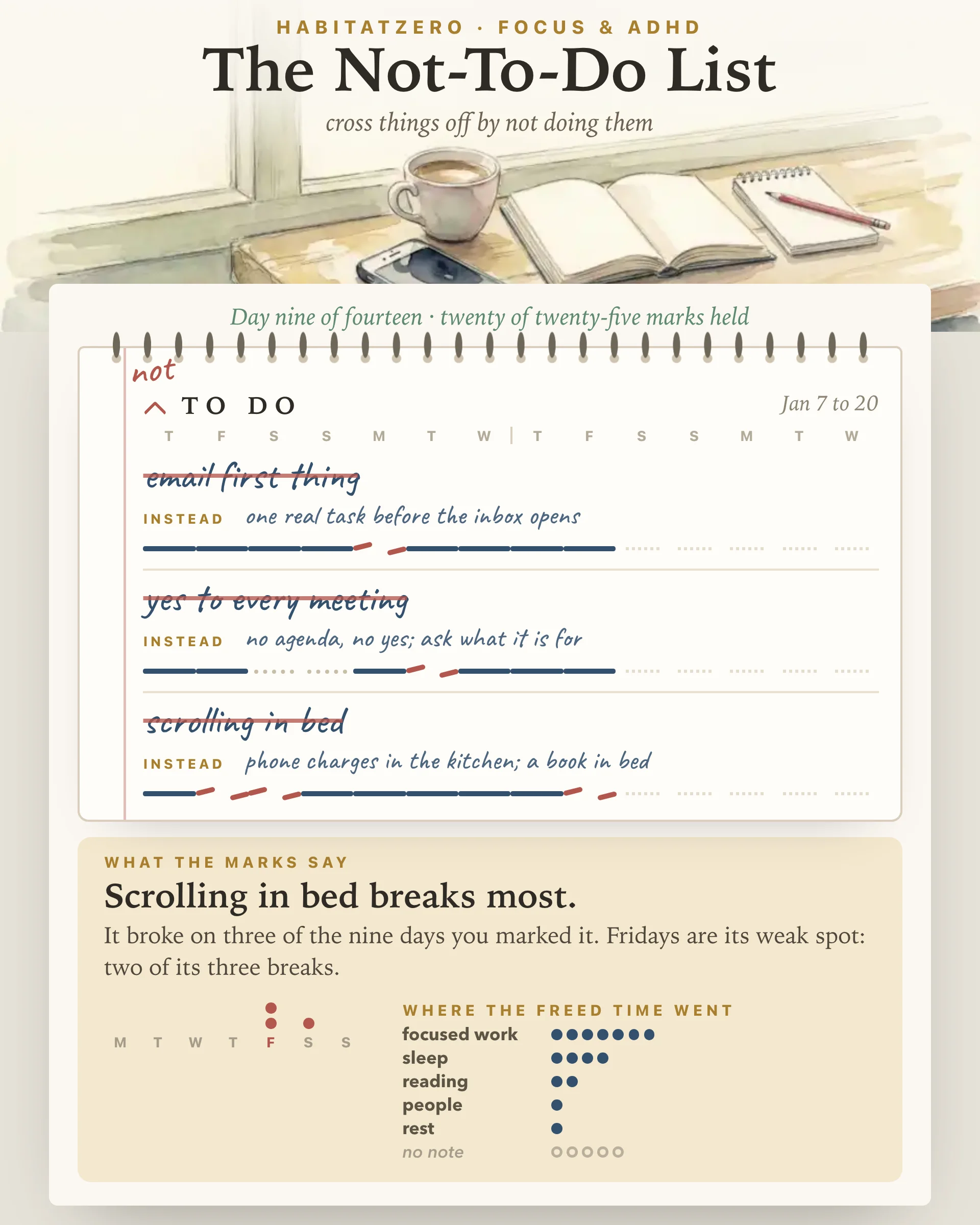
Credit first. Tim Ferriss popularized the phrase in a 2007 blog post, The Not-To-Do List: 9 Habits to Stop Now, arguing that "what you don't do determines what you can do." Jim Collins had made a similar case four years earlier with his "stop doing" list, a New Year's resolution built by subtraction. This worksheet is an independent take on the idea: neither of them made it, reviewed it, or stands behind it.
A to-do list only ever grows: every good intention adds a line. A not-to-do list works the other side of the ledger: the reflexes that eat the hours you meant for something else. Email before you have done anything that matters. A yes to every meeting that lands on your calendar. The phone in bed that turns ten minutes into an hour.
Ferriss suggested working on one or two at a time, the way you would treat your most important tasks. This pad keeps that spirit: it stops at five lines, and it asks for a mark every day, because a rule you never check on is only a wish.
Each line on the pad is a habit you are stopping, crossed out in red the moment you write it. Tap a suggestion and it arrives with its trigger and swap filled in, or write your own. Keep both short:
Each evening, mark every line held or broke for the day. Under each line an ink line grows one day at a time, solid where it held and snapped where it broke. On a day a line held, you can note where the freed time went: sleep, reading, focused work, people. Missed an evening? Step back and fill in any earlier day of the run. A run lasts two weeks from your first mark, which gives every weekday two chances to show up; after that, start the next two weeks and your lines carry over with fresh marks.
The reading underneath does the part paper can't. It names the line that breaks most, finds the weekday its breaks gather on, quotes the trigger you wrote for it, and names the line that holds best. The tally of freed time shows what all that not-doing actually bought you.
Nobody has run a trial on not-to-do lists as such, so any promise that one will transform your year is marketing. The research that does exist covers the pieces this pad is built from.
The strongest piece is the if-then plan. Pairing a goal with a specific plan of the form "if this happens, then I will do that" helps people follow through: a meta-analysis of 94 independent tests found a medium-to-large effect on reaching goals (Gollwitzer and Sheeran, 2006). Your when and instead lines are that kind of plan, pointed at a habit you want gone.
How you word the plan matters too. In studies of unhealthy eating habits, plans phrased as "if this happens, then I will not do that" ironically strengthened the habit they targeted, most of all when it was strong, while plans that named a replacement did not backfire (Adriaanse and colleagues, 2011). Those studies were about food, not email, so read them as a good reason to write an instead, not as a guarantee. A bare "don't" leaves the trigger with nowhere to go.
The marks give you evidence about your own weeks instead of a vague feeling. If scrolling in bed breaks on Fridays, the fix is probably not more willpower on Friday night. It is a different Friday: the book on the pillow before you go out, the charger moved to the kitchen before you are tired.
Start with two or three lines, not five, and write triggers you can see coming. "When I'm bored" is too loose to plan around; "when I sit on the couch after dinner" gives the instead a place to stand.
Put the swap where the trigger is. If email first thing keeps breaking, the one real task has to be open on the screen before the inbox is, and Eat the Frog helps you choose that task the night before. For a habit with a stubborn obstacle, The WOOP Method walks you through naming the obstacle and planning around it.
Once a replacement sticks, it has become something you do, and a daily habit tracker is the better home for it. Keep the not-to-do list for what you are still stopping.
Reach for it when your days are full but the things you care about keep slipping, when you notice the same reflex swallowing the same hour, or at a natural fresh start: a new year, a new job, a new semester. By the end of two weeks you will know which line needs a sharper rule and which one you can stop thinking about.
It is a short list of habits and commitments you have decided to stop, kept where you will see it. A to-do list adds work to your day; this one guards your time by naming what you will no longer spend it on, like email before your first real task or a phone in bed.
Choose habits that cost you something you can name, such as a morning, an hour of sleep or a conversation you only half heard. Common picks are email first thing, yes to every meeting, answering every ping the second it arrives, working through lunch, news before noon and hitting snooze.
They are close cousins. To don't list is another name for the same habit list. Jim Collins described a stop doing list in a 2003 newspaper column about New Year's resolutions, as a yearly look at commitments worth dropping, while a not-to-do list usually holds daily habits you can check each evening.
No. Ferriss made the name popular with a 2007 blog post, and this page credits him for it, but he had no part in building it and has not endorsed it. The suggestions, the daily marks and the reading belong to this independent worksheet from Fabulous.
The page shows a sample pad, nine days into its two weeks, that you can look over. To cross out your own lines and mark them every evening, personalize it in HabitatZero at no cost.
By the team behind Fabulous, the science-based self-care app used by over 30 million people.