ADHD Daily Task OrganizerFocus & ADHD · ~10 min
About this template · Updated September 2026
The phrase belongs to Brian Tracy, whose 2001 book Eat That Frog! turned one line about doing the worst job first into a full method for beating procrastination. His own short guide, how to eat that frog, is the place to hear it in his words. This worksheet was made independently to practice that single habit; Tracy and his company had no part in it and do not endorse it.
In Tracy's terms, your frog is your biggest, most important task, the one you are most likely to put off. The rule is to eat it first thing, before anything easier gets a chance to fill the morning. That is the whole method. The hard parts are choosing the frog honestly the night before, and then noticing which frogs you keep letting get away.
Tracy opens with a line he credits to Mark Twain, about eating a live frog first thing so that nothing worse can happen to you for the rest of the day. Quote Investigator found no substantive evidence that Twain ever said or wrote it. The oldest version it traced sits in Nicolas Chamfort's writings from the 1790s, where a worldly gentleman recommends swallowing a toad every morning to steel yourself for a day spent in high society. The earliest link to Twain it found dates from 1988, more than seventy years after his death. So the saying is older and odder than its usual source, and it still makes the point.
Procrastination research describes the frog with some precision. Piers Steel's meta-analysis of procrastination, which pooled 691 correlations, found task aversiveness among the strongest and most consistent predictors of putting things off. Put plainly, a frog gets pushed because it feels bad to start, whether or not it is actually difficult. That is why this page asks what makes each frog a frog. Awkward, boring, huge, foggy and nerve-racking are different flavors of unpleasant, and each one calls for a different small fix.
Reaching for the easy jobs first carries a cost of its own. In a study of emergency department physicians, KC and colleagues found that as the workload climbed, doctors picked easier cases. The shift looked more productive at first, but once the difficulty of the work was accounted for, throughput was worse, and the doctors improved more slowly. A lab experiment in the same paper traced the pull toward easy tasks partly to fatigue and partly to the sense of progress that finishing something gives you.
Eating the frog is a rule of thumb, not a tested treatment, so hold it lightly. The explanation you often hear, that willpower is a tank that drains as the day goes on, has also taken a knock: a preregistered ego-depletion replication run across twenty-three labs with more than two thousand participants found an effect close to zero. The better reasons for going first are plainer. Early in the day fewer things have claimed your attention, and a job finished at nine cannot trail you around until five.
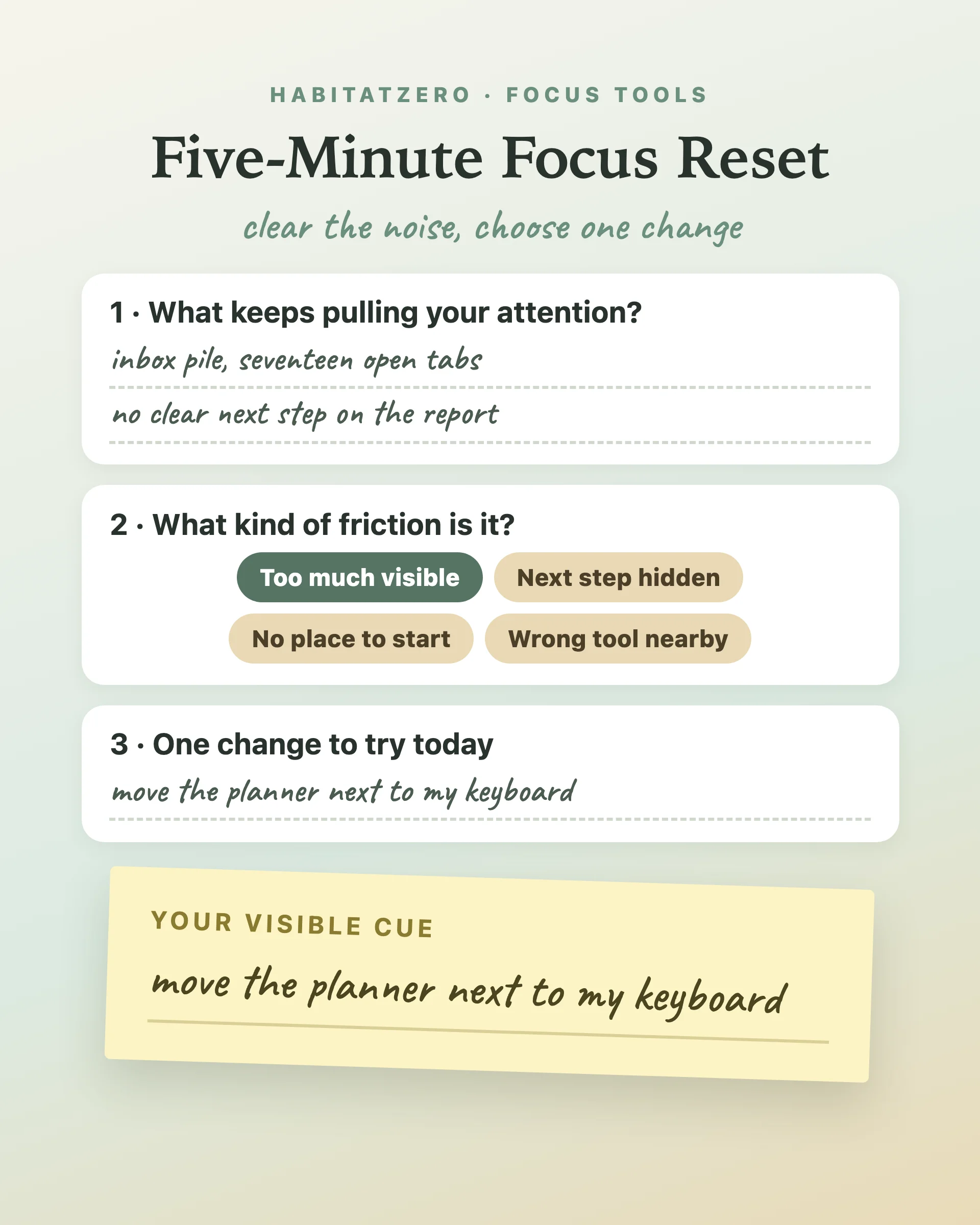
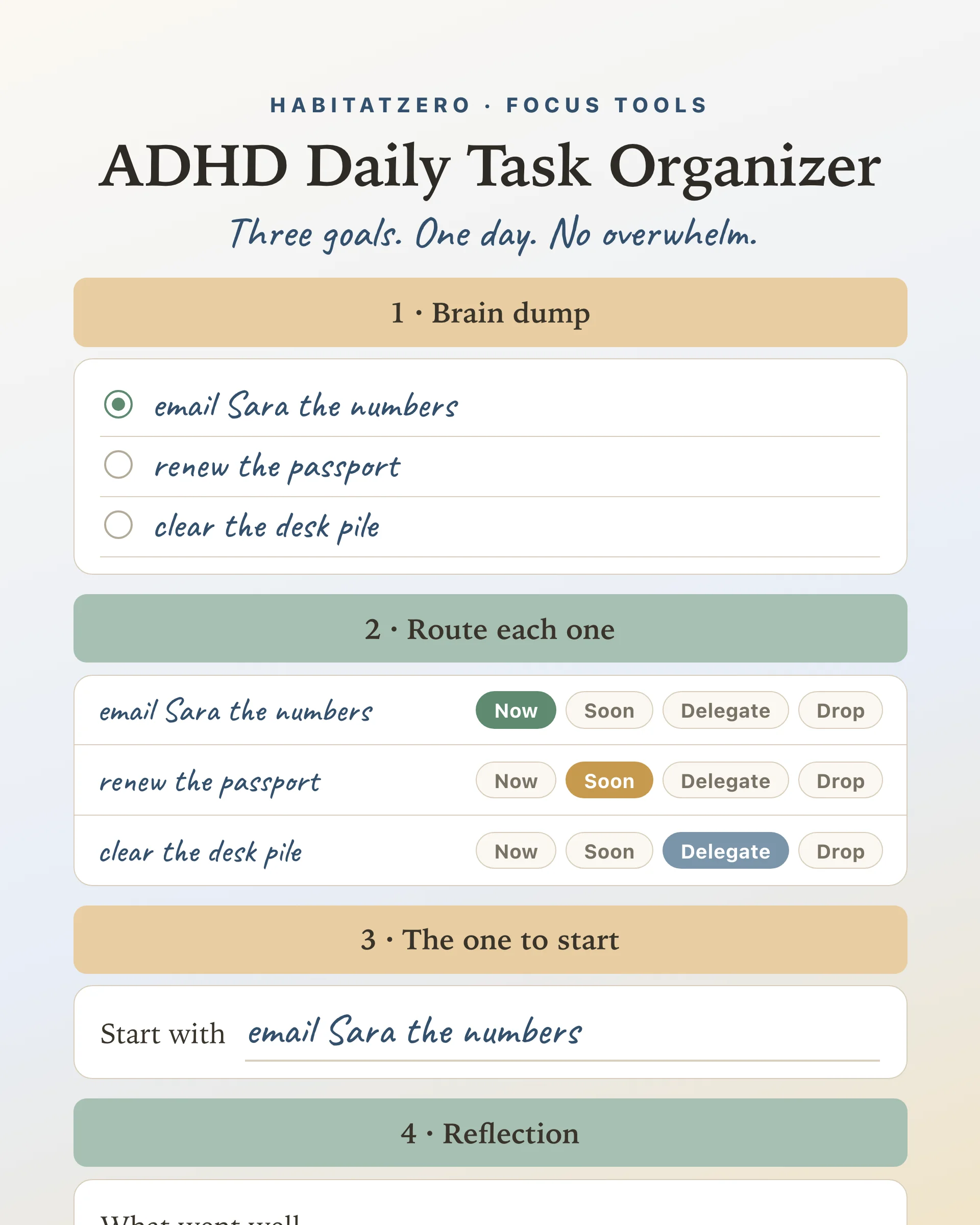
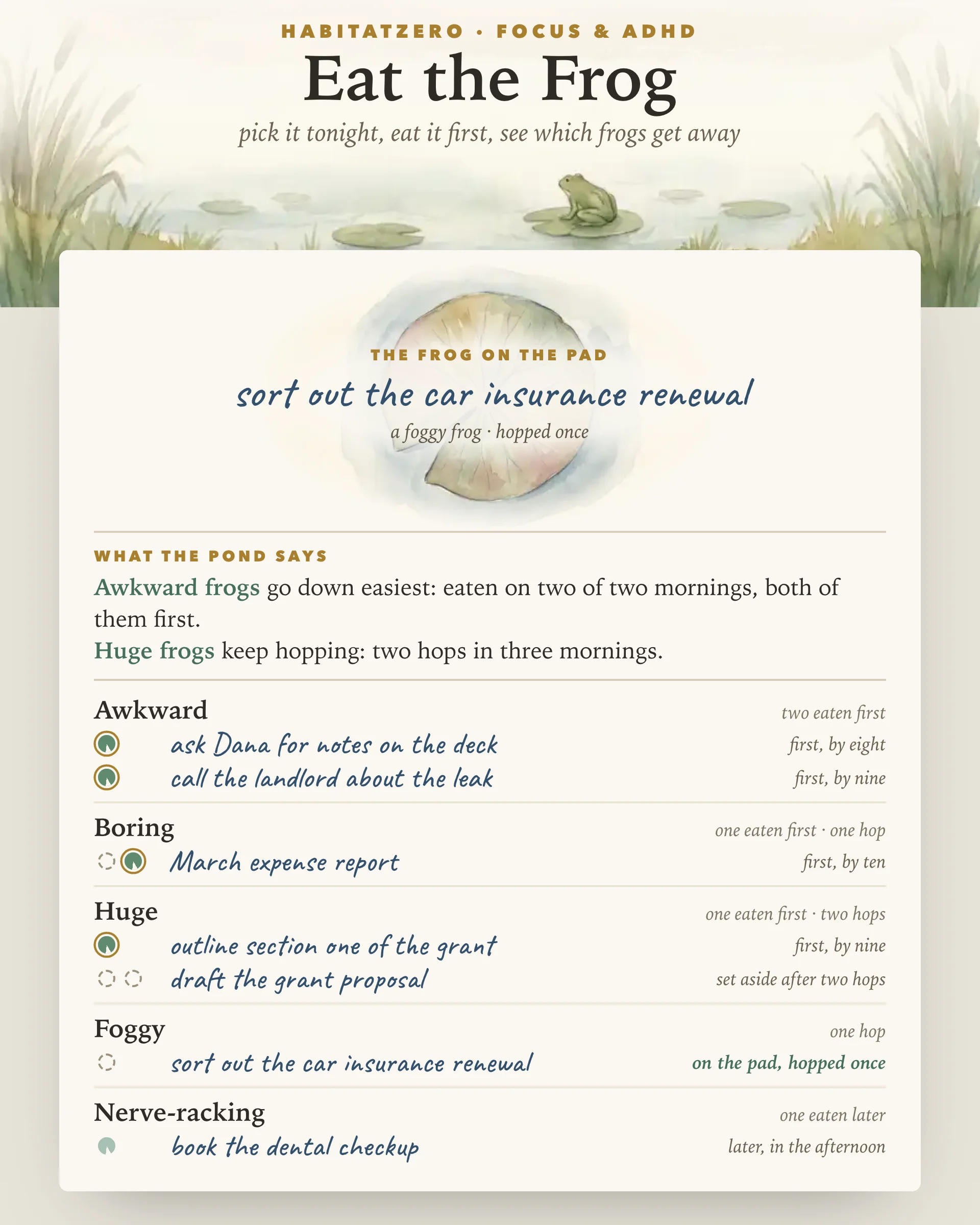
Tonight, write tomorrow's frog on the lily pad in a few words, then tap what makes it a frog. In the morning, mark it eaten first, eaten but not first, or hopped, and tap roughly when it went down. A frog that hops stays on the pad for the next morning, and its hops stack up where you can see them. After five hops the page stops offering another night and asks you to slice off a smaller bite or set the frog aside, because a frog that has dodged you all week needs reshaping more than it needs more waiting.
Every morning you log lands in the pond, grouped by kind. Once three mornings are in, the page reads them back to you: which kind of frog goes down easiest, which kind keeps hopping, and the hour your first-thing frogs usually go down. The stubborn kind comes with one concrete change to try tonight. The pond holds twelve frogs, so the pattern stays readable at a glance, and you can clear out old ones with a two-tap remove.
Not everyone does well with a cold start. Some people, and the complaint comes up often in ADHD circles, find that opening the day with the hardest task stalls the whole morning. If that sounds like you, try a two-minute warm-up and then the frog, and log it truthfully as eaten, not first. After a couple of weeks the pond will show whether the warm-up gets frogs eaten or just postpones them. When a huge or foggy frog keeps hopping, try making it smaller rather than pushing harder: name the first slice as tomorrow's frog instead of the whole project.
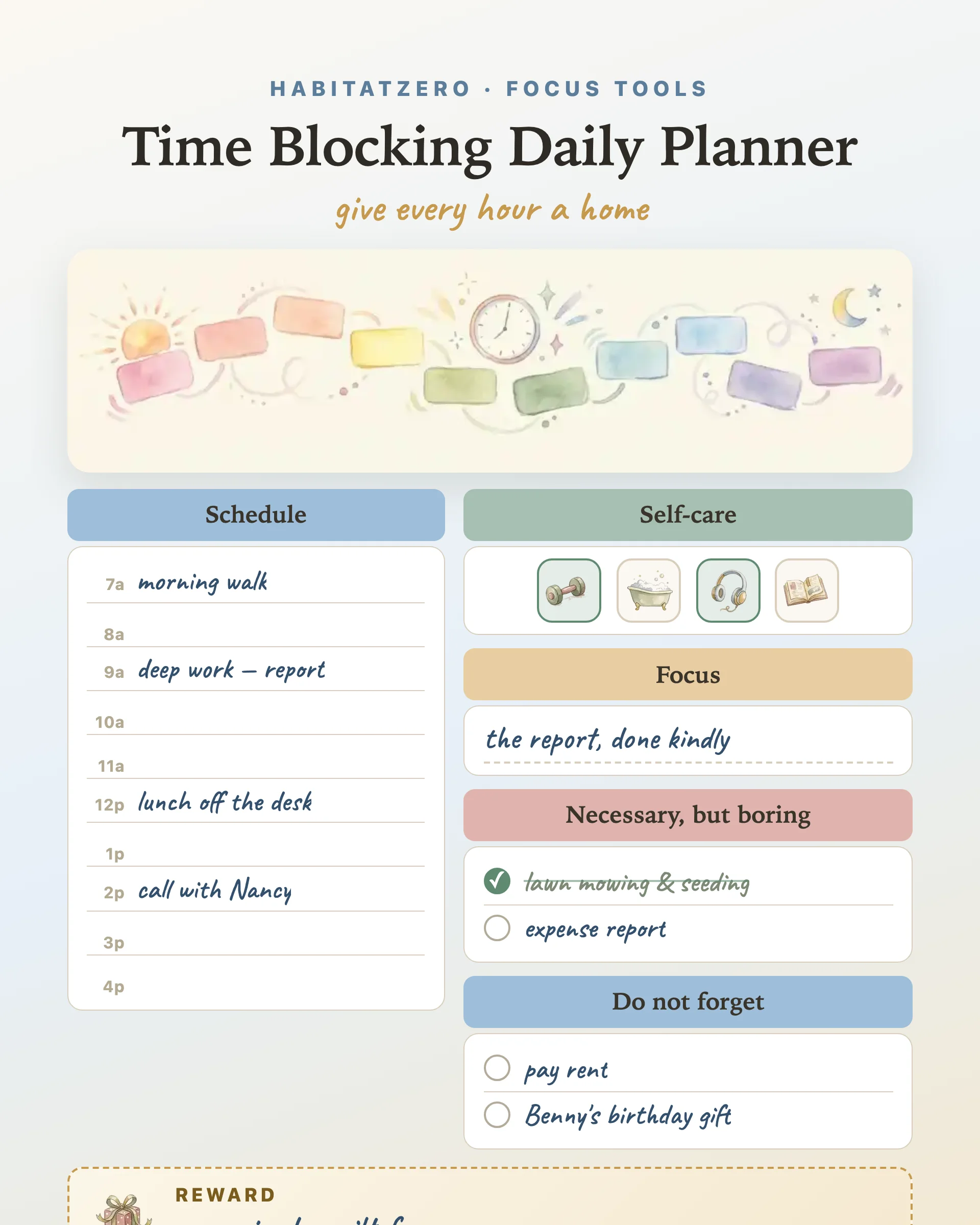
Reach for it during any stretch when important work keeps losing to whatever is urgent or easy. If you cannot tell which task is the frog, sort the pile first with the ADHD Priority Matrix. If the frog needs a protected slot, give it the opening block in the Time Blocking Daily Planner. And if one frog a day feels too narrow, The Ivy Lee Method ranks six tasks the night before and works through them in order.
It means doing the important task you most want to put off before anything else in your day. The frog is that task, the one that matters and the one you least want to start. Once it is eaten, the hardest part of the day is already behind you.
The version most people know comes from Brian Tracy's 2001 book Eat That Frog!, which built a whole approach to procrastination around tackling your most important task first. This worksheet is a separate tool for practicing that one habit, and neither Tracy nor his publisher is involved with it or endorses it.
Probably not. Quote Investigator found no solid evidence that Twain ever said or wrote it, and traced the idea to a line in Nicolas Chamfort's writings from the 1790s about swallowing a toad every morning. The earliest link to Twain it turned up dates from 1988, long after his death.
Make the first real step on it your opening move instead: find the number, open the file, write the first line, or book the call for the minute the office opens. If the frog itself goes down later in the day, log it as eaten, not first, so the pond reads your mornings as they really were.
You can look through the filled-in example on this page without signing up. To name your own frogs and keep a pond of mornings that reads your patterns back to you, personalize it in HabitatZero, which is free.
By the team behind Fabulous, the science-based self-care app used by over 30 million people.