Wind-Down Routine BuilderSleep & Evenings · ~4 min
About this template · Updated September 2026
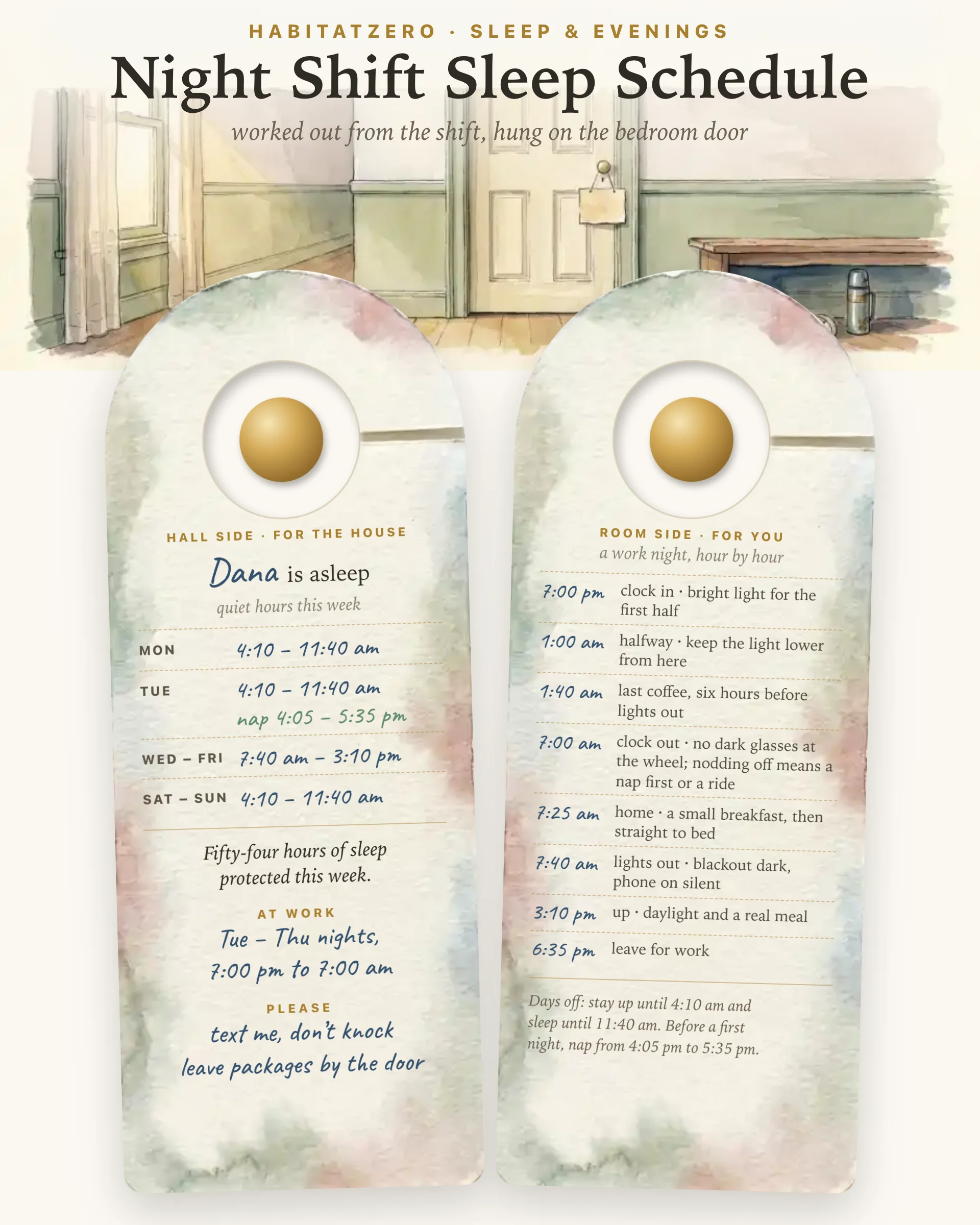
Working nights asks you to sleep at the hour when the sun, the household and your own body clock all agree you should be up. Good intentions rarely survive that. What does help is deciding the hours ahead of time, while you are rested, and making them visible to everyone who could wake you. That is the job of this page: you give it your shift and your trip home, and it lays a week of sleep out on a two-sided sign for the bedroom door.
Start with the row of seven days and tap each evening you clock in. Set the start time and length of the shift, how long getting home takes, and whether you drive. Then say how your days off run: steady nights, where you stay partly on a night rhythm, or rotating, where you switch back to daytime between runs. Last, choose one long sleep, a long sleep plus a short nap, or a sleep split in two.
The hall side is for the people you live with. It lists your quiet hours day by day, the way a store door lists its hours, and carries up to three short requests, such as texting instead of knocking. The room side is for you: a work night hour by hour, from bright light at clock-in to the minute you leave again the next evening.
Under the sign, the page adds up every hour it has set aside and tells you how many hours of sleep your week protects, what that comes to per day, and where those hours come from. That total is the point. A plan can look fine one night at a time and still come up short across seven days, usually on the day you switch back to daytime or when a long drive eats into the afternoon.
The core rule comes from the NIOSH training for nurses on shift work: sleep as soon as you get home and for as long as you can. The same training describes a compromise for days off, where you stay up until three or four in the morning and sleep until about noon, so the hours from roughly 8 am to noon stay asleep on every day of the week. The steady-nights setting builds exactly that overlap and names your anchor hours.
For switching back to days, the page follows a Delphi consensus of shift-work sleep experts: a short sleep on the morning after the last night, some daylight once you are up, and a bedtime earlier than usual. That consensus also sets the target at seven to nine hours per twenty-four and allows it to arrive as one main sleep plus a shorter one, which is why the split option exists.
Light and coffee serve the sleep that comes after the shift. Following the NIOSH training, the room side puts bright light in the first half of the night and lower light in the second. Your last coffee lands six hours before lights out, a gap backed by a home study of caffeine taken zero, three and six hours before bed, which found sleep disturbed even at six. The American Academy of Sleep Medicine's advice for shift workers also tells you to stop coffee in the later part of a shift and to make sure the people at home know your schedule, which is the whole reason the hall side exists.
Dark glasses on the way home can help you fall asleep sooner, but NIOSH cautions that blocking daylight at the wheel makes a drowsy drive more dangerous. So the sign only suggests them when you have said you do not drive. If you drive and catch yourself nodding, the room side tells you to nap before setting off or to get a ride.
Hours in bed are not hours asleep, so read the total as the most your plan allows rather than a promise of what you will get. Rotating schedules vary so widely that the NIOSH training does not try to cover them and points rotating workers who struggle toward a sleep specialist; treat the rotating setting as a starting point. None of this is a diagnosis. If day sleep stays broken for weeks, if seven or eight hours still leave you worn out, or if you nod off at work or while driving, talk with a clinician about shift work disorder. An accredited sleep center has ways to help your body adjust that a door sign does not.
Set it up when a new schedule posts, and again before any run of nights that looks different from the last. Keep a Sleep Log for two weeks alongside it, since a record of when you actually slept is also what a clinician will ask to see. If your plan includes a nap, The Nap Timer will wake you on time, and the Caffeine Calculator shows how your own cups fade before the day sleep begins.
For most night workers it is one long sleep that begins as soon as you get home, in a room kept truly dark, with a few morning hours held for sleep on work days and days off alike. NIOSH describes this as a compromise schedule: on nights off you stay up until the small hours and sleep until around noon.
Head home and go straight to bed, with a small breakfast first if hunger would wake you. Black out the bedroom, silence the phone and ask the people you live with to guard those hours. Sleep you get before early afternoon tends to hold better than sleep you start later.
With a 7 pm to 7 am shift and a half-hour drive, lights out lands near 7:45 am and seven and a half hours of sleep ends around 3:15 pm, which leaves time to eat and wake up properly before leaving at 6:30. On nights off, staying up until about 4:15 am and sleeping until 11:45 am means you are asleep from 7:45 to 11:45 every morning, work or not.
After your last night, take a short sleep in the morning, get up, spend some time in daylight and go to bed a little earlier than usual that evening. Staying awake all day to reset leaves you up for far too many hours in a row. On steady nights you may prefer not to switch back fully at all.
You can study the filled-in sign on this page without an account. Setting your own nights, trip and sleep length, and keeping the sign to change when the next schedule comes out, happens in HabitatZero, which costs nothing.
By the team behind Fabulous, the science-based self-care app used by over 30 million people.