Wind-Down Routine BuilderSleep & Evenings · ~4 min
About this template · Updated September 2026
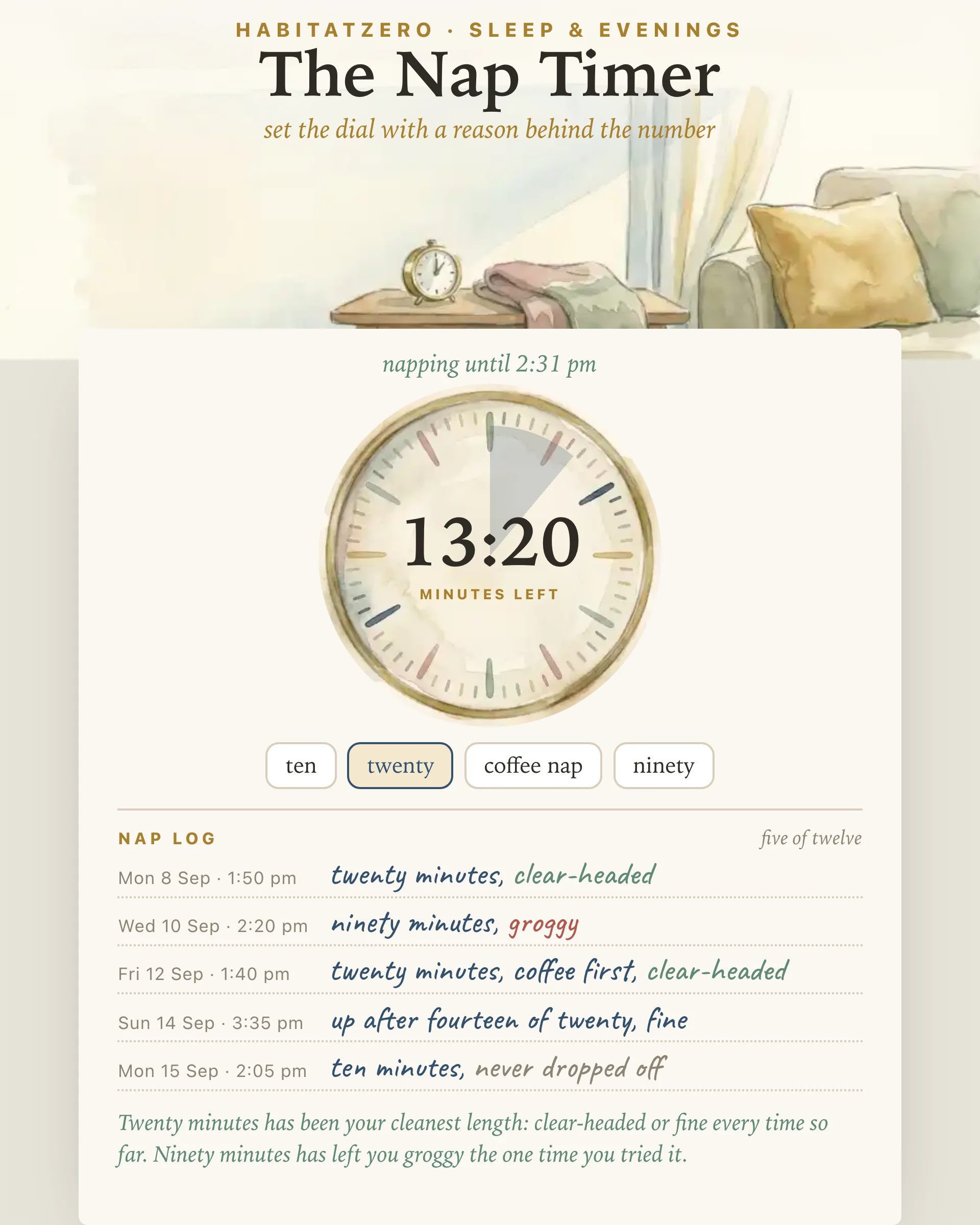
A nap timer has one job that a phone alarm already does, and one that it does not. The alarm wakes you. What it never tells you is why twenty minutes and not forty, whether a coffee first would help, or which of last week's naps left you sharp and which left you wrecked. This page is a bedside dial that carries those answers with it, and a log that keeps score.
Naps are not one thing. What you get out of one depends almost entirely on how deep you went before something pulled you back up.
A ten-minute nap barely leaves the shallows. In a controlled comparison of afternoon naps after a short night, the ten-minute nap produced the fastest improvement in alertness, with benefits that showed up immediately and held for over two hours. Twenty minutes did well too, though its benefits took a little longer to appear. Thirty minutes was the odd one out: people woke into a stretch of impaired alertness before the nap paid off.
That stretch has a name, sleep inertia, and the review literature is clear that it is worst when you are woken from deep sleep and that it can linger for a good while afterwards. Once a nap passes the half hour, deep sleep is where you are likely to be. So the dial on this page calls thirty to sixty minutes the groggy zone, and says so under the number.
Ninety minutes is a different bet. A full sleep cycle runs from light sleep down through deep sleep and back up into the lighter, dreaming stage, and cycles average about ninety minutes each. Set the dial there and you tend to surface near the top of one. It is the length for a genuinely short night, with the honest caveat that a nap this long can borrow from the sleep you would have had tonight.
It sounds like a contradiction, and it works because of timing. Caffeine takes a good twenty minutes to start working. Drink it and lie down straight away, and it turns up as you get up. In a driving-simulator study, a coffee followed by a short nap cut sleepy-driving incidents to under a tenth of placebo levels, where the coffee alone only managed a third, and even people who merely dozed still benefited. The coffee nap preset sets the dial to twenty minutes and changes the start button so it reminds you which comes first.
Tap a length, or nudge the dial five minutes either way, and a line under it tells you what that length usually buys and costs. Press start. The shaded wedge on the face shrinks as the minutes go, the numerals count down, and the page shows the exact minute it will reach zero.
Then the honest part. A web page cannot ring or buzz while your phone is locked or the screen is dark. Nothing on this page pretends otherwise. So the moment you start, set a phone alarm for the wake time the dial gives you. The page keeps counting from the real clock, and when you come back to it the face has turned warm and reads time to get up, whether you were watching or not.
Getting up is when the second half begins. Four words are waiting: clear-headed, fine, groggy, never dropped off. Tap one and the nap goes on the log with its date, start time and length, or the minutes you managed if you got up early. The log holds twelve. After a couple of entries, a line beneath it starts reading them back: which length has been your cleanest, which has left you groggy, and whether your naps have been starting late enough in the day to eat into the night.
Rules of thumb about napping are population averages. Some people rise out of a ninety-minute nap feeling reborn; others feel like they have been dug up. The length that suits you is something you can only learn from your own record, which is why this page keeps one instead of just counting down.
Read the log in two weeks, not tomorrow. Two groggy ninety-minute naps and four clear twenty-minute ones is a pattern worth trusting. One bad nap is a bad day.
The classic window is early afternoon, when the body clock dips whether or not you slept well. Naps that start after mid-afternoon tend to steal from the night, and the log will say so if it sees a habit forming. If evenings are the real problem, the Wind-Down Routine Builder works on the other end of the day, and the Sleep Log tracks the nights so you can see whether daytime napping is helping them or hurting them. On days when a nap is not an option, the Afternoon Reset is the awake alternative.
A nap timer will not fix a chronic short night, and daytime sleepiness that will not lift belongs with a doctor rather than a dial. For the ordinary afternoon dip, though, twenty minutes and a coffee is a surprisingly good plan, and this page will tell you whether it is yours.
For most afternoons, ten to twenty minutes: you stay in light sleep and wake without much fog. Thirty to sixty minutes tends to land you in deep sleep, which is why those naps feel worse on waking. If you have a real sleep debt and the time, ninety minutes is roughly one full cycle and you tend to surface near the top of it.
You drink a coffee, then lie down for about twenty minutes. Caffeine takes roughly that long to take effect, so it arrives as you get up. In driving-simulator research, a coffee followed by a short nap cut sleepy-driving incidents to a fraction of what the coffee alone managed, and even dozing without properly sleeping helped. The coffee nap preset on this page sets the dial to twenty and reminds you to drink first.
That heaviness is called sleep inertia. It is strongest when you are woken out of deep sleep, which is more likely once a nap passes the half-hour mark. Shorter naps avoid it, and a full ninety-minute cycle usually ends in lighter sleep. The log on this page lets you check which lengths leave you groggy.
No, and it does not pretend to. A page in a browser cannot ring or vibrate once the screen is off. The dial keeps counting from the real clock, so when you come back it will show that time is up, but the thing that actually wakes you should be a phone alarm set for the minute the dial gives you.
You can look at a filled example on this page. Running the dial yourself and keeping the nap log happens inside HabitatZero, which costs nothing to personalize.
By the team behind Fabulous, the science-based self-care app used by over 30 million people.