
The Overwhelm Recovery ProtocolWellness & Routines · ~5 min
About this template · Updated September 2026
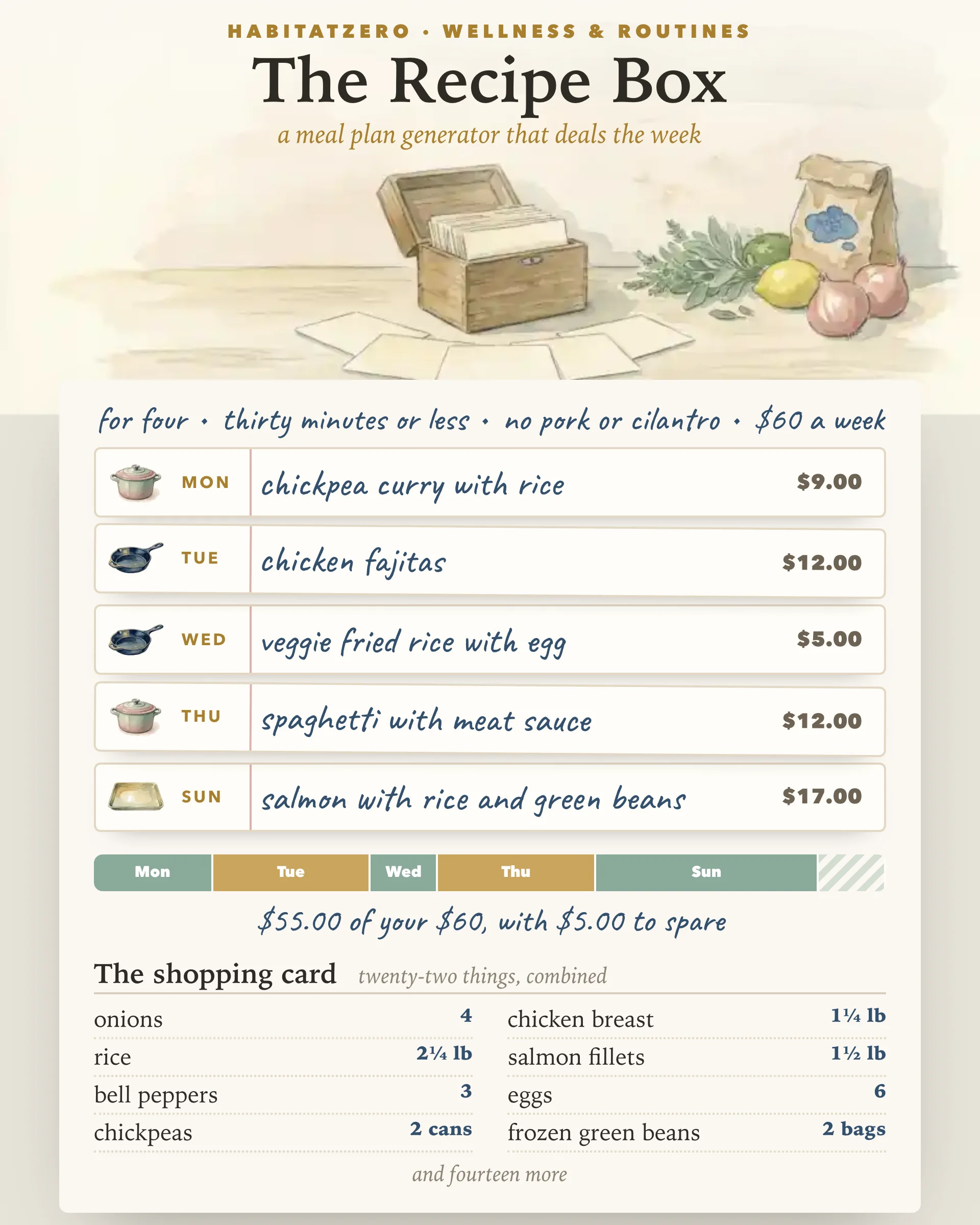
At six in the evening the question is rarely just what to eat. It is what fits: who is home, how long until everyone is hungry, what somebody refuses to touch, and what is left of this week's grocery money. Solving that from nothing every night is how dinner becomes whatever needs the least thought. A meal plan generator does the fitting once, for the whole week.
This page is built like a recipe box on a kitchen counter. Behind its dividers sit your rules: how many people you are cooking for, which nights you really cook, the minutes each of those nights can spare, the foods to leave out and, if you want one, a weekly budget. Inside the box are forty-one weeknight dinners written for this page, each with a cooking time, a short ingredient list and a rough price per plate. Every one of them has at least one vegetable in it.
Press deal and the box lays a card that satisfies every rule on each cooking night. It shuffles first, so two deals rarely match, and whenever it can it keeps any one main ingredient, such as chicken breast or black beans, to two nights. Swap a card that does not appeal and its replacement still obeys the rules; a dinner you sent back stays out until the box runs short of fresh ones. Change a rule after dealing and only the cards that now break it get replaced. If a smaller budget or a bigger household pushes the week over, the priciest nights go back in the box first, and the page names the nights that moved.
Below the week, the shopping card merges every ingredient across your nights, multiplies it by your headcount and rounds up to what you would carry home: whole cans, bags and bunches, and pounds to the nearest quarter. When two dinners share onions or rice, one line covers both and lists the nights that use it.
Switch on budget mode and give the week a number. From then on it deals only weeks that come in under it, whenever your other rules leave enough dinners to make that possible. When they cannot, it deals its cheapest week and marks the overrun on the bar. The bar splits your budget night by night, and the reading beneath it names the priciest night, the cheapest one and the part of the store taking the largest share. The spread can be wide: a plate of salmon with rice and green beans comes to more than twice a bowl of red lentil soup.
The prices are deliberately rough. Where the Bureau of Labor Statistics publishes a national figure, the estimates start from its average price data for August 2026, a month when a dozen large eggs averaged about $2.27 and a pound of ground chuck about $6.77. The rest are plain store-brand guesses. Each plate counts only what that dinner uses, so a first shop costs more than the week's total while your pantry fills, and your store, region and season will move every number.
For scale, the USDA monthly cost of food reports priced the Thrifty Food Plan, the least expensive of the department's four food plans, at $233.80 a week for a family of four in April 2026. That figure covers every meal and snack eaten at home, not dinner alone, so a dinners-only budget will sit well below it.
Planning ahead has encouraging research behind it, though none of it proves cause and effect. In a survey of 40,554 French adults, Ducrot and colleagues found that people who planned their meals were more likely to eat a wide variety of foods and to come closer to their national nutrition guidelines. It was a single snapshot, so planners may differ from everyone else in ways the study could not see.
Pooling twenty-seven studies from ten countries, Rao and colleagues found that the healthiest eating patterns cost about $1.48 more per person per day than the least healthy ones. That is one reason the cheaper cards here lean on beans, lentils, eggs, rice and frozen vegetables: they keep a tight week varied without falling back on packaged noodles every night.
This page is a planning tool, not nutrition advice. It counts no calories and promises nothing about your health. If you manage a medical condition or a serious allergy, a registered dietitian or your doctor can build a plan around it, and packaged labels still deserve a read, since the leave-out filter only sees the ingredients each dinner lists.
Deal the week on the day you write your grocery list. Be honest about the nights you will actually cook and leave the rest for leftovers or takeout; they get their own card, so they are planned too. To fill a week by hand and print it, the Meal Planner is a plain grid built for that. If the hard part is having any plan at all on a worn-out evening, The Fridge Door Meal Plan keeps a short list of dependable meals in sight. And if food and exercise share one schedule in your house, set this week beside the Meal and Movement Planner.
You set who is eating, the nights you cook, the minutes you have each evening, the foods to leave out and, if you like, a weekly budget. The recipe box then deals a dinner onto every cooking night that satisfies all of those rules at once, lets you swap any card, and merges the ingredients into a single shopping list.
Pick a figure for the week's dinners first, then lean on low-cost anchors such as beans, lentils, eggs, rice and frozen vegetables, and keep the pricier proteins to a night or two. Budget mode here does that fitting for you: it deals only weeks that come in under your number and shows which night eats the most of it.
Yes, though it takes a plan rather than luck. A large review found that healthier eating patterns cost somewhat more per day on average, so cheap staples have to carry most nights. Every dinner in this box includes at least one vegetable, and a tight budget in budget mode leaves room mostly for the cheaper bean, lentil and egg nights. It is not personal nutrition advice; a registered dietitian can tailor a plan around a medical need.
They are rough by design. Where the Bureau of Labor Statistics publishes a US average price, the estimates start there; everything else is a store-brand guess, and each plate counts only what that dinner uses. Your store, your region and the season will all move the numbers, and a first shop runs higher while the pantry fills.
It is free, and the dinners it picks are random, but only among the ones that match your rules. Leave out pork, dairy or cilantro and none of the cards will use them. The filter reads each dinner's listed ingredients, so check packaged foods yourself when an allergy is serious.
By the team behind Fabulous, the science-based self-care app used by over 30 million people.


