
The Overwhelm Recovery ProtocolWellness & Routines · ~5 min
About this template · Updated September 2026
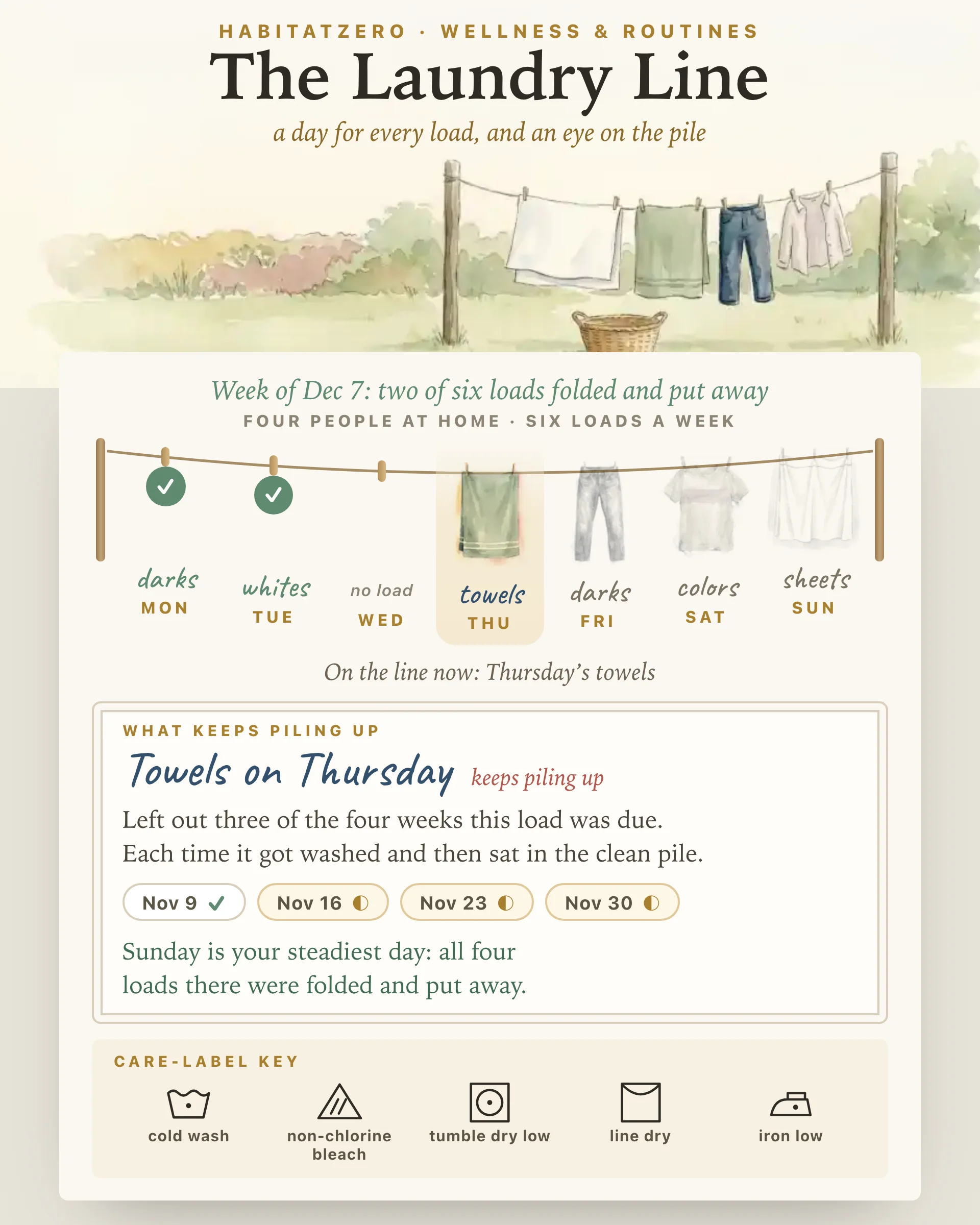
Laundry rarely falls apart inside the machine. It falls apart in the gaps: the load nobody starts, and the clean load that sits in a basket for four days because folding it never quite makes the list. A laundry schedule closes the first gap by giving every load a day. This sheet goes after the second gap too, by keeping track of where each load stops.
"Do the laundry" is a wish. "Towels on Thursday" is a plan with a time attached, and plans shaped like that get carried out more often. Psychologists call them implementation intentions: you decide in advance when and where you will act. A meta-analysis by Peter Gollwitzer and Paschal Sheeran pooled 94 independent tests of the idea and found a medium-to-large effect on reaching goals. None of those tests involved towels, so read it as a reason to try, not a promise.
A day per load also keeps each job small. One load can be washed, dried and folded in a single evening. Six loads saved up for Saturday rarely can.
ENERGY STAR puts the average American family at about 300 loads a year, close to six a week. This sheet starts from a simple rule that lands near that number: one load of clothes for each person at home, plus one load of towels and one of sheets. A family of four starts at six, and someone living alone starts at three. Babies, sports and work uniforms push the real number up.
The page is a clothesline with seven pegs, Monday to Sunday. Tap how many people live with you and the week hangs itself. Tap any day to hang a second load, swap one, or take one down (it asks twice). If your home has a load the chips don't cover, such as gym clothes or cloth diapers, name it once and it joins them.
Each load then moves through three states. Still in the hamper, it hangs faded. Washed, it hangs in full color and stays up until you tap folded and put away. A single checkbox hides that middle state, which is often where laundry waits: clean, dry, and not yet in a drawer. The line under the pegs lists whatever is still hanging. A load you run every other week, such as sheets, can be marked not this week on its off weeks, and the pile reading leaves it out.
When a week ends, its marks lock the way you left them and the sheet asks you to file it. The first week only counts from the day you hung the line, and a week you never marked stays out of the record instead of counting as a week of piles. Change a load after checking it off and the check comes down with it, unless you moved the same load to a new day, in which case the sheet tells you the mark traveled along.
Once a few weeks are filed, the card at the bottom names the load that was left out most often and the day it was due: towels on Thursday, say, left out three weeks out of four. It also says where they stalled. A load that keeps sitting in the hamper has a starting problem. A load that keeps getting washed and then abandoned has a folding problem, and a lighter day, or folding straight out of the dryer, is the likelier fix. If another day has a better record and room to spare, the card offers to move the load there.
A single bad week reads as a blip, not a pattern, and the card looks back eight weeks at most, so an old slump fades out of the reading. It cannot tell you why Thursday goes wrong; the answer is usually ordinary, like a late shift or a practice night.
The key on the sheet decodes the symbols sewn into your clothes. The FTC's guide to the Care Labeling Rule explains that manufacturers may use the ASTM symbol system in place of words, and that a label has to warn you when a normal method, such as hot water or chlorine bleach, would damage the garment. The rule's own glossary pins down the temperatures: cold means water up to 86°F, warm runs from 87 to 111°F, and hot from 112 to 145°F. A label that says machine wash and nothing more means hot water is fine.
That makes the label the final word. If a shirt says cold and its load runs warm, the shirt waits for a cold load. Cold covers a lot anyway, and ENERGY STAR notes that heating the water accounts for about 90 percent of the energy a washer uses.
Hang the week on a quiet evening, or on the day the hamper starts winning. Give it a month: the pile reading needs a few filed weeks before it says anything useful.
If the real question is who does the laundry rather than when, settle that first with The Household Chore List. In a shared apartment, The Roommate Chore Chart sorts out whose turn the machine is. For the rest of the house, the Cleaning Checklist runs on a rhythm of its own.
Often enough that the hamper never overflows and nobody runs short of towels. A few loads spread through the week tend to be easier than one marathon laundry day, because each load stays small enough to fold the same evening.
Around six is a fair starting point. ENERGY STAR estimates the average American family washes about 300 loads a year, close to six a week, and this sheet starts a family of four there: four loads of clothes, one of towels and one of sheets.
Weekly is a common rhythm for both, and it is where this sheet starts them, each on a day of its own so neither waits behind the clothes. If yours run every other week, mark the off week as not this week and the pile card leaves it out.
The tub is washing, and its dots are the water temperature: one for cold, two for warm, three for hot. The triangle covers bleach, the square covers drying, with a circle inside for the dryer, the iron covers ironing and a plain circle means dry cleaning. An X through any symbol means do not.
No. This page shows a filled-in line so you can see how it reads. To hang your own week, mark real loads and keep the filed weeks that feed the pile reading, personalize it in HabitatZero, which costs nothing.
By the team behind Fabulous, the science-based self-care app used by over 30 million people.


