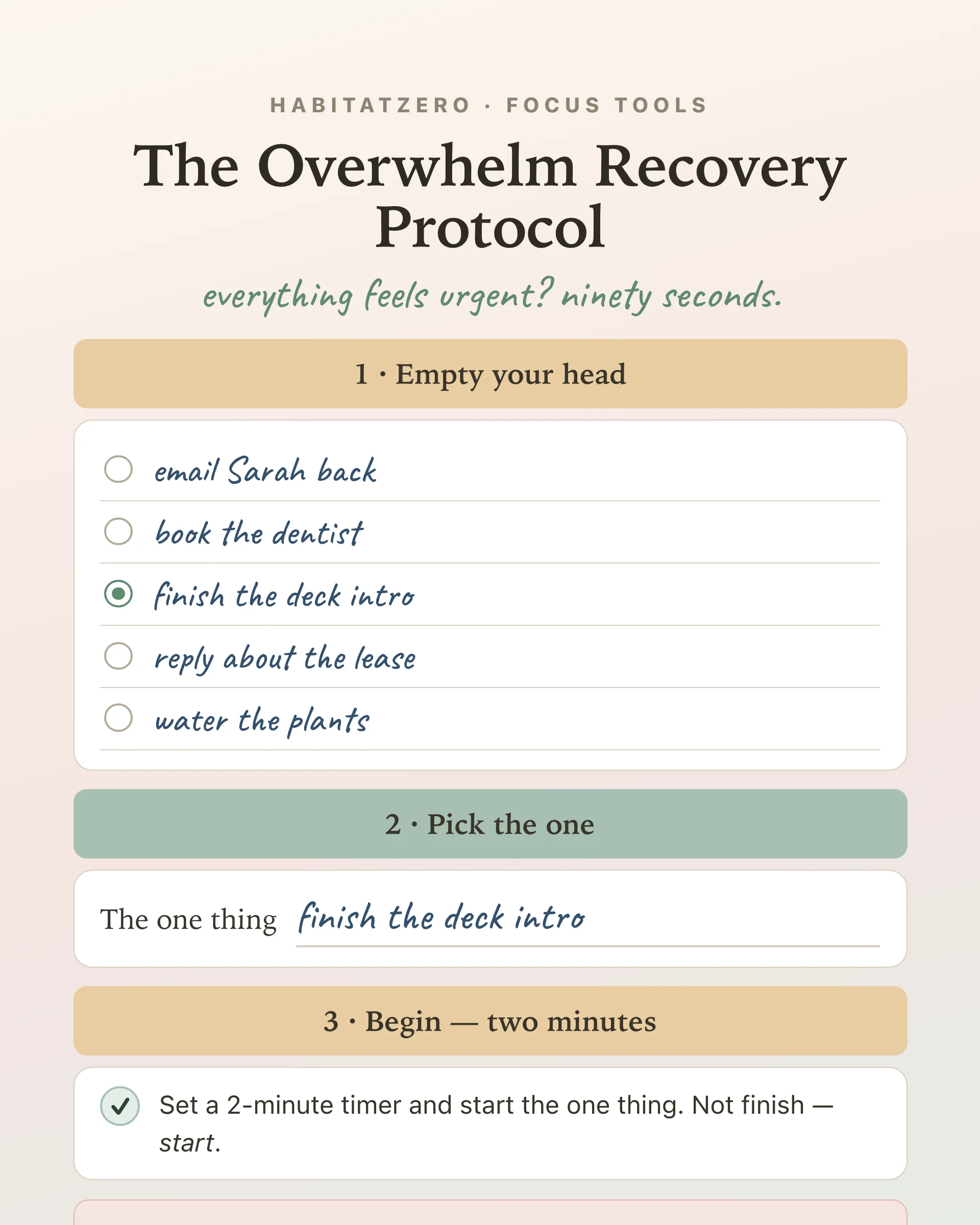
The Overwhelm Recovery ProtocolWellness & Routines · ~5 min
About this template · Updated September 2026
Most kitchen cleaning checklists are one long sheet of daily, weekly and monthly chores that ends up on the fridge unread. A kitchen really needs two things: a short reset every night, so the morning starts on a clear counter, and a deep clean that moves around the room slowly enough that no weekend disappears into it. This page gives each its own tool.
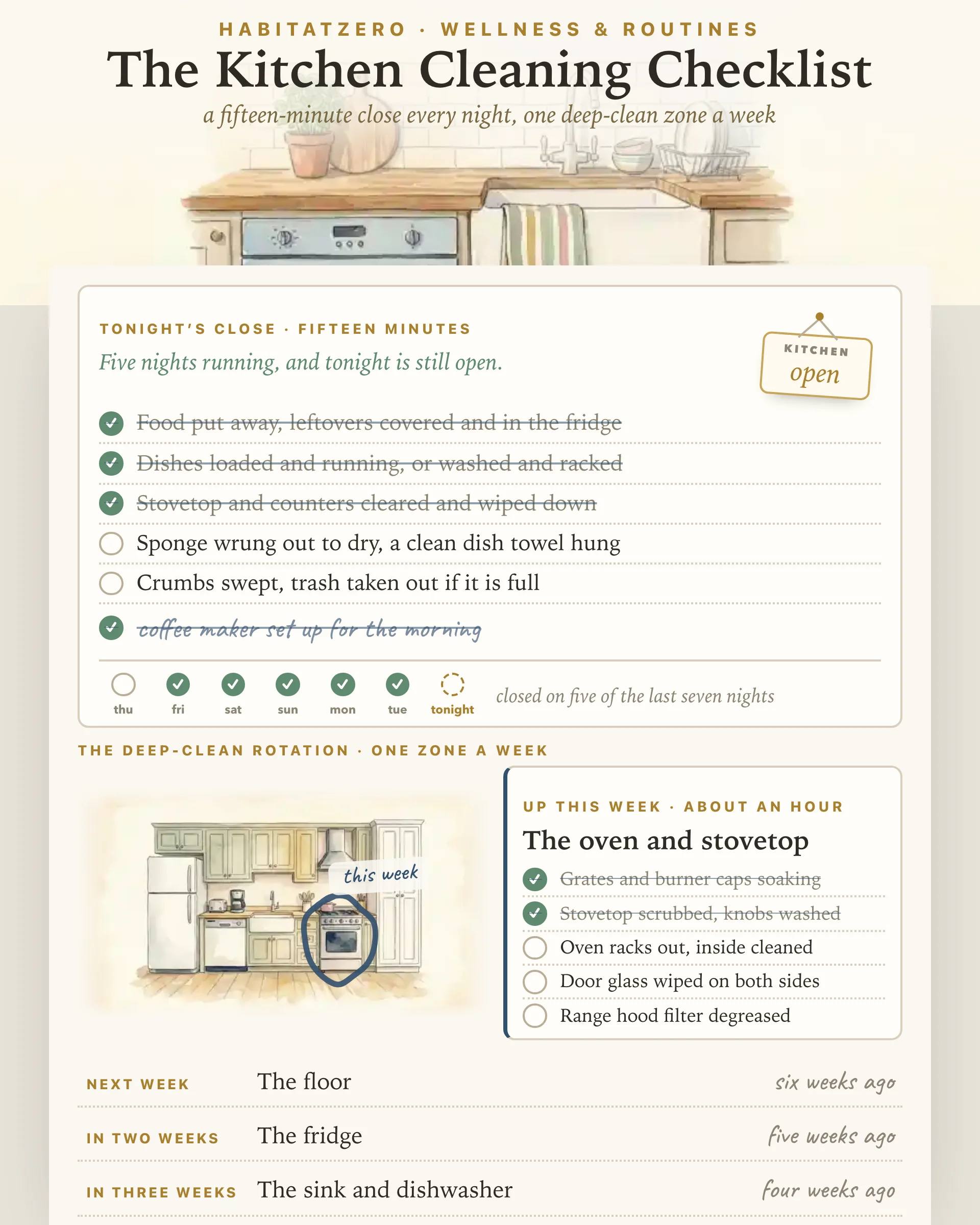
Restaurants call the end-of-night routine the close, and the word suits a home kitchen. Yours is six lines, in the order the work falls after dinner: food put away, dishes loaded or washed, stovetop and counters wiped, the sink scrubbed and dried, the sponge wrung out with a clean towel hung, then crumbs swept and the trash checked. On an ordinary night that is about fifteen minutes.
The first line carries the routine's one real deadline. The USDA limit for leftovers is two hours at room temperature, or one hour when it is above 90°F, and its refrigeration guidance says warm food can go straight into the fridge, so the pot does not have to cool on the stove first.
Tap each line as you finish and it is crossed off. When the last one goes, the small sign on the card flips from open to closed, and the page writes your run out in words: four nights running, then five. A strip underneath shows the last seven evenings, so one missed night reads as a gap in a good week, not a broken record. Ticks reset at four in the morning, so a close that drags past midnight still counts for its evening. Up to three lines of your own can join the list, such as setting up the coffee maker.
The deep clean is split into seven zones: the fridge, the oven and stovetop, the sink and dishwasher, the counters and backsplash, the cabinets and pantry, the small appliances, and the floor. Each takes between half an hour and an hour, and the page hands every week exactly one of them.
The painted kitchen shows which. A pen loop is drawn around this week's zone, and the card beneath it lists that zone's five jobs. The zone chosen is always the one that has waited longest, so a kitchen left alone for a month does not come back as a pile of overdue work. The schedule below gives the coming weeks by date and says when each zone was last done.
If a week goes sideways, nothing breaks. Tap another part of the painting, do that zone instead, and the rotation reshuffles around it. Finish a zone and the card names the week it comes round again, about seven weeks later. Four small habits sit beside the rotation because they belong to every week: old food out of the fridge, the sponge cleaned or swapped, towels washed hot, and the floor mopped.
The fridge zone follows that same USDA page: shelves and walls washed with hot, soapy water and rinsed, no solvent cleaners or abrasives that could leave a taste in food or ice, an appliance thermometer reading 40°F or lower, and the condenser coil brushed or vacuumed several times a year. It also suggests a weekly clear-out of perishables that should no longer be eaten, which is why that job is a weekly habit here.
For boards, the USDA cutting board guidance is one tablespoon of unscented liquid chlorine bleach in a gallon of water, flooded over the surface and left for several minutes, then rinsed and air-dried. It suggests one board for raw meat, poultry and seafood and a separate one for produce and bread, and says to throw a board out once it is worn into hard-to-clean grooves.
A USDA research team also tested the usual ways to clean a sponge. In their lab trial, a minute in the microwave killed more than 99.9 percent of the bacteria on heavily contaminated sponges, a dishwasher run with a drying cycle did nearly as well, and a soak in bleach solution did far worse. Microwave a sponge only while it is wet, and never one with a metal scrubber in it.
Then the rule worth memorizing: bleach goes into the bucket alone. The Washington State Department of Health explains why. Bleach with ammonia, which some glass cleaners contain, gives off toxic chloramines, and bleach with an acid gives off chlorine gas. Vinegar is an acid, so if you descale the faucet with it, rinse it away before any bleach comes out.
None of these sources sets a deep-clean timetable. The seven-week cycle spreads the work so it gets done; it is not a public health rule, and the page makes no claim about germs on your counters.
Keep it open on the counter after dinner and tick as you go, then give the circled zone an hour on the weekend. For the whole house's routine on paper, the Cleaning Checklist prints one for the fridge door. On a night when six lines feel like sixty, the Tiny-Win Cleaning Checklist turns a room into tiny wins, already sorted. And if you are handing a kitchen back to a landlord, the Move-Out Cleaning Checklist sorts the work the way an inspector checks it.
Two layers work better than one long list. A short nightly reset covers leftovers, dishes, the stovetop and counters, the sink, the sponge and towels, and the floor and trash. A deep clean covers seven zones in turn: the fridge, the oven and stovetop, the sink and dishwasher, the counters and backsplash, the cabinets and pantry, the small appliances and the floor. This page carries both, with five jobs listed for every zone.
Food-safety guidance names a few specific jobs rather than a full deep-clean timetable, so treat any schedule as a convenience. On this page each of the seven zones comes round about every seven weeks, one per week, so no single day carries the whole job. A few things run on their own clocks: the USDA suggests clearing spoiled perishables out of the fridge weekly and cleaning the condenser coil several times a year.
It is the few minutes after dinner that put the kitchen back to a clean starting point for the morning. The version here has six lines and takes about fifteen minutes on an ordinary evening. Leftovers come first because the USDA limit for food at room temperature is two hours, or one hour above 90°F, and warm food can go straight into the fridge.
For boards, the USDA recipe is one tablespoon of unscented liquid chlorine bleach in a gallon of water, poured over the board, left for several minutes, rinsed and air-dried. For sponges, a USDA lab study found a minute in the microwave or a dishwasher run with a drying cycle removed nearly all bacteria, far more than a bleach soak. Microwave the sponge wet and never with metal in it, and never mix bleach with ammonia or vinegar.
Anyone can look through the sample kitchen on this page, halfway through its week with five closed nights behind it. To tick your own evenings, keep a streak and move through the rotation week after week, open the checklist in HabitatZero. It costs nothing to start.
By the team behind Fabulous, the science-based self-care app used by over 30 million people.