
The Overwhelm Recovery ProtocolWellness & Routines · ~5 min
About this template · Updated September 2026
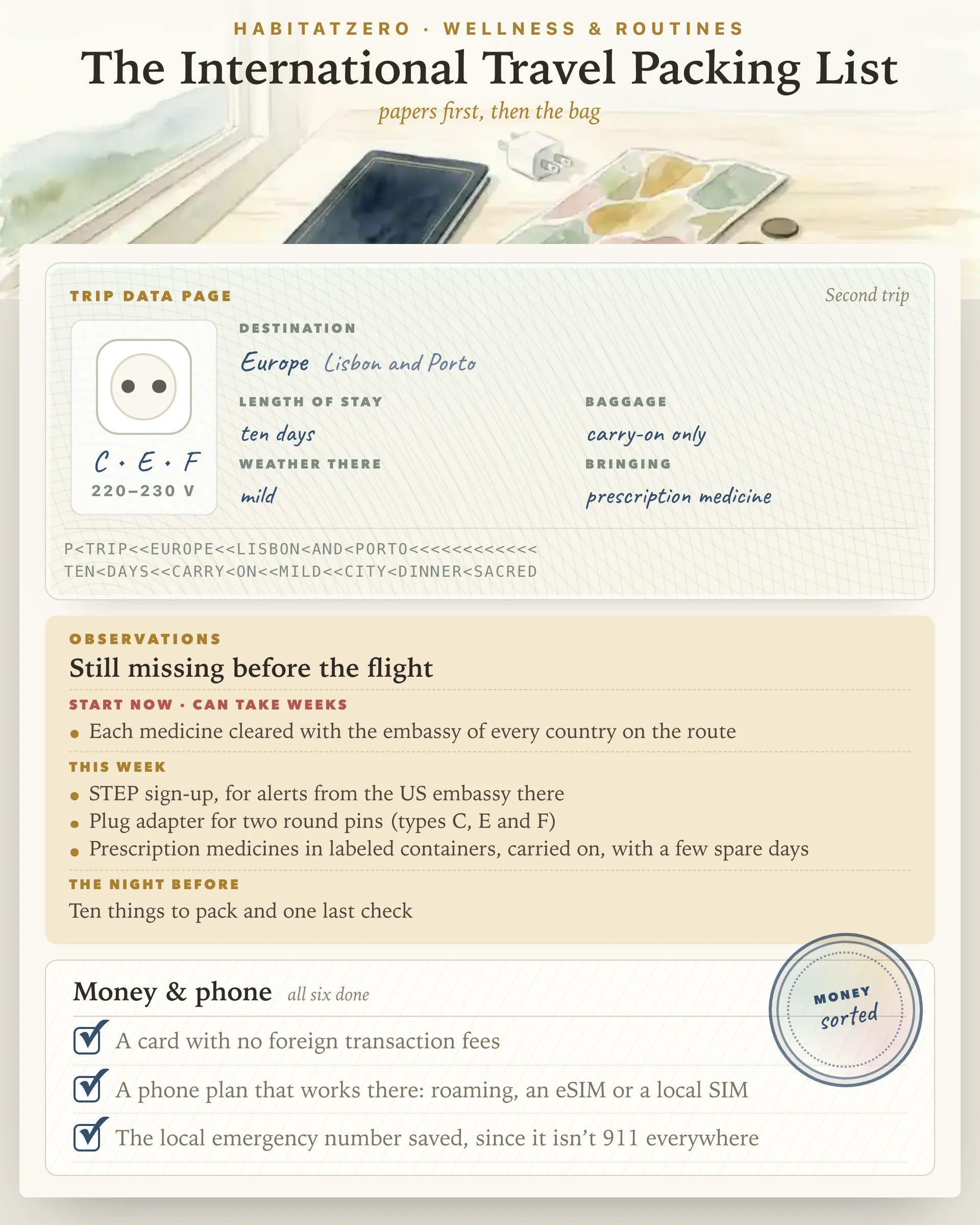
A weekend bag and an overseas bag hold nearly the same clothes. What separates them is a layer of paperwork and money with lead times of its own: a passport renewal measured in weeks, an authorization some countries want before you board, a socket your charger will not fit. This page starts with that layer, because almost none of it can be fixed at the gate.
Look at your passport's expiration date the day you begin planning, as the State Department's international travel checklist advises. The date alone is not enough, because countries count differently. The Schengen area, which covers most of Europe, wants the passport valid three months past the day you leave it. The UK and Japan want it valid for the whole stay. Vietnam, Indonesia, Peru and China want six months. A routine renewal takes four to six weeks of processing, plus mailing in both directions.
Entry papers come next. The UK asks US citizens for an electronic travel authorization before the flight, Australia and New Zealand each ask for one of their own, and Brazil requires a visa that you apply for online. Europe has its own changes. The EU's Entry/Exit System takes fingerprints and a photo at the border, and the State Department's page for US travelers in Europe says there is nothing to arrange in advance. ETIAS, the EU's planned travel authorization, is not running yet, and the EU says it will announce a start date months before it opens.
If the trip calls for vaccines or travel medicines, CDC suggests seeing a provider at least four to six weeks before you leave.
US health insurance, Medicare and Medicaid included, usually does not cover care abroad, so the insurance line matters more than it looks. Prescriptions need a routine of their own: check with the embassy of every country on your route, layovers too, that each medicine is allowed there, keep it in its original labeled container in your carry-on, and bring copies of the prescriptions with the generic names written out, as CDC's page on traveling abroad with medicine lays out. A doctor's letter is quicker to request when your medicines already sit in one place, which is what My Medication List is for.
The money and phone lines are small but miserable to fix mid-trip: a card with no foreign transaction fees, a backup card carried apart from the first, and a phone plan that works where you land, whether that means roaming, an eSIM or a local SIM. Save the local emergency number as well, since it is not 911 everywhere.
Europe gets notes of its own, since one trip there can cross several borders under one set of rules. Most sockets take two round pins, types C, E and F, at 220 to 230 volts, while Italy and Switzerland add socket types of their own. Pack the shoes you can walk in all day before the ones you dress up in. A carry-on makes train platforms and hotel stairs easy, and when you pick carry-on only, the page plans clothes for five days plus a mid-trip wash. Leaving a US airport, liquids in a carry-on must sit in containers of 3.4 ounces or less, all in one quart-size bag. A light scarf covers your shoulders when a church asks you to.
The trip data page holds the plan: region, days, bag, weather, plans and anything you are bringing. The photo window draws the socket waiting at the other end. Every line then sorts onto a visa page, and the observations box near the top lists what is still missing, grouped by how far ahead it has to happen: weeks, days or the night before. Tap a line when it is done. A finished page takes an ink stamp.
Plans change, and the pages change with them. A new destination clears the checks you made for the old one and tells you which. A longer stay tops up the clothes counts. Anything already packed that the new trip no longer lists waits in a strip until you take it out, and it never counts toward what is done. After the trip you mark what came home unused, and the next trip opens without it.
Writing a plan down is a form of what psychologists call cognitive offloading: using a physical action, such as a written list or a phone reminder, to lower the demands a task makes on your mind. The review behind that phrase treats it as an everyday habit only recently studied in its own right, and it makes no promise that a list will save your charger. The rules on these pages carry a date, September 26, 2026, because entry rules change. Treat each one as a prompt to check the official page before you go.
Open it a month or more before departure, while a renewal or a visa still has time to arrive. Come back the week of the flight for the insurance, the adapter and the phone plan, and once more the night before. A semester overseas is a bigger load, and The Study Abroad Packing List is built for it.
Lead with the papers and money a domestic trip never needs: a passport valid long enough for the country, any visa or travel authorization, insurance that covers medical care abroad, a card without foreign transaction fees, a phone plan that works there and the right plug adapter. Clothes, toiletries and a small first-aid pouch follow, counted to the length of the stay and the size of your bag.
Walking shoes you trust, layers, a rain jacket outside high summer, a scarf for covering shoulders in churches, and an adapter for two round pins, since most of Europe uses plug types C, E and F at 220 to 230 volts. For the paperwork, the passport must stay valid three months past the day you leave the Schengen area, and US citizens need no visa for stays of up to ninety days. Those rules were checked on September 26, 2026, so look again before you go.
It changes with the country. The Schengen area wants three months past your departure, the UK and Japan want the passport valid for the whole stay, and countries such as Vietnam, Indonesia, Peru and China want six months. A routine US renewal takes four to six weeks plus mailing time, so check the expiration date the day you book. These rules were read on official pages on September 26, 2026; confirm them before you go.
Usually just the adapter, because what changes most is the shape of the socket. A charger labeled 100 to 240 volts copes with the current by itself, while anything built for 120 volts alone, as some hair tools are, needs a converter or a dual-voltage version. The page draws the plug and lists the voltage for each region it covers.
No. The filled passport on this page is there to browse without an account. Building your own trip, checking pages off and carrying the list into the next journey all happen in HabitatZero, which is free to use.
By the team behind Fabulous, the science-based self-care app used by over 30 million people.


