Reading JournalStudy & Learning · ~4 min
About this template · Updated September 2026
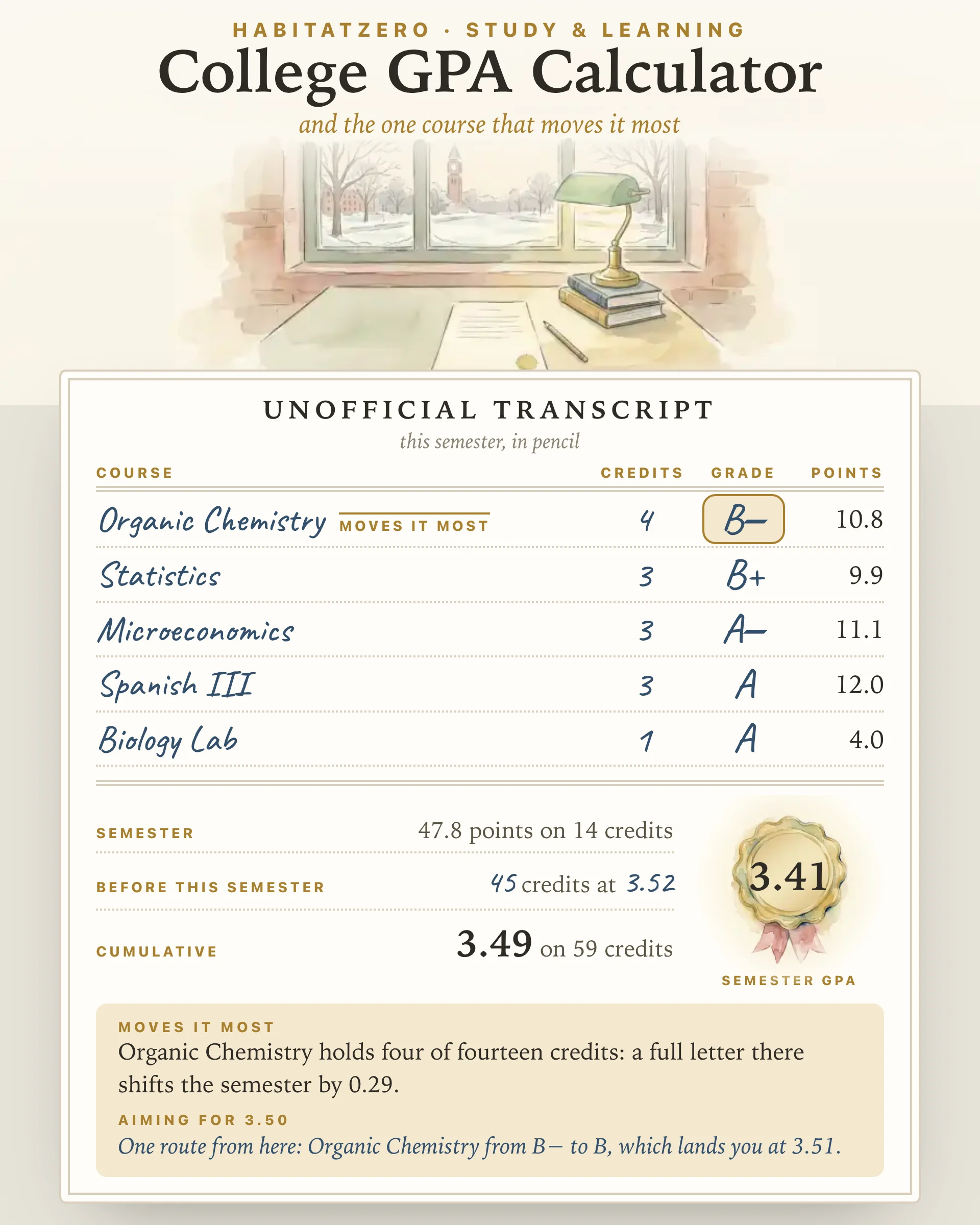
Finals week turns your GPA from a number in a portal into a string of urgent questions. What happens if the chemistry final goes badly? Can the 3.50 your scholarship asks for survive this semester? Which course deserves the hours you have left? This calculator answers all three on one page, set out like the unofficial transcript you will download once grades post.
Every letter grade has a point value on a 4.0 scale. Multiply that value by the course's credit hours to get its grade points, add the grade points for every course, and divide by the credits you attempted. The University of Missouri registrar, for example, counts an A+ or an A as 4.00, an A- as 3.7 and a B+ as 3.3, with every step written in tenths, down to a D- at 0.7 and an F at zero.
Not every school works in tenths. The University of Florida's advising office counts an A- as 3.67 and a B+ as 3.33, in thirds of a point. The gap looks tiny, but five A- grades average 3.70 at one school and 3.67 at the other, so the grading key on this page switches between the two. If your college skips plus and minus grades altogether, use the plain letters.
Some grades stay out of the arithmetic. Missouri keeps satisfactory and unsatisfactory grades out of the GPA, and Florida's advising calculator tells students to leave S-U courses out entirely. A withdrawal usually leaves your GPA alone. Retaken courses are where schools differ most: some replace the old grade and others average both, so check your registrar's rule before you enter one.
Your cumulative GPA is the same division over everything you have taken. Multiply your GPA so far by the credits behind it to get the grade points already banked, add this semester's points, and divide by all the credits together.
That is why the course holding the most credits matters most. On a fourteen-credit semester, a full letter grade in a four-credit course shifts your semester GPA by about 0.29, four times what a one-credit lab can. Put forty-five earlier credits behind the same semester and that letter moves your cumulative by only about 0.07.
Write each course on the transcript's next line or tap a common one, set its credit hours with the plus and minus buttons, and tap the grade box to pick the letter. The seal shows your semester GPA as soon as one course has a grade. Add the GPA credits and cumulative GPA from your degree audit, and the cumulative line follows.
The margin names the course that moves your GPA most and how far a full letter there shifts each number. Slide to a target, and it tells you what this semester has to average and how far your grades as written fall short of it or clear it. When you fall short, it finds one route: raising grades a step at a time wherever a step is worth the most grade points, which usually means your heaviest course. When you already clear it, it checks whether a one-step slip in that course would cost you the target. When a target needs more than a 4.00 this semester, it estimates how many more credits of A's it would take.
Change a grade, a credit count or the scale, and every number and sentence recalculates. GPAs you have earned are cut at two decimals rather than rounded up, and what a target asks for is rounded up, so the page never shows you closer than you are.
Grades bunch near the top. A study of letter grades at 135 four-year schools found that A's made up 43 percent of all grades, making A the most common grade on American campuses, with schools focused on science and engineering grading more strictly than those built around the liberal arts. When so many GPAs sit close together, a few hundredths can separate a 3.49 from the 3.50 line on a scholarship form.
The weak point in any GPA forecast is the grade you expect. Over a semester-long course, undergraduates predicted their own exam scores: the strongest students were accurate and grew more accurate from exam to exam, while the lowest scorers were badly overconfident, before the test and after it. So pencil in the grade your scores so far support rather than the one you hope for, then try your least certain course one step lower and see what changes.
A calculator also cannot know every rule your school keeps, from transfer credit to how a repeated course counts. The registrar's number is the official one; this page is for planning around it.
Open it after midterms, when grades start to firm up, and again the week before finals to decide where your study hours go: the heaviest course usually earns the first ones. The Exam Planner can turn that choice into a day-by-day countdown to the exam. When grades post, update the transcript so next semester starts from the right cumulative number, then plan the new load with the Study Plan Builder and the Class Schedule Card.
Turn each letter grade into points on the 4.0 scale, multiply by that course's credit hours, and add the results to get your grade points. Then divide by the credits you attempted. A fifteen-credit semester that earns 49.5 grade points works out to a 3.30.
At most colleges with plus and minus grades, a B+ counts 3.3, an A- 3.7 and a B- 2.7. Some schools work in thirds instead, so the University of Florida counts a B+ as 3.33 and an A- as 3.67. The grading key on this calculator switches between the two.
Multiply your cumulative GPA so far by the GPA credits behind it to get the grade points you already hold. Add this semester's grade points, then divide by all the credits together. Forty-five credits at 3.20 plus fifteen at 3.60 comes to a 3.30.
Multiply the target by the credits you will have once this semester ends, subtract the grade points you already hold, and divide what is left by this semester's credits. That is the average this semester has to reach. Above 4.00, the target is out of reach for now, and the calculator estimates how many more credits of A's it would take.
The sample transcript on this page works without it. To write in your own courses and find the sheet waiting when grades post, open the calculator in HabitatZero, where it is free to use.
By the team behind Fabulous, the science-based self-care app used by over 30 million people.