Wind-Down Routine BuilderSleep & Evenings · ~4 min
About this template · Updated September 2026
The cognitive shuffle comes from Luc P. Beaudoin, a cognitive scientist and adjunct professor in the Faculty of Education at Simon Fraser University. He named it serial diverse imagining in a 2013 paper and co-created mySleepButton, an app that reads random words aloud for you to picture. This deck is a separate project made by Fabulous. Beaudoin has not reviewed or endorsed it, and it has no tie to him, to his university or to his app.
Lying awake is rarely quiet inside. Your head plans tomorrow, replays a conversation, checks the clock, then worries about the hour. That is sense-making, orderly thinking with a goal. Beaudoin proposes that the brain's sleep switch reads orderly thinking as a reason to stay alert, and the loose, disconnected images of the minutes before sleep as permission to let go.
The shuffle lets you make that loose imagery on purpose. A random word gives you letters, each letter gives you things to picture, and because the things are unrelated, there is no story to follow and no problem to solve. A banjo, then a bagel, then a boot. Each one fills the space the planning wanted, and none of them leads anywhere.
Most nights you will not finish the word. That is the idea.
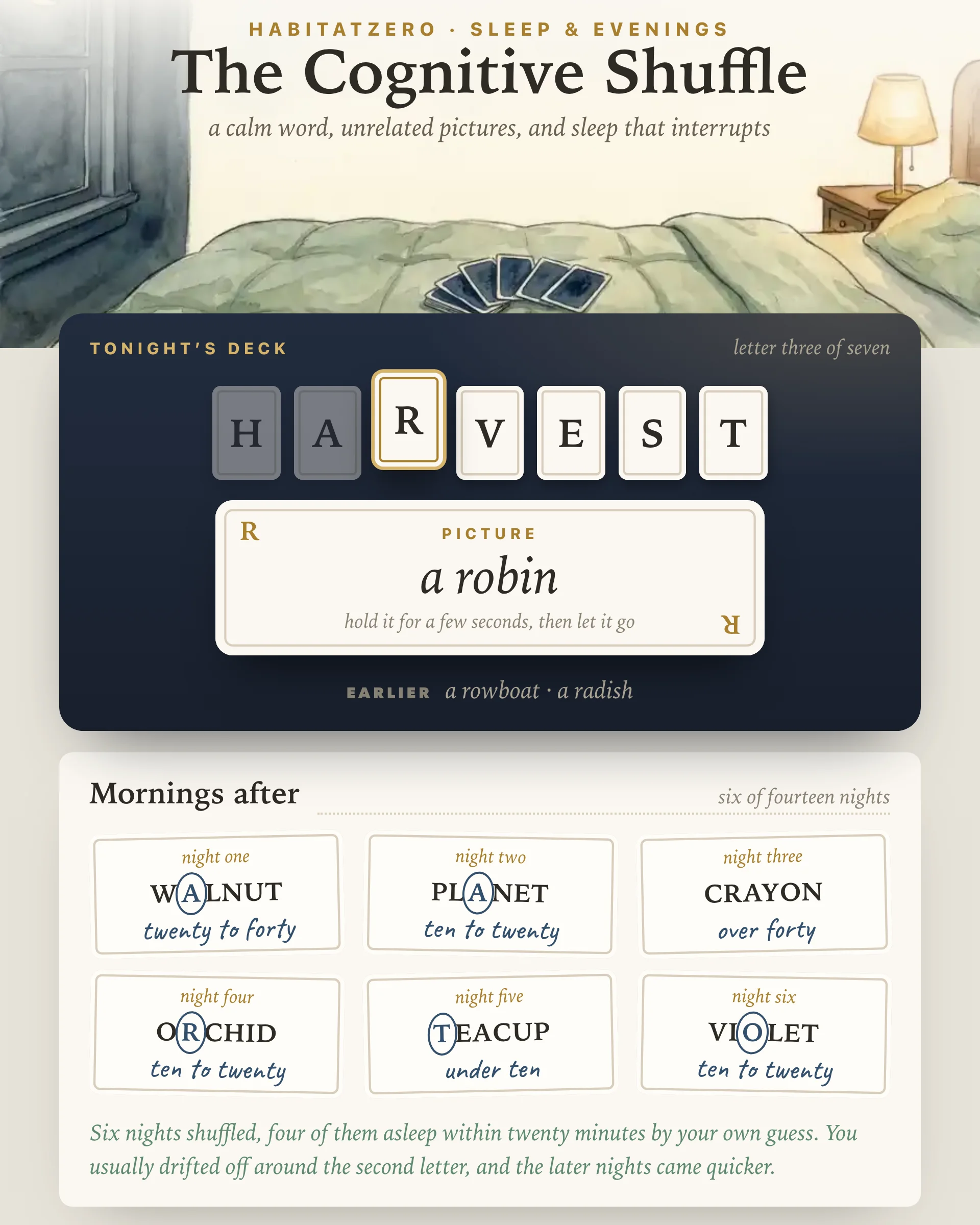
The page is a bedside deck laid on a dark tray. Tap shuffle the deck and it deals a calm word of five to eight letters, every letter different. You can type your own word instead; the page turns away anything shorter than five letters or heavy with repeats, and it will not deal the same word twice in a row.
The current letter rises from the row, and the card below deals one thing to picture at a time. The deck avoids dealing two things of the same kind back to back and never hands your word back as a picture, so no candle turns up while the word is CANDLE. Deal two or three, then close your eyes and carry on with pictures of your own. If the screen feels bright, dim the cards. Nothing on the page makes a sound.
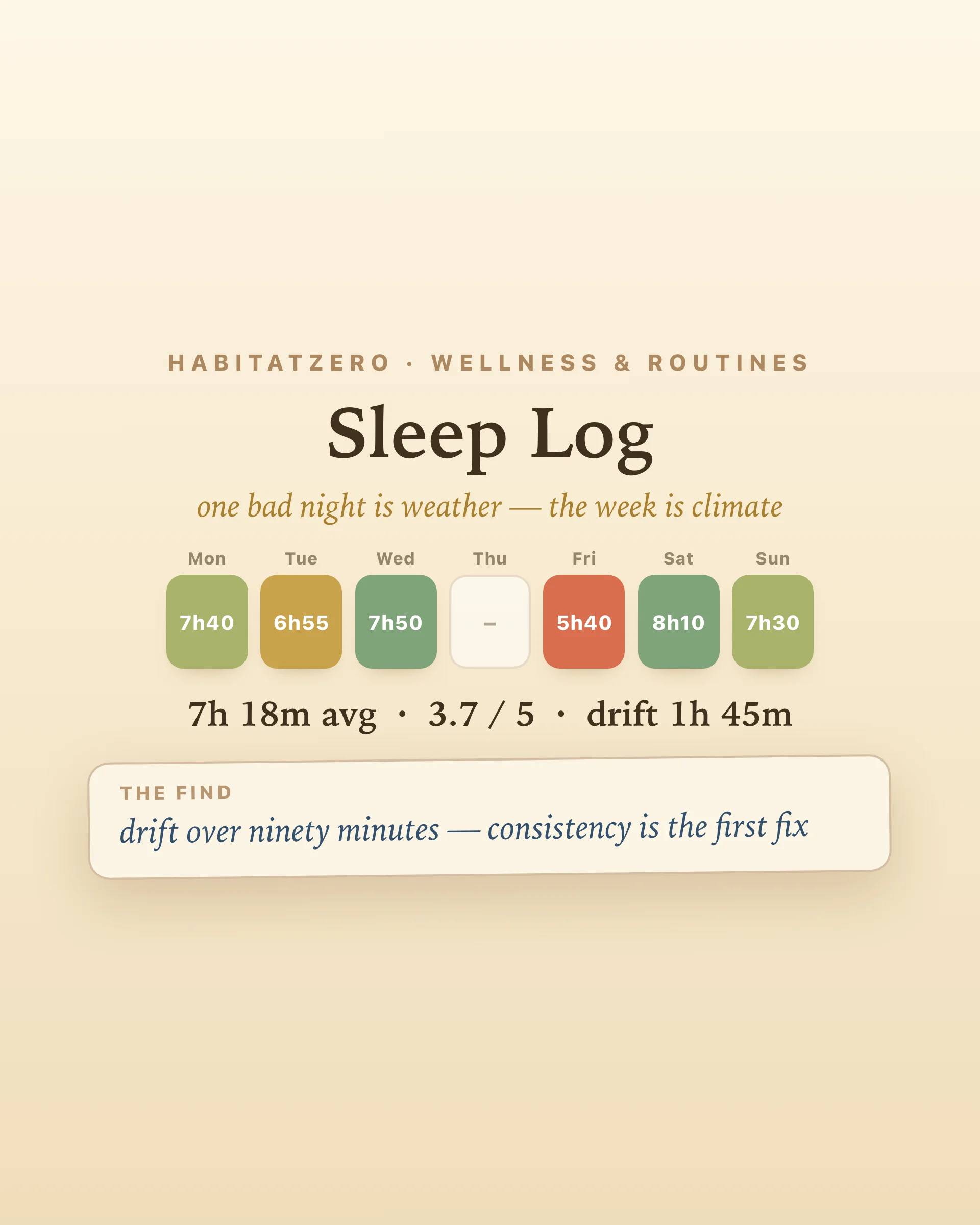
In the morning, a few taps log the night: roughly how many minutes sleep took and the last letter you remember reaching. Each night becomes a small card with that letter circled, and the page reads the pile back in plain words: how many nights came within twenty minutes, and where you tend to drift off. The log holds fourteen nights, long enough to see a pattern and short enough to keep the trial honest.
Beaudoin's 2013 paper is theory, and by his own account it contains no new data. Since then, a small number of early studies from his team have reported calmer minds at bedtime and better sleep quality. Two sleep scientists at Monash University, reviewing the method for The Conversation in 2025, called that research promising but still in its infancy. We could not find a large, independent trial of the shuffle in the medical literature.
The firmer evidence sits next door, in imagery used as distraction. In a 2002 Oxford study of forty-one people with insomnia, those taught to occupy the mind with an engaging imagery task fell asleep sooner on the test night than people given no instructions, and reported fewer unwanted thoughts. The shuffle is a close cousin of that approach, except that its pictures keep changing.
So treat it as an experiment on yourself: two weeks of honest morning guesses will say more about your nights than any article.
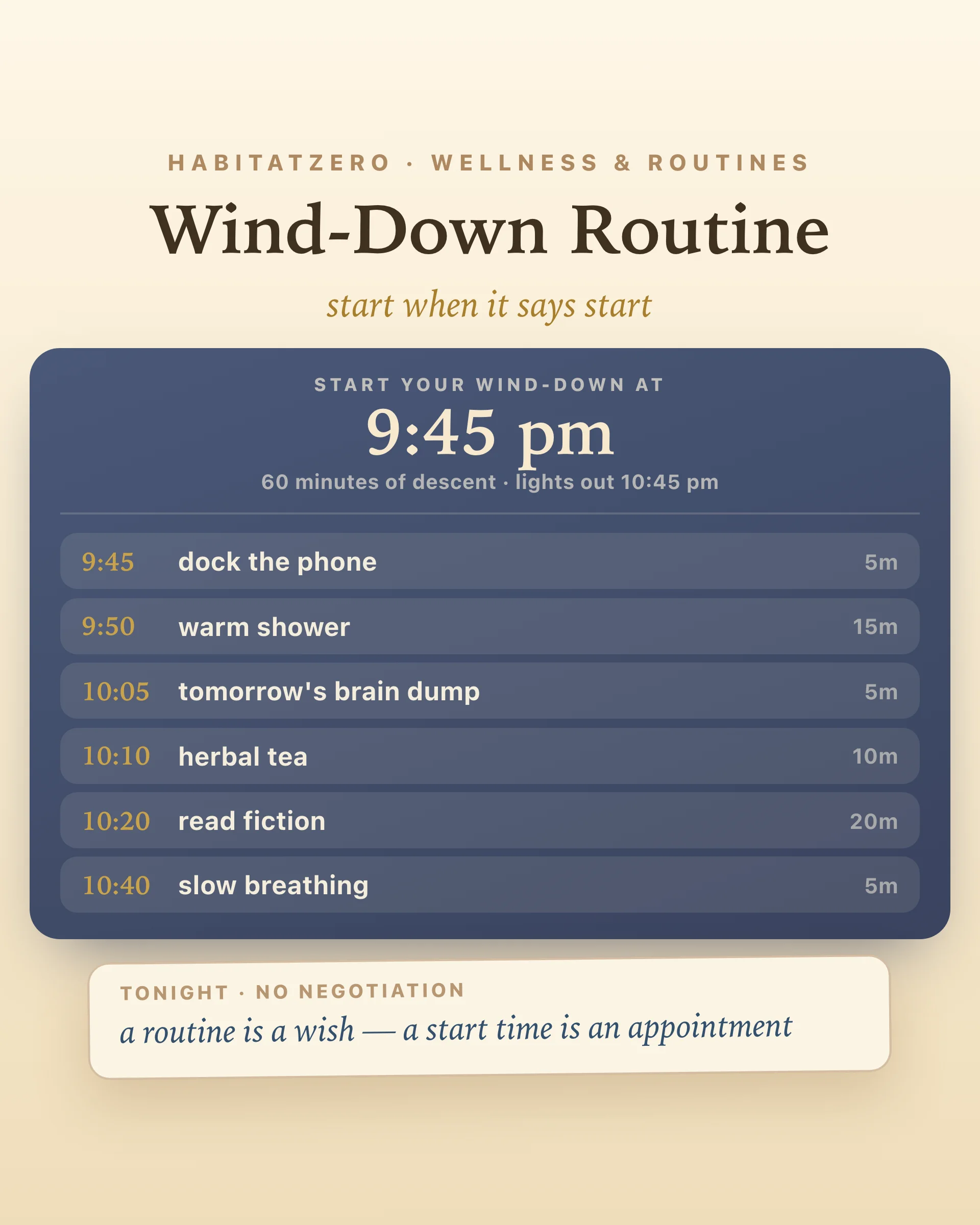
The shuffle suits a mind that is busy rather than distressed, such as the head that keeps drafting emails after a crowded day. It helps less when you are too tired to come up with words yet too awake to sleep, a limit Beaudoin points out himself, and it cannot fix the conditions around sleep. If the evening is the trouble, set up a Wind-Down Routine Builder plan first. If the thoughts are really tomorrow's list, a Bedtime Brain Dump empties it before the shuffle begins, and a Sleep Log shows the wider pattern of your weeks.
If falling asleep has been hard on most nights for months, or the tiredness is spilling into your days, talk with a doctor or a sleep clinician. The American College of Physicians recommends cognitive behavioral therapy for insomnia, known as CBT-I, as the first treatment for chronic insomnia in adults, and a word game is no substitute for it.
It is a way of falling asleep in which you take a random word and, letter by letter, picture a run of unrelated things that start with each letter. The scattered pictures give a busy mind harmless work and resemble the loose imagery that comes just before sleep.
Luc P. Beaudoin, a cognitive scientist and adjunct professor in the Faculty of Education at Simon Fraser University, set out the idea under the name serial diverse imagining in 2013. This deck is an independent Fabulous tool with no link to him, to Simon Fraser or to his mySleepButton app.
The evidence is early. A small number of studies from Beaudoin's team reported calmer minds at bedtime and better sleep, and an older Oxford study found that an engaging imagery task helped people with insomnia fall asleep sooner. We found no large independent trial of it, so judge it on two weeks of your own mornings.
Choose a calm, neutral word of at least five letters in which few letters repeat, such as MEADOW or WALNUT, so every letter brings fresh pictures. The generator on this page only deals words like that and never hands the word itself back as something to picture.
You can read the method and look at the filled example here without installing anything. Shuffling your own words at night and keeping the morning cards happen once you personalize the deck in HabitatZero, which costs nothing.
By the team behind Fabulous, the science-based self-care app used by over 30 million people.