ADHD Daily Task OrganizerFocus & ADHD · ~10 min
About this template · Updated September 2026
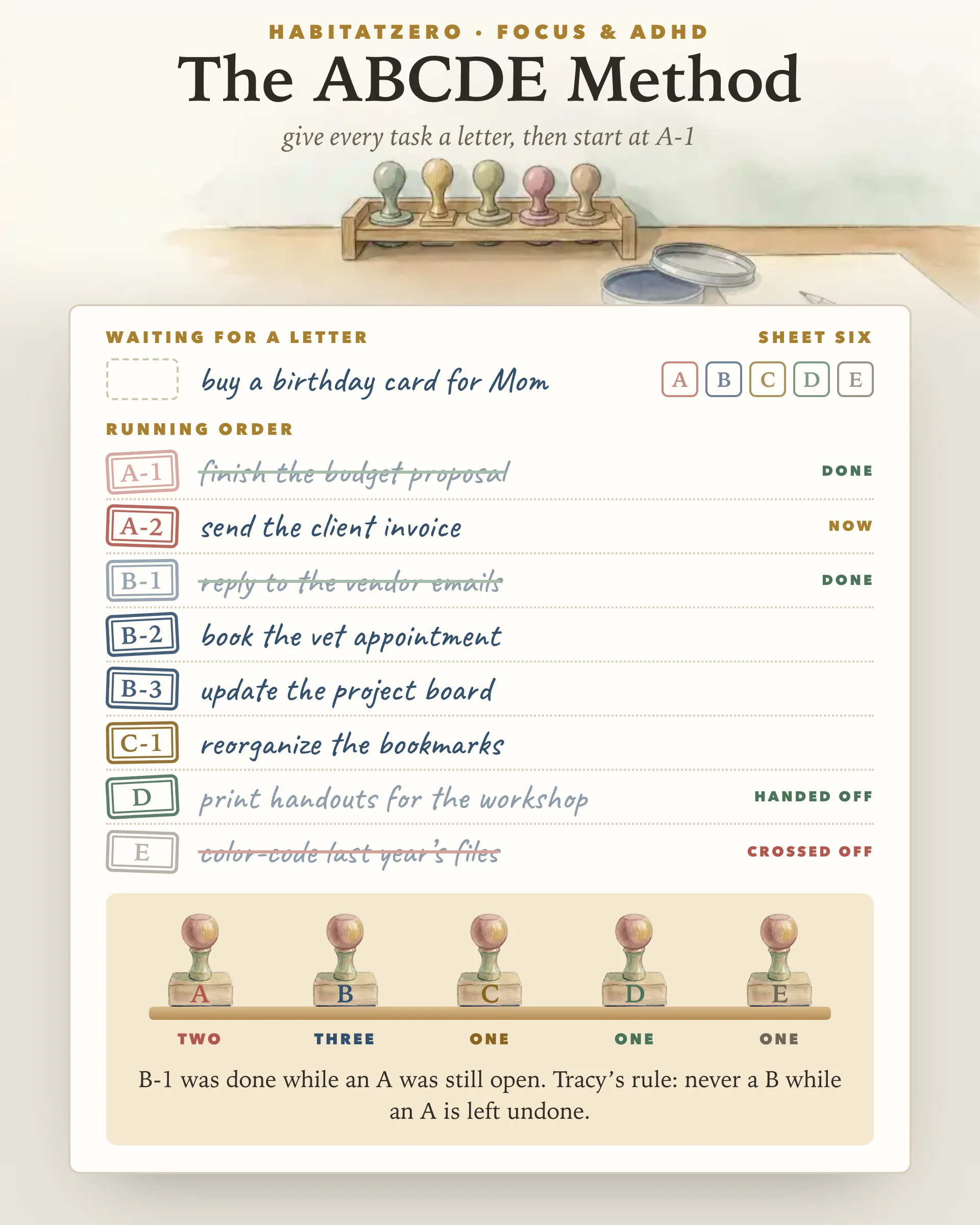
The ABCDE method belongs to Brian Tracy. It is one of the techniques in Eat That Frog!, his 2001 book on procrastination, and he lays it out in his own words in How to Set Priorities Using the ABCDE Method on his site. Fabulous made this interactive sheet independently to practice his rule; it has no affiliation with Tracy or his company, and neither of them has endorsed it.
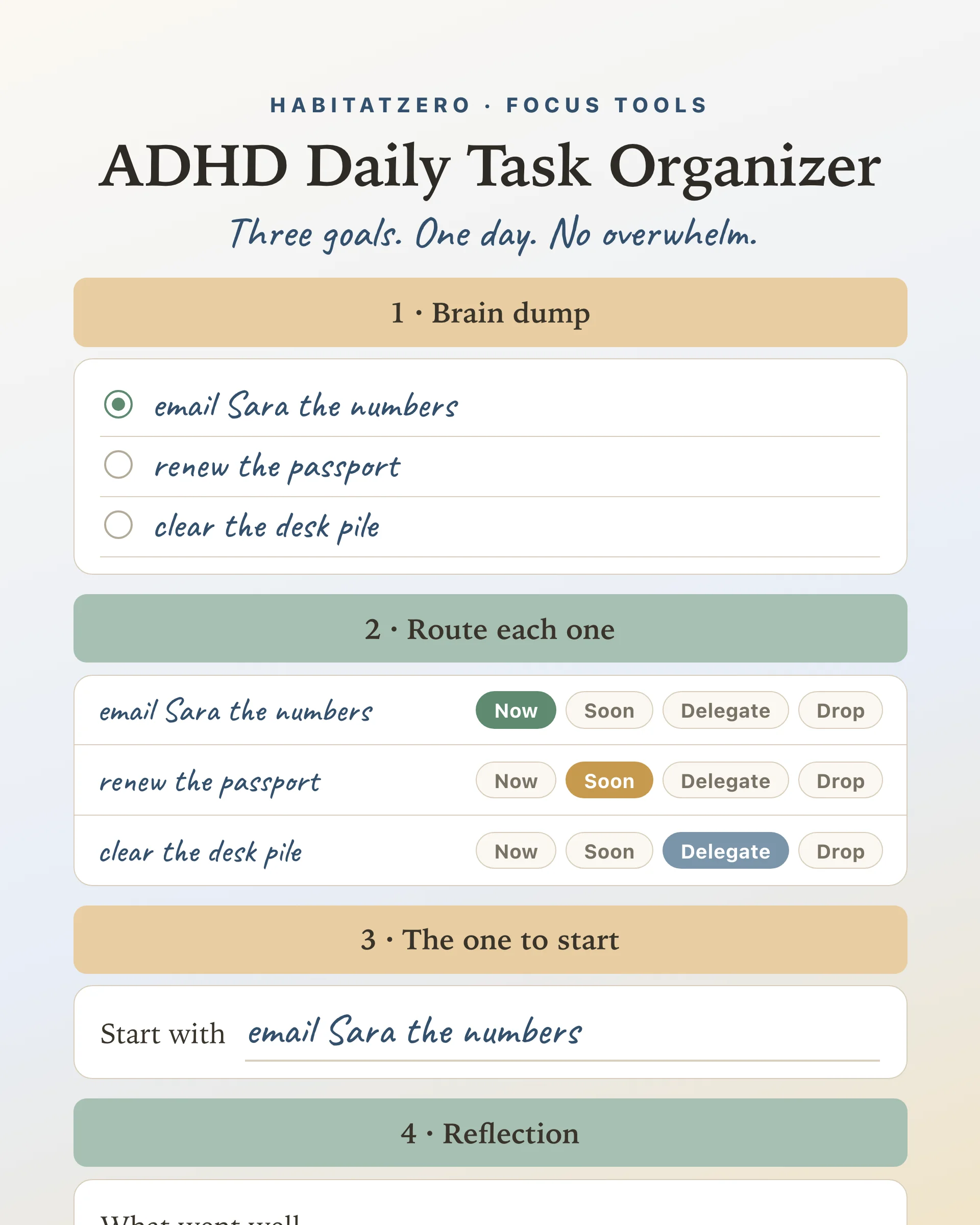
The whole method fits in a few lines. Write down everything you have to do today. Put a letter next to each task. Then work the list in letter order, starting with your most important A, and leave every lower letter alone while a higher one is still open.
Looking for the ABCDE model from cognitive behavioral therapy, which grew out of Albert Ellis's ABC of adversity, beliefs and consequences? That is a separate tool that only shares the letters.
The letters only help because of the rules about order that come with them. No B while an A is left undone, no C while a B or an A is waiting, and once you start A-1, stay with it until it is finished. Tracy also asks you to letter anything new before you start on it, so the list stays the one place where the day gets decided.
Write the day's tasks one line at a time, or tap a common one to add it. New lines wait at the top of the sheet with five small stamps beside them. Tap a letter and the line drops into the running order, stamped A-1, A-2, B-1 and so on. The up arrow moves a line within its letter, which is how you choose your A-1, and the sheet marks the line you should be working on now.
As the day goes, mark lines done, hand off the D's and cross off the E's. The stamp rack underneath counts each letter, and the sheet reads the mix back to you: too many A's, no D on a long list, an E still standing, a line still waiting for its letter, or a B finished while an A was open. A sheet holds twelve lines. At the end of the day, start tomorrow's sheet: unfinished lines carry over without their letters, because Tracy's practice is to letter the list fresh every day, before the work begins.
We could find no published study that tests the ABCDE method itself. It is a practitioner's rule from a business trainer, and it is worth holding it as one.
The research around it still helps. A 2021 meta-analysis on whether time management works, by Brad Aeon, Aïda Faber and Alexandra Panaccio, found time management moderately related to job performance, academic achievement and well-being, with a stronger pull on well-being, and life satisfaction in particular, than on performance. Those are relationships pooled across many studies of time management in general, not a trial of any one technique.
The clearest case for lettering by consequences comes from work on urgency. Across five experiments, Meng Zhu, Yang Yang and Christopher Hsee found that people were more likely to pick tasks with objectively smaller payoffs over better ones when the lesser task merely looked urgent, for instance because it seemed about to expire. They named this the mere urgency effect. Asking what happens if a task never gets done pushes back against that pull, because a looming deadline alone does not earn anything an A.
The letters are only as good as your judgment, and the method will not tell you what matters; it makes you say so before the day starts deciding for you. If half your list keeps coming out as A's, treat that as news about the list, not as a failure to prioritize.
Reach for it on days with more tasks than hours, especially when big work and small errands share one list. Letter the sheet the evening before or first thing in the morning, before your inbox does the choosing. If a single task matters today, the frog habit on its own is simpler. If you would rather commit to six ranked tasks and nothing else, try The Ivy Lee Method. And if urgent and important are easier for you to judge than consequences, the ADHD Priority Matrix sorts the same pile a different way.
It ranks a daily to-do list by consequences. Every task gets a letter from A to E, the A tasks are numbered A-1, A-2 and so on, and you work down from A-1, finishing each letter before you move on to the next one.
Brian Tracy, the author and business trainer, who teaches it in his book Eat That Frog! and on his own website. Fabulous built this sheet on its own to put his lettering rule into practice, and it carries no endorsement from Tracy or his company.
An A task has serious consequences if it slips, like a report someone needs for a meeting. A B task only has mild ones: someone may be put out, but nothing important breaks. Tracy's rule is that no B gets done while an A is still open.
They are close relatives. Alan Lakein's ABC system, from his 1973 book How to Get Control of Your Time and Your Life, ranked tasks A, B or C by value, with A-1 at the very top. Tracy's ABCDE keeps that ranking and adds two letters that take work off the list: D for delegate and E for eliminate.
No. Brian Tracy described the ABCDE method in Eat That Frog!, and this sheet was made independently of him and his publishers, with no review or endorsement from either. The article credits him; the lettering, sorting and reading here are this page's own.
The filled-in sample on this page is free to look through without signing up. Lettering your own sheet, keeping it from one day to the next and carrying lines over all happen in HabitatZero, which costs nothing.
By the team behind Fabulous, the science-based self-care app used by over 30 million people.