Wind-Down Routine BuilderSleep & Evenings · ~4 min
About this template · Updated September 2026
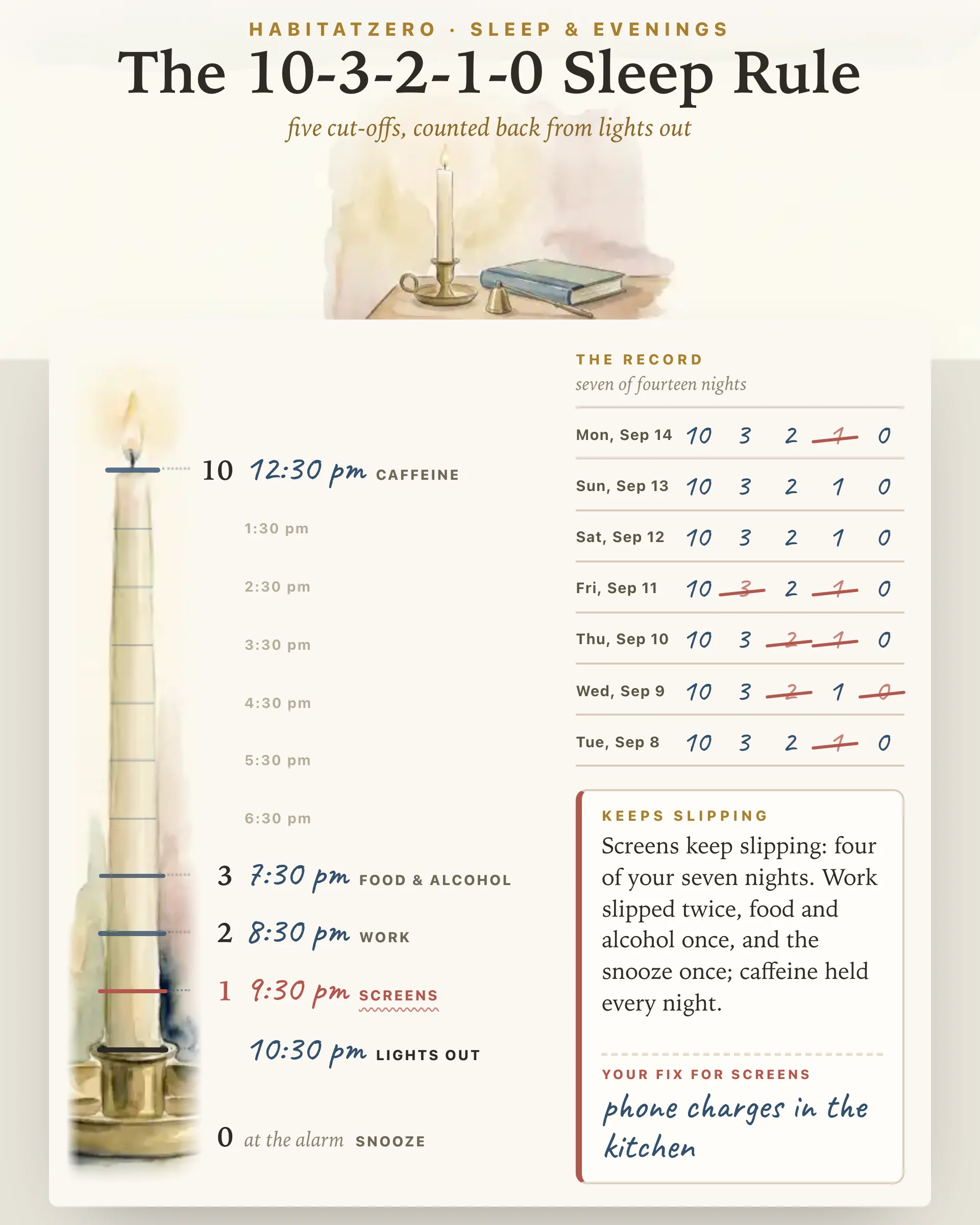
The 10-3-2-1-0 formula comes from Craig Ballantyne, a fitness coach and writer, who set it out on his Early To Rise blog in January 2016 as the 10-3-2-1-0 Formula to Get More Done. Some health sites trace it to a physician's Instagram post from 2021, which is when it spread; Ballantyne's version is five years older. This page is our own worksheet built on his countdown; neither Ballantyne nor Early To Rise had a hand in it or endorsed it.
Choose the time you want to be asleep, then count backward:
The shorter 3 2 1 sleep rule is the middle of the same countdown: the dinner, work and screen cut-offs without the caffeine and snooze bookends.
The arithmetic is easy for a 10:30 pm bedtime and fiddly for a late one. If lights out is 12:30 am, caffeine stops at 2:30 pm, food and alcohol at 9:30 pm, work at 10:30 pm and screens at 11:30 pm. The page does that counting for you.
Pick lights out from the common times, or nudge it a quarter hour at a time anywhere from 7:00 pm to 3:00 am. A painted candle then marks itself like an old candle clock. The top band is your last caffeine, faint bands below it count off the hours in between, and three marks crowd together near the holder: dinner, work and screens. The bunching is the lesson: three of the five cut-offs fall in the last three hours of your evening.
Each morning, log the night that just ended. All five numbers start out held; tap the ones that slipped and log the night. Log the same night again and the page corrects that entry rather than adding a second one. The record holds fourteen nights.
Once three nights are in, the page reads the record. If one cut-off has slipped more than the others, and at least twice, it names that one, turns its mark ember on the candle and asks for a single fix, from suggestions to tap or a line of your own. Five rules at once are hard to keep. One is something you can work on.
The rule is a popular rule of thumb, not a tested protocol, and nobody has trialed the five parts together. Some numbers have research behind them; others are round figures.
Caffeine, ten hours. In a 2013 study, 400 mg of caffeine taken six hours before bed still disrupted sleep, measured at home with a portable sleep monitor, and the authors advised stopping substantial caffeine at least six hours before bed. Ten hours adds a cushion to that. How much you need depends on your cups and how fast you clear caffeine, which the Caffeine Calculator works out for your day.
Food and alcohol, three hours. The clearest support concerns heartburn, which was Ballantyne's own reason. In a case-control study, people who went to bed less than three hours after dinner had more than seven times the odds of reflux disease of people who waited four hours or more. That is an association, not proof, and it says nothing about alcohol, so treat three hours as the least you give a drink, not a sign it has worn off.
Work, two hours. We found no study that tests a two-hour work cut-off. The idea is to give a busy head time to settle, and Ballantyne's own fix was a five-minute brain dump on paper, which the Bedtime Brain Dump turns into a short worksheet.
Screens, one hour. The closest test is a small randomized trial in which people kept their phones away for the last thirty minutes before bed for four weeks. They fell asleep faster and slept longer than a control group. That backs the direction of the rule with half its window.
Zero snooze presses. This is the part the research supports least. In a lab study of habitual snoozers, thirty minutes of snoozing cost about six minutes of sleep and left their thinking just after waking no worse, sometimes better, with no clear effect on mood or sleepiness. Keep the zero if a clean start suits you; it is a preference, not a finding.
Use it for two weeks when you are resetting your nights, after travel, a new job or a run of short sleep. Use it when you suspect one habit is costing you sleep but cannot tell which. If you work nights, this rule was not built for your schedule, which is why the candle stops at 3:00 am.
These cut-offs tend the conditions around sleep. If you hold them for a few weeks and still lie awake most nights, or wake unrefreshed however long you sleep, talk to a doctor. Insomnia that lasts has a treatment of its own, cognitive behavioral therapy for insomnia (CBT-I), which physicians' guidelines recommend first, and two weeks of a Sleep Log gives that conversation something to start from.
It is a countdown you run back from bedtime: no caffeine in the last ten hours, no food or alcohol in the last three, no work in the last two and no screens in the last one. The zero is how many times you press snooze the next morning.
It is the middle stretch of the same countdown. Food and alcohol stop three hours before bed, work stops two hours before, and screens go off one hour before, with no caffeine or snooze part attached.
Fitness coach Craig Ballantyne published it on his Early To Rise blog in January 2016 as the 10-3-2-1-0 Formula. It went viral in 2021 after a doctor explained it on social media. This worksheet is independent, and neither of them made or endorsed it.
We know of no study that tests the whole rule. The caffeine part has the best support: a 2013 study found a large dose six hours before bed still cut sleep, and a 2023 review of twenty-four studies put the cut-off for an ordinary coffee at about nine hours. The snooze part has the least, since a lab test found that half an hour of snoozing cost habitual snoozers about six minutes of sleep and left their thinking no worse.
Reading the rule and the sample candle on this page needs nothing. To mark a candle for your own bedtime and keep two weeks of nights, open it in HabitatZero, which is free.
By the team behind Fabulous, the science-based self-care app used by over 30 million people.