
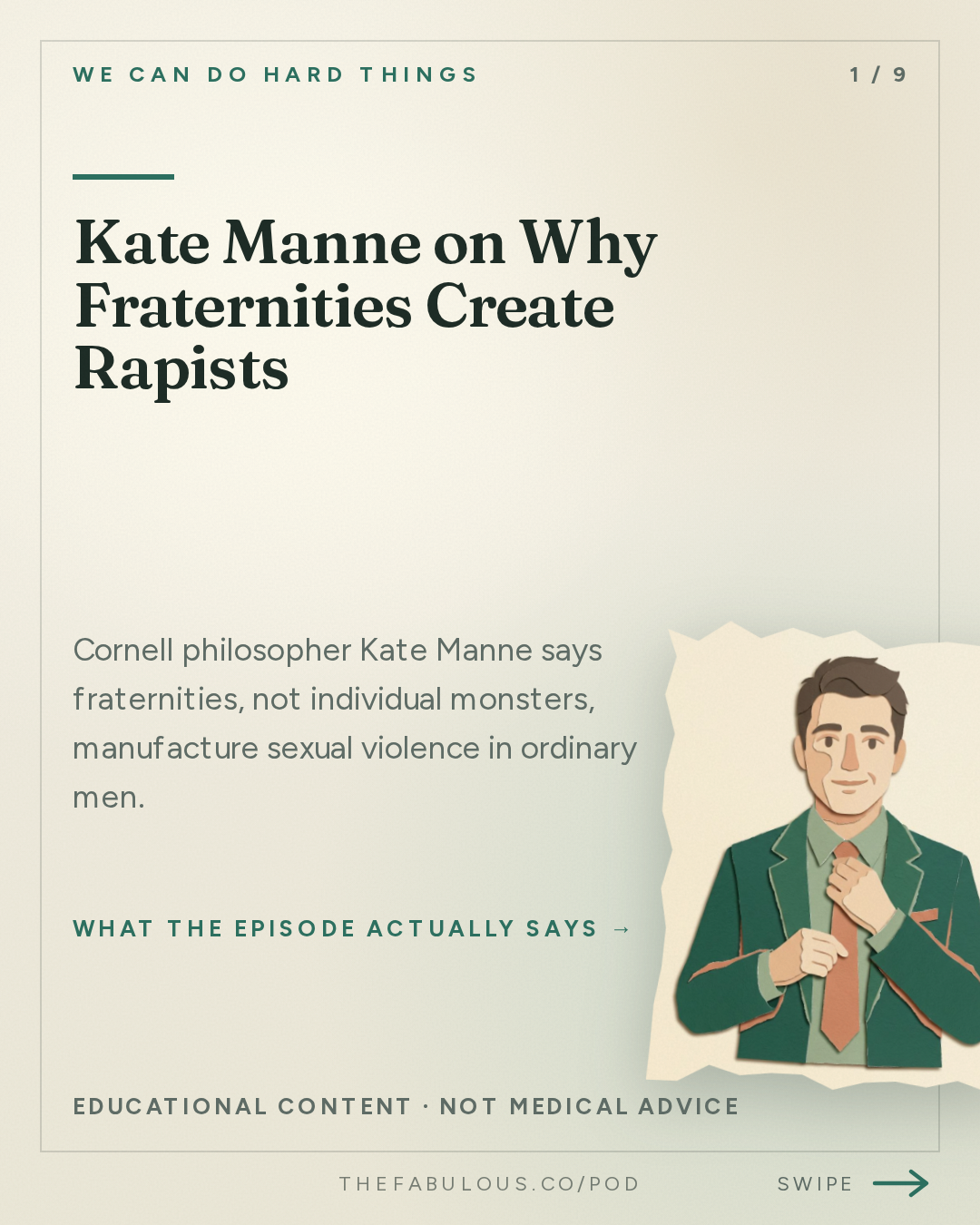
Kate Manne on Why Fraternities Create Rapists
Ban the Frats | Cornell Professor Kate Manne with Amanda
▶ Listen to the full episode More from We Can Do Hard Things
The brief
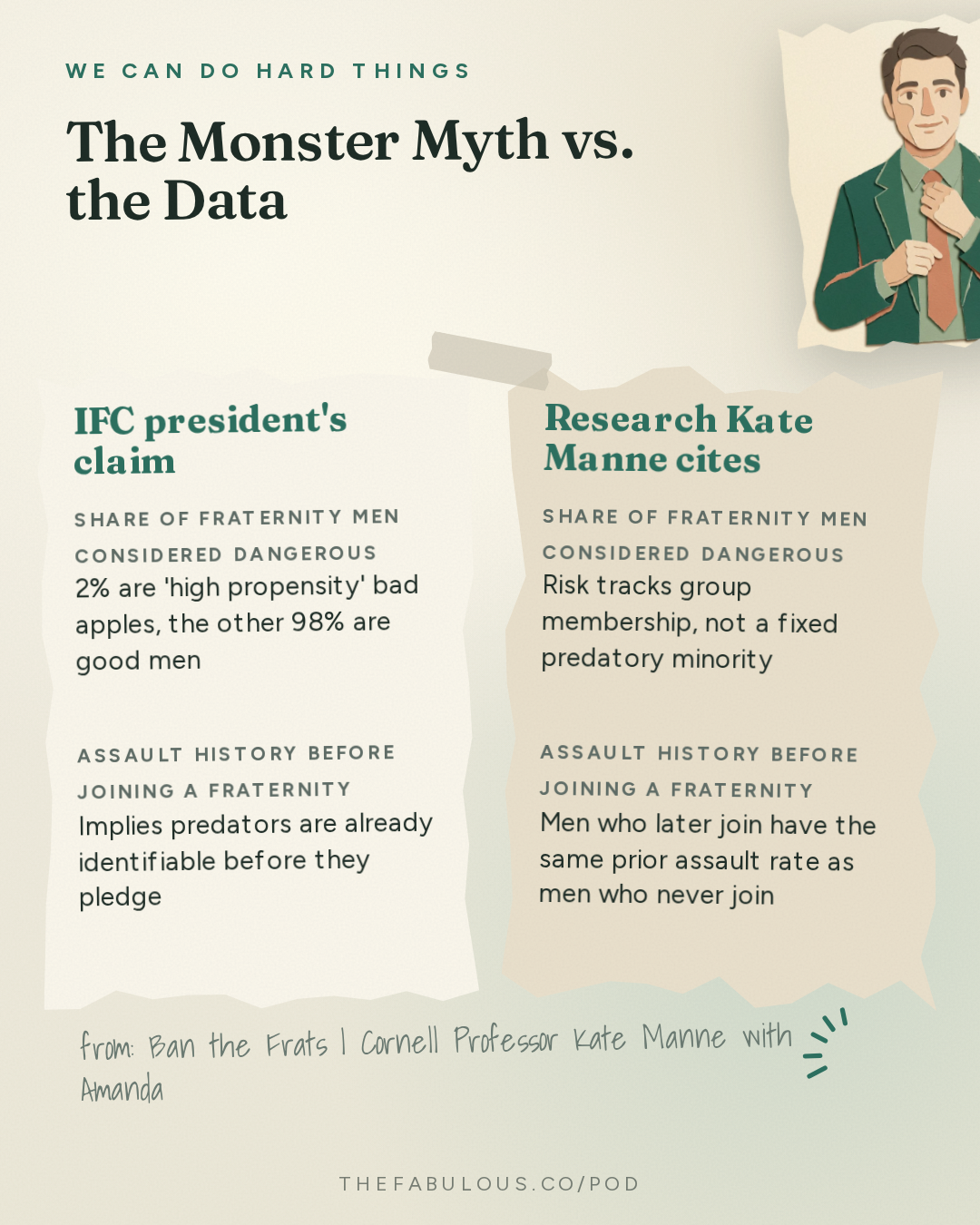
Cornell philosopher Kate Manne says fraternities, not individual monsters, manufacture sexual violence in ordinary men. Men are three times more likely to commit assault after joining a frat, rising to 3.7 times by sophomore year (24:41, 27:20). Cornell logged 1,200 gender-violence reports but only 7 expulsions in six years (09:48), proof, she argues, that institutions value loyalty over safety.
In 1985, two researchers named Ehrhart and Sandler wrote up something they found on American college campuses, from the Ivy League to small liberal arts colleges to big state schools: a ritual, sometimes weekly, in which a group of fraternity brothers took turns on a woman who was too drunk or drugged to resist, while she pleaded to be left alone. Read the passage cold and it could pass for a 2025 lawsuit. It is, instead, forty years old. That gap, between what we have known and what we keep calling unthinkable, is the subject of Cornell philosophy professor Kate Manne's conversation with Amanda on this episode. Manne is the philosopher who gave the world the word himpathy, the extraordinary sympathy society extends to powerful men accused of harming women, often at the cost of believing the women themselves (01:25).
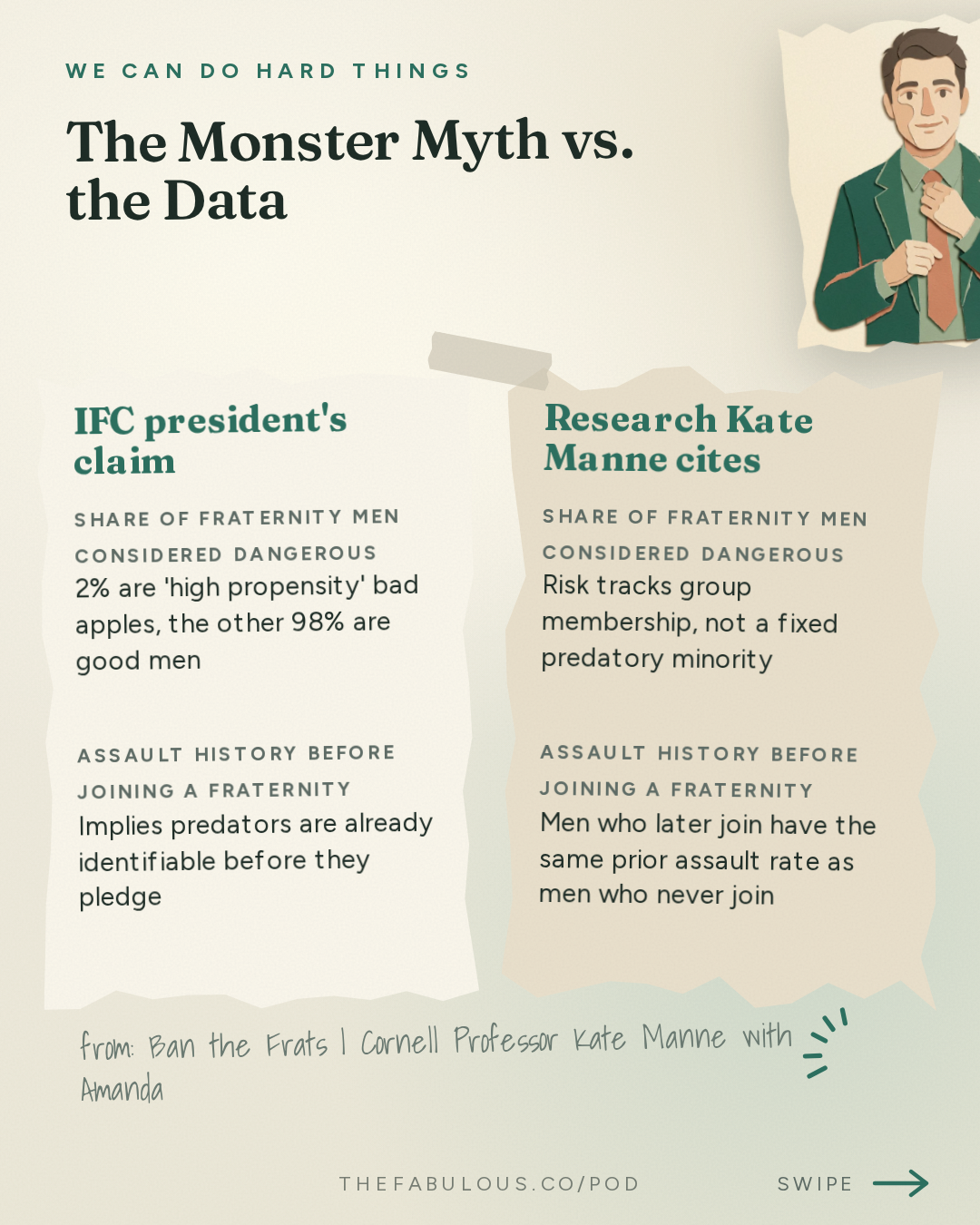
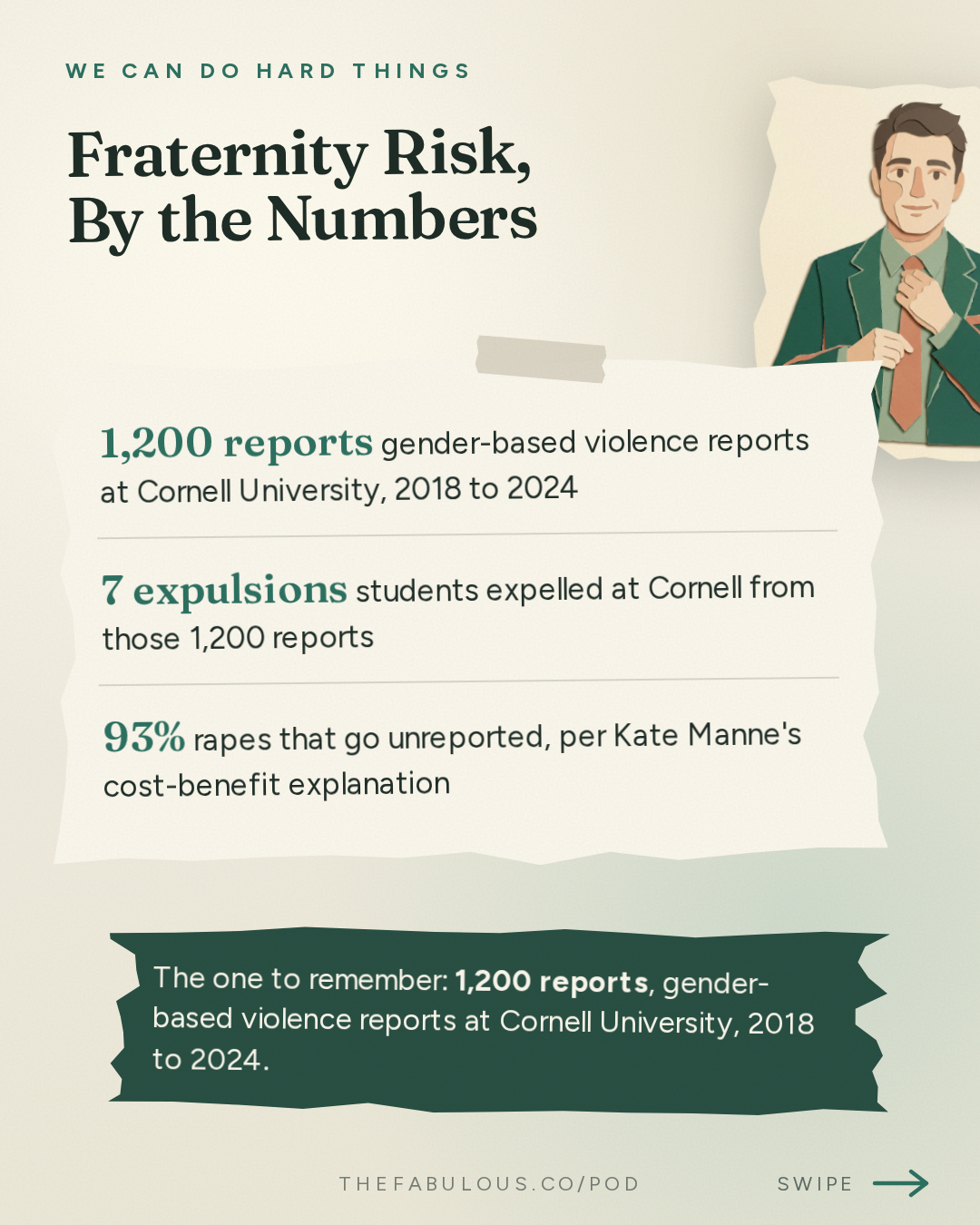
Manne arrived at Cornell in 2013 as an academic specializing in abstract ethics. She did not stay abstract for long. Students, one after another, began telling her what had happened to them at parties, mostly at fraternities. Thirteen years later, with a Cornell case known as Jane Doe forcing a reckoning (a lawsuit alleging a gang assault that several accused men were found responsible for, with only two expelled), Manne's university faculty senate took a vote of no confidence in its president for the first time in thirty years (07:49). The numbers behind that vote are blunt: Cornell logged 1,200 reports of gender-based violence between 2018 and 2024, and produced 14 suspensions and 7 expulsions in that same stretch (09:48).
Manne makes a careful distinction here, between moral shock and actual surprise. She is permanently shocked, she says, and never surprised, because the data on fraternity gang rape goes back to that 1985 report (10:53). The surprise, she argues, is manufactured: institutions perform astonishment so the latest case can be filed under exception rather than pattern. That performance lets everyone avoid a harder question, the one about why decades of identical reports changed so little.
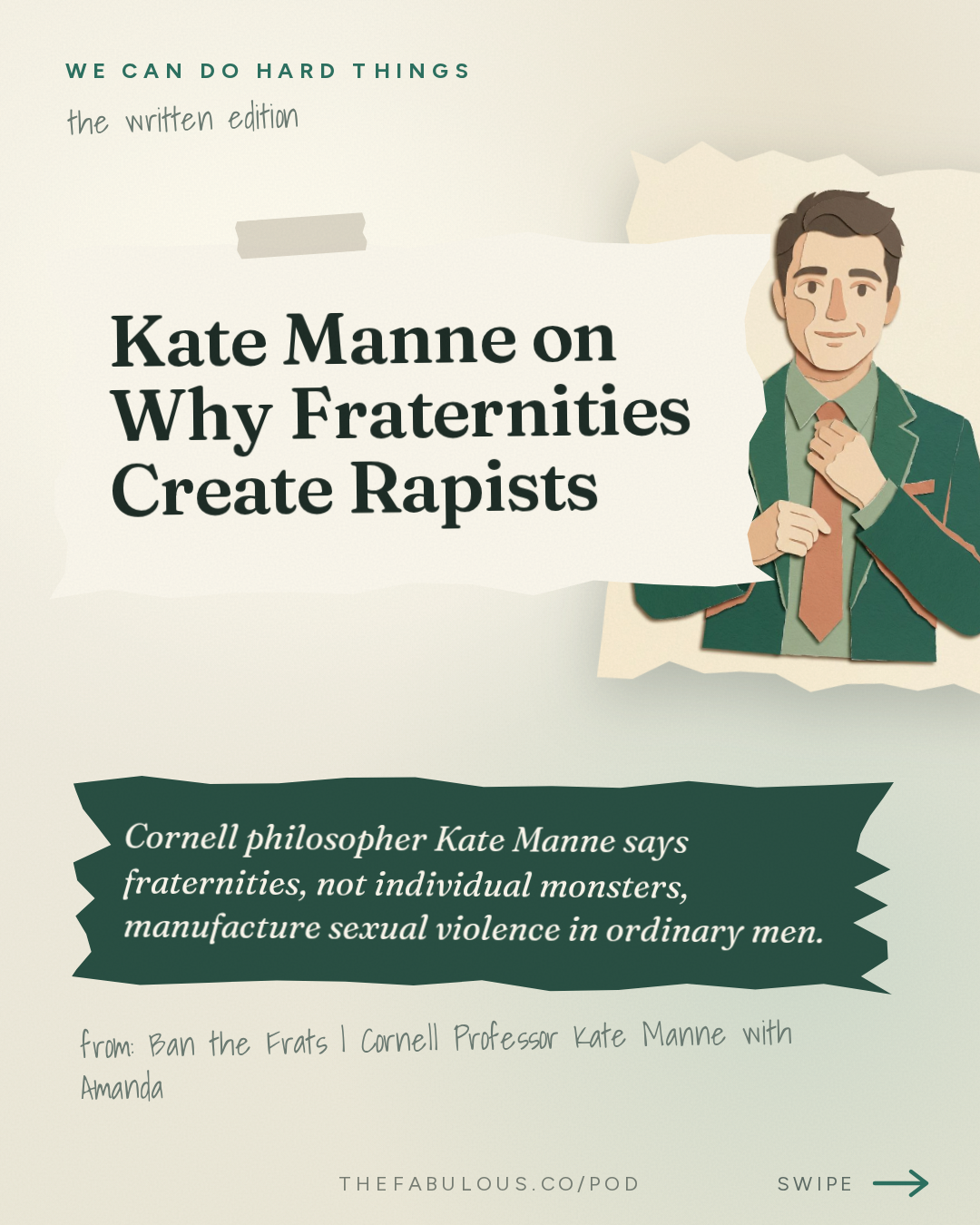
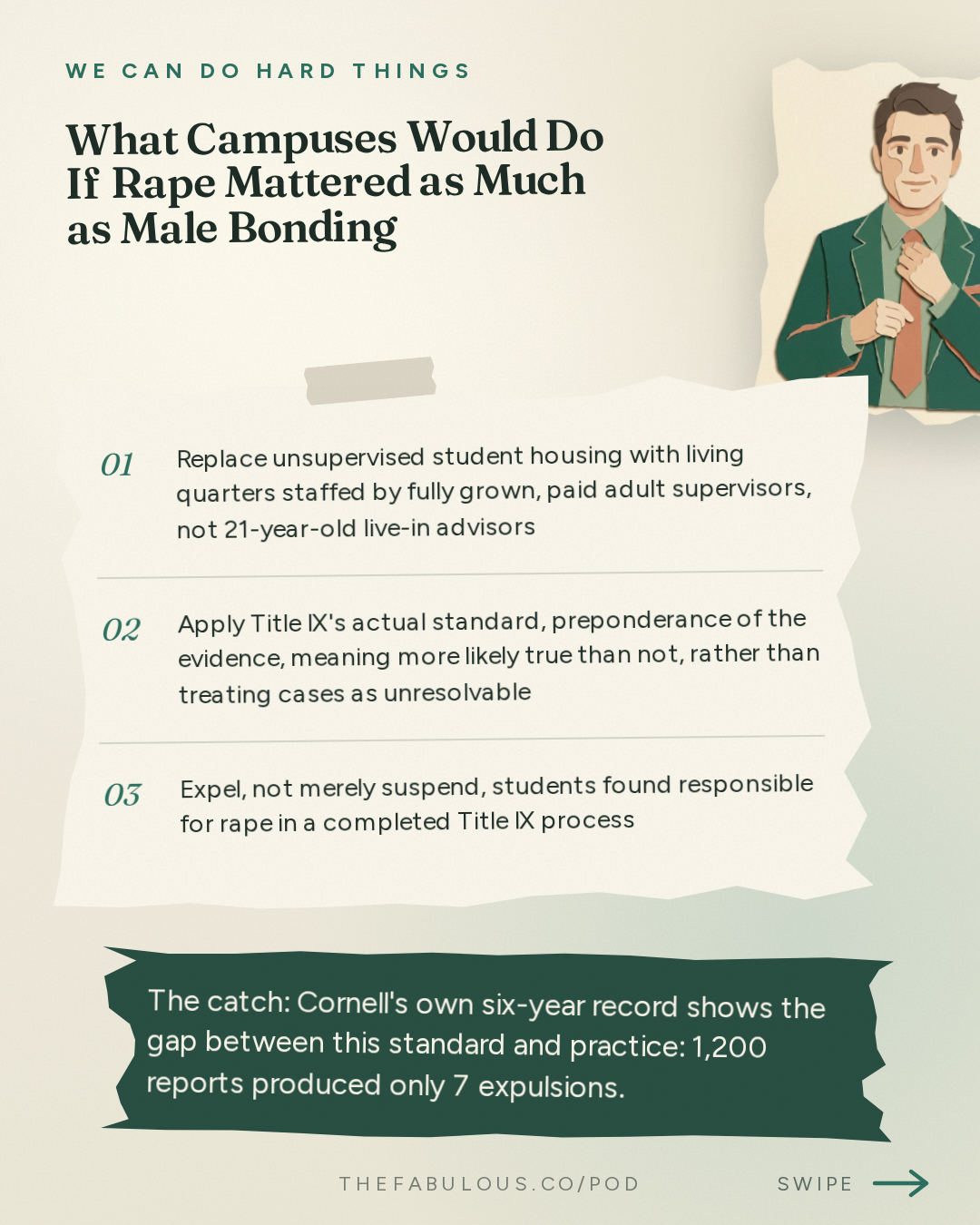
The habit Manne spends the most energy dismantling is what she calls the monster myth, the comforting idea that rapists are a rare, obviously identifiable type, unlike the men in our own families and friend groups. She cites a recent radio exchange with the president of the Interfraternity Council's national conference, who argued that only 2 percent of fraternity men are "high propensity" offenders, with the other 98 percent being good, Bible-study-attending young men (23:01).
"The idea of a monster exonerates by caricature, because you have this picture of a monster, like it would be totally obvious." — Kate Manne [22:31]
The actual research cuts against that comfort. Men who join fraternities have the same rate of prior sexual assault as men who don't join, before they pledge. After joining, they become three times more likely to commit assault (24:41). By sophomore year, the odds climb to 3.7 times those of a non-member (27:20). The mechanism isn't a hidden population of predators sneaking into Greek life. It's ordinary men, placed in an environment that makes going along with harm feel mandatory, or at least cool.
Manne pushes further, into territory most coverage of this topic skips: what fraternities do to the boys themselves. She calls it a moral injury, a resocialization that separates young men from their own instincts about right and wrong (29:00). She describes a student, Diego, whose fraternity had no known sexual assault problem but whose pledging process still drilled in an absolute code of protecting brothers above all else, even when real harm was happening in front of them (30:48). The costs aren't only psychological. Manne points to a case from Ohio State, reported the day before this conversation, in which two pledges were set on fire during a hazing ritual, suffering second-degree burns over 6 to 25 percent of their bodies (29:32).
"We need to ban the fucking frats yesterday." — Kate Manne [32:37]
Why Nothing Changes
If the data has been available for forty years, why do fraternities still exist on campuses that claim to care about student safety? Manne's answer starts with money: alumni donations and institutional loyalty to the Greek system. But she argues universities overstate how fixed that calculation is. Her colleague, sociologist Dan Hirschman, frames it as a weight and a counterweight: yes, some donors are devoted to their old fraternities, but plenty of worried alumni exist too, people who would give more, not less, to a school that visibly cleaned up the problem (58:57).
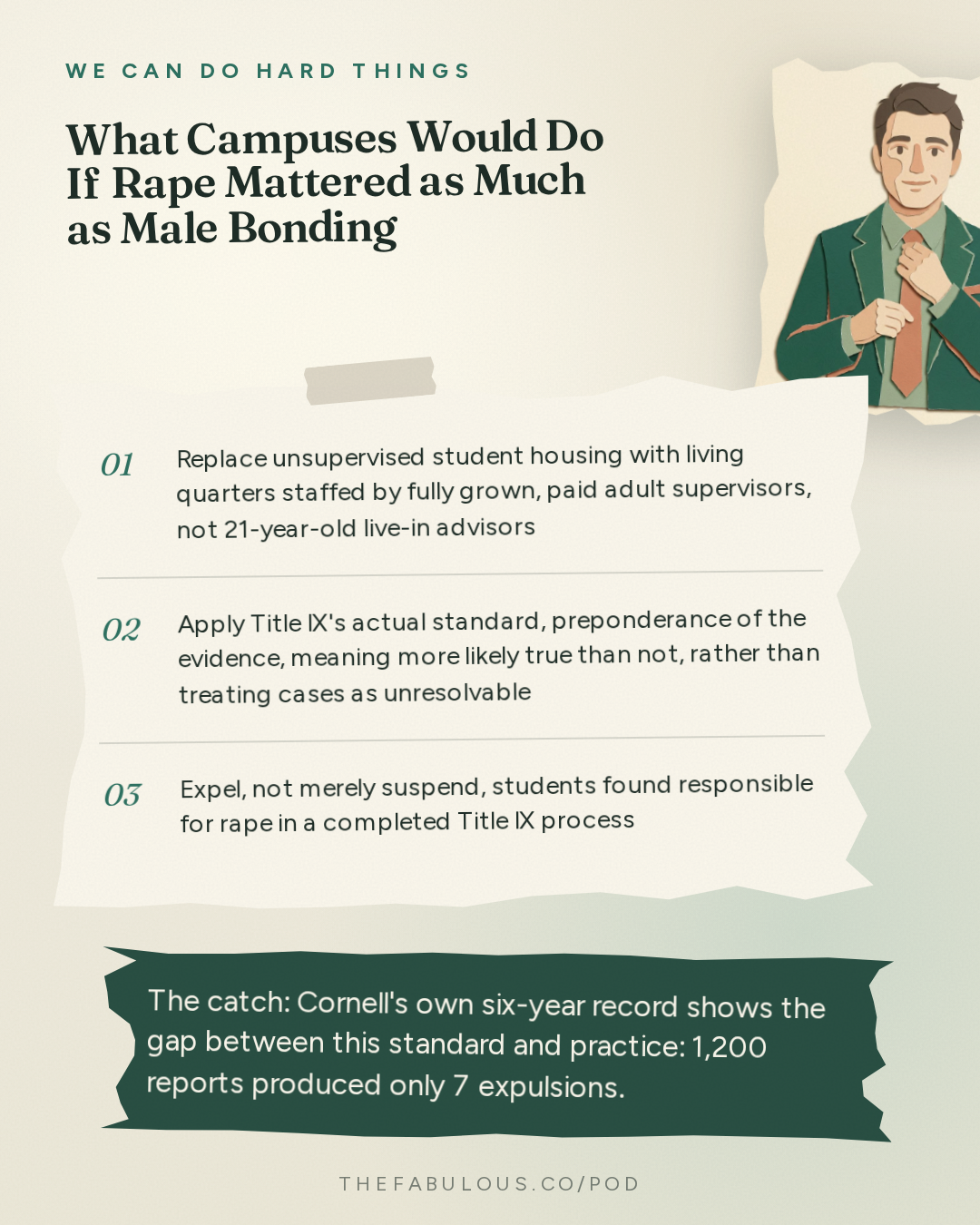
Universities don't need to wait for full abolition to act, Manne says. Brown University already refuses to endorse any fraternity that won't submit to close supervision, making unapproved chapters unattractive without banning them outright (60:55). The legal mechanism for faster action already exists too. Title IX's standard of evidence is "preponderance of the evidence," meaning more likely true than not, a far lower bar than the criminal system's proof beyond a reasonable doubt (47:16). Manne argues that if universities actually enforced that standard and expelled, rather than merely suspended, students found responsible for rape, it would function as a real deterrent. Students are rational, she says: if they know an act could get them expelled, they do it less (48:10). She links this directly to why victims stay silent. An estimated 93 percent of rapes go unreported, because for the victim the costs of reporting are high and the benefits are low, while for the perpetrator, the reverse is true (48:34).
This is where Manne's argument becomes most uncomfortable, and most persuasive. The standard campus response to all of this has been consent education: workshops, orientation modules, posters explaining what consent looks like. Cornell's own internal survey found that 52 percent of women affiliated with Greek life reported experiencing some form of sexual assault, compared with 29 percent of non-Greek women, a rate already close to the troubling national average (53:32). Three decades of consent training have not moved that number. Manne's explanation is blunt.
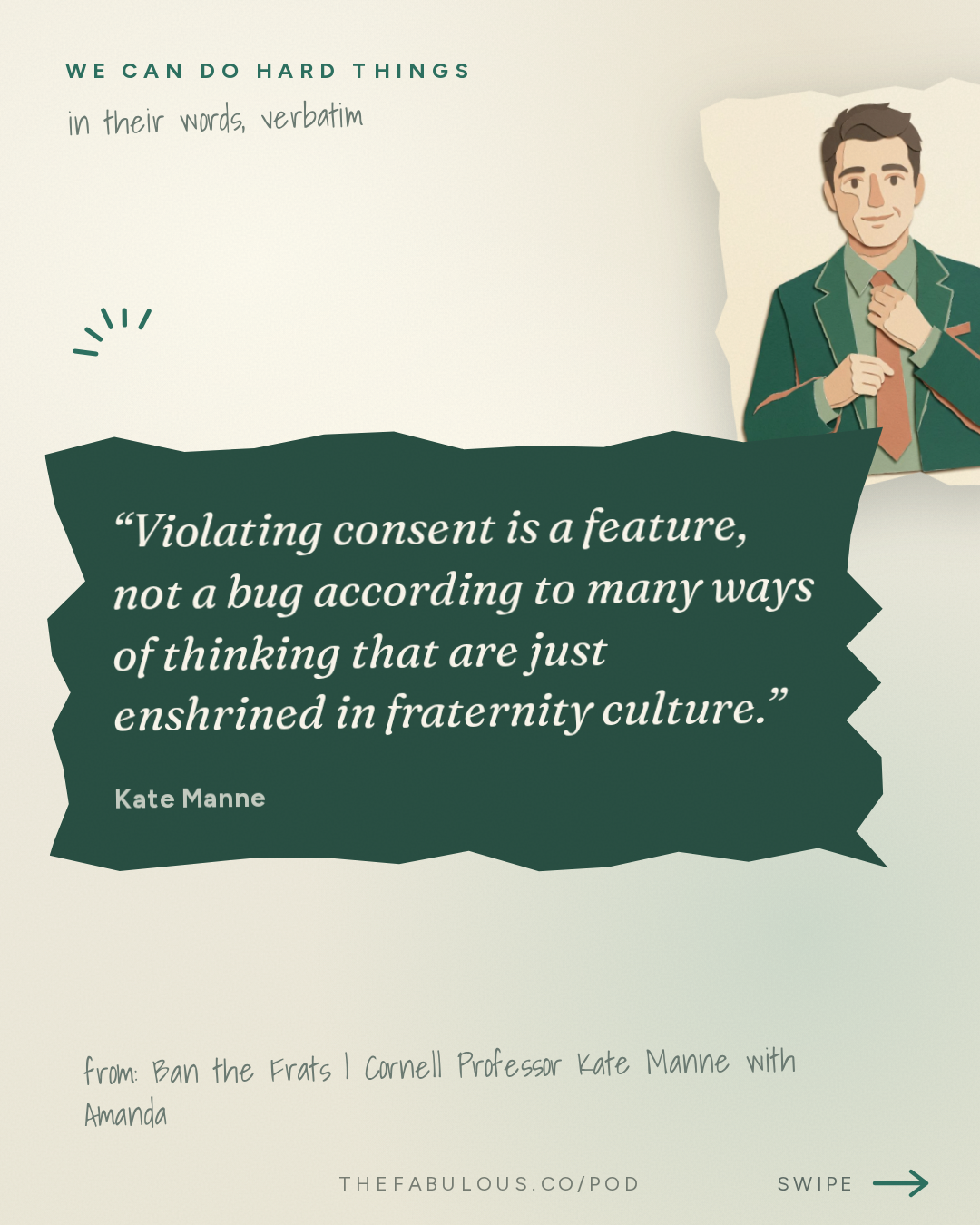
"Violating consent is a feature, not a bug according to many ways of thinking that are just enshrined in fraternity culture." — Kate Manne [51:28]
Her point is that for some fraternity rituals, the thrill isn't obtaining consent and then acting. The thrill is the transgression itself: the status that comes from getting away with something, from bonding a group around a shared violation. Teaching a man the definition of consent does nothing if breaking it is the actual goal.
A Different Kind of Brotherhood
Manne isn't arguing that friendship or loyalty among young men is the problem. She's arguing that the current blueprint for male bonding, domination dressed up as brotherhood, has convinced a generation of sons that the price of belonging is surrendering some piece of their own humanity. She suggests a concrete counter-habit for parents: give sons the same caregiving duties typically reserved for daughters, babysitting, camp counseling, changing diapers, alongside ordinary chores, so that caring for other people's bodies becomes normal rather than foreign (74:14).
She also dismantles a popular justification for male-only spaces: the idea that men are uniquely lonely and need fraternities as a cure. Research from her student Ryan Beaulieu finds men are not, on average, lonelier than anyone else; caregivers, the chronically poor, and people facing disability or marginalization report far higher loneliness (76:33). The loneliness epidemic narrative, she suggests, is being used to justify an institution that does the opposite of connecting people safely.
Near the end of the conversation, Amanda invokes a line from writer Bess Cobb: raise sons who make the entire notion of fraternities obsolete, who look at the hazing and the secrecy and the cruelty and find it ridiculous rather than aspirational (73:15). Manne's whole argument rests on a simpler version of the same idea, one she states early on: an institution's values are not revealed by what it says, but by what it allows. Cornell allowed 1,200 reports and produced seven expulsions. That ratio, more than any mission statement, is the actual policy.
Ask this episode anything
Pod's AI answers from the episode itself, with the minute mark so you can hear it yourself.
Or start with one of these
Ask this episode
Pod's AI listens to the whole episode to answer, and points you to the minute it comes from.
The rest of this answer, and any question after it
Answers come from the episode itself, never from a summary of it.
ContinueKey takeaways
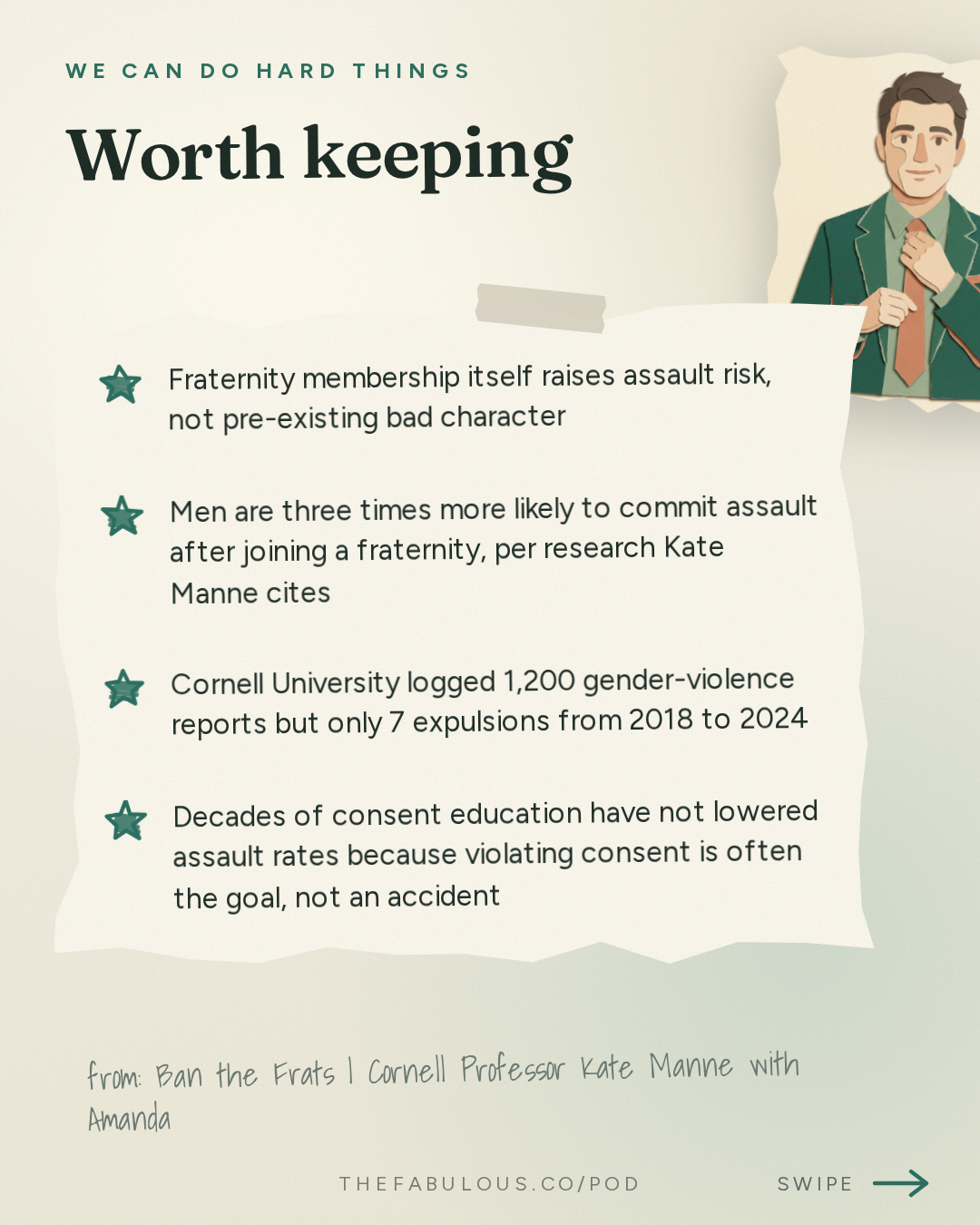
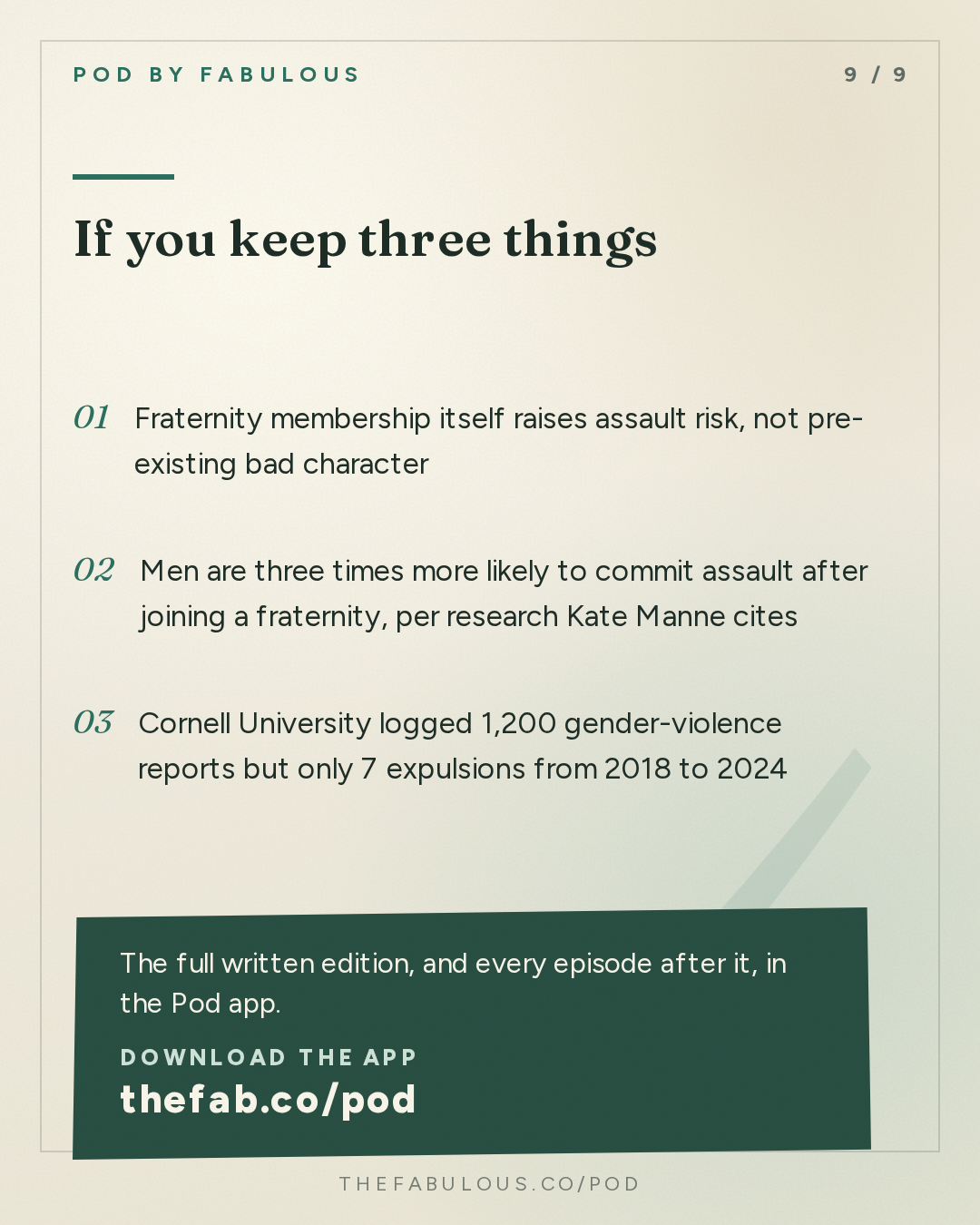
- Fraternity membership itself raises assault risk, not pre-existing bad character
- Men are three times more likely to commit assault after joining a fraternity, per research Kate Manne cites (24:41)
- Cornell University logged 1,200 gender-violence reports but only 7 expulsions from 2018 to 2024 (09:48)
- Decades of consent education have not lowered assault rates because violating consent is often the goal, not an accident (51:28)
- The belief that men are uniquely lonely is a myth; caregivers and marginalized groups report more loneliness (76:33)
The episode in cards

By the numbers
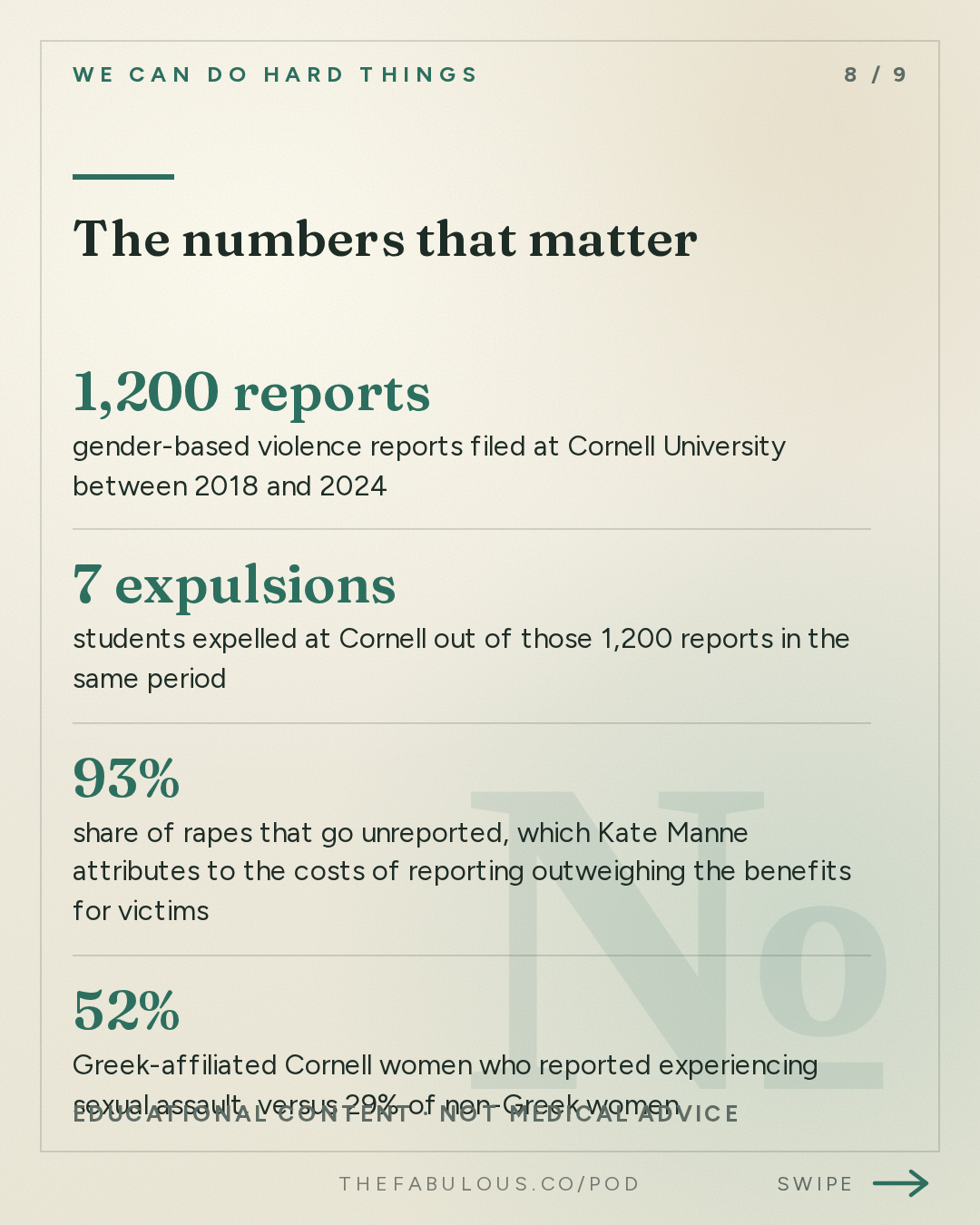
- 1,200 reports gender-based violence reports filed at Cornell University between 2018 and 2024
- 7 expulsions students expelled at Cornell out of those 1,200 reports in the same period
- 93% share of rapes that go unreported, which Kate Manne attributes to the costs of reporting outweighing the benefits for victims
- 52% Greek-affiliated Cornell women who reported experiencing sexual assault, versus 29% of non-Greek women
In their words
“The extraordinary sympathy our culture extends to powerful men who harm women, even as the women they've harmed are disbelieved, diminished, or forgotten”
“The idea of a monster exonerates by caricature, because you have this picture of a monster, like it would be totally obvious.”
“We need to ban the fucking frats yesterday.”
“Violating consent is a feature, not a bug according to many ways of thinking that are just enshrined in fraternity culture.”
Protocols
-
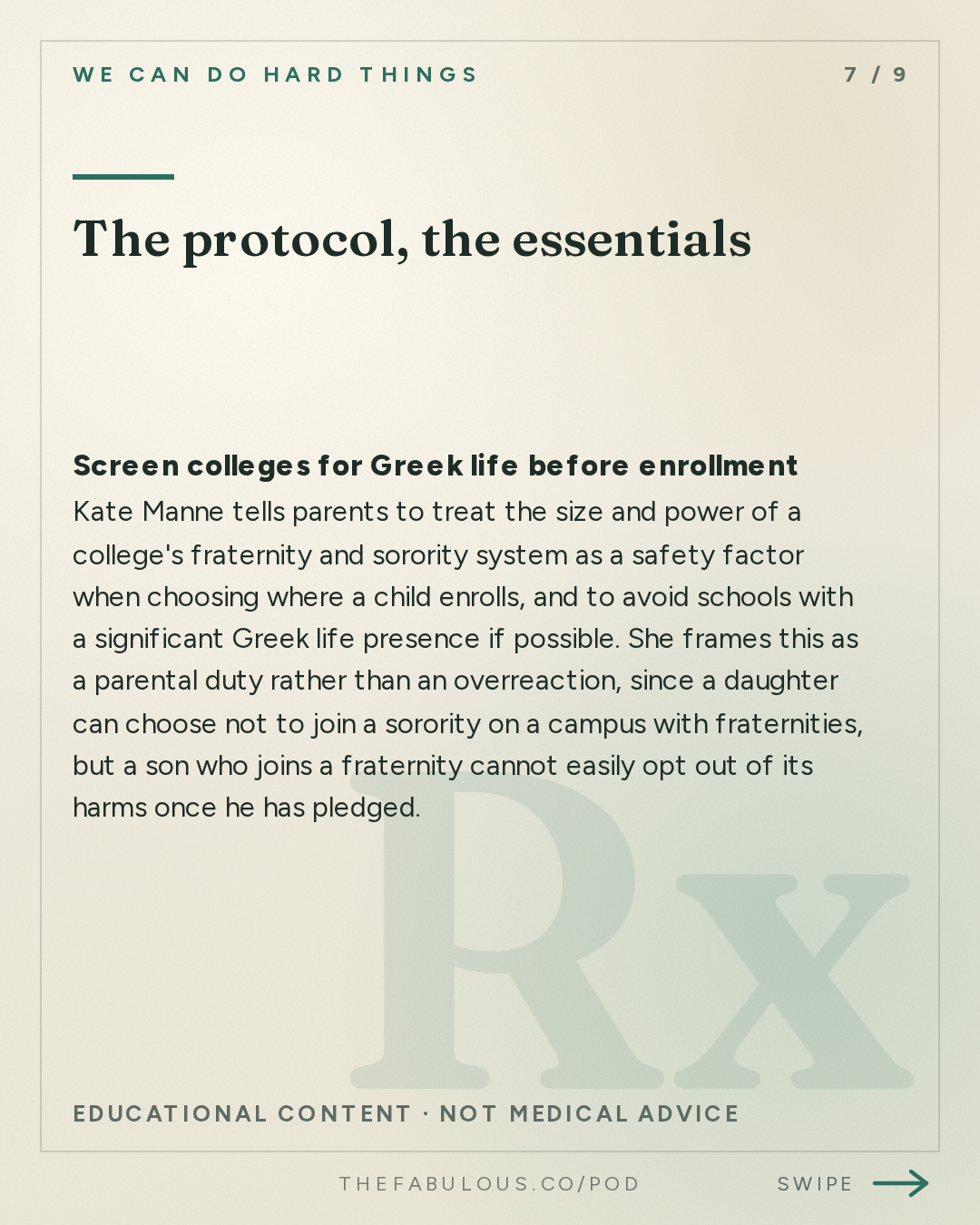
Screen colleges for Greek life before enrollment
Kate Manne tells parents to treat the size and power of a college's fraternity and sorority system as a safety factor when choosing where a child enrolls, and to avoid schools with a significant Greek life presence if possible. She frames this as a parental duty rather than an overreaction, since a daughter can choose not to join a sorority on a campus with fraternities, but a son who joins a fraternity cannot easily opt out of its harms once he has pledged.
before choosing a college
-
Build caregiving habits into sons' routines
Kate Manne advises parents to assign sons the same caregiving tasks often reserved for daughters, including babysitting, camp counseling, and diaper changing, alongside standard chores like taking out the trash. She says normalizing care for other people's bodies works as a counterweight to viewing bodies as exploitable, which she sees as a root attitude behind hazing and assault.
ongoing through childhood
-
Withdraw institutional support short of full abolition
Kate Manne points to Brown University's policy of refusing to endorse any fraternity that will not submit to strict adult supervision, which makes unapproved chapters unattractive to students without banning them outright. She calls this a harm-reduction step for universities unwilling to abolish fraternities immediately, while stating her own preference remains full abolition.
as an interim institutional policy
Questions this episode answers
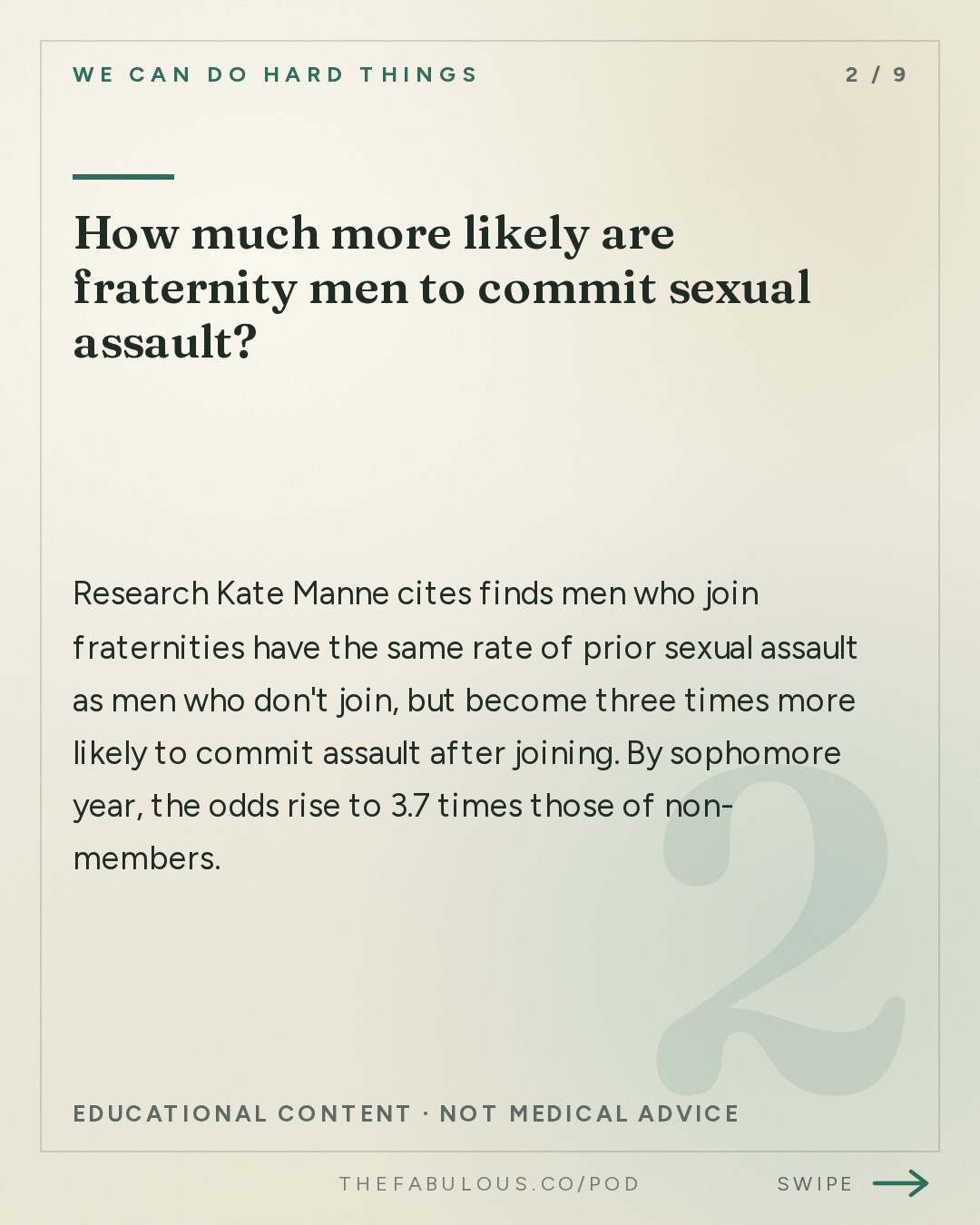
How much more likely are fraternity men to commit sexual assault?
Research Kate Manne cites finds men who join fraternities have the same rate of prior sexual assault as men who don't join, but become three times more likely to commit assault after joining (24:41). By sophomore year, the odds rise to 3.7 times those of non-members (27:20).
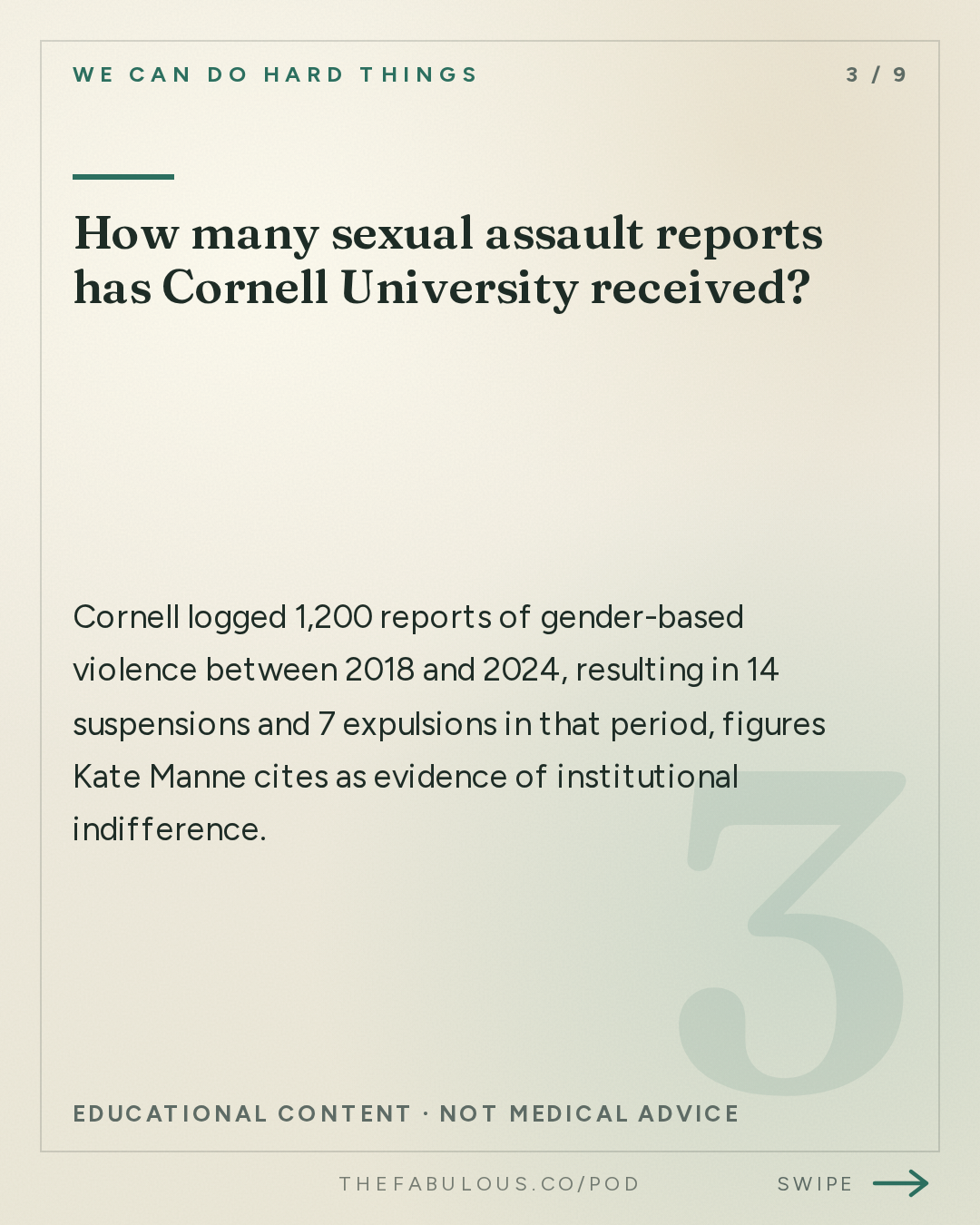
How many sexual assault reports has Cornell University received?
Cornell logged 1,200 reports of gender-based violence between 2018 and 2024, resulting in 14 suspensions and 7 expulsions in that period, figures Kate Manne cites as evidence of institutional indifference (09:48).
What does himpathy mean?
Himpathy is a term coined by Cornell philosopher Kate Manne for the excess sympathy society gives to powerful men accused of harming women, often at the expense of believing the women involved (01:25).
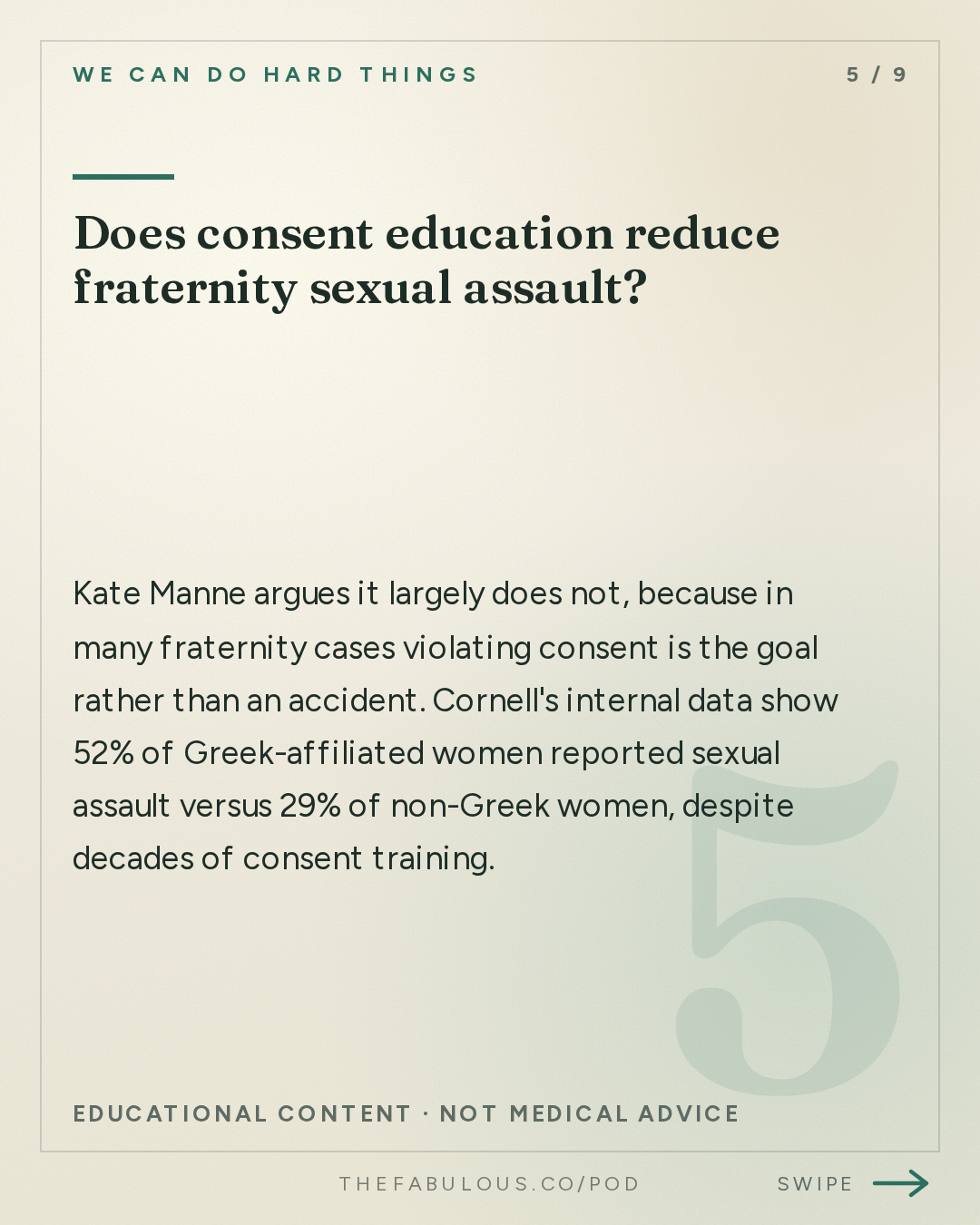
Does consent education reduce fraternity sexual assault?
Kate Manne argues it largely does not, because in many fraternity cases violating consent is the goal rather than an accident (51:28). Cornell's internal data show 52% of Greek-affiliated women reported sexual assault versus 29% of non-Greek women, despite decades of consent training (53:32).
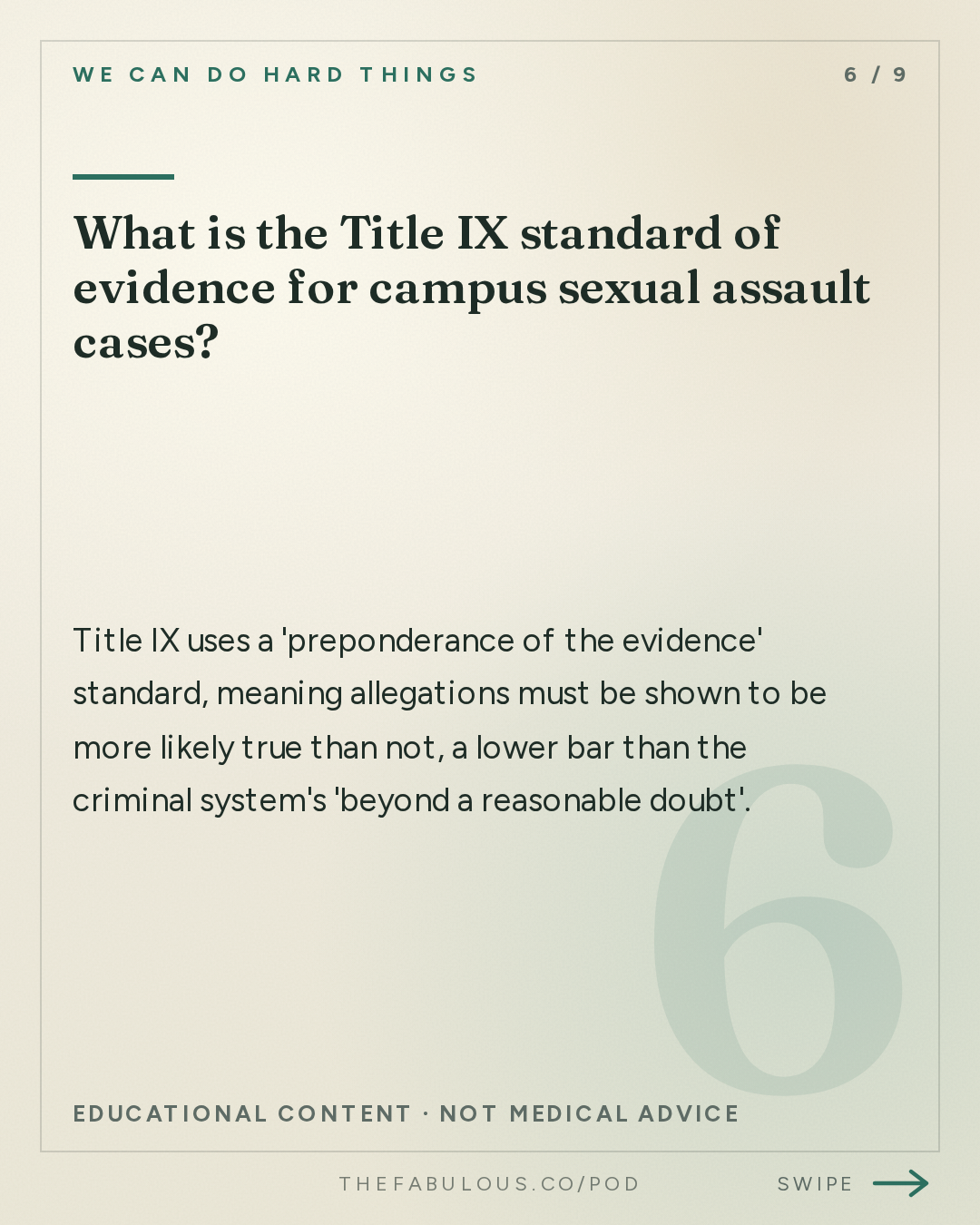
What is the Title IX standard of evidence for campus sexual assault cases?
Title IX uses a 'preponderance of the evidence' standard, meaning allegations must be shown to be more likely true than not, a lower bar than the criminal system's 'beyond a reasonable doubt' (47:16).
The full read, in cards
Go deeper
- Fraternity Gang Rape — anthropologist Peggy Reeves Sanday's study drawing on a 1985 report that found fraternity gang rape was a common, sometimes weekly occurrence across Ivy League, liberal arts, and state school campuses
- Down Girl: The Logic of Misogyny — Kate Manne's book that introduced the concept of himpathy, the excess sympathy extended to powerful men accused of harming women
- 1985 Ehrhart and Sandler report — early documentation of planned fraternity gang rape involving drugging and alcohol, used by Manne to argue the pattern is decades old, not new
Mentioned
Kate Manne · Cornell University · Down Girl: The Logic of Misogyny · Peggy Reeves Sanday · Fraternity Gang Rape · Michael Kotlikoff · Jane Doe · Interfraternity Council · Bess Cobb · Celeste Davis · Judson Haras · Diego · Brown University
More from this show and category

Why Fraternities Are Toxic for Sons
Fraternity membership raises a young man's odds of committing sexual assault by 66% freshman year, 3.7 times by sophomore year, studies show. The episode argues this isn't about bad apples: two centuries of secrecy, university financial backing, and hazing rituals train ordinary pledges to treat boundary violation as proof of manhood.

2026 Midterms: Results, Firsts, and What's Next
Hosts of We Can Do Hard Things treat the 2026 midterm wins as a nervous-system event and a political one. Democrats took 54 Senate seats and 247 House seats; the episode covers historic firsts, a critique of establishment-picked candidates, and the National Popular Vote Interstate Compact, now at 222 of 270 electoral votes needed.

Dr. Orna Guralnik on Couples Therapy
Psychoanalyst Orna Guralnik says relationship fights are really negotiations over otherness, not actual disputes about chores. She explains how splitting pushes blame onto a partner, how old family debts called intergenerational errands get replayed in marriage, and offers one exercise: treat a partner's most annoying trait as the source of personal growth.

What Is a Father Wound? Terri Cole Explains
A father wound is a psychological injury from a father who was absent, abusive, addicted, or emotionally unavailable. Psychotherapist Terri Cole calls it a worthiness wound, the belief that love must be earned through achievement or perfection. Her study of 650 women found it fuels hyperindependence and perfectionism until perimenopause forces a stop (07:58, 21:36).
