
Tim Ferriss: Use AI as a Pocket Strategist
#890: Timeless Principles for Fast-Changing Times — Asymmetric Bets, Effectiveness Over Efficiency, Identity Diversification, and The Books I Keep Rereading
The brief
Tim Ferriss, interviewed on stage before 3,500 real estate professionals in Las Vegas, argues effectiveness beats efficiency and that fear-setting, mini-retirements, and identity diversification build resilience for fast-changing times. He also shows how to use AI as a pocket strategist rather than a search engine.
Imagine winning so completely that the win breaks you. That is the question Tim Ferriss puts to a room of 3,500 real estate professionals in Las Vegas, where Zillow senior vice president Zahara Washington turns the tables and interviews him for once (00:19). "What happens if you're the dog who catches the car?" he asks (12:45). A broker who closes 50 deals this year and 80 next year is not automatically safe. He may be one unanswered phone call away from losing everything he built, because the business never learned to run without him.
Ferriss built his first company, a sports supplement business called BrainQUICKEN, around 14-hour days (01:48). The business ran him, not the other way around. His fix became the backbone of his first book, The 4-Hour Workweek: a four-step method he calls DEAL, short for Definition, Elimination, Automation, and Liberation (03:02). The order matters. Before eliminating or automating anything, Ferriss says a business owner needs to define what they actually want, in dollar terms. He calls this a target monthly income, or TMI, a concrete number that replaces the vague, endless pressure to just "grow the business" (05:34). Without that number, ambition has no edges. "If you have infinite optionality, you are dead in the water," he says, describing his younger self chasing every wholesale account instead of serving the small group of customers who already bought the most (03:26).
Doing the right thing, not doing it well
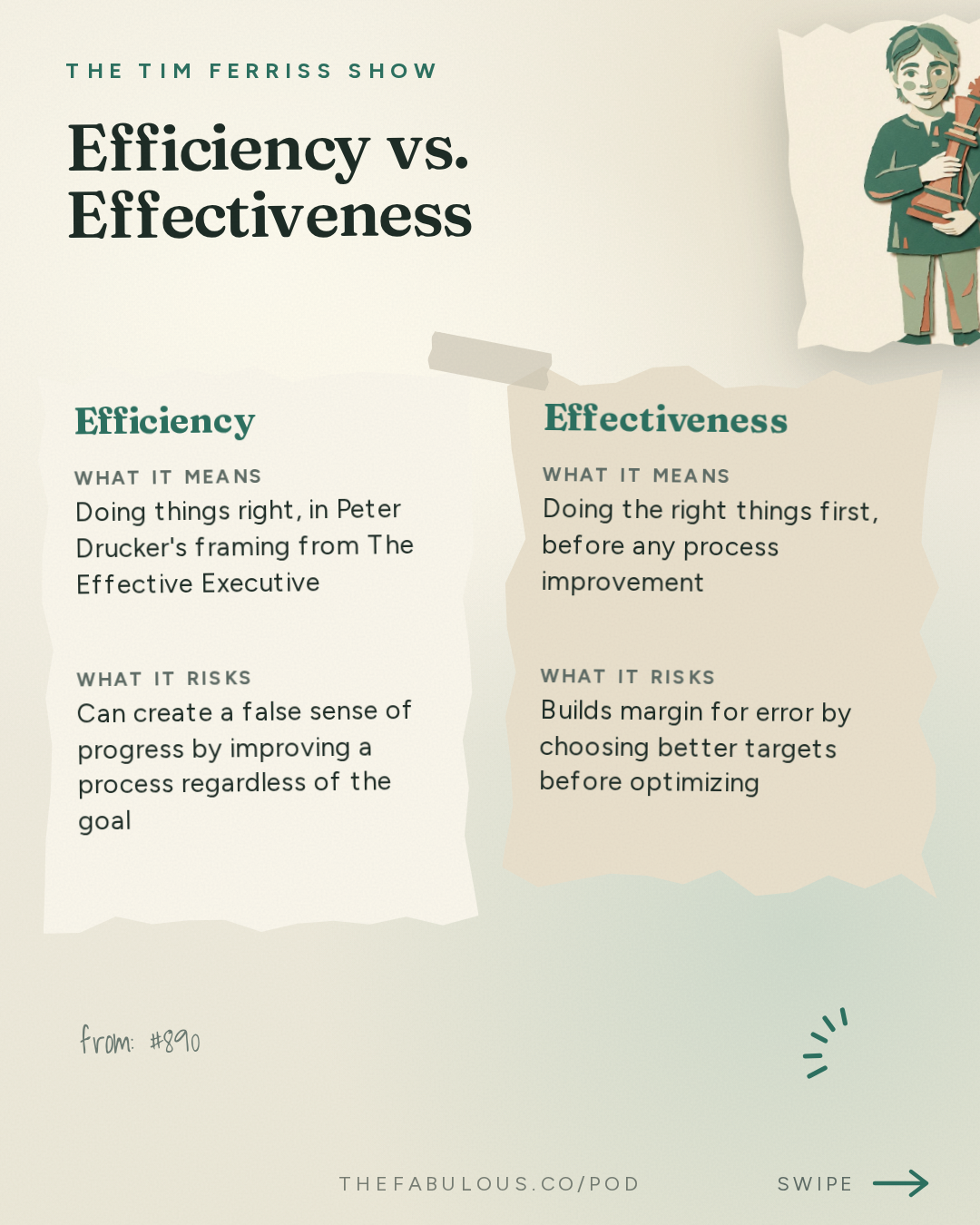
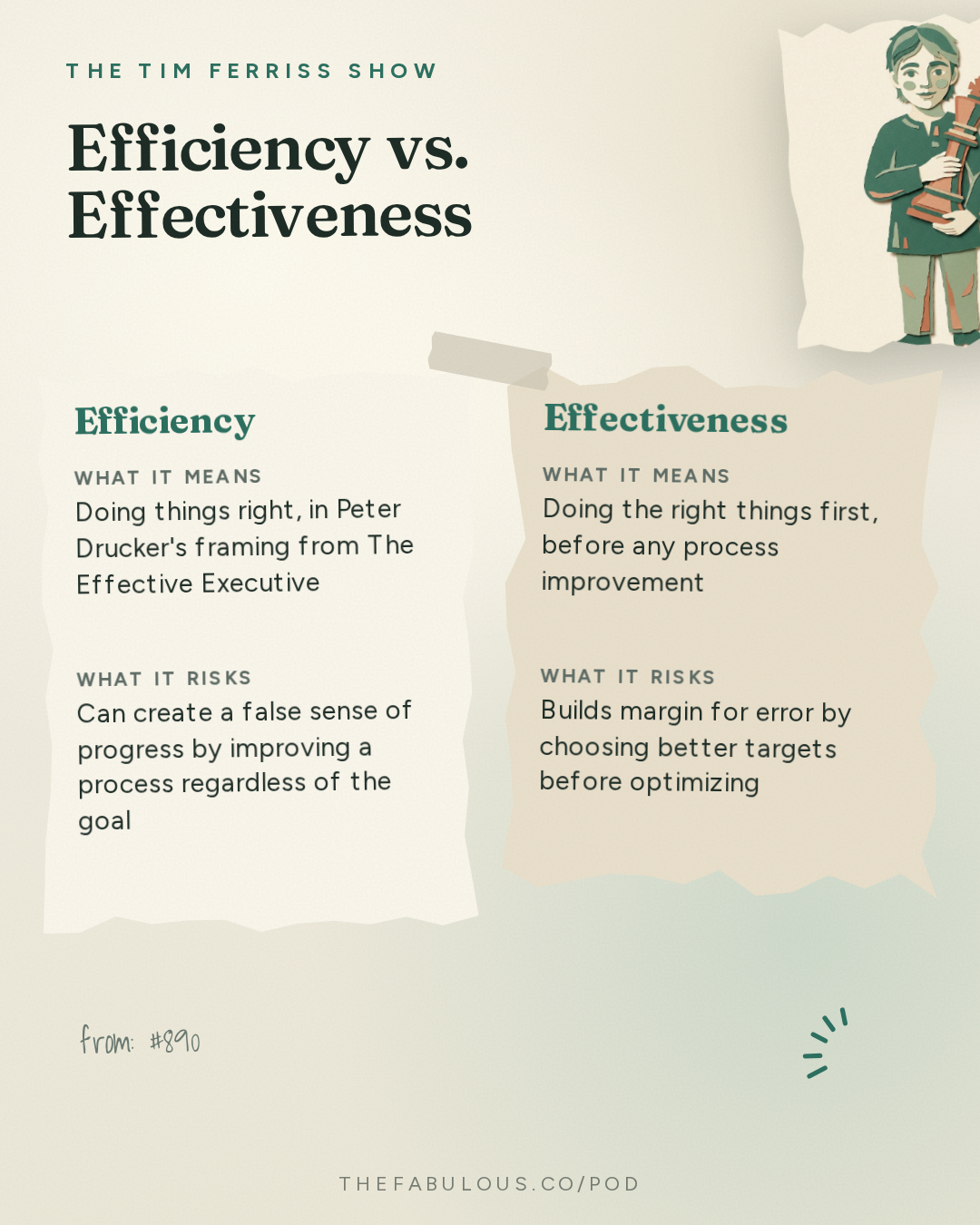
Ferriss keeps returning to a distinction he borrows from management thinker Peter Drucker's book The Effective Executive: efficiency is doing things right, effectiveness is doing the right things (19:25). Most people chase efficiency because it is measurable and feels like progress. Speed in the wrong direction is still the wrong direction.
"Doing the right things matters a lot more than doing things well." (Tim Ferriss, 05:05)
He pushes the point further: optimizing the wrong target does not just waste time, it hides the waste. "Efficiency is a blunt instrument," he says. "It can give us a false sense of progress because we're improving at doing something, regardless of what that something is" (21:27). His example comes from a friend who ranks number one on HackerOne, a platform that ranks security researchers paid to find software flaws. Ferriss told the friend to ask an AI model, a large language model or LLM, for only two versions of an email draft, not five. More options felt efficient. Ferriss warned that asking for five drafts would create more work than writing the email from scratch (22:07).
A strategist, not a search engine
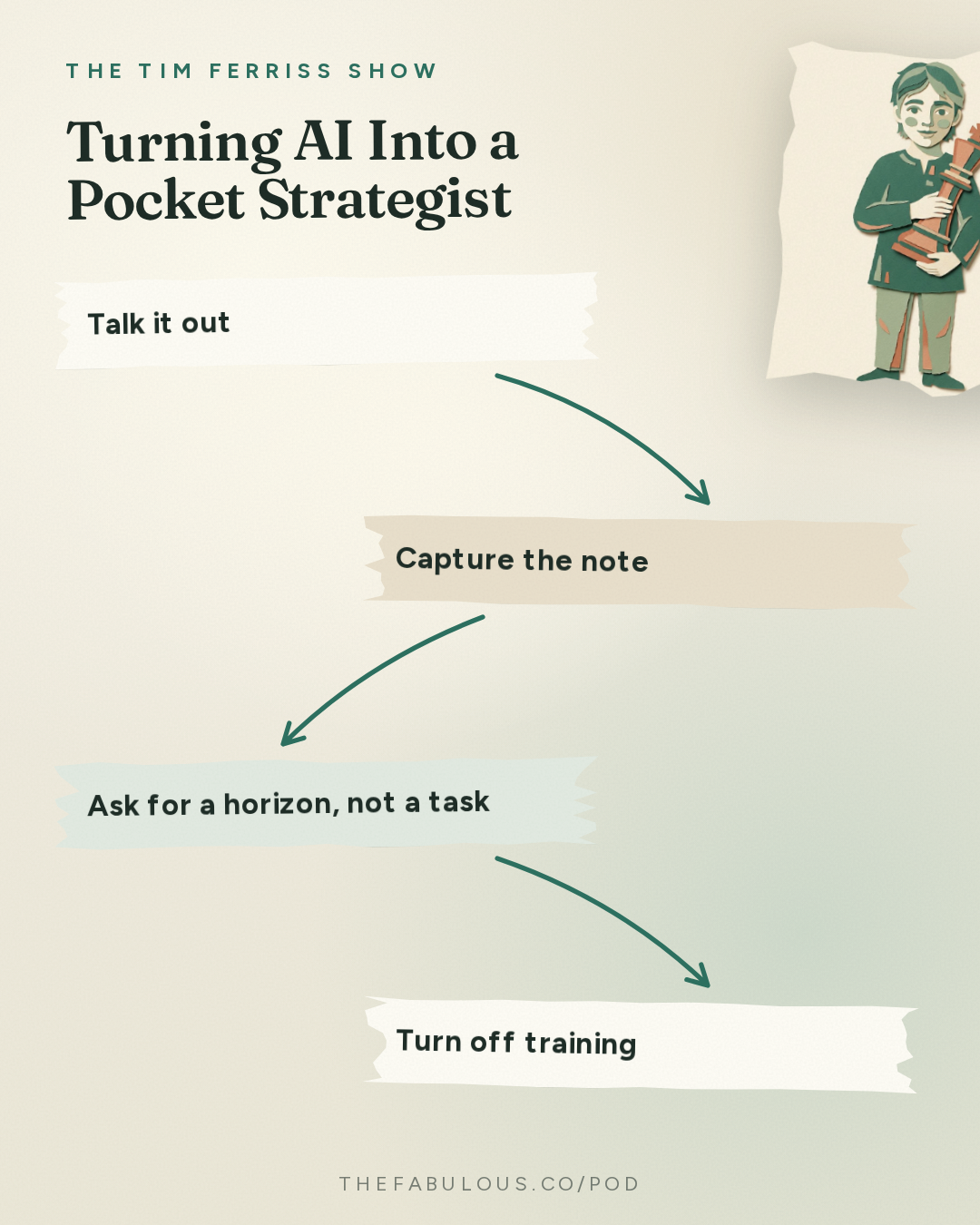
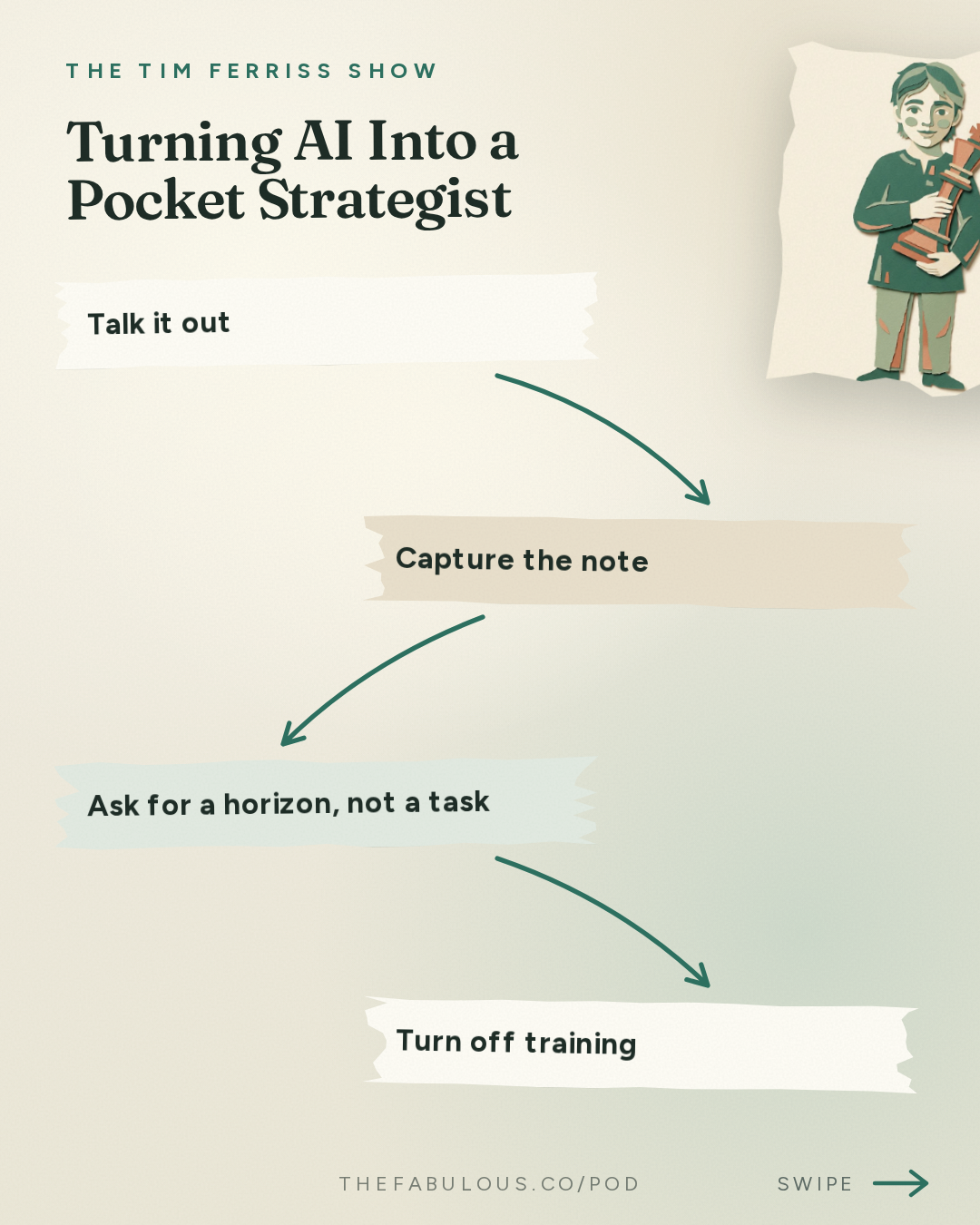
The same logic shapes how Ferriss uses AI himself. Most people treat large language models like a faster search engine: ask a question, get a fact. He treats a model like an advisor who has read everyone else's homework too. His method: open a dictation tool such as Whisperflow, go for a walk, and talk for about ten minutes about what is worrying, what the constraints are, what might come next, pausing every two minutes so the transcription can keep up (08:26). Save that as a note, paste it into ChatGPT or Claude, then ask what to aim for three to five years out (08:44).
"It is a strategist in your pocket," he says, "just like Waymo is the most experienced driver in the world," a reference to the self-driving car company whose vehicles have logged more driving data than any individual human could (10:13). OpenAI's user base is nearing a billion people, he notes, so the model has absorbed patterns from an enormous range of careers and decisions (10:13). One caveat: uncheck the box that lets the service train on personal data before sharing anything sensitive (09:54).
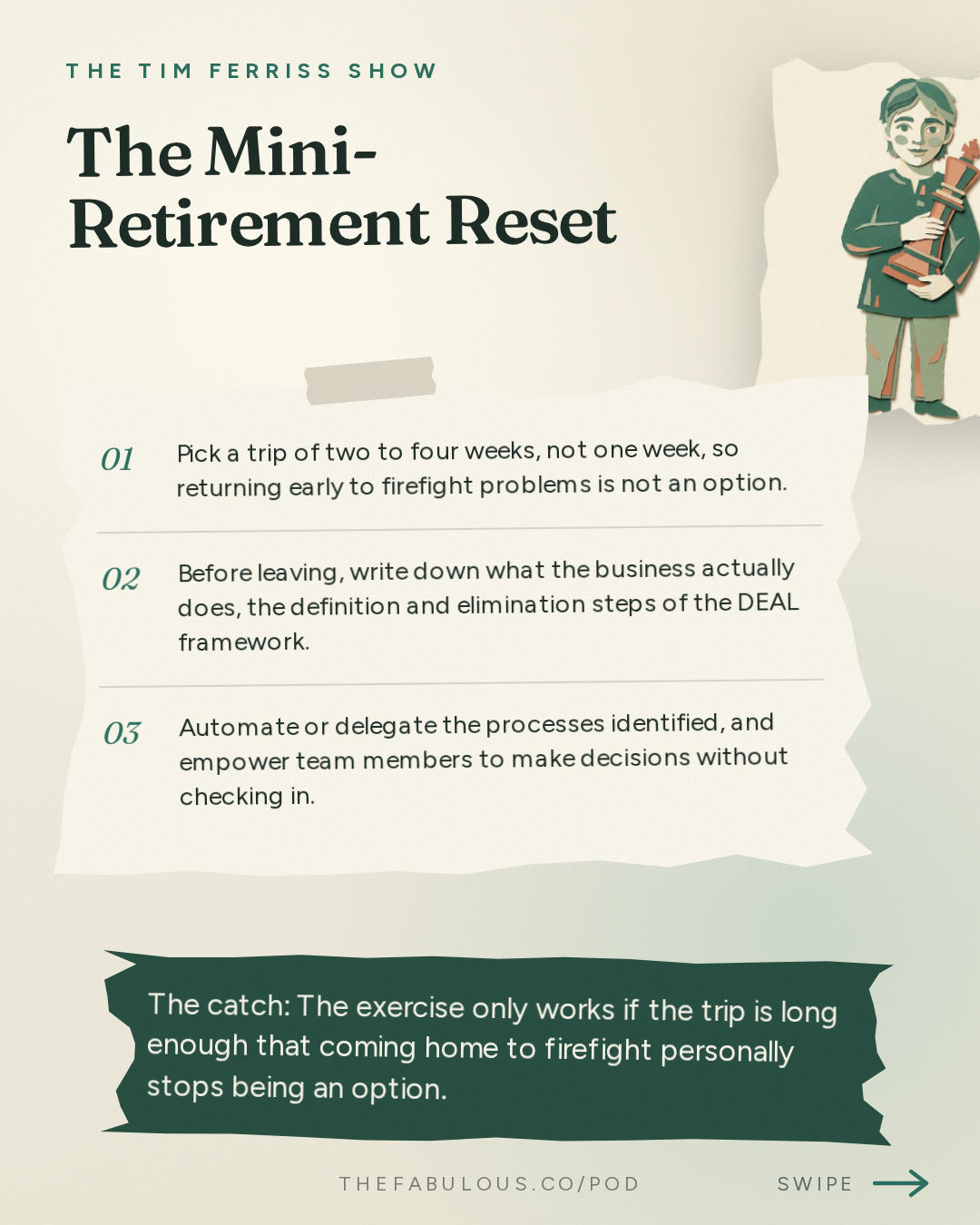
A listener named Jeremy Ruff, a broker at Garrett Realty Partners in Virginia Beach on pace for 50 deals this year and 80 next year, asked what to cut first before a planned trip to Alaska with his father (10:35). Ferriss answered with the trip itself: book it, make it two to four weeks rather than one, and treat the absence as the thing that forces change, not a reward for having already finished the work (12:02). A week lets an owner come home and personally firefight whatever broke. A month forces real delegation, because gaps in the system become visible and have to get fixed before departure, not after.
The fear underneath that decision gets its own exercise. Fear-setting, which Ferriss describes in a TED talk, is a structured writing exercise that maps worst-case outcomes in specific detail, the way goal-setting maps best-case outcomes (13:06). He pairs it with something he calls practicing poverty: living on roughly ten dollars of food for a week, an idea he credits to Wired founding editor Kevin Kelly, who does it annually in his own living room with instant coffee and beans (13:30). The point is not deprivation for its own sake. It is proof, felt in the body, that a bad month is survivable, which makes bigger professional risks, delegating, taking the trip, saying no to a demanding client, feel smaller by comparison (14:02).
Those smaller risks are what separate reckless bets from what Ferriss calls asymmetric bets: a bet where the downside is capped and the upside stays open (19:55).
"Asymmetric bet is something where you really cap the downside, but you have a lot of upside potential." (Tim Ferriss, 19:55)
Richard Branson's public image, windsurfing with a model on his back, suggests a gambler. Ferriss says the opposite is true. When Branson started Virgin Atlantic, he negotiated a deal with Boeing to lease a plane for one year, with the right to sell it back at the original cost if the airline failed (20:44). The venture that looked reckless was structured so that failure would have cost almost nothing.
The same portfolio thinking applies to the self, not just the business. Ferriss describes identity diversification: spreading self-worth across more than one role so a bad week in one area does not take down the whole sense of self (26:35). He cites Paul Graham, co-founder of startup accelerator Y Combinator, who argues that the more labels a person applies to themselves, the dumber they become, because each label is a constraint disguised as an identity (25:40). Ferriss's own hedge is rock climbing, a sport he is openly mediocre at. If a brutal week of writing threatens his sense of progress, climbing gives him a second, unrelated place to feel like he is improving (26:56). Richard Branson, he adds, credited daily exercise with adding three to four hours of usable productivity to his day (27:49).
Ferriss closes with smaller, same-night moves. Archive email older than six months and text the most frequent senders directly to ask what they still need, rather than scrolling back through a backlog (31:20). Anything that takes under two minutes gets answered immediately, anything longer gets moved onto the calendar, a system he credits to Levels CEO Sam Corcos (31:41). He also recommends an app called Freedom that blocks social media on a phone entirely, since those platforms are built to capture attention, not to serve the user's goals (30:28).
Underneath all of it sits a small piece of etymology he picked up from Oliver Burkeman's book Four Thousand Weeks: the word priority had no plural for most of its history. Something either was the priority or it was not (22:42). Ferriss suggests writing down every label a person uses for themselves, business owner, parent, spouse, and asking which one would survive if only one could remain. The answer will not hold forever, he says, but it holds for a season, and a season is long enough to make the next hard decision easier (23:18).
Ask this episode anything
Pod's AI answers from the episode itself, with the minute mark so you can hear it yourself.
Or start with one of these
Ask this episode
Pod's AI listens to the whole episode to answer, and points you to the minute it comes from.
The rest of this answer, and any question after it
Answers come from the episode itself, never from a summary of it.
ContinueKey takeaways
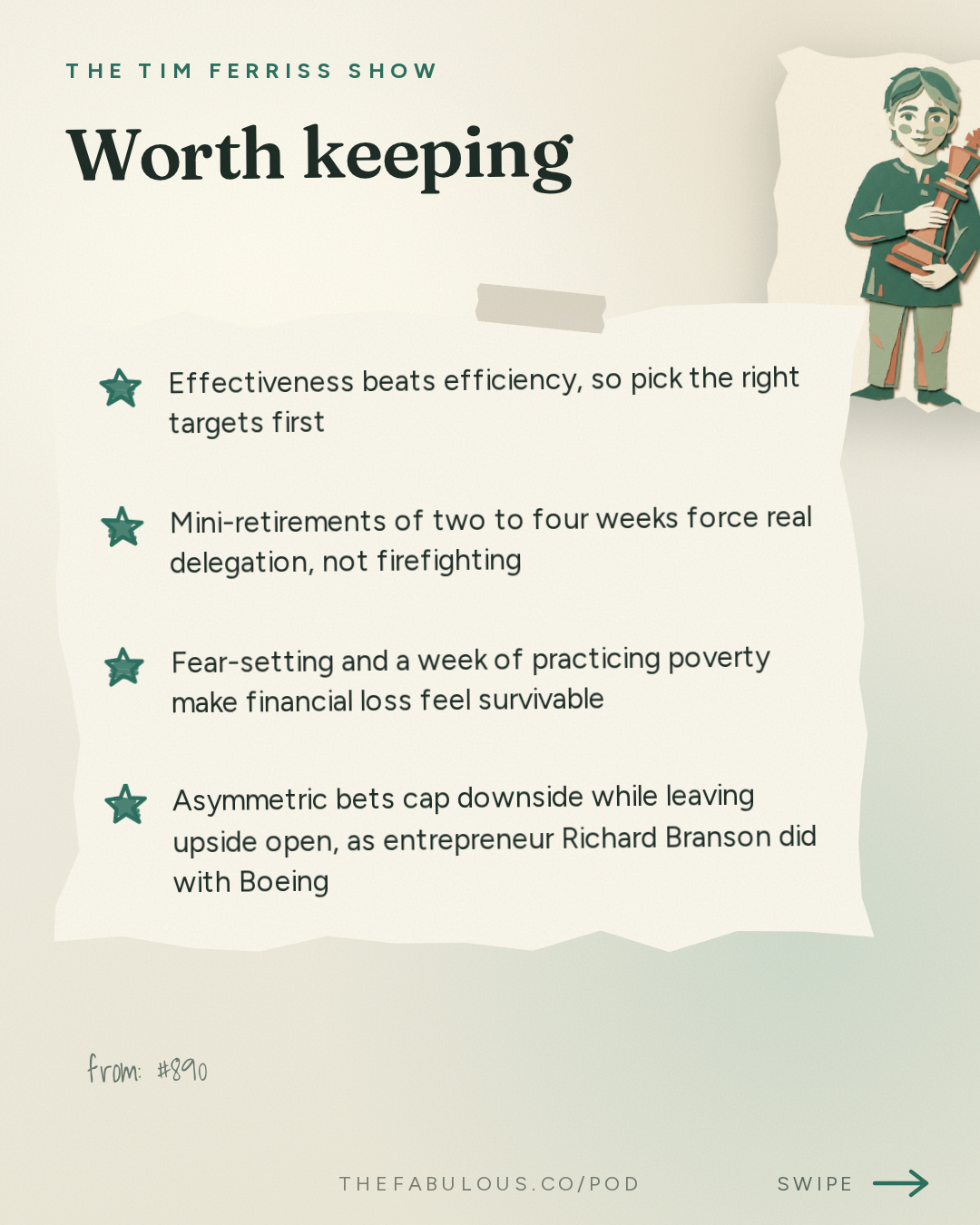
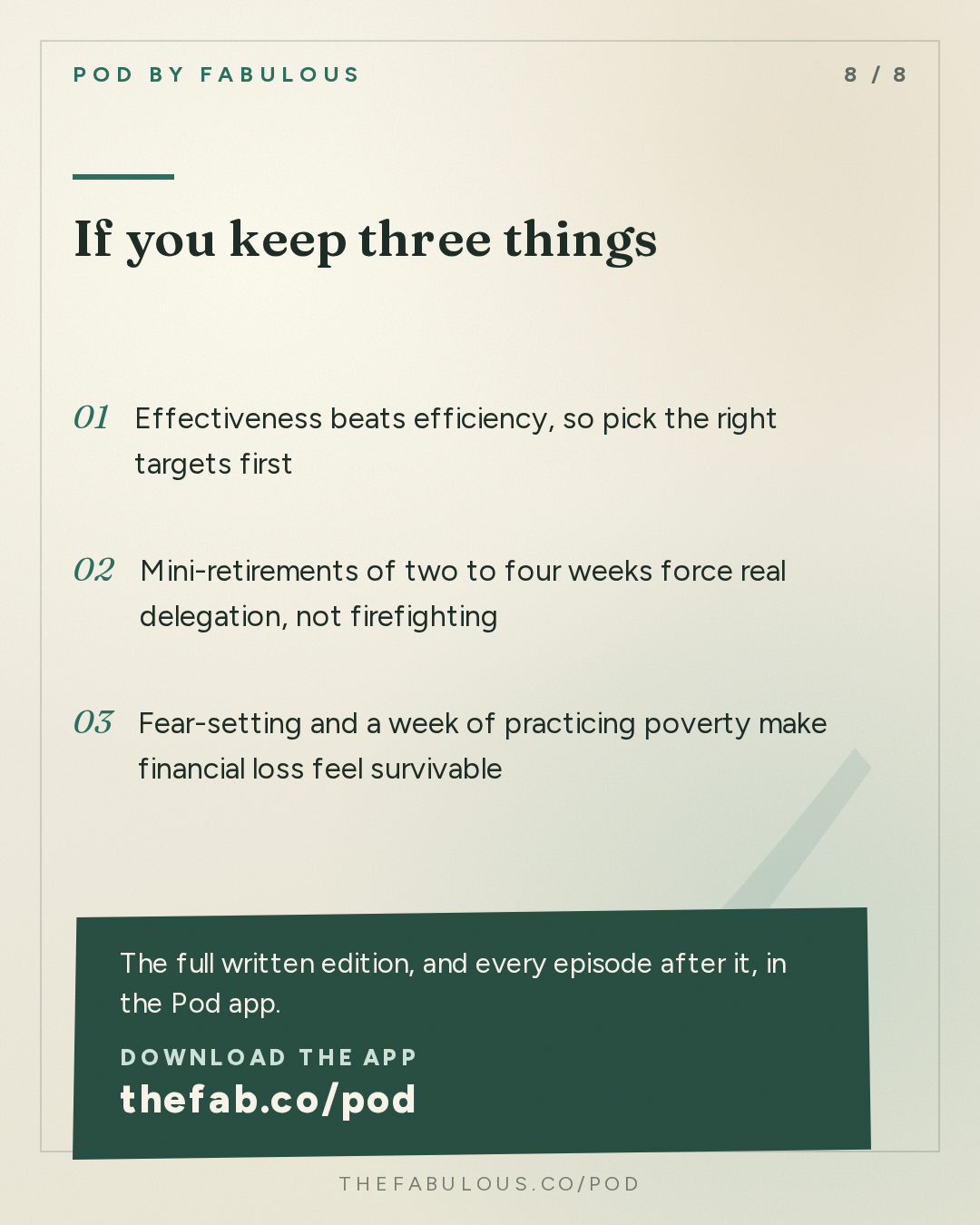
- Effectiveness beats efficiency, so pick the right targets first
- Mini-retirements of two to four weeks force real delegation, not firefighting
- Fear-setting and a week of practicing poverty make financial loss feel survivable
- Asymmetric bets cap downside while leaving upside open, as entrepreneur Richard Branson did with Boeing
- Identity diversification protects self-worth from one bad week in one role
The episode in cards
By the numbers
- $10 per week food budget for practicing poverty for a week
- 80/20 ratio share of time spent on low-yield customers versus high-yield ones
In their words
“If you have infinite optionality, you are dead in the water.”
“Doing the right things matters a lot more than doing things well.”
“What happens if you're the dog who catches the car? What then, right?”
“Asymmetric bet is something where you really cap the downside, but you have a lot of upside potential.”
“The more labels you apply to yourself, the dumber you become.”
Protocols
-
Book a real mini-retirement
Ferriss advises blocking off two to four weeks away from the business, not just one week, because a shorter trip lets the owner come home and personally firefight any problems instead of fixing the underlying systems.
Once as a forcing function, then as needed
-
Practice poverty for a week
Ferriss recommends living on about ten dollars of food for one week, the way Wired founding editor Kevin Kelly does annually, to build the felt experience that a financial dip is survivable.
Once a year
-
Use AI as a pocket strategist
Ferriss suggests dictating worries and goals aloud for about ten minutes using a tool like Whisperflow, pausing every two minutes so the transcription keeps up, then pasting the note into an LLM such as ChatGPT or Claude and asking what to focus on over the next three to five years.
As needed, when facing a decision
-
Clear the inbox onto the calendar
Ferriss recommends archiving any email older than six months, texting the most frequent senders to ask what they still need, then answering anything under two minutes immediately and moving longer tasks straight onto the calendar, a system he credits to Levels CEO Sam Corcos.
Daily or weekly upkeep
-
Block social media at the phone level
Ferriss recommends using an app called Freedom to block social media on the phone entirely and only access those platforms from a laptop, since added friction curbs a habit built around capturing attention.
Ongoing
Questions this episode answers
How does Tim Ferriss recommend using AI as a strategist?
Ferriss suggests dictating worries and goals aloud using an app like Whisperflow, pasting the transcript into an LLM such as ChatGPT or Claude, and asking what to focus on over the next three to five years (08:26). He compares the output to advice from a strategist trained on patterns from close to a billion other users (10:13).
What is the DEAL framework from The 4-Hour Workweek?
DEAL stands for Definition, Elimination, Automation, and Liberation (03:02). Ferriss says the first step is an 80/20 analysis of customers to find which ones consume the most time for the least return (03:26).
What is fear-setting?
Fear-setting is a writing exercise Tim Ferriss developed and covered in a TED talk, which maps worst-case scenarios in specific detail to remove the emotional brake on hard decisions, the way goal-setting maps best-case outcomes (13:06).
What is an asymmetric bet?
An asymmetric bet caps the downside of a decision while leaving the upside open. Ferriss cites Richard Branson's negotiation with Boeing for Virgin Atlantic's first leased plane, structured with a one-year term and the right to sell it back at cost (19:55, 20:44).
Why does Tim Ferriss recommend identity diversification?
Ferriss argues that concentrating self-worth in one role, such as business owner, is psychologically risky because a bad week in that single area can crash overall well-being (26:35). He suggests adding unrelated pursuits, like rock climbing, as separate sources of progress (26:56).
The full read, in cards
Go deeper
- The Effective Executive — Peter Drucker's book distinguishing efficiency, doing things right, from effectiveness, doing the right things
- Losing My Virginity — Richard Branson's memoir describing how he structured Virgin Atlantic's launch to cap downside risk
- Four Thousand Weeks — Oliver Burkeman's book noting the word priority had no plural for most of its history
- Awareness — Anthony de Mello's book on recognizing the beliefs that govern behavior, which Ferriss says he has reread about 50 times
Mentioned
Zahara Washington · Peter Drucker · Whisperflow · Jeremy Ruff · Richard Branson · Losing My Virginity · Four Thousand Weeks · Oliver Burkeman · Awareness · Anthony de Mello · Paul Graham · Sam Corcos · Freedom · The Effective Executive · Kevin Kelly
More from this show and category
Tim Ferriss's Alzheimer's Prevention Protocol
Tim Ferriss answers a grab-bag of listener questions on preventing Alzheimer's decades early, using fear-setting to break stuck patterns, treating optimism as a daily practice, and why he trusts well-studied drugs over unregulated supplements for serious risk. He also explains how meditation reshaped his posture and why he still treats psychedelics with real caution.
Why Is the Number Eight Lucky in Asia?
Tim Ferriss explains why the number eight, which sounds like the Mandarin word for prosperity, became East Asia's luckiest digit. He traces how that belief shaped skyscraper floor counts, casino design, license plate auctions, and Toyota's name, while four, linked to the word for death, disappears from elevators across China, Japan, and Korea.
4-Hour Workweek Meets AI: Tim Ferriss Q&A
Tim Ferriss says AI multiplies whatever work you feed it, so without defining and eliminating tasks first, it manufactures busywork instead of leisure (04:16). The episode also covers rebuilding self-trust through small daily actions, Oryx software for near vision, a critique of John Sarno's psychosomatic back pain theory, and why the slow-carb diet and 16-hour fasting still work after 40.
How to Simplify Your Life: 5 Expert Tips
Five longtime guests explain how to cut overwhelm: release the identity you've outgrown, question what you only value because you own it, write down every open task before sorting it, and decline requests without an excuse. Oliver Burkeman adds that real simplicity is an attitude, not a new system.
