
Pete Carroll's 1-7 Competitor Scale Explained
we need to talk about Jensen
The brief
Nvidia's Jensen Huang was ousted over an alleged affair and spy rumor, then reinstated as the stock jumped 32% in a day. The hosts use the episode to unpack Pete Carroll's 1-7 competitor scale, Sam Altman's deliberate gap year, and the Profit First method for funding a dream before spending on everything else.
There is a small, odd piece of software on one host's laptop: a floating emoji that tells him, before he reads any news, whether it is a good day or a bad day in the market. Crying Jordan means stay away. Smirking Obama means things are fine. Vince McMahon's screaming face means something big just happened. One morning he saw Vince McMahon before he saw the headline. Nvidia was up 32 percent in a single day (01:32), because its chief executive, Jensen Huang, had just been reinstated after a chaotic few weeks in which the board had pushed him out.
The official story, as the hosts reconstruct it, had three competing threads. Huang's stock had fallen 30 to 40 percent in the month before his return (07:56), partly on fear that he would be forced out. The case against him stacked up fast: he'd had a relationship with a direct report, Alice Wang, a breach of the company's code of conduct but not automatically a fireable offense on its own. Then came the harder question, the one that actually mattered to the board: was she, knowingly or not, connected to interests that wanted Nvidia's chip technology flowing toward China. The Wall Street Journal reported that Wang's husband, Kang Wang, had built a data center business with state backing, and had bragged to friends in group chats about his wife's closeness to Nvidia's chief, using the word "assistant" in a way that suggested everyone understood what it really meant (11:05). None of this was proven in a courtroom. It didn't need to be. The board moved in days, not months, because, as one host puts it, they wanted to cover themselves before congressional hearings and a lack of insurance exposure made the decision for them anyway.
What makes the story interesting isn't the scandal. It's the reason Huang got his job back so fast. One host calls it Jenga theory: in most companies you could remove a dozen people and the tower stays up. A few people are load-bearing. Pull them and everything collapses. Huang, they argue, is one of maybe three or four people in corporate America whose exit visibly moves a nation's retirement accounts. That is a strange kind of power for someone who never ran for anything, and it's new. A generation ago, ordinary people could name two Fortune 100 CEOs, maybe Bill Gates and Warren Buffett, and both were abstractions more than people. Now tech executives have followings, haters, and gossip cycles the way senators and actors used to, which means their personal lives are no longer treated as separate from their professional authority.
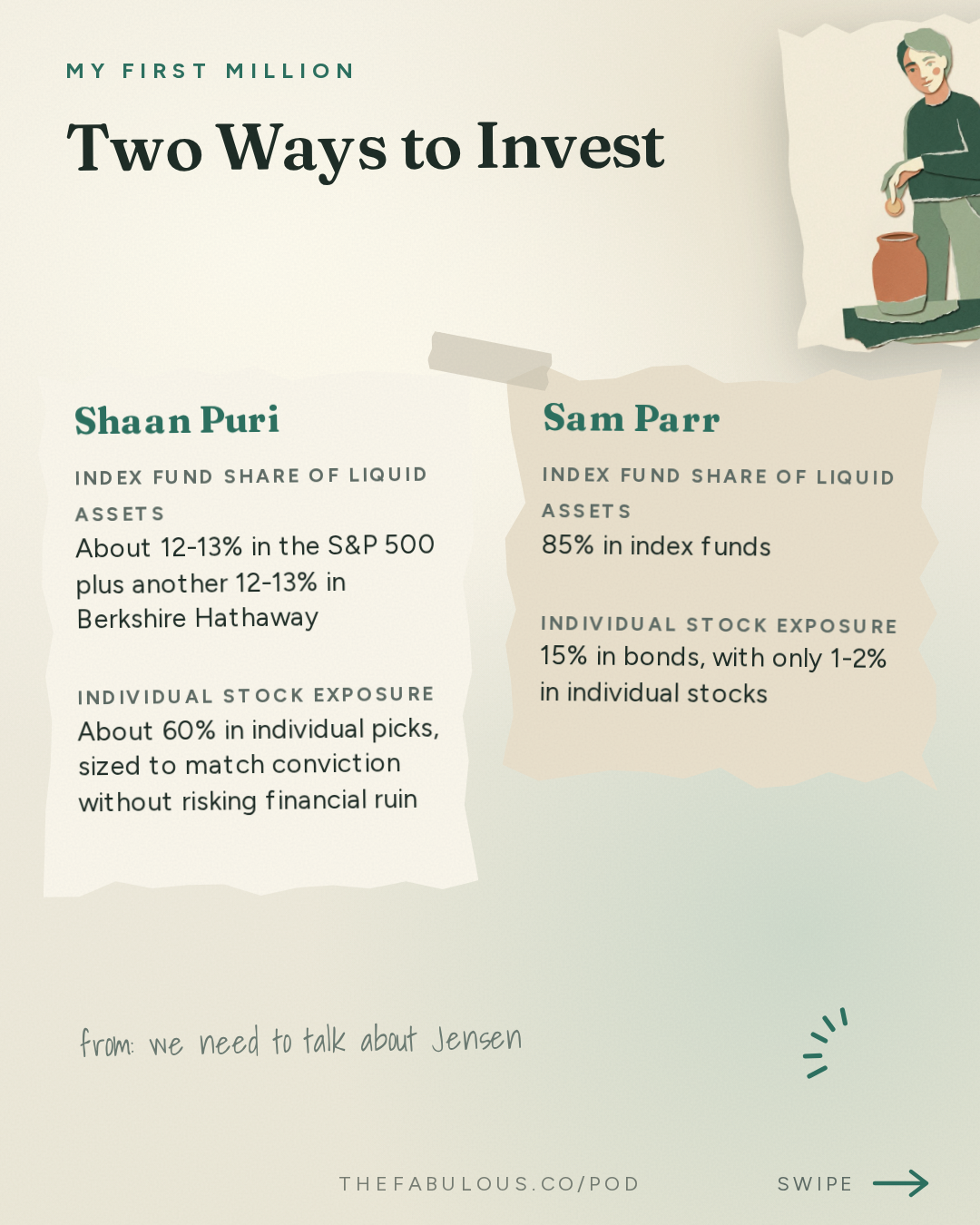
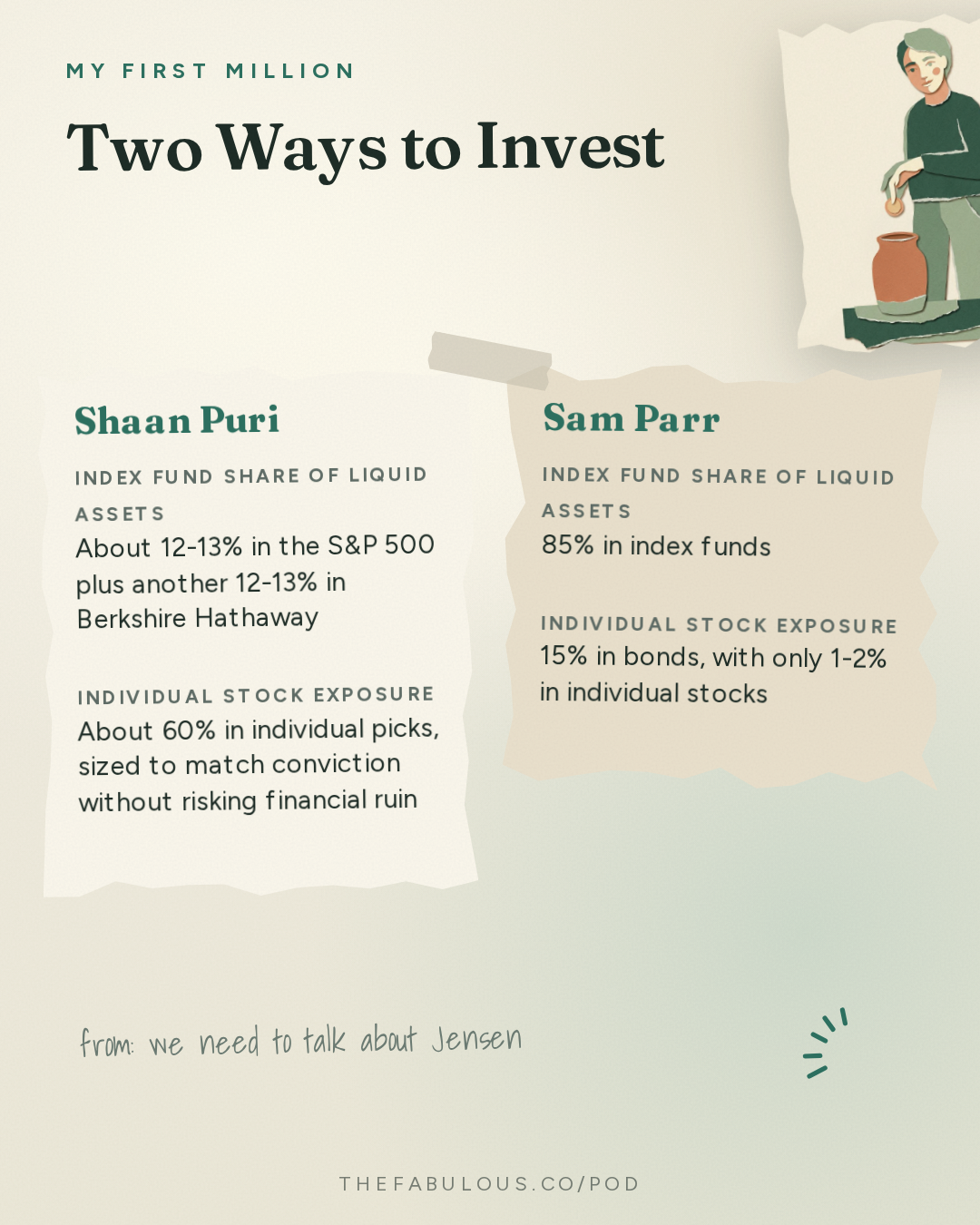
From the market, the conversation turns inward, toward how each host actually invests, and the split is clean. One of them keeps roughly 12 to 13 percent of his liquid assets in the S&P 500 and another 12 to 13 percent in Berkshire Hathaway, with about 60 percent in individual names he has strong conviction in: Amazon, SpaceX, Tesla, Meta, Eli Lilly (16:06). His logic is to size each bet to his conviction, but never so large that being wrong would wreck his life. The other host, Sam Parr, runs the opposite playbook: 85 percent index funds, 15 percent bonds, with a sliver in Oscar Health and Coinbase, bought mostly because he liked the founders (18:37). Both approaches are defensible. The difference is really a bet on how much confidence someone has in their own judgment versus the market's aggregate judgment, and neither host pretends the other is wrong.
A Scale for Ambition
The episode's real center of gravity, though, is a quote one host reads from Seattle Seahawks coach Pete Carroll, who also wrote the foreword to the book The Inner Game of Tennis. Carroll describes a scouting tool his staff uses to rate a player's competitive nature from one to seven. A three or four is a serious competitor, but one who's chasing external rewards, money, status, the approval of being seen as great. A five or six is internally driven, someone who runs their own world and barely needs coaching. A seven is rarer still: someone who has everything in order and is compelled to take other people with them to what Carroll calls the Promised Land (24:22).
I do mean in seriousness that I'm not trying to become a seven because there's a huge cost. (Shaan Puri) [29:41]
Both hosts admit, almost immediately, that they land around a four. One jokes that being externally driven, needing the clap, wanting the fame, chasing the money, describes basically everyone making a podcast. But the more useful part of the conversation is what follows the confession: whether moving up the scale is even worth it. The cost of becoming a six or seven, one host argues, isn't abstract. It's measured in days not spent making snowmen with his kids in Lake Tahoe, days not spent chasing the next deal. He'd rather be a four and a half who is happy than a seven who has traded away the rest of his life to get there. There are other ways to win inside a four's life too: invest in or hire people who are naturally sixes and sevens, and let some of that intensity rub off by proximity.
Did you wanna climb the mountain to see the world or for the world to see you? (Sam Parr) [25:40]
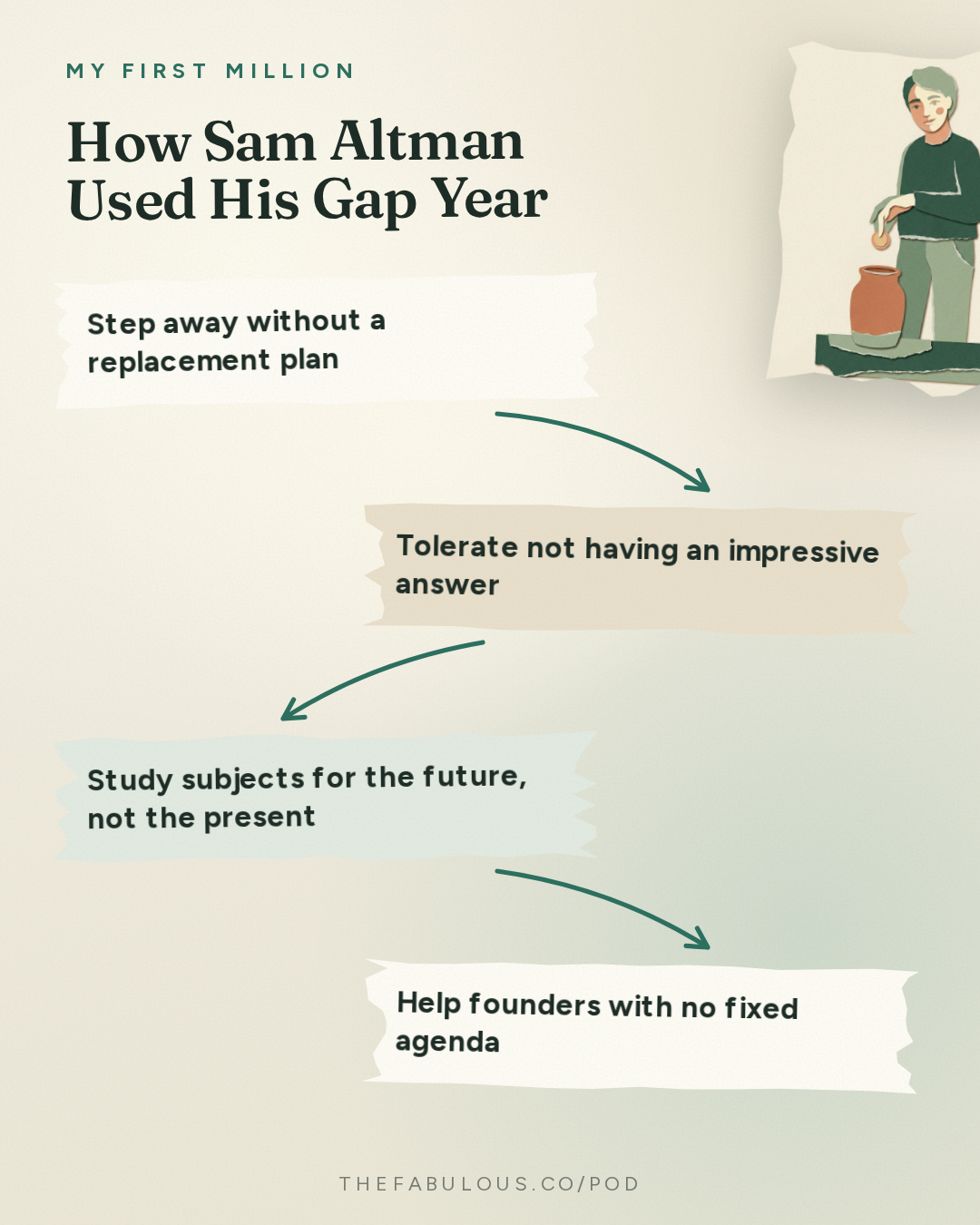
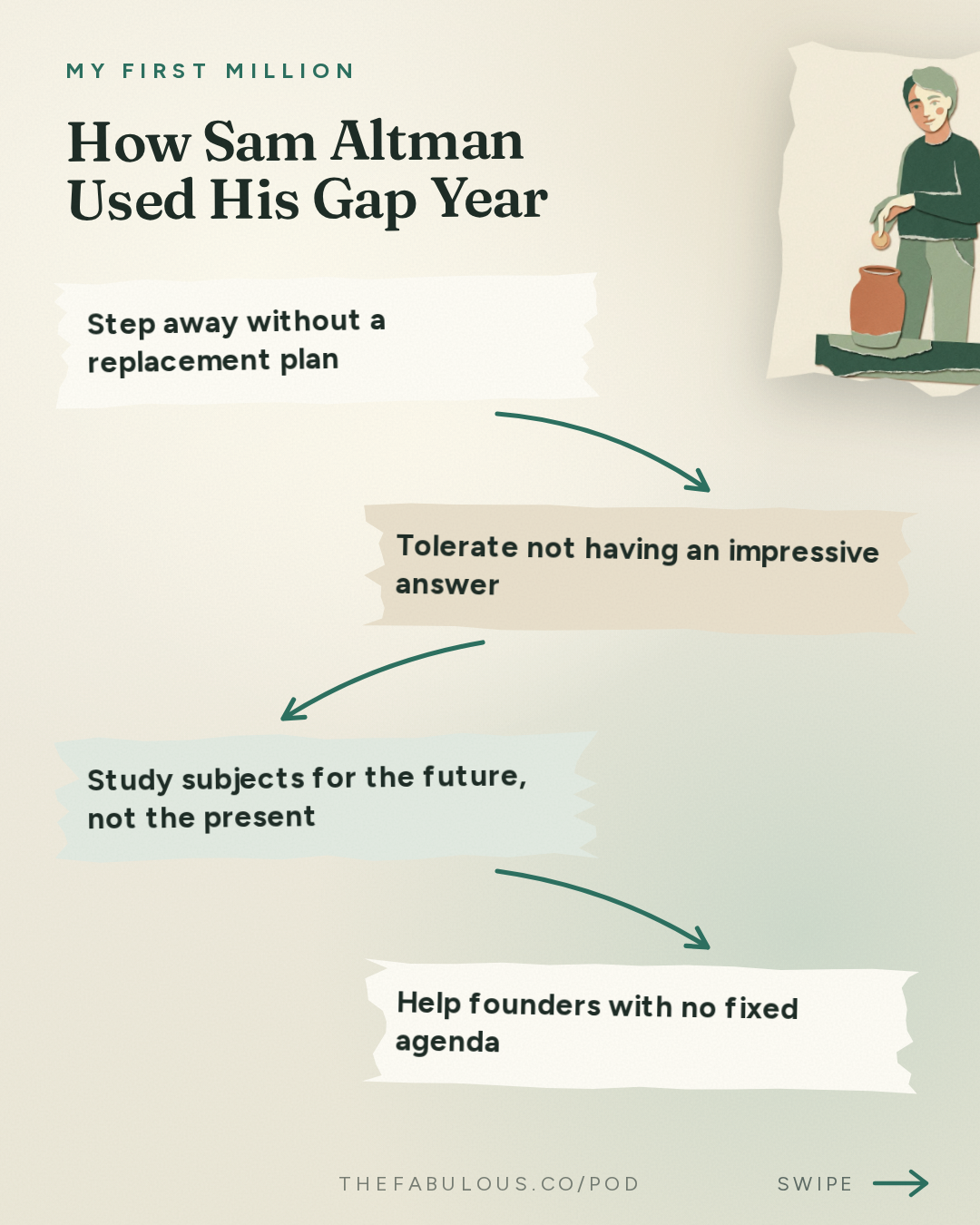
That question sits underneath the next stretch of the episode, which turns to Sam Altman, the OpenAI chief executive, and the gap year he took in his mid-20s after selling his first company for 30 to 40 million dollars (36:37). Altman has said publicly that the year off was one of the best decisions of his career, even though it meant tolerating long stretches of time without an impressive answer to give at Silicon Valley parties. He read textbooks on biology and nuclear engineering, traveled, caught up with friends, and helped founders with no particular agenda, which eventually turned into some of his best investments, including stakes in Stripe and Airbnb (37:52). The hosts frame this less as a lucky accident and more as deliberate project selection: someone who is constantly busy rarely stops to ask whether the next thing they're jumping into is actually the right thing, or just the nearest thing.
Paying the Dream First
The last act of the episode turns that idea into something almost anyone can use without selling a company first. One host tells the story of a man in Inglewood, California, who saved 100,000 dollars to open a comic book shop by treating his own savings like a bill he couldn't skip.
Every month, I'm making a car payment, but the car is my dream. (Shaan Puri) [46:35]
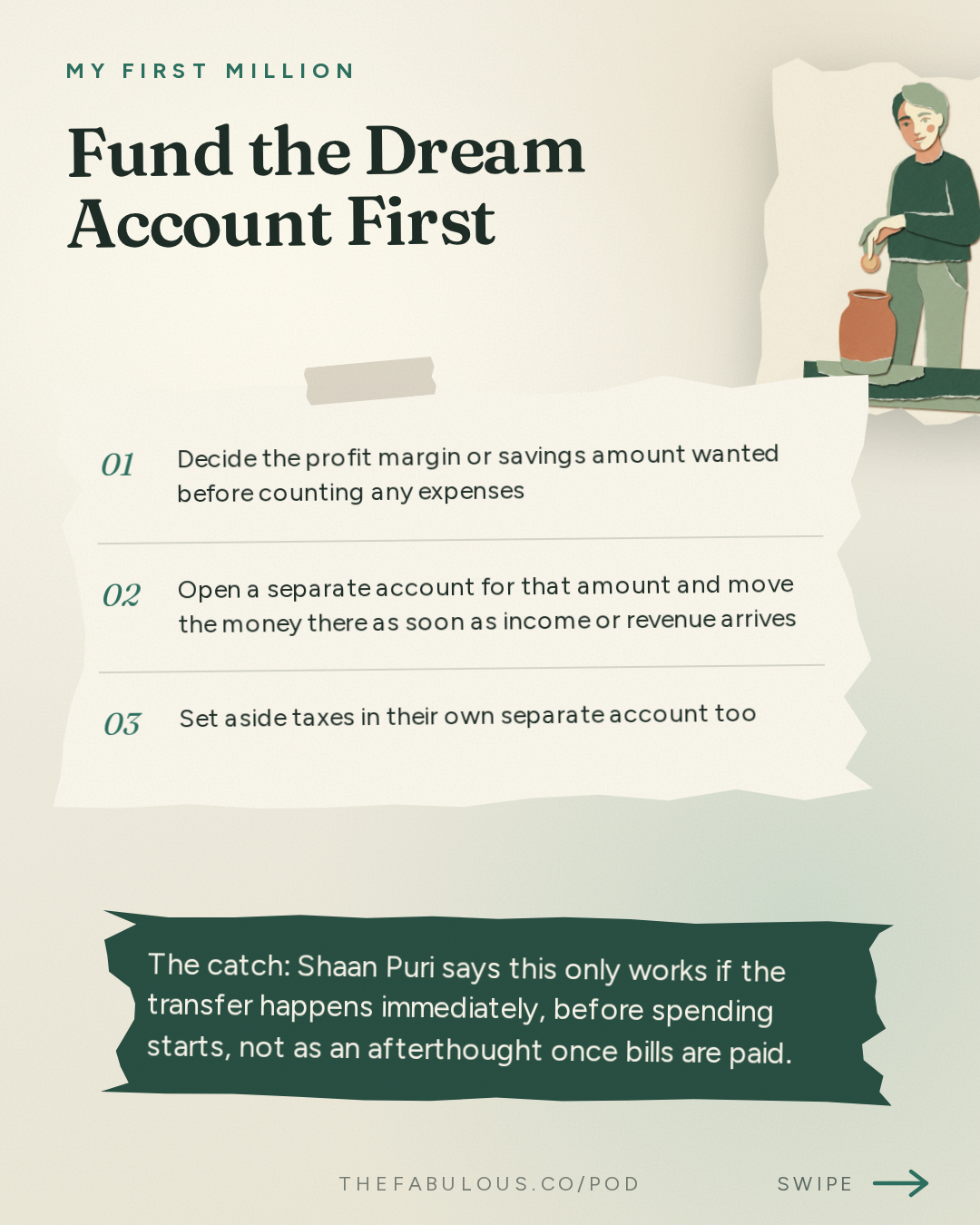
He didn't actually have a car loan. He simply paid 1,500 dollars a month into a separate account, the exact amount his old car payment used to be, for two or three years, until he had enough to open the store (46:08). That is, in miniature, the idea behind the book Profit First, which one host credits to a recommendation from entrepreneur Andrew Wilkinson: instead of treating profit as whatever happens to be left after expenses, a business, or a person, decides the profit margin up front, moves that money into a separate account the moment revenue arrives, and lets expenses shrink to fit whatever remains (48:36). It inverts the usual order of operations, and the hosts argue the inversion is the entire point. When spending is capped by what's left over, the brain finds ways to cut the extra subscription, skip the delivery app, share a car. The constraint does the budgeting work that willpower usually fails at.
None of this requires selling a company for tens of millions or holding 60 percent of a portfolio in Nvidia, Tesla, and SpaceX. It mostly requires honesty about the math. Most people who say a gap year or a savings goal is impossible for them, one host argues, have never actually sat down and multiplied their monthly expenses by the number of months they'd need. Resourcefulness, not intelligence, is the trait that separates the people who make the leap from the people who stay on the scale's lower rungs, wishing they were higher up.
Ask this episode anything
Pod's AI answers from the episode itself, with the minute mark so you can hear it yourself.
Or start with one of these
Ask this episode
Pod's AI listens to the whole episode to answer, and points you to the minute it comes from.
The rest of this answer, and any question after it
Answers come from the episode itself, never from a summary of it.
ContinueKey takeaways
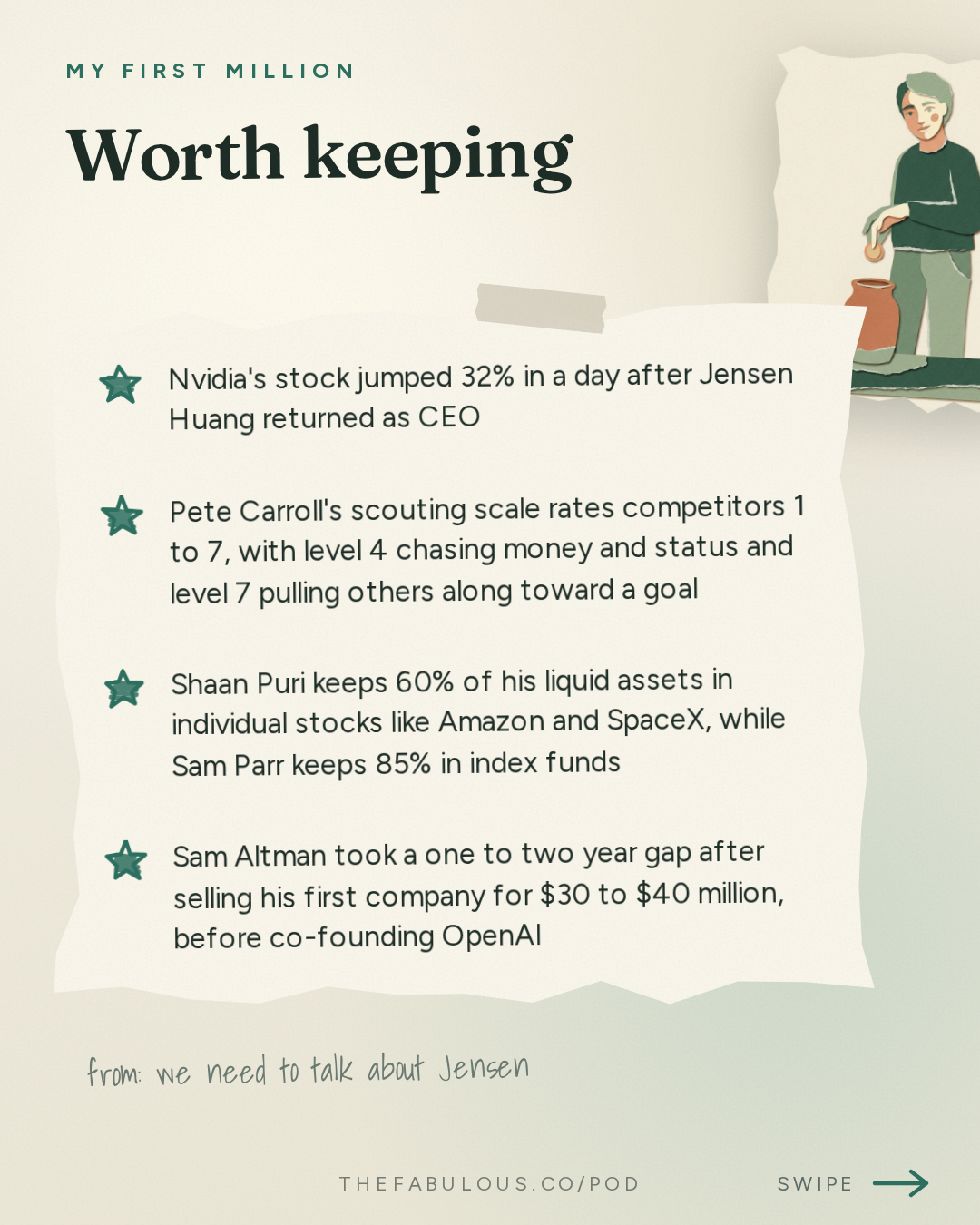
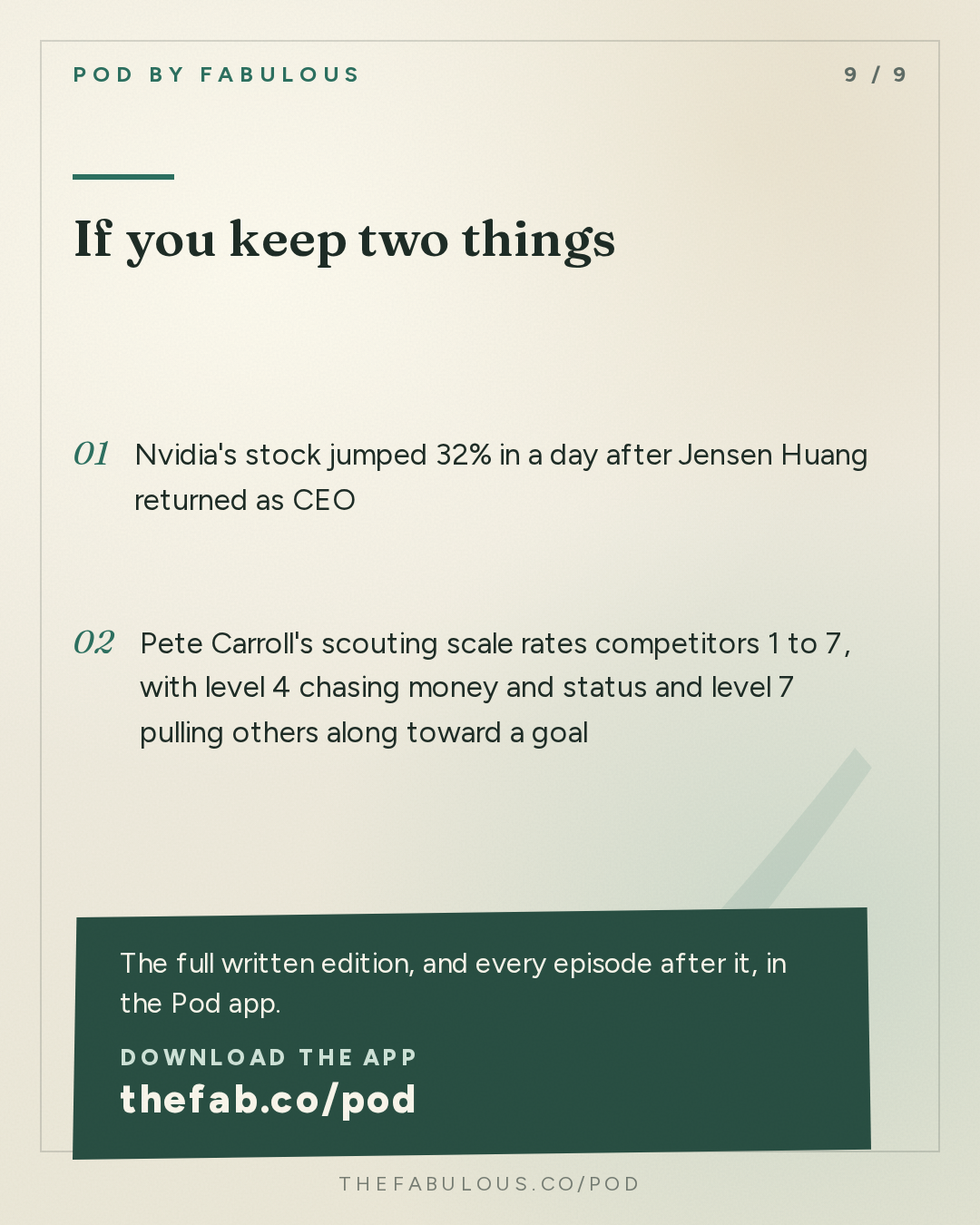
- Nvidia's stock jumped 32% in a day after Jensen Huang returned as CEO
- Pete Carroll's scouting scale rates competitors 1 to 7, with level 4 chasing money and status and level 7 pulling others along toward a goal
- Shaan Puri keeps 60% of his liquid assets in individual stocks like Amazon and SpaceX, while Sam Parr keeps 85% in index funds
- Sam Altman took a one to two year gap after selling his first company for $30 to $40 million, before co-founding OpenAI
- The Profit First method has a person set aside savings or profit before spending, instead of saving whatever happens to be left over
The episode in cards


By the numbers
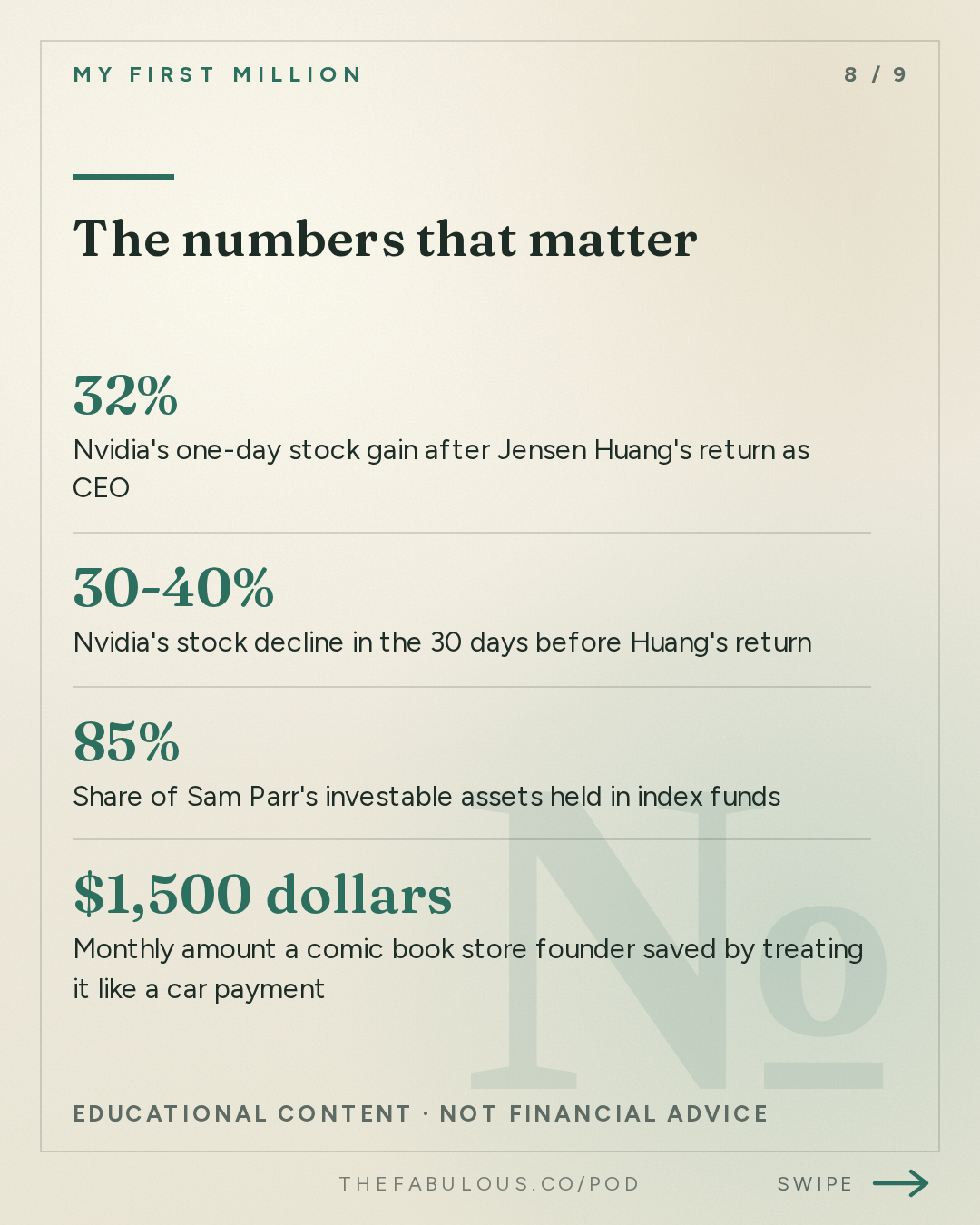
- 32% percent Nvidia's one-day stock gain after Jensen Huang's return as CEO
- 30-40% percent Nvidia's stock decline in the 30 days before Huang's return
- 85% percent Share of Sam Parr's investable assets held in index funds
- $1,500 dollars Monthly amount a comic book store founder saved by treating it like a car payment
In their words
“You have the urge, the male urge to take action, and that's actually, like, pretty counterproductive for my investing.”
“I do mean in seriousness that I'm not trying to become a seven because there's a huge cost.”
“The mark of an entrepreneur is not intelligence. It's resourcefulness. It's the ability to acquire the resources needed.”
“Did you wanna climb the mountain to see the world or for the world to see you?”
“Every month, I'm making a car payment, but the car is my dream.”
Protocols
-
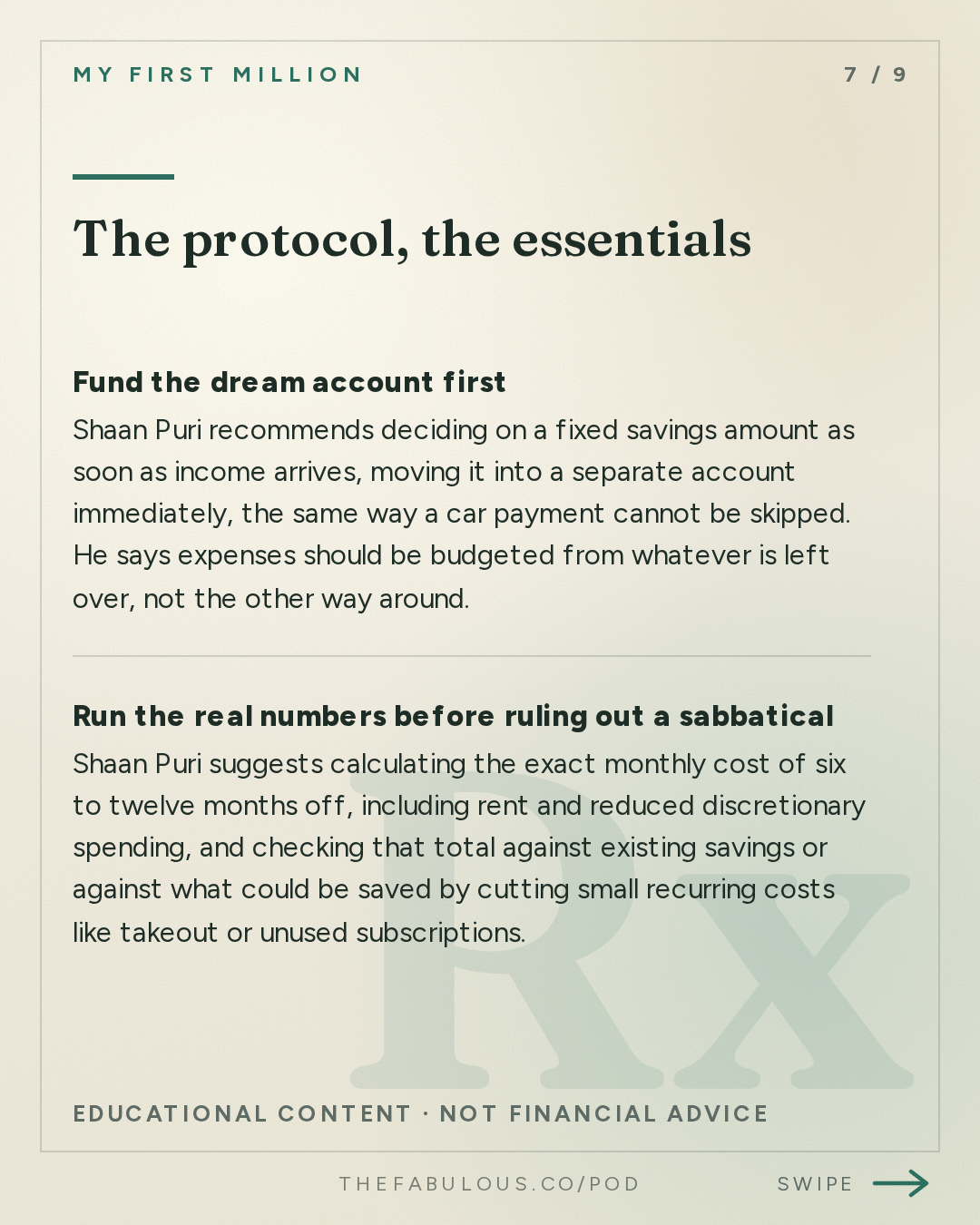
Fund the dream account first
Shaan Puri recommends deciding on a fixed savings amount as soon as income arrives, moving it into a separate account immediately, the same way a car payment cannot be skipped. He says expenses should be budgeted from whatever is left over, not the other way around.
Every paycheck or every month
-
Run the real numbers before ruling out a sabbatical
Shaan Puri suggests calculating the exact monthly cost of six to twelve months off, including rent and reduced discretionary spending, and checking that total against existing savings or against what could be saved by cutting small recurring costs like takeout or unused subscriptions.
One-time calculation before taking time off
-
Split revenue into separate accounts immediately
Shaan Puri describes the Profit First method: a business or person divides incoming revenue into separate profit, tax, and operating-expense accounts the moment it arrives, then lets the operating budget shrink to fit whatever remains instead of treating profit as a leftover.
Every time revenue comes in
Questions this episode answers
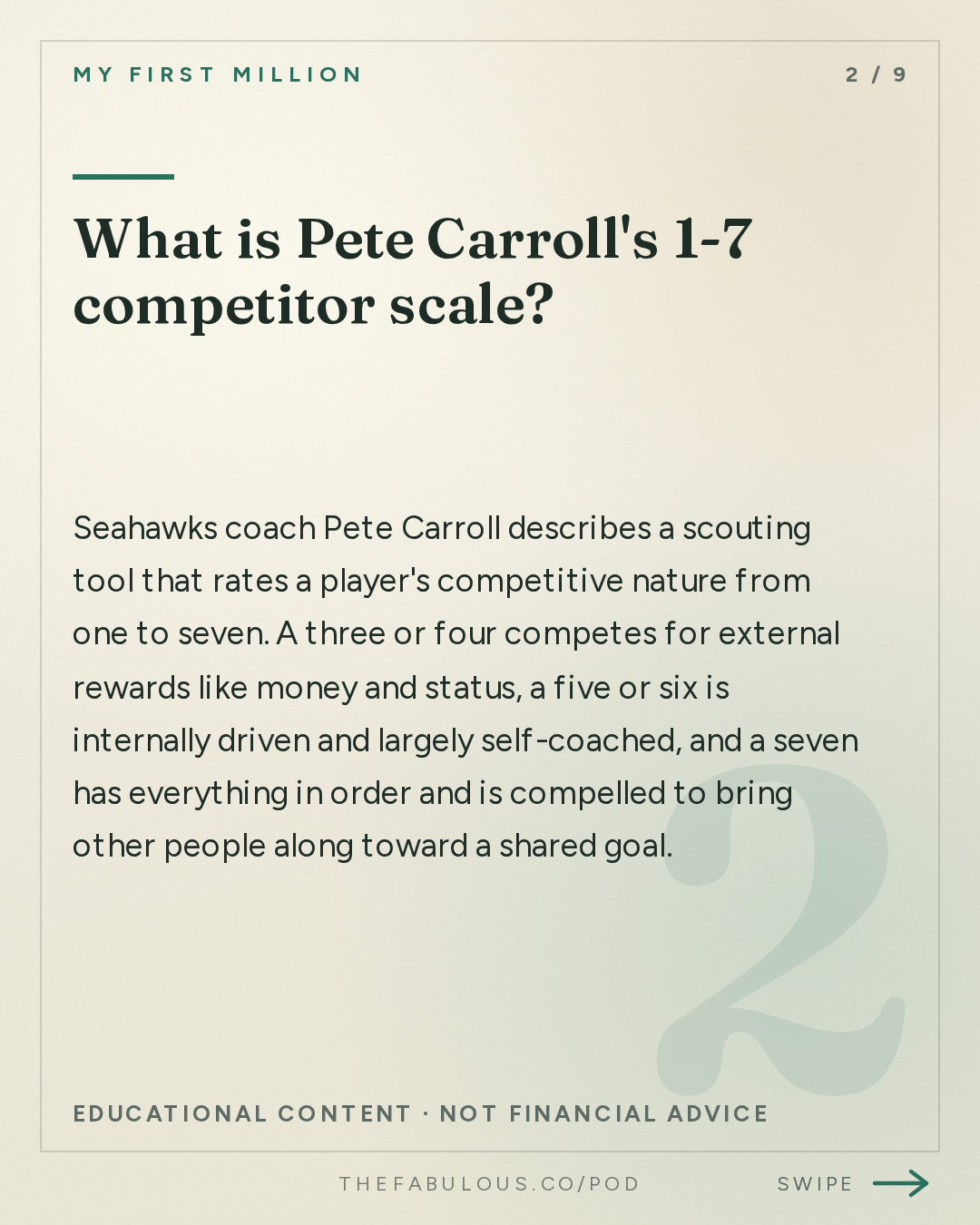
What is Pete Carroll's 1-7 competitor scale?
Seahawks coach Pete Carroll describes a scouting tool that rates a player's competitive nature from one to seven. A three or four competes for external rewards like money and status, a five or six is internally driven and largely self-coached, and a seven has everything in order and is compelled to bring other people along toward a shared goal (23:24, 24:22).
Why was Nvidia CEO Jensen Huang pushed out and then reinstated?
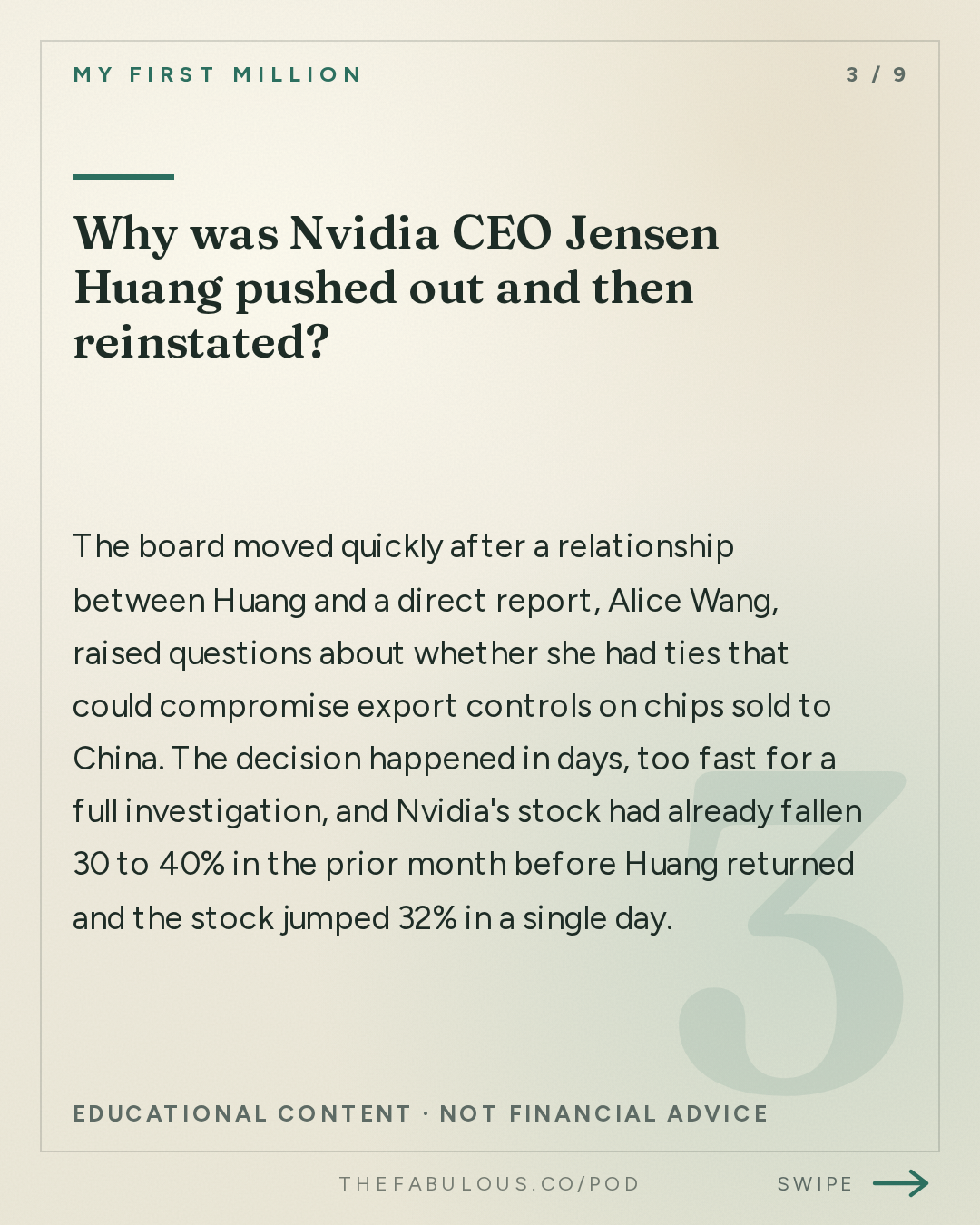
The board moved quickly after a relationship between Huang and a direct report, Alice Wang, raised questions about whether she had ties that could compromise export controls on chips sold to China. The decision happened in days, too fast for a full investigation, and Nvidia's stock had already fallen 30 to 40% in the prior month before Huang returned and the stock jumped 32% in a single day (07:56, 01:32).
Who is Alice Wang and why is she called a spy?
The Wall Street Journal reported that Alice Wang's husband, Kang Wang, built a data center business backed by the Chinese state while she was romantically involved with Nvidia's chief executive. Reported screenshots show Kang Wang bragging to friends about her closeness to the CEO using the word assistant, which fueled speculation, though it remains an allegation rather than a proven fact (11:05).
How much money did Sam Altman make from his first company?
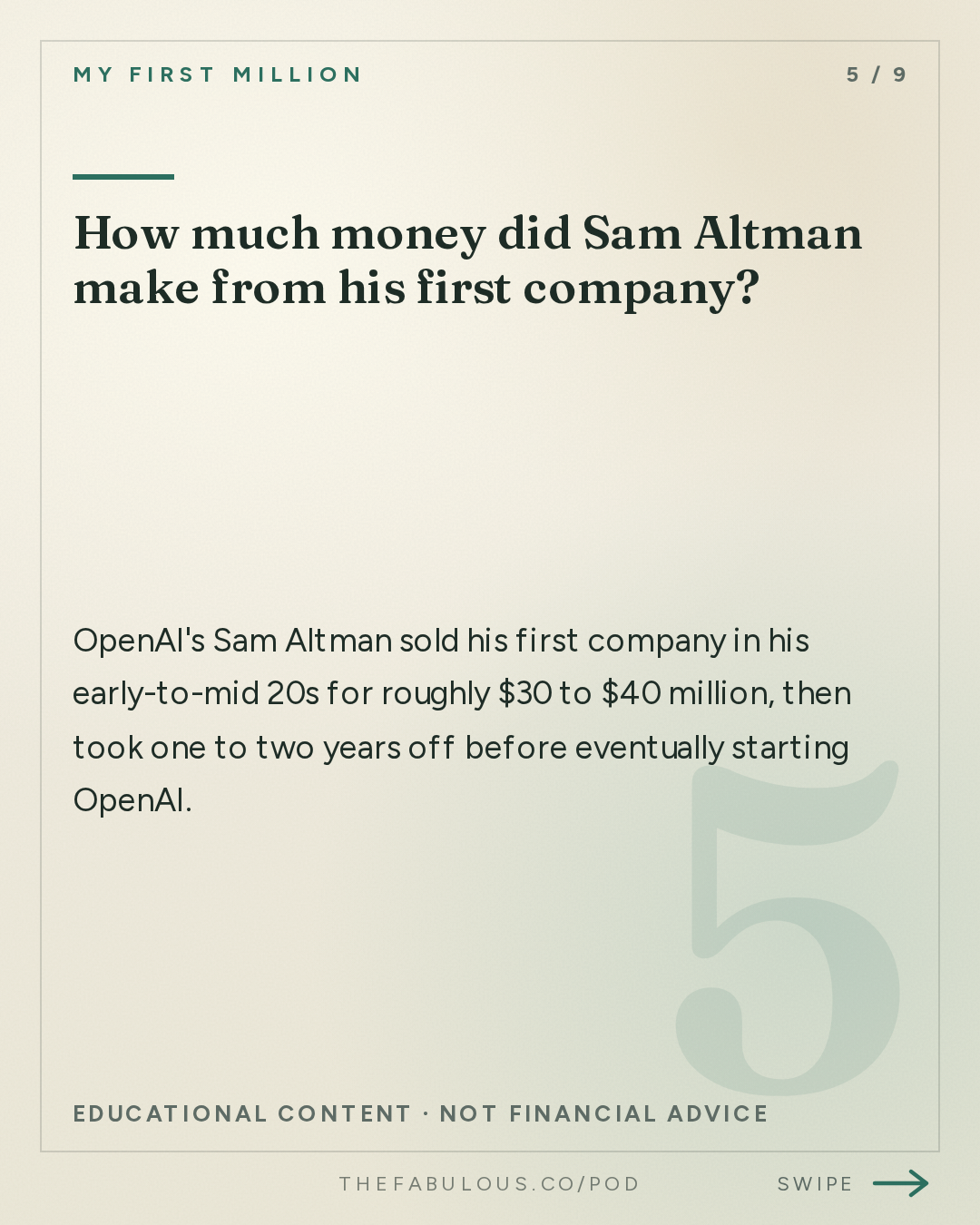
OpenAI's Sam Altman sold his first company in his early-to-mid 20s for roughly $30 to $40 million, then took one to two years off before eventually starting OpenAI (36:37).
What is the Profit First method for personal finance?
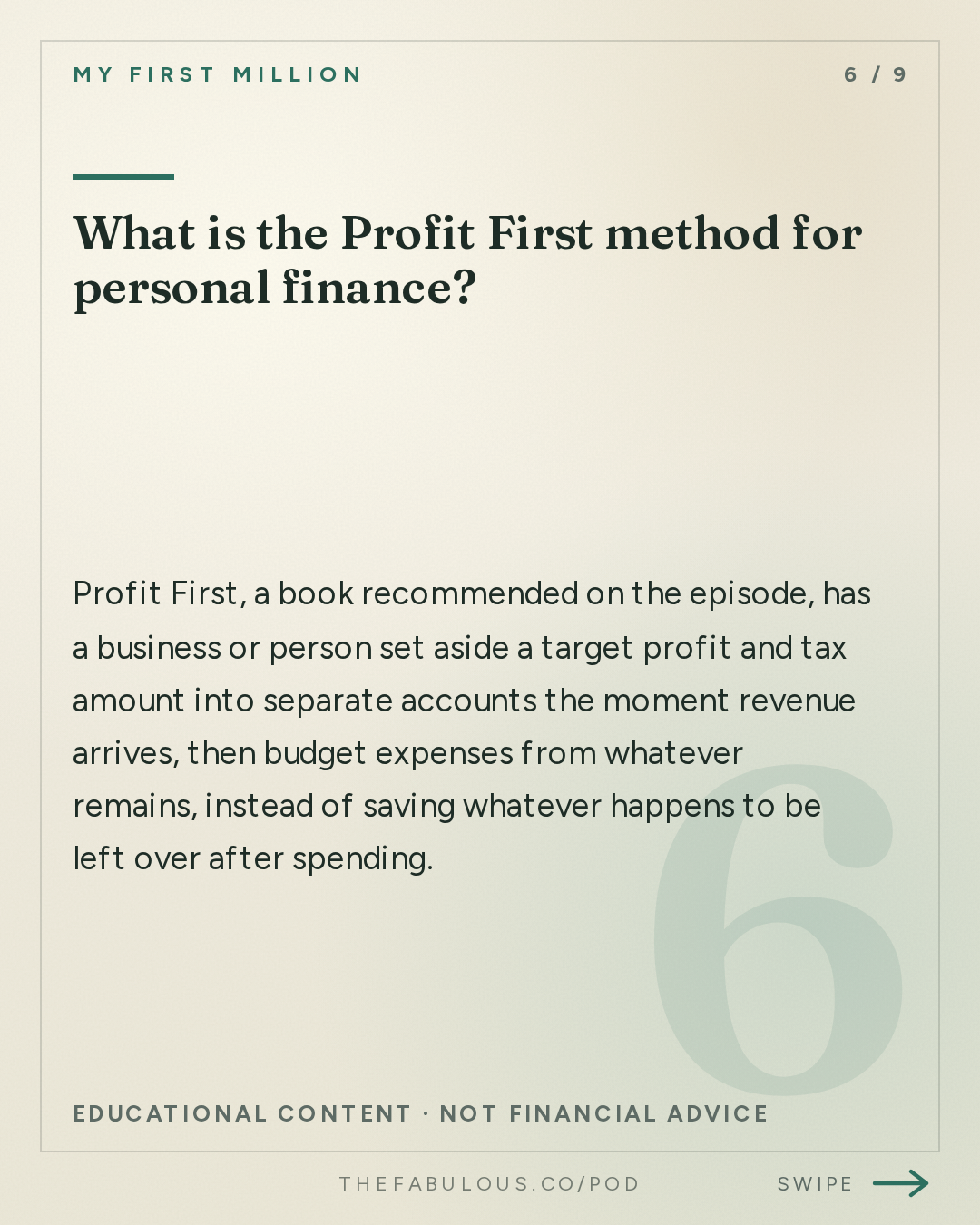
Profit First, a book recommended on the episode, has a business or person set aside a target profit and tax amount into separate accounts the moment revenue arrives, then budget expenses from whatever remains, instead of saving whatever happens to be left over after spending (47:12, 48:36).
What does 'live like you have a car note' mean as a savings strategy?
A comic book store founder described saving $1,500 a month, the exact size of his old car payment, into a separate account for two to three years even after the car was paid off, until he had enough to fund his business. The hosts use it as a metaphor for paying a future goal first rather than saving whatever is left over (46:08, 46:35).
The full read, in cards


Go deeper
- Profit First — Advocates setting aside profit and taxes before spending on expenses, recommended to the hosts by entrepreneur Andrew Wilkinson
- The 100-Year Life — Argues retirement will shift toward age 80 as human lifespans extend toward 100 years
- The 4-Hour Workweek — Contrasts the old-rich model of retiring at 65 with taking mini-retirements throughout a career
- Wall Street Journal reporting on Alice Wang — Reported screenshots showing Alice Wang's husband Kang Wang discussing her closeness to Nvidia's CEO
Mentioned
Jensen Huang · Nvidia · Alice Wang · Kang Wang · Pete Carroll · Sam Altman · Tim Ferriss · Andrew Wilkinson · SpaceX · Berkshire Hathaway · Oscar Health · Coinbase · The 100-Year Life · The 4-Hour Workweek · Profit First · Inner Game of Tennis · Stripe · Airbnb
More from this show and category
ChatGPT Wrapper Business Ideas That Make Money
Adding “GPT” to a boring task is already a business: TaxGPT, PointsGPT and PhotonGPT turn paperwork into a chat window and make real money (02:30, 03:02). The hosts also unpack why speed, not quality, predicts founder success, citing Mike Cassidy's 500-day, 500-million-dollar exit and James Hong's eight-day build rule.
Vanessa Van Edwards: The Science of Charisma
Communication researcher Vanessa Van Edwards argues that warmth and competence drive 82% of first impressions, and that the first minute of an interaction is harder to undo than the next thirty. She offers concrete fixes: visible hands, information hooks, lower vocal pitch, and matching a listener's words and pace.
How Oh My Mahjong Hit $40 Million in Sales
Oh My Mahjong grew from $1 million to $40 million in revenue in two years by turning a $20 board game into a $450 art object people had to earn. The episode traces that same severity of initiation effect through $3,000 designer sunglasses, Andrew Huberman's $24 million deal with Hims, and a growing backlash against screens and ease.
James Currier's Speed Bar Framework for Startups
James Currier, cofounder of venture firm NFX, argues the single trait that predicts startup success is speed: how fast founders test, decide, and ship. He shows how time constraints, disposable test brands, and founder psychology work together to let underdogs out-move better-funded incumbents (01:34).
