
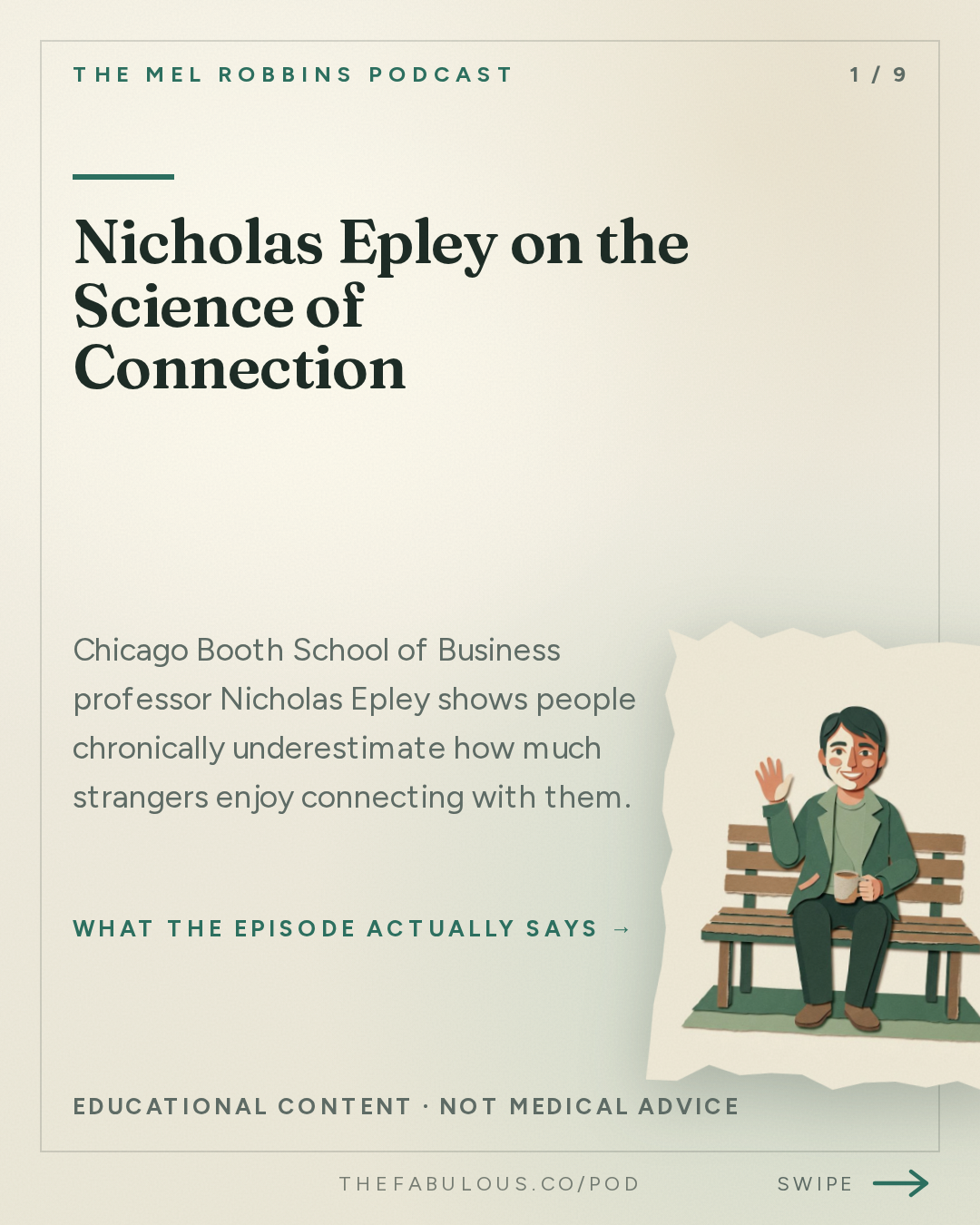
Nicholas Epley on the Science of Connection
What Makes a Good Life? The Science of Better Relationships with Dr. Nicholas Epley
▶ Listen to the full episode More from The Mel Robbins Podcast
The brief
Chicago Booth School of Business professor Nicholas Epley shows people chronically underestimate how much strangers enjoy connecting with them: deep conversations rate far better than predicted (30% give top marks versus the roughly 10% expected), and tiny habits like the 10/5 rule close that gap.
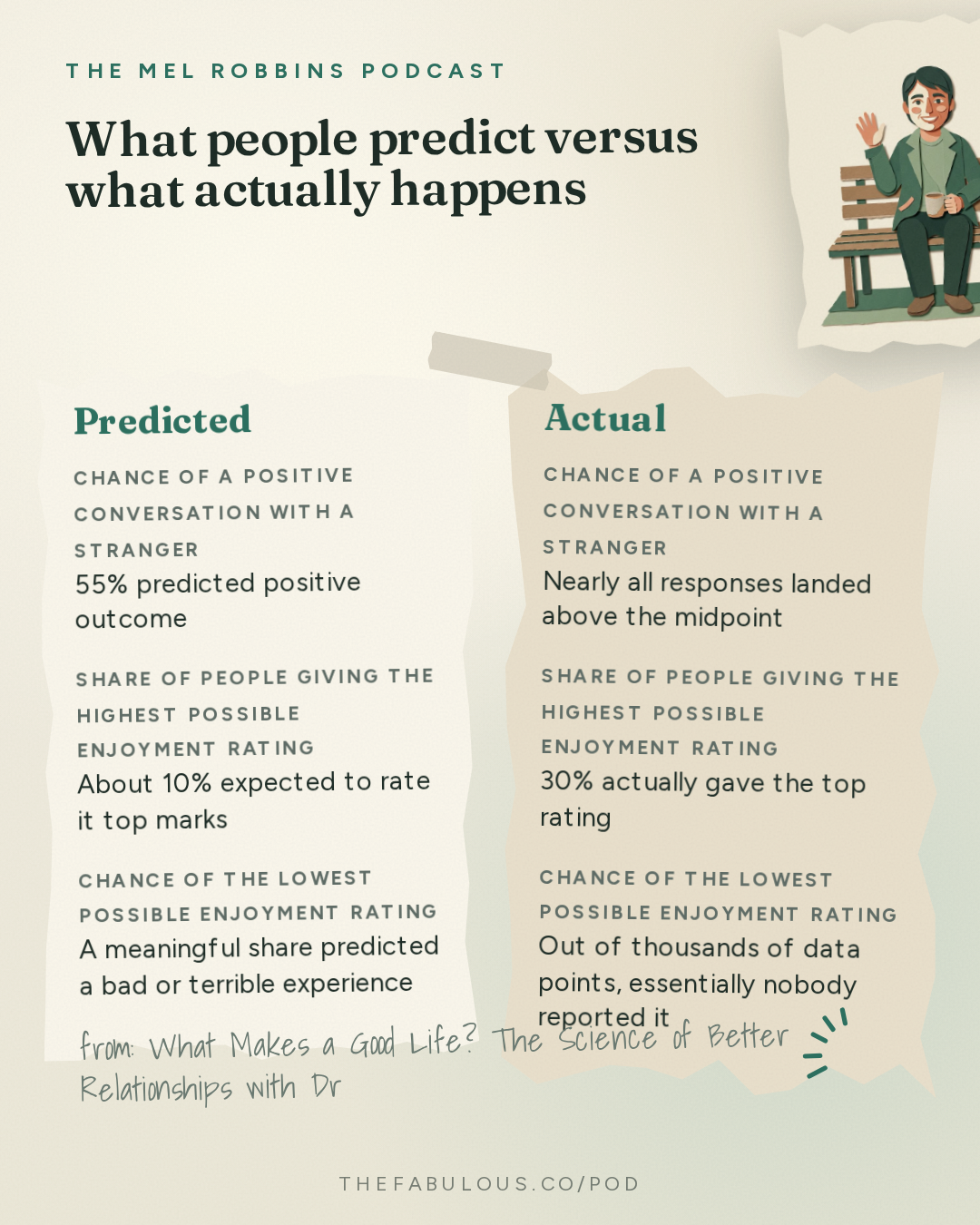
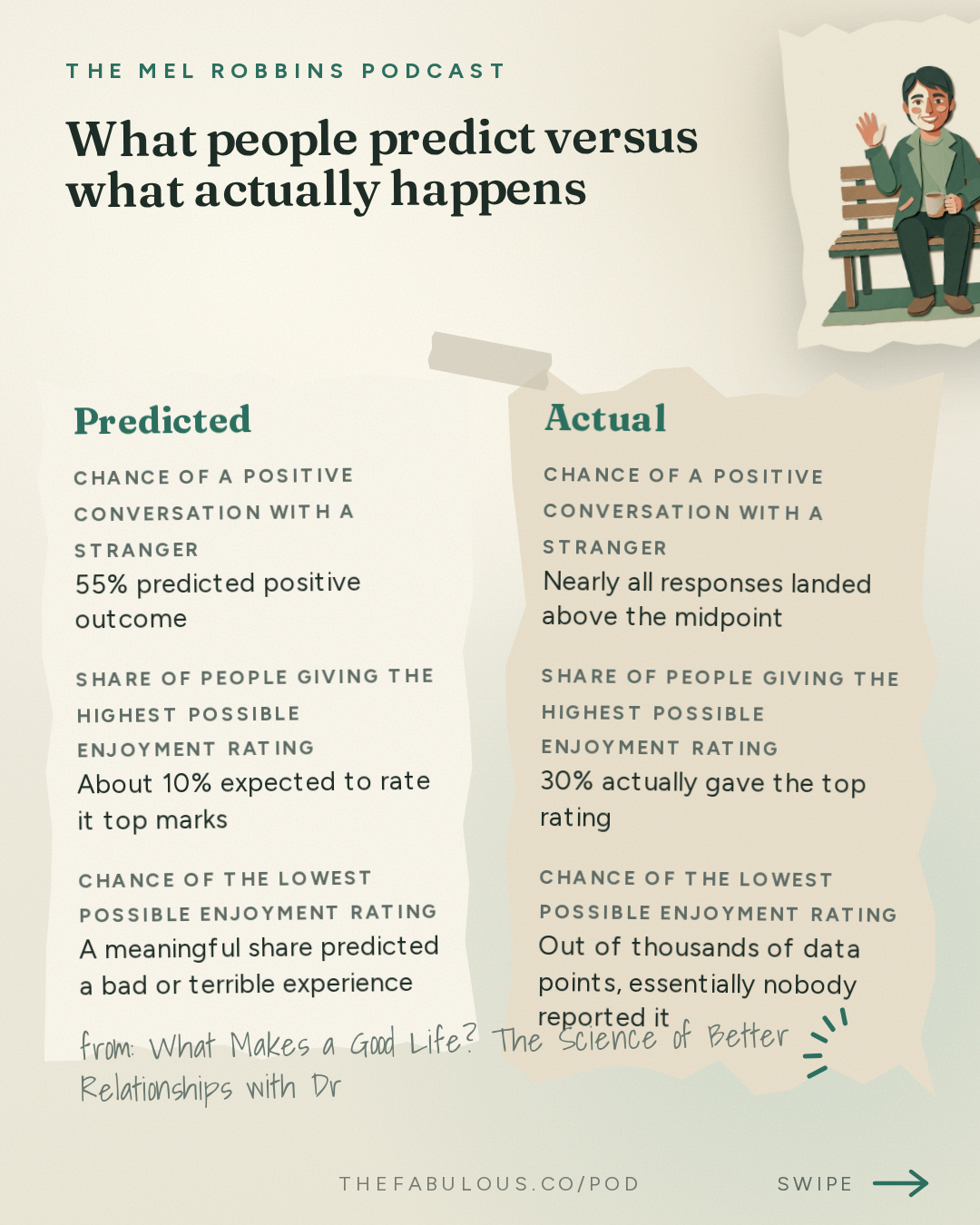
Picture a lecture hall with five mason jars lined up on a table, each labeled with a level of enjoyment, from "not at all" to "very much." A professor asks a room full of strangers to predict how they will feel after talking with someone they have never met about the last time they cried in front of another person. Almost everyone bets on the middle jars, the safely mediocre ones. Then the conversations happen. When the room reports back, the jars tell a different story: hardly anyone lands below the midpoint, and 30 percent max out the top jar (38:04), roughly three times the number who predicted they would feel that good (39:00). The gap between what people expect and what actually happens, what Nicholas Epley calls the distance between the red line and the blue line on his chart, is the puzzle this University of Chicago Booth School of Business professor has spent his career untangling: why a species built for connection keeps predicting the worst about it.
Epley's broader claim is that people carry more power than they realize to make their days better, and that they routinely leave that power on the table. In one of his surveys, people were asked to think back over the roughly 14 waking hours of the previous day and flag every hour in which they could have been a little more social. On average, they named about seven of those hours (13:06), half the day, as missed chances to say hello, share a ride, or call an old friend. That is not a small oversight. It is the raw material of a happier life, because Epley's research keeps finding that mood tracks frequency of good moments far better than their intensity. He describes happiness as a leaky tire: inflate it with something wonderful and it slowly deflates as people adapt (08:14). The fix is not one big win. It is topping up the tire often.
Magnets, Not Marbles
The reason people hold back, Epley argues, is not that they fail to value connection. It is that they misjudge how others will respond. He frames the mistake with an image: we treat social encounters like marbles bumping together, outcomes determined by chance, when they actually behave like magnets.
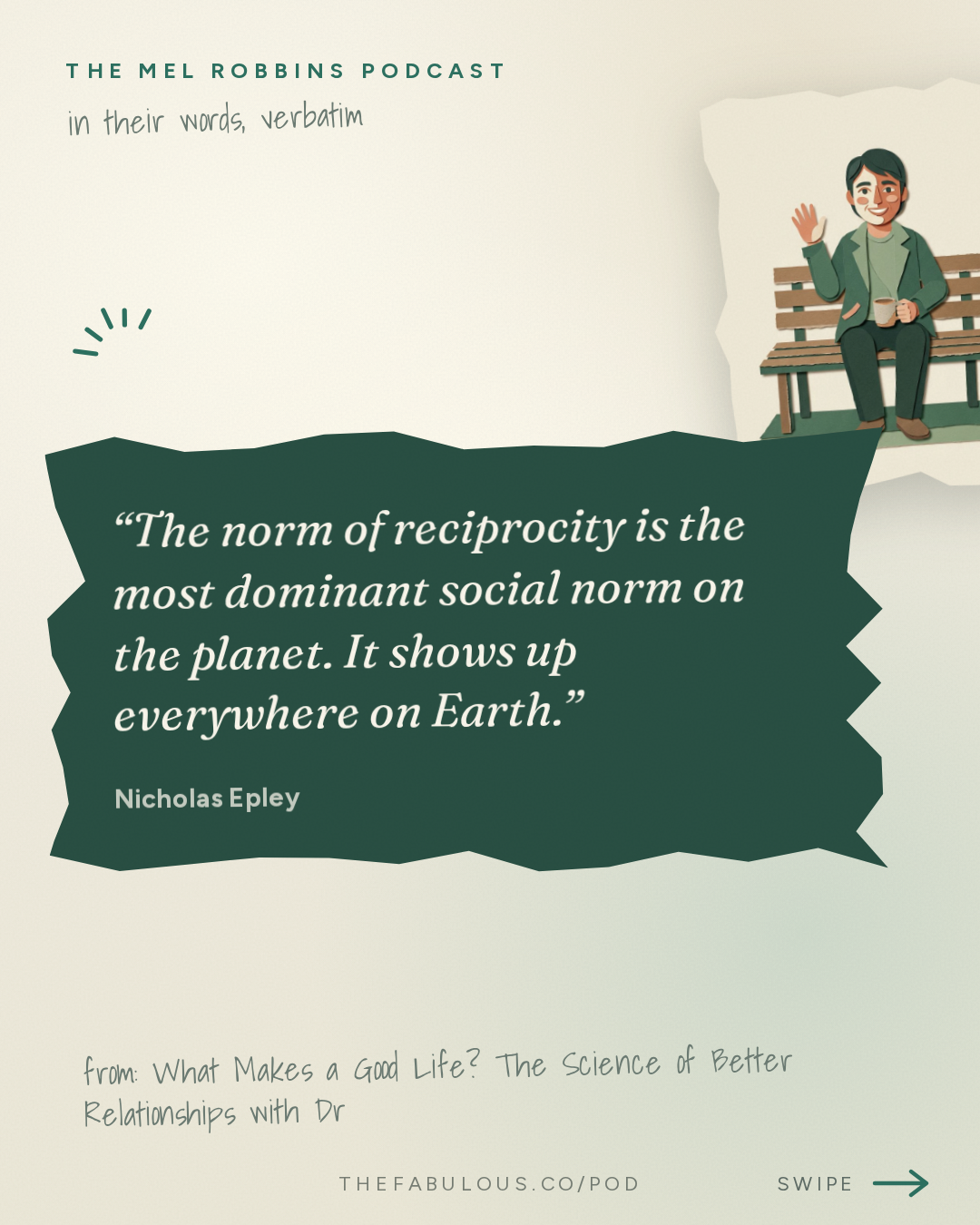
"The norm of reciprocity is the most dominant social norm on the planet. It shows up everywhere on Earth." — Nicholas Epley [15:08]
Say hello and the near-universal response is hello back. Wave and people wave. This is not guesswork, Epley says. It is close to a law. He extends the idea with a second analogy: a person is not just a bystander in someone else's day, they are that person's situation. Walk past a colleague with a smile and you have set the terms of a small interaction that is mostly out of their hands (24:29). Mel Robbins names the same idea in plainer language.
"You bring the weather." — Mel Robbins [25:13]
Epley likes the phrase because it captures something people get backward. Many assume personality is fixed, that someone just is a warm person or a cold one, the way climate is stable. But weather varies day to day, and so does the tone a person sets for everyone nearby. The choice to bring sunshine or a thunderstorm into a room is made fresh each time.
The mason jar experiment is where this theory meets its sharpest test. Before talking, participants guessed the odds of a mediocre or bad conversation at 44.3 percent and a genuinely positive one at only 55 percent (36:20). They treated the outcome as close to a coin flip. What actually happened was lopsided: out of thousands of data points, Epley says nobody reported the lowest level of enjoyment (37:36), and the responses clustered hard at the enjoyable end of the scale. People are not bad at predicting their own feelings so much as they are bad at predicting other people's warmth, and that specific blind spot, Epley notes, is the one most open to correction, because it is a belief about someone else, not about the self (41:11).
That correction does not happen by accident. In follow-up testing, participants who felt great after one deep conversation were, a week later, back to their original pessimism, just as doubtful about the next one (41:51). The people least prone to this reset were those who had simply practiced more, logging enough real conversations to recalibrate. Which raises the practical question Epley spends the second half of the conversation answering: how does someone actually start.
From Small Talk to a Real Question
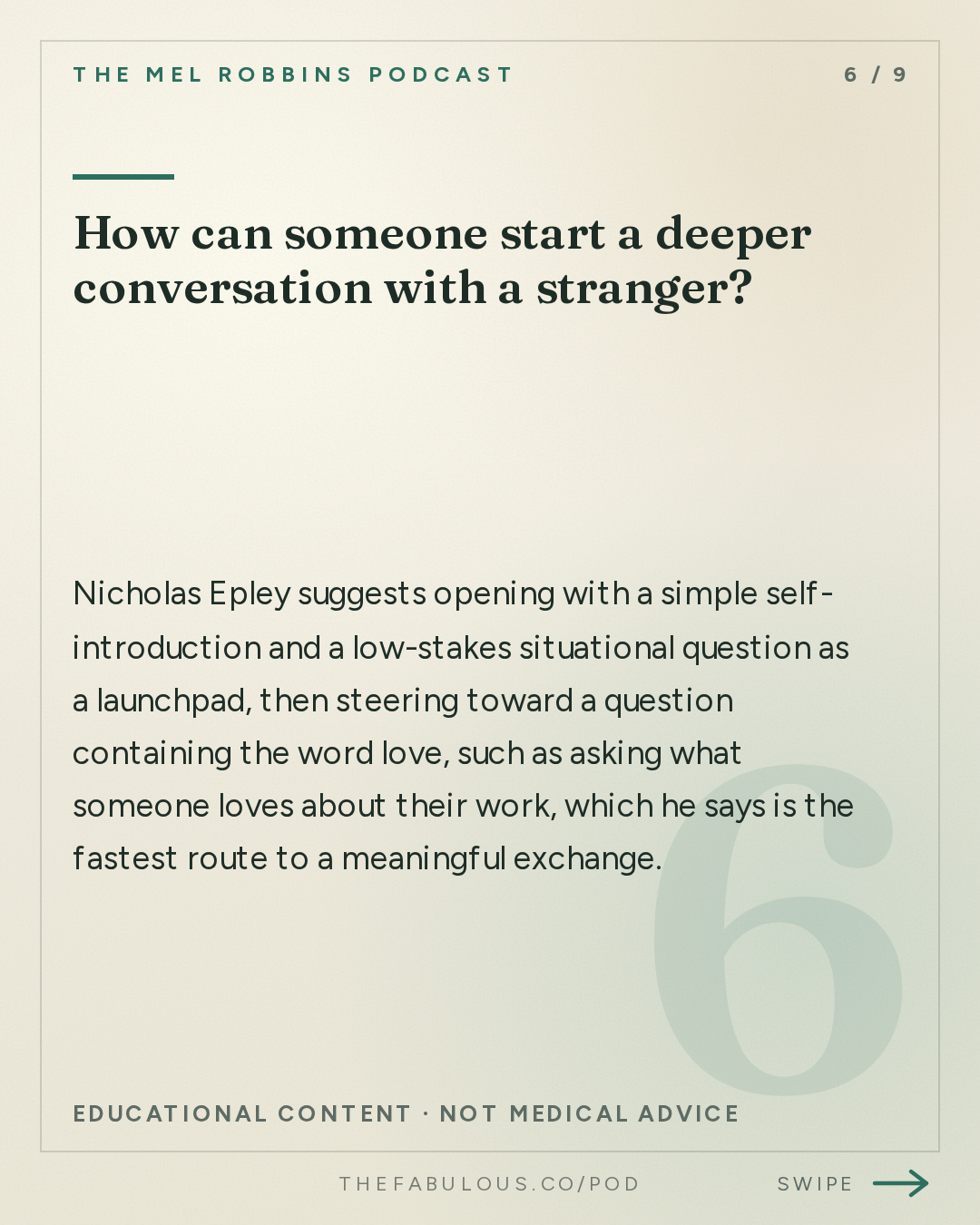
Epley is skeptical of the idea that there is a magic opening line. What changes a conversation's depth, he says, is not the words but the mindset behind them: curiosity. He credits science communicator Bill Nye with a line he returns to often, that everyone a person meets knows something they don't (46:30). Noticing a bracelet, a tattoo, or a pair of unusual socks is not a script, it is evidence of paying attention, and paying attention is what opens the door to a better question. From Los Angeles community organizer Dave Fleischer, who canvasses voters across deep political divides, Epley borrowed a single word that reliably deepens a conversation fast: love. Asking someone what they love about their work, rather than simply what they do, signals real interest in something meaningful (53:30), and Epley says it has worked in settings as different as an emergency room and a long flight next to a stranger who turned out to be adopted, a conversation that became, in his words, like holding a unicorn (49:57).
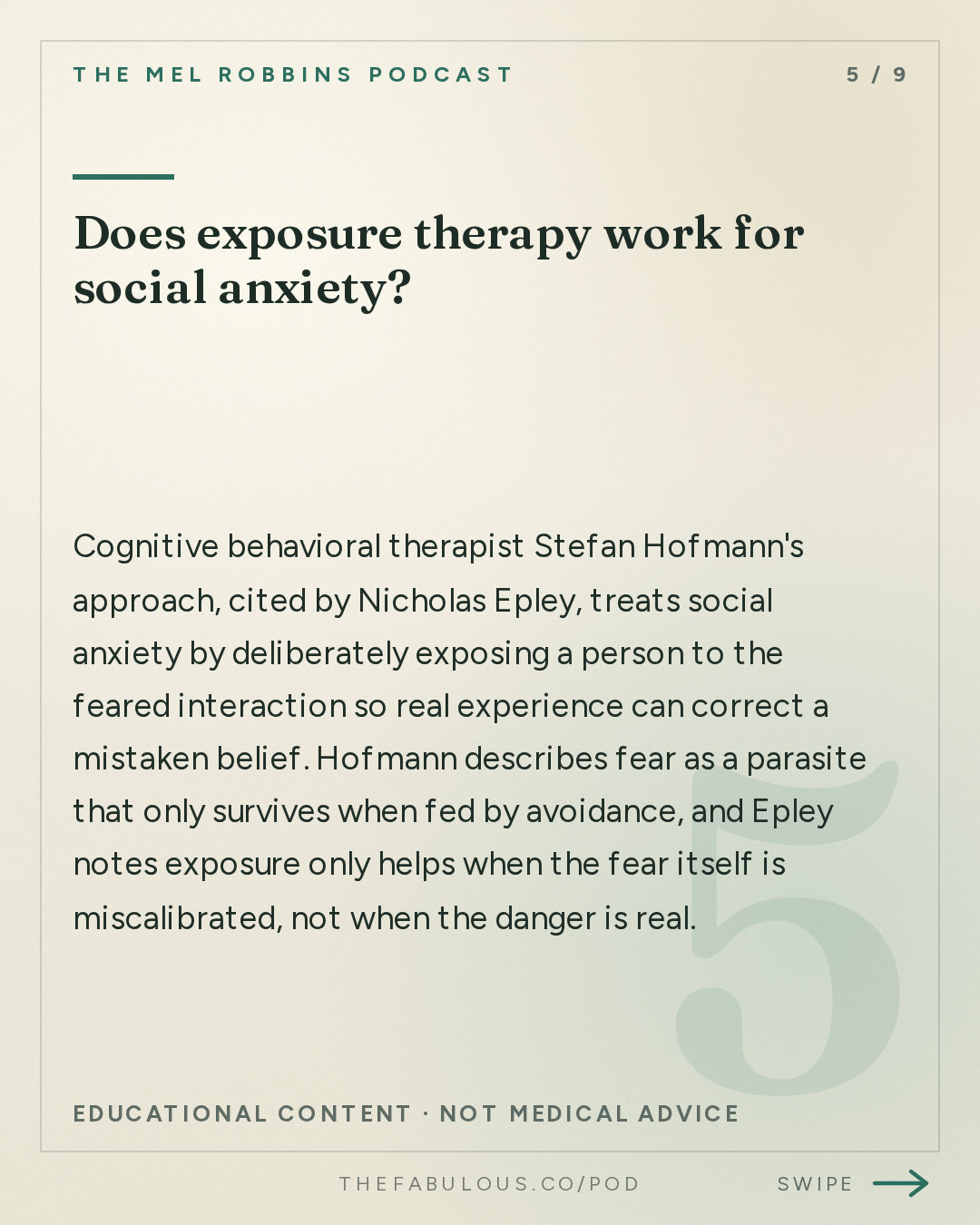
For people who find even that first step terrifying, Epley points to the clinical playbook for social anxiety, built by cognitive behavioral therapist Stefan Hofmann. Hofmann's approach is exposure therapy, which simply means deliberately doing the feared thing in small, repeated doses so the brain can update its prediction with real evidence. Hofmann's own description of anxiety, which Epley quotes from Hofmann's book CBT For Social Anxiety, is blunt.
"Fear is like a parasite. It can't live on its own. It can only survive if it is being fed and protected by avoidance." — Nicholas Epley, quoting Stefan Hofmann [55:20]
Avoidance starves out the correction a person needs. Epley's advice is to start small and routine rather than attempting a dramatic leap: take the stairs, talk to the stranger on a daily commute, treat each attempt as a data point rather than a verdict (58:34). Collected over ten tries, the record usually looks far better than feared.
One popular excuse Epley wants to retire is the idea of a social battery, the belief that introverts are drained by interaction while extroverts are charged by it. He says there is little evidence for this in the data (62:37). What actually differs is expectation, not experience: extroverts predict they will enjoy a conversation more, but once underway, introverts and extroverts report similar enjoyment. And in experiments where people are simply asked to act more extroverted for a stretch of time, regardless of their own personality, they report more positive mood (64:10). The tiredness people feel afterward, Epley and Robbins suggest, may be less a drained battery and more the ordinary fatigue of doing something unfamiliar, the same soreness that follows a first trip to the gym.
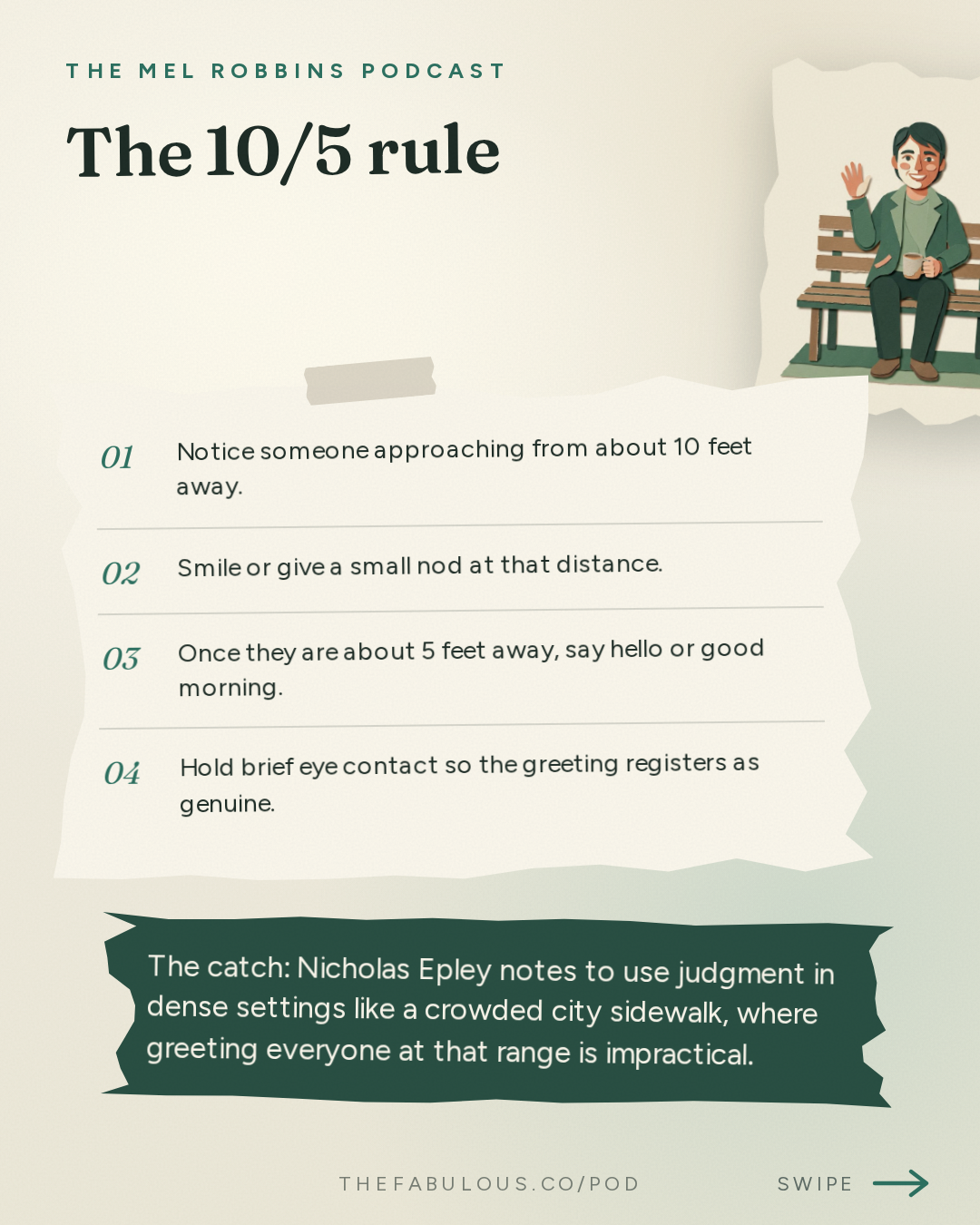
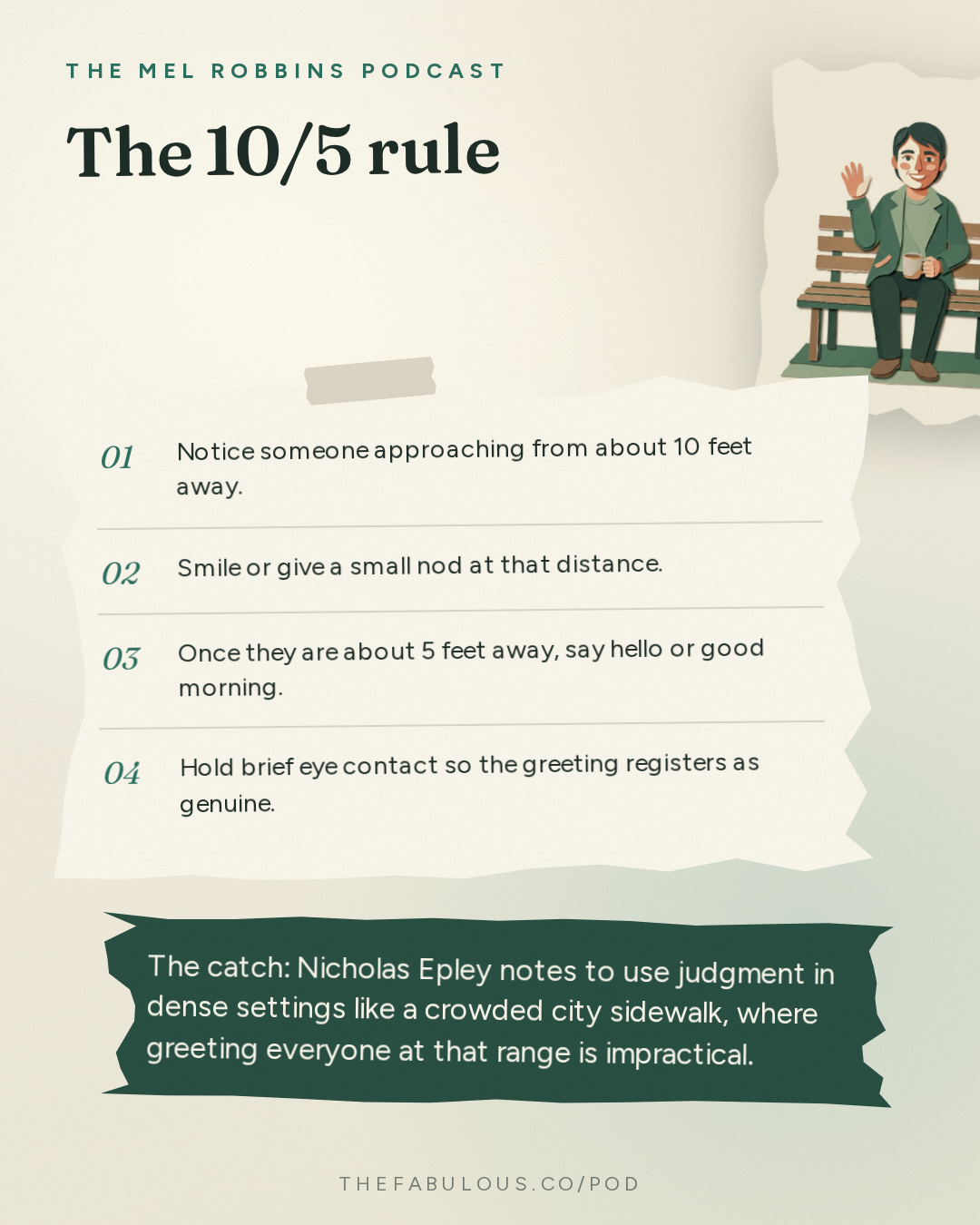
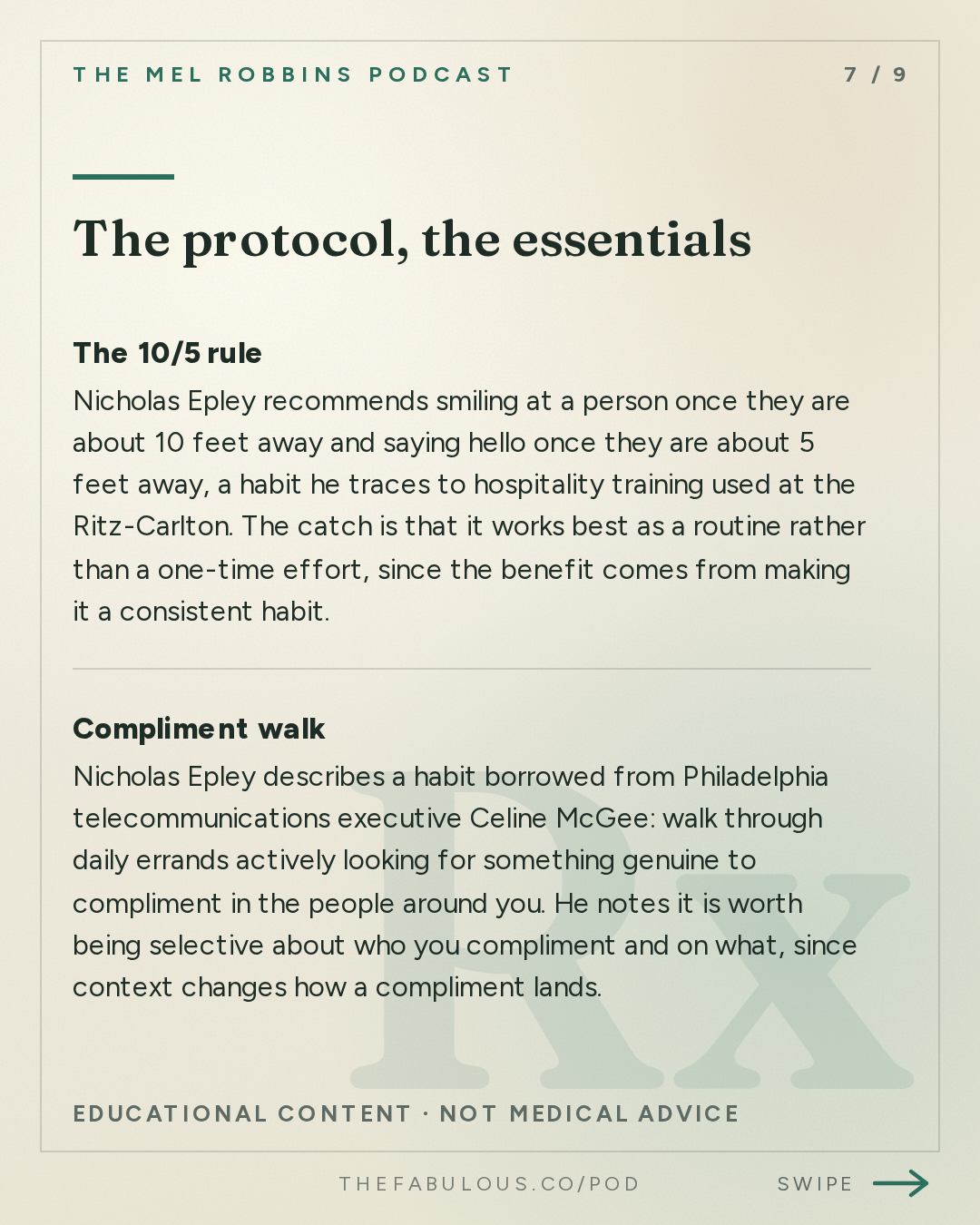
Epley's single most actionable habit is one he borrows from the hospitality industry: the 10/5 rule, reportedly used at the Ritz-Carlton to train staff. Smile at someone ten feet away. Say hello once they are five feet away (68:16). It costs nothing and requires no script, but it forces the resting, unreadable face most people walk around with to flip into something warmer, and warmth, as the reciprocity research shows, tends to come straight back. Paired with what Epley calls a compliment walk, a habit borrowed from Philadelphia telecommunications executive Celine McGee of simply looking for something good to notice in passing strangers (70:01), these are not grand gestures. They are the small, repeatable moments Epley insists are the actual unit of a good life.
His closing instruction doubles as the whole episode's argument in four words: when in doubt, reach out (70:49). The data he has spent a career collecting suggests the doubt is almost always miscalibrated, and the reaching out almost always worth it.
Ask this episode anything
Pod's AI answers from the episode itself, with the minute mark so you can hear it yourself.
Or start with one of these
Ask this episode
Pod's AI listens to the whole episode to answer, and points you to the minute it comes from.
The rest of this answer, and any question after it
Answers come from the episode itself, never from a summary of it.
ContinueKey takeaways
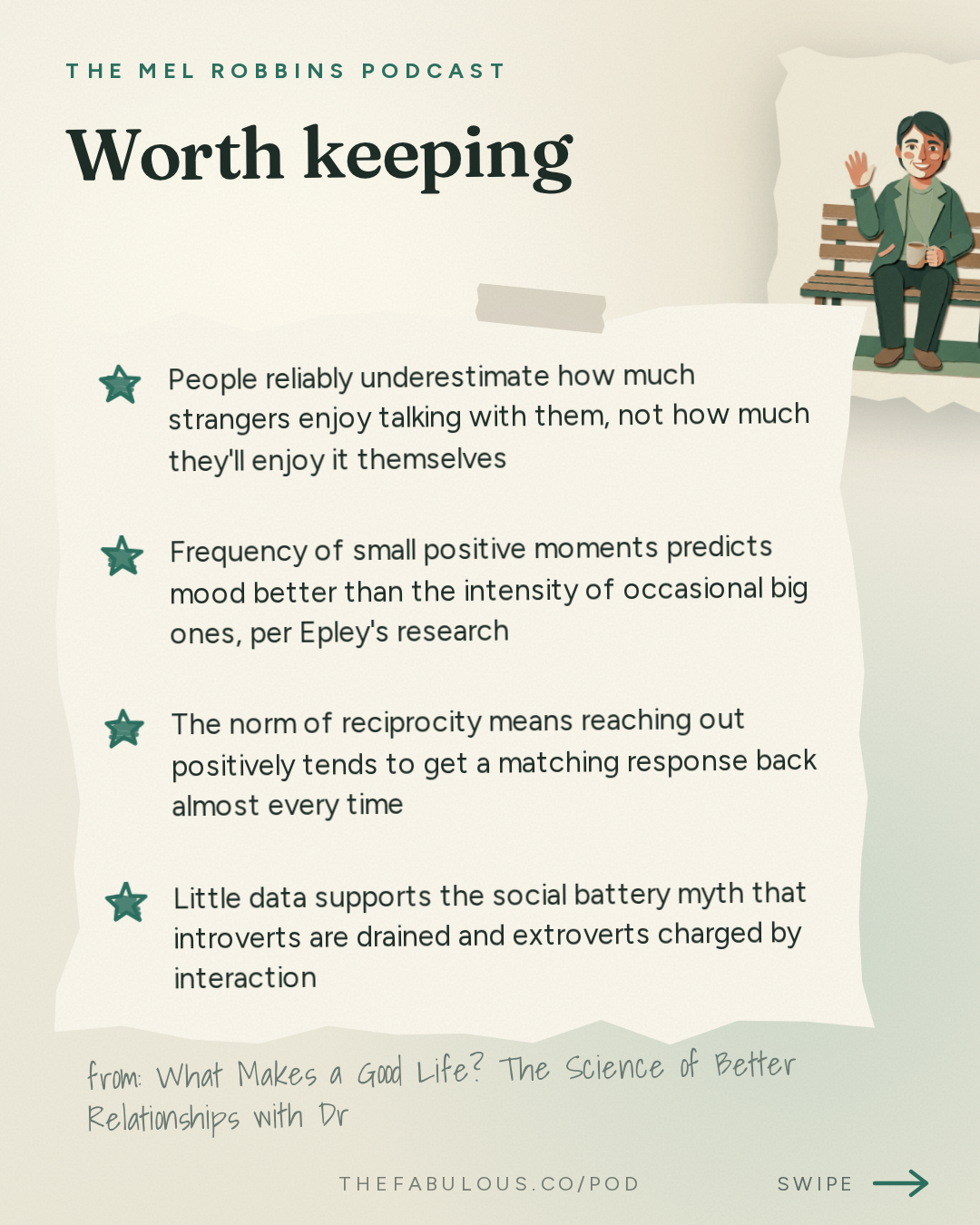
- People reliably underestimate how much strangers enjoy talking with them, not how much they'll enjoy it themselves
- Frequency of small positive moments predicts mood better than the intensity of occasional big ones, per Epley's research
- The norm of reciprocity means reaching out positively tends to get a matching response back almost every time
- Little data supports the social battery myth that introverts are drained and extroverts charged by interaction
- The 10/5 rule, smile at 10 feet and say hello at 5 feet, is Epley's single easiest habit to start with
The episode in cards

By the numbers
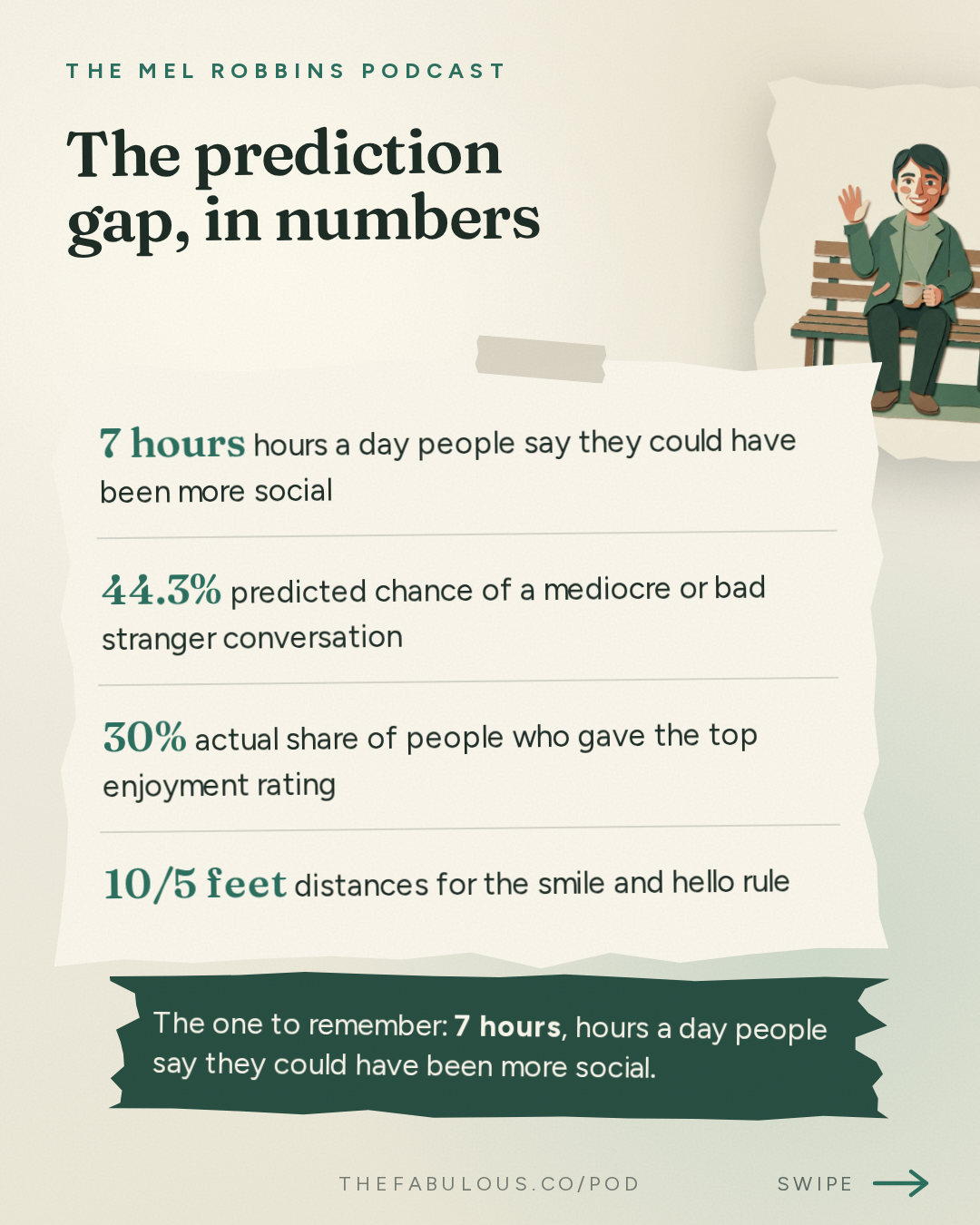
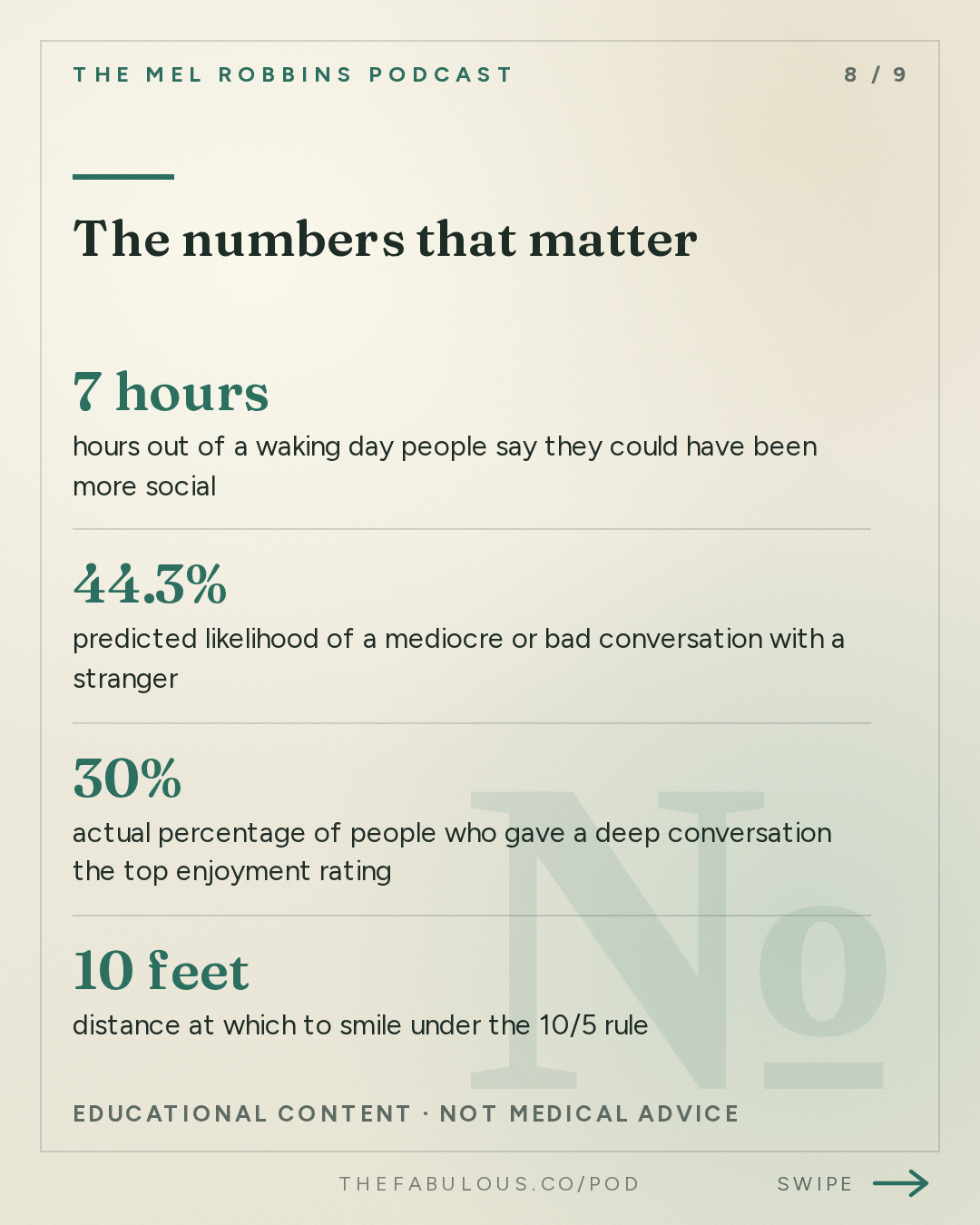
- 7 hours hours out of a waking day people say they could have been more social
- 44.3% predicted likelihood of a mediocre or bad conversation with a stranger
- 30% actual percentage of people who gave a deep conversation the top enjoyment rating
- 10 feet distance at which to smile under the 10/5 rule
- 5 feet distance at which to say hello under the 10/5 rule
In their words
“Social connection isn't something that just happens to us. It's not something magical that just occurs. It's a choice that we make”
“The norm of reciprocity is the most dominant social norm on the planet. It shows up everywhere on Earth.”
“"Fear is like a parasite. It can't live on its own. It can only survive it is, if it is being fed and protected by”
“You bring the weather.”
“When in doubt, reach out.”
Protocols
-
The 10/5 rule
Nicholas Epley recommends smiling at a person once they are about 10 feet away and saying hello once they are about 5 feet away, a habit he traces to hospitality training used at the Ritz-Carlton. The catch is that it works best as a routine rather than a one-time effort, since the benefit comes from making it a consistent habit.
Daily, applied to anyone encountered at that distance
-
Compliment walk
Nicholas Epley describes a habit borrowed from Philadelphia telecommunications executive Celine McGee: walk through daily errands actively looking for something genuine to compliment in the people around you. He notes it is worth being selective about who you compliment and on what, since context changes how a compliment lands.
As needed, especially when feeling low
-
Start small and test the belief
For social anxiety, Nicholas Epley recommends starting with easy, low-stakes opportunities, such as talking to a stranger during a daily commute, rather than attempting a dramatic conversation right away. He advises repeating this multiple times and tracking how it actually goes, since the goal is to collect enough real data to correct a mistaken belief about how badly it will turn out.
Repeated routinely, building up over time
-
Open with your name, then a launchpad question
Nicholas Epley suggests opening any conversation with a simple self-introduction, such as "Hi, my name is," because revealing a personal detail invites reciprocity. He then recommends following with a low-stakes situational question as a launchpad before moving toward a question that includes the word love, such as asking what someone loves about their work, to reach a more meaningful exchange faster.
At the start of any new conversation
Questions this episode answers
Why do people avoid talking to strangers even though they enjoy it?
Research by Nicholas Epley found that people badly underestimate how positively a stranger will respond, predicting only a 55% chance of a good conversation when actual results clustered heavily at the enjoyable end of the scale (36:20). The barrier is misjudging others, not disliking connection.
What is the 10/5 rule from the Mel Robbins podcast?
It is a habit Nicholas Epley traces to hospitality training reportedly used at the Ritz-Carlton: smile at someone once they are about 10 feet away, then say hello once they are about 5 feet away (68:16). The idea is to replace a neutral resting face with visible warmth before an interaction even starts.
Is the social battery theory for introverts and extroverts backed by data?
Nicholas Epley says there is little evidence in the data that introverts are depleted by social interaction while extroverts are charged by it (62:37). What differs is expectation rather than experience: extroverts predict more enjoyment going in, but once a conversation starts, introverts and extroverts report similar enjoyment, and acting extroverted raises mood for both groups (64:10).
Does exposure therapy work for social anxiety?
Cognitive behavioral therapist Stefan Hofmann's approach, cited by Nicholas Epley, treats social anxiety by deliberately exposing a person to the feared interaction so real experience can correct a mistaken belief (54:56). Hofmann describes fear as a parasite that only survives when fed by avoidance (55:20), and Epley notes exposure only helps when the fear itself is miscalibrated, not when the danger is real (56:05).
How can someone start a deeper conversation with a stranger?
Nicholas Epley suggests opening with a simple self-introduction and a low-stakes situational question as a launchpad, then steering toward a question containing the word love, such as asking what someone loves about their work, which he says is the fastest route to a meaningful exchange (53:30).
The full read, in cards
Go deeper
- CBT For Social Anxiety — Stefan Hofmann's practical guide to treating social anxiety disorder through exposure therapy
Mentioned
Nicholas Epley · University of Chicago Booth School of Business · Bill Nye · Dave Fleischer · Stefan Hofmann · CBT For Social Anxiety · Paul van Lange · Ritz-Carlton · Celine McGee · Mel Robbins
More from this show and category
Mel Robbins' 58 Years of Life Lessons, Explained
Mel Robbins compresses 58 years of trial and error into one episode: friendship takes a measurable 50 to 200 hours to form (05:41), rejection often precedes a better outcome, and a seven-step morning routine of small kept promises builds the self-trust that makes everything else possible.
Vinh Giang's Guide to Confident Communication
Communication coach Vinh Giang coaches three podcast staffers live to tame shaky voices, stop interrupting, and speak up in groups. His toolkit: star jumps to burn adrenaline, a four-archetype vocal scale from Friend to Coach, and games that force listening before responding.
Vinh Giang's 9 Habits for Clearer Speaking
Communication expert Vinh Giang says insecurity in speech comes from rambling, filler words, and non-functional body language, not a lack of things to say. He teaches a 3-2-1 framework for structuring answers, a 3 to 5 second pause before tough questions, and control of posture, volume, and vocal melody so speakers sound, then feel, confident.
PMOS vs PCOS: New Diagnosis Criteria Explained
OBGYN Dr. Thais Aliabadi argues that PCOS (now renamed PMOS), endometriosis, and PMDD are routinely misdiagnosed as anxiety or stress. She traces each to a physical mechanism, insulin resistance, immune dysfunction, hormone-sensitive brain circuits, and gives exact diagnostic criteria and treatments, including a new blood test and a window-dosed SSRI protocol.
