
Mel Robbins' 58 Years of Life Lessons, Explained
It Took Me 58 Years to Realize What I’ll Tell You in 55 Minutes
▶ Listen to the full episode More from The Mel Robbins Podcast
The brief
Mel Robbins compresses 58 years of trial and error into one episode: friendship takes a measurable 50 to 200 hours to form (05:41), rejection often precedes a better outcome, and a seven-step morning routine of small kept promises builds the self-trust that makes everything else possible.
When Mel Robbins and her husband left the Boston suburb where they had raised their kids for 26 years and moved to Vermont in her early fifties, she expected the excitement of a new chapter. What she got instead was a familiar, uncomfortable silence: a new house, a new town, and nobody to call (04:05). The lesson she pulls from that moment is not comfort. It is arithmetic.
The Arithmetic of Belonging
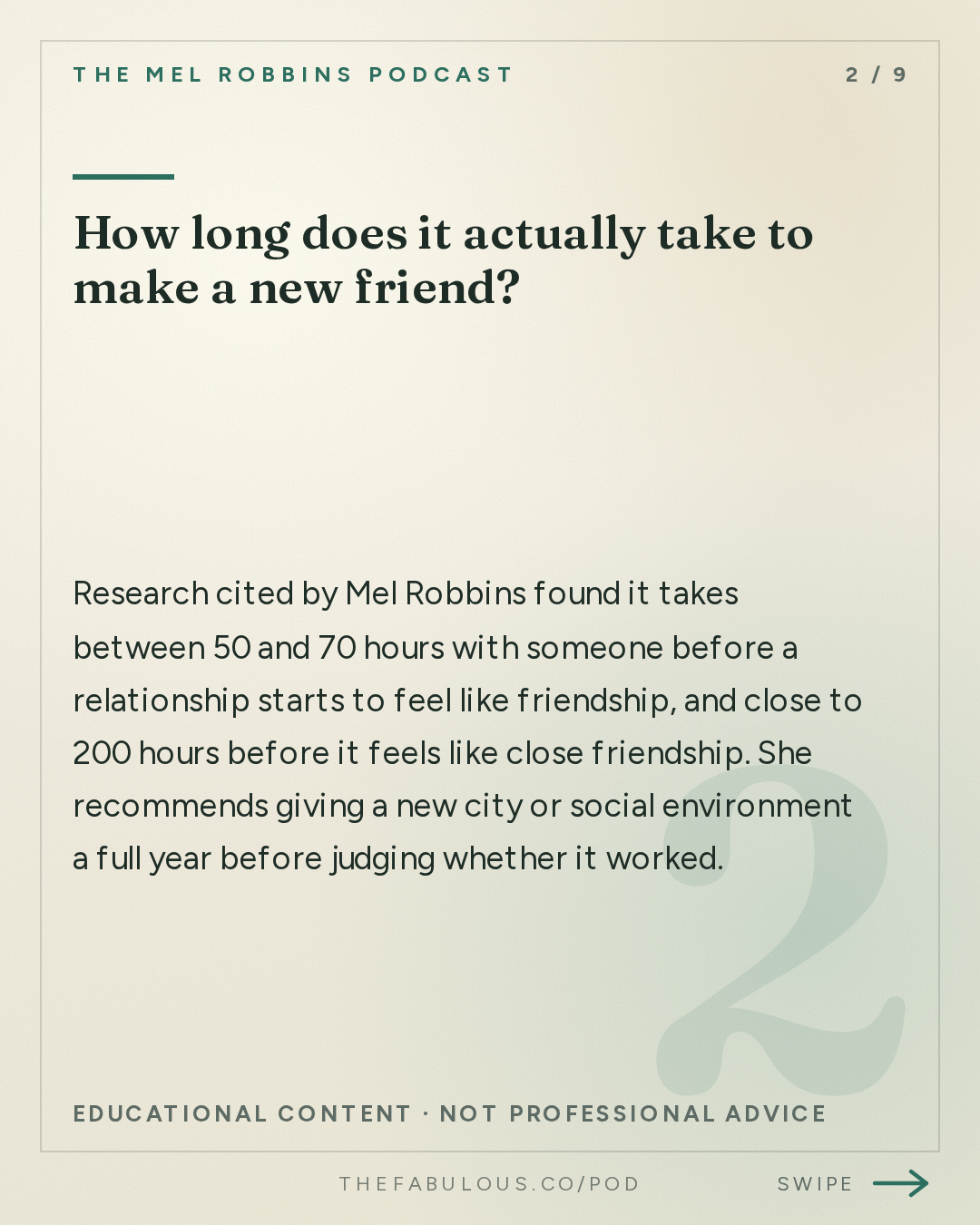
Robbins cites research showing it takes somewhere between 50 and 70 hours with another person before the relationship starts to feel like friendship, and close to 200 hours before it feels like a close friendship (05:41). That number matters because it turns a vague, demoralizing feeling (I don't know anyone here) into a solvable problem with a timeline. Her practical rule follows directly from the math: give a new place a full year before judging whether the move worked, because a year is roughly how long it takes to log enough hours with enough people for a real social life to form (05:14).
The tactic she recommends for logging those hours fast is to stop waiting for invitations. Go first, she says: compliment a stranger's shoes, ask the barista for a recommendation, learn names. She describes literally opening a notes app after a coffee run to write down the name of the cashier and a detail about him, Ben, man bun, red and black flannel, so that the next morning she can walk in and greet him like a person she already knows (07:42). She calls this building \"warm connections,\" a layer of low-stakes familiarity with the crossing guard, the regular barista, the neighbor on the walk, that exists below the level of friendship but produces the feeling of belonging to a place before any actual friends have arrived (07:16). The fastest way to convert those warm connections into the 50-hour threshold, she adds, is to join something recurring: a club, a class, a running group, anything that puts a person in repeated contact with the same humans without requiring a dinner party.
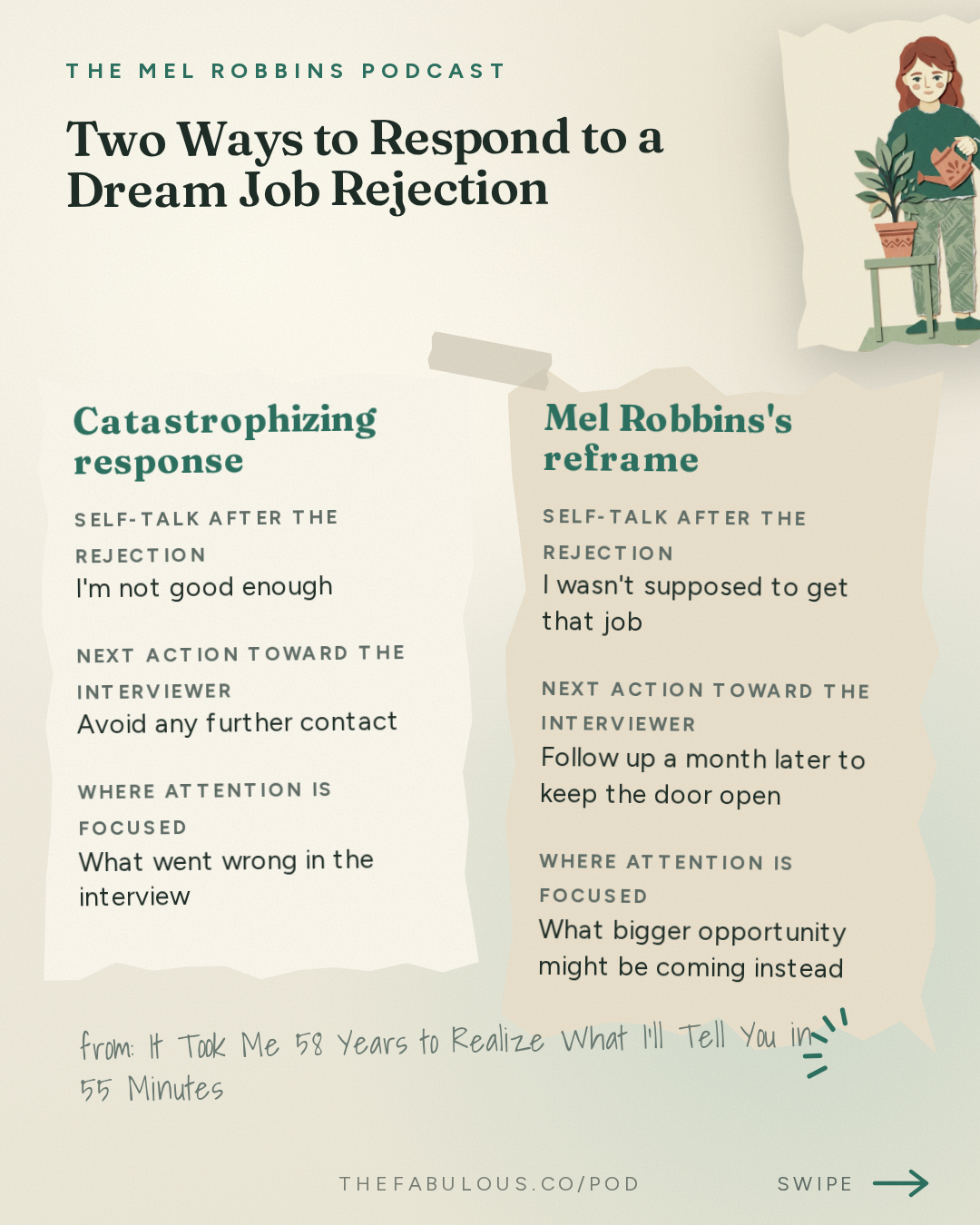
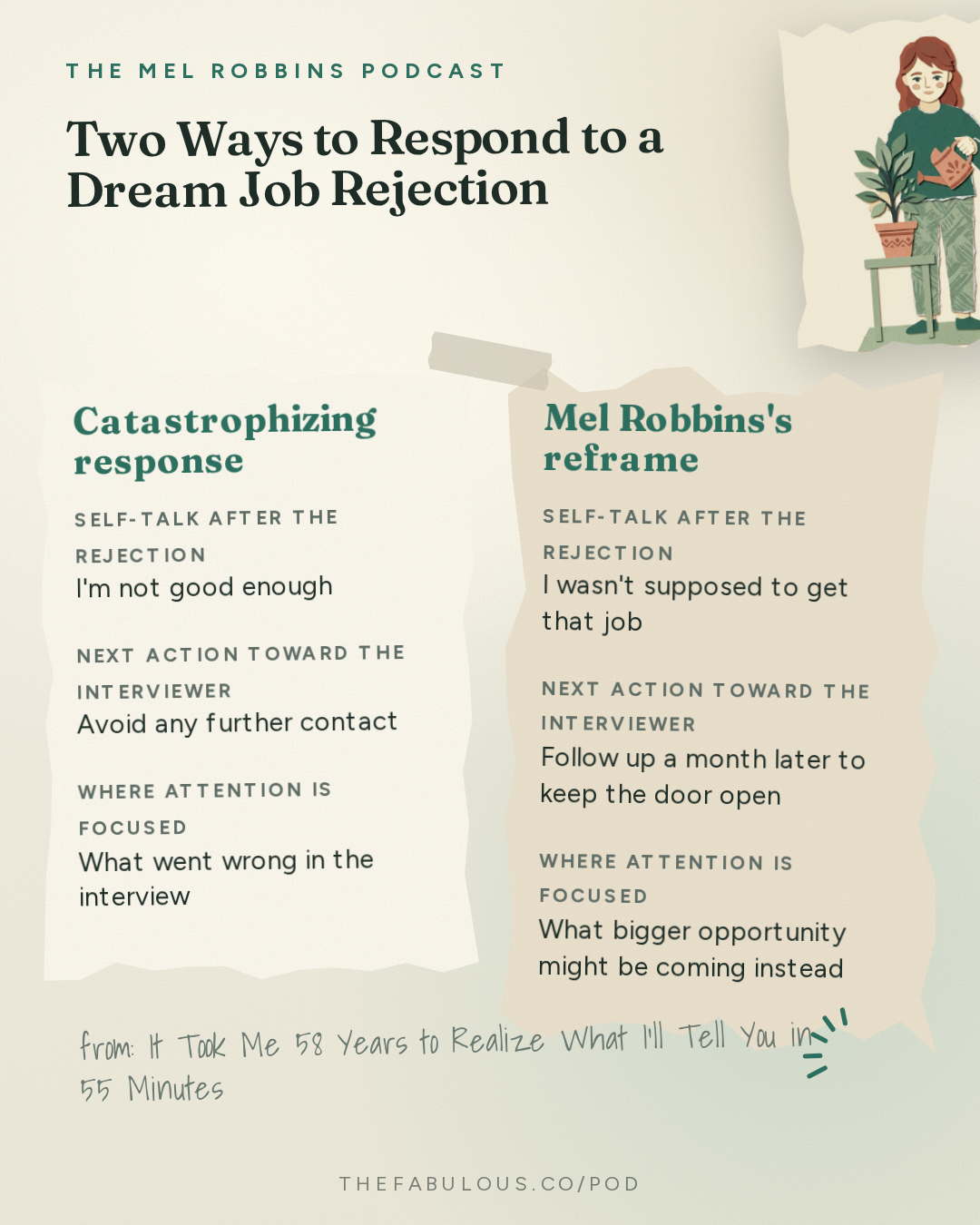
The same one-year patience applies to a harder, more common wound: getting rejected after a final-round interview for a job someone genuinely wanted. Robbins tells the story of someone close to her who made it to the final round twice, got glowing feedback both times, and still heard no. Her two-part protocol starts with a practical move, reach out a month later to keep the door open and remind the interviewer of the good impression made (13:52), and then a mental one.
I didn't get that job because I wasn't supposed to. [14:59]
The line works, she argues, because it separates the rejection from self-blame and reframes it as redirection rather than failure. In the case she describes, three months after the second rejection, the person landed a job paying roughly twice as much at a far more prestigious company that had not even been on his radar when the rejections happened (15:36). The point is not that rejection always leads somewhere better. It is that the belief buys enough patience to keep looking instead of shutting down.
A related but more playful version of the same idea shows up in a question about trying to get cast on the reality show Survivor. Robbins's answer strips the romance out of manifesting: identify exactly what you want, then study the people who already got it, because Survivor casting runs on character archetypes rather than pure wilderness skill, and the formula for getting selected is visible if someone actually researches the last five years of cast members (17:59). Wanting is not enough. Reverse engineering the people who already did the thing is what turns wanting into a plan.
Robbins applies a similar time-shifted logic to a far heavier decision: whether to have children. Her suggested exercise is to mentally time travel to the end of life and look around. Who is in the room on the deathbed? If the answer includes a partner, children, and grandchildren, that is the answer to have them (24:24). She applies this to her own choice to have a third child, saying the deathbed image, three kids and all their eventual grandchildren filling the decades of her forties through her nineties, made the decision obvious even though she is candid that she personally found early parenting, especially the toddler years, difficult rather than instantly joyful (25:25). The exercise works by removing the question from the present tense, where the logistics look overwhelming, and placing it at the only vantage point that actually reflects a whole life.
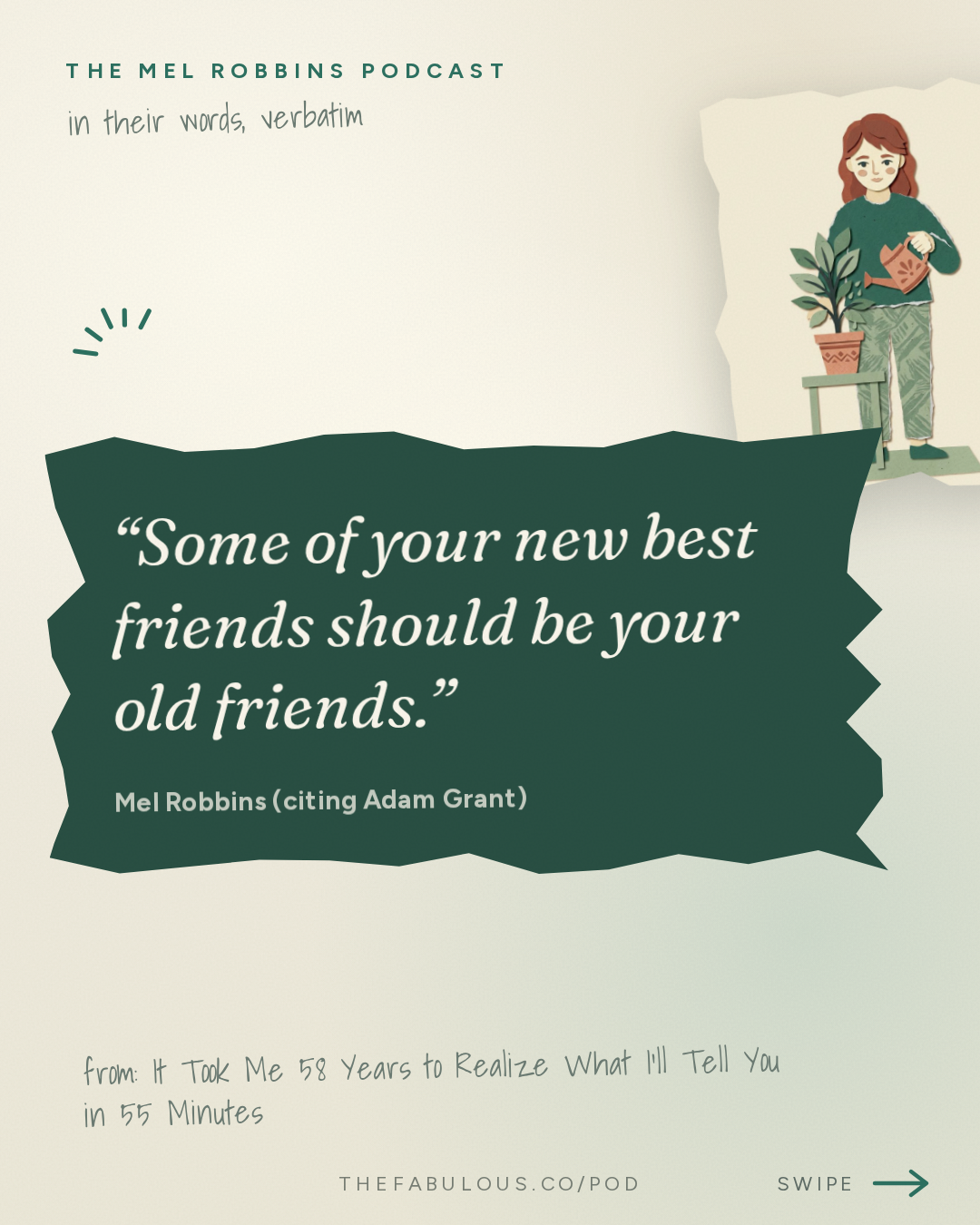
Friendship, too, gets evaluated on a longer timeline. When a friend seems to be pulling away, Robbins names three ingredients a friendship actually needs to survive: proximity, meaning how often two people are physically near each other, timing, meaning whether both people are in a similar life stage, and vibe, the harder-to-name energy between them (28:18). When one of those three shifts, drift is not a betrayal, it is physics. She cites Wharton School of Business professor Adam Grant's observation that some of a person's best new friends should be old friends rediscovered after years of silence, not because anything went wrong, but because life simply moved people apart and later moved them back (29:40).
Systems Over Intentions
The episode's most consequential reframe may be financial. Responding to a 51-year-old listener on the edge of filing for bankruptcy while supporting in-laws and three college students, Robbins insists that bankruptcy is not a moral failure but a legal protection designed to give someone structure to catch their breath and reinvent (31:39). Her advice pairs the hard news with a forward-looking instruction: write down the specific bad habits and decisions that led to the crisis, because naming them is what prevents a repeat, and remember that the feeling of the present moment is temporary.
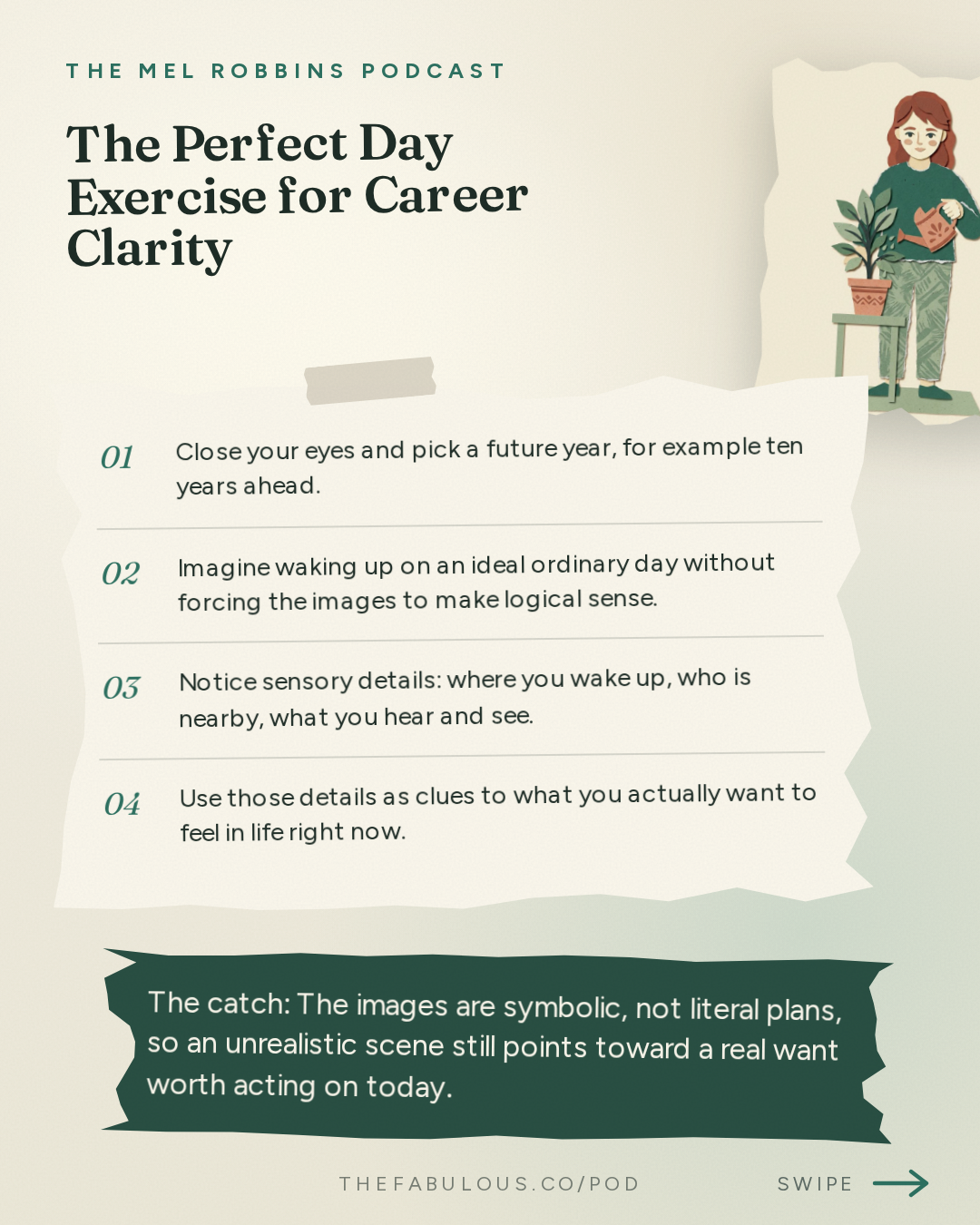
That same forward-looking exercise, called Perfect Day and borrowed from a conversation with author Martha Beck, resurfaces for a 52-year-old listener who feels financially secure but bored after three decades in one career. The exercise asks someone to time travel ten years ahead, in this case to 2037, and imagine waking up on an ideal ordinary day without forcing the images to make logical sense (40:01). Robbins describes doing this herself and seeing woven curtains, an ocean in the distance, and the sound of grandchildren, details that told her she wanted to live near family and water, information she could act on now rather than discover by accident later.
None of these reframes matter without follow-through, which is where Robbins draws her sharpest distinction of the episode.
Intention sets the direction, but systems are what will get it done. [42:22]
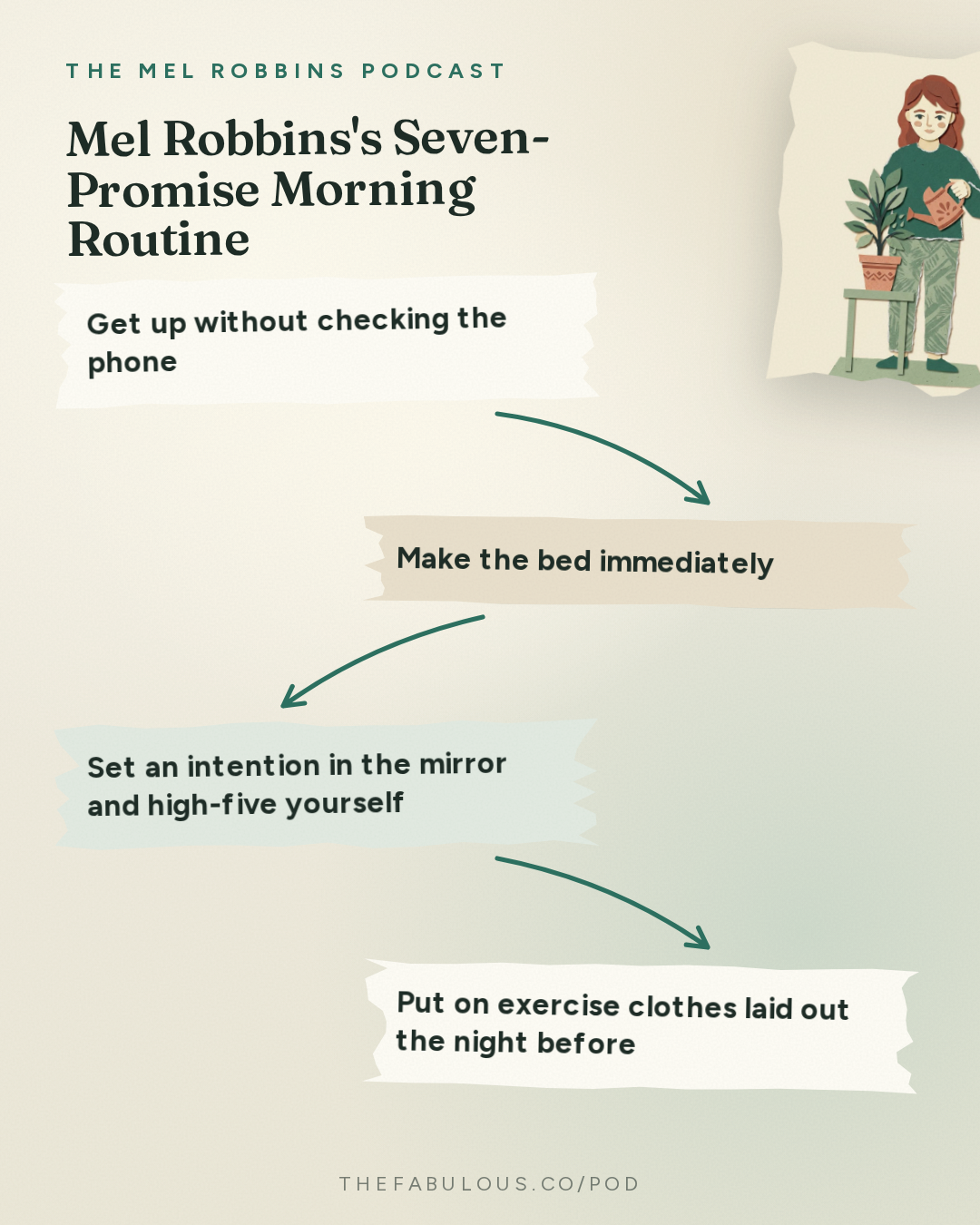
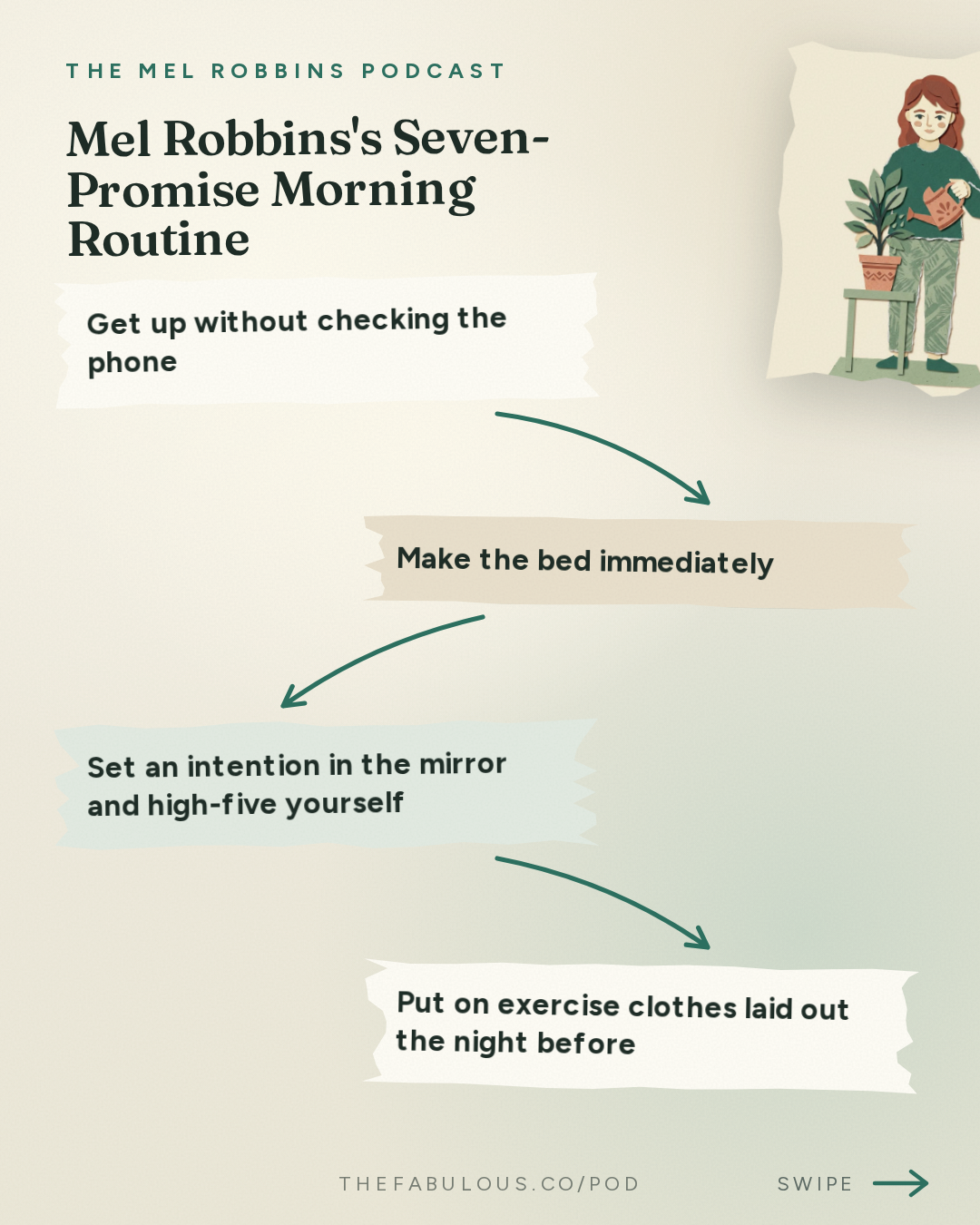
Her own system is a seven-step morning routine, each step framed as a promise kept to herself rather than a task completed: get up without checking the phone, make the bed, look in the mirror and set an intention, put on clothes laid out the night before, drink a protein and fiber shot, drink water before coffee to let the brain's adenosine clear naturally before caffeine arrives, and walk the dogs for a few minutes of daylight (44:08). The mechanism she describes is not about productivity. It is about building evidence, within the first fifteen seconds of the day, that she is the kind of person who does what she says she will do. The same logic extends to visibility: a Post-it note on a laptop screen or the back of a phone keeps an intention in front of the eyes, because, as she puts it, it is nearly impossible to follow through on something that has simply been forgotten (47:38).
The episode closes on six words meant to counter the habit of imagining the worst. Since nobody can actually know whether a risk will pay off, Robbins argues, a person might as well imagine that it will.
What if it all works out, she asks, is not a guarantee. It is a deliberate bet, repeated the way a person might repeat any other habit, on the version of the future worth building toward.
Ask this episode anything
Pod's AI answers from the episode itself, with the minute mark so you can hear it yourself.
Or start with one of these
Ask this episode
Pod's AI listens to the whole episode to answer, and points you to the minute it comes from.
The rest of this answer, and any question after it
Answers come from the episode itself, never from a summary of it.
ContinueKey takeaways
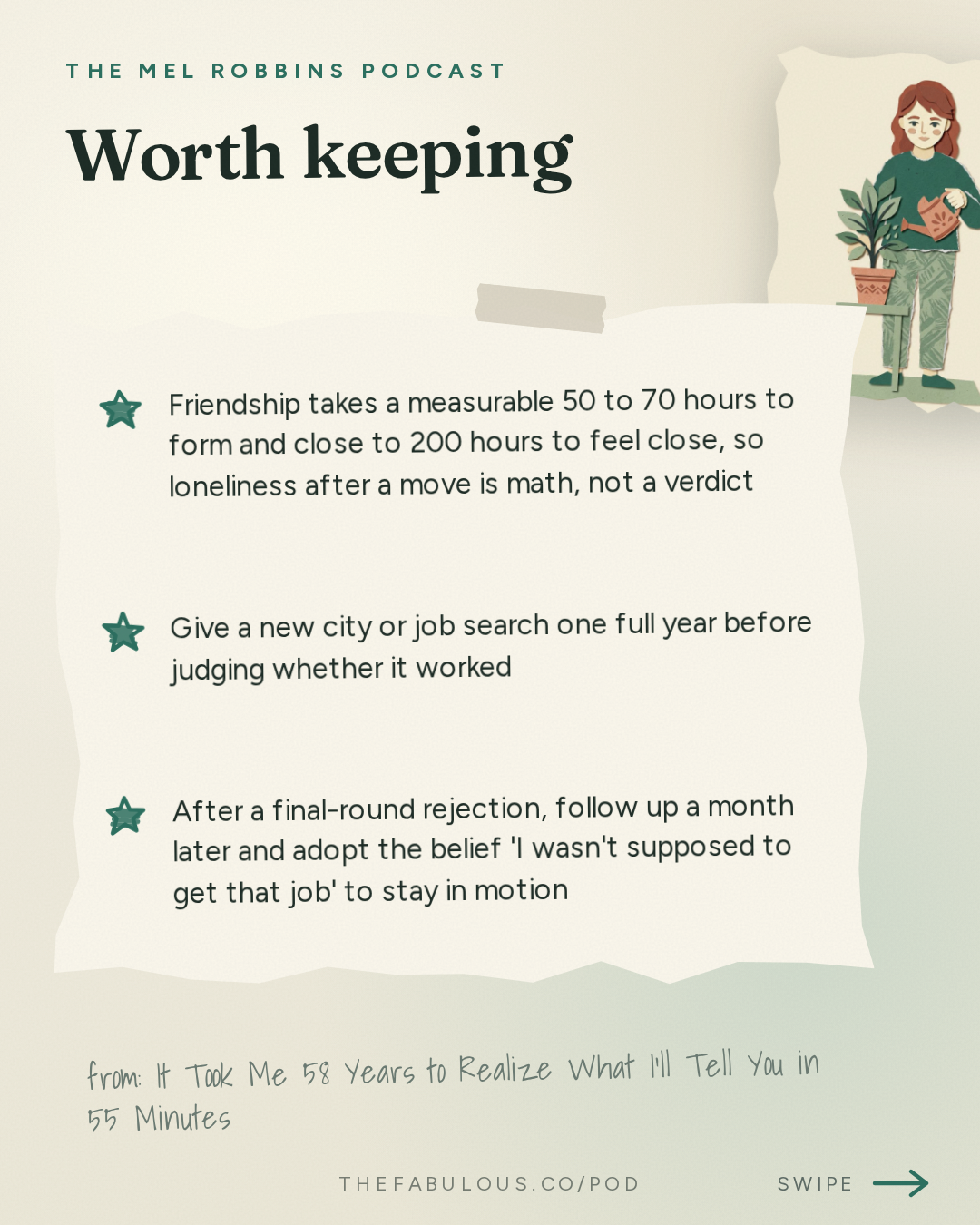
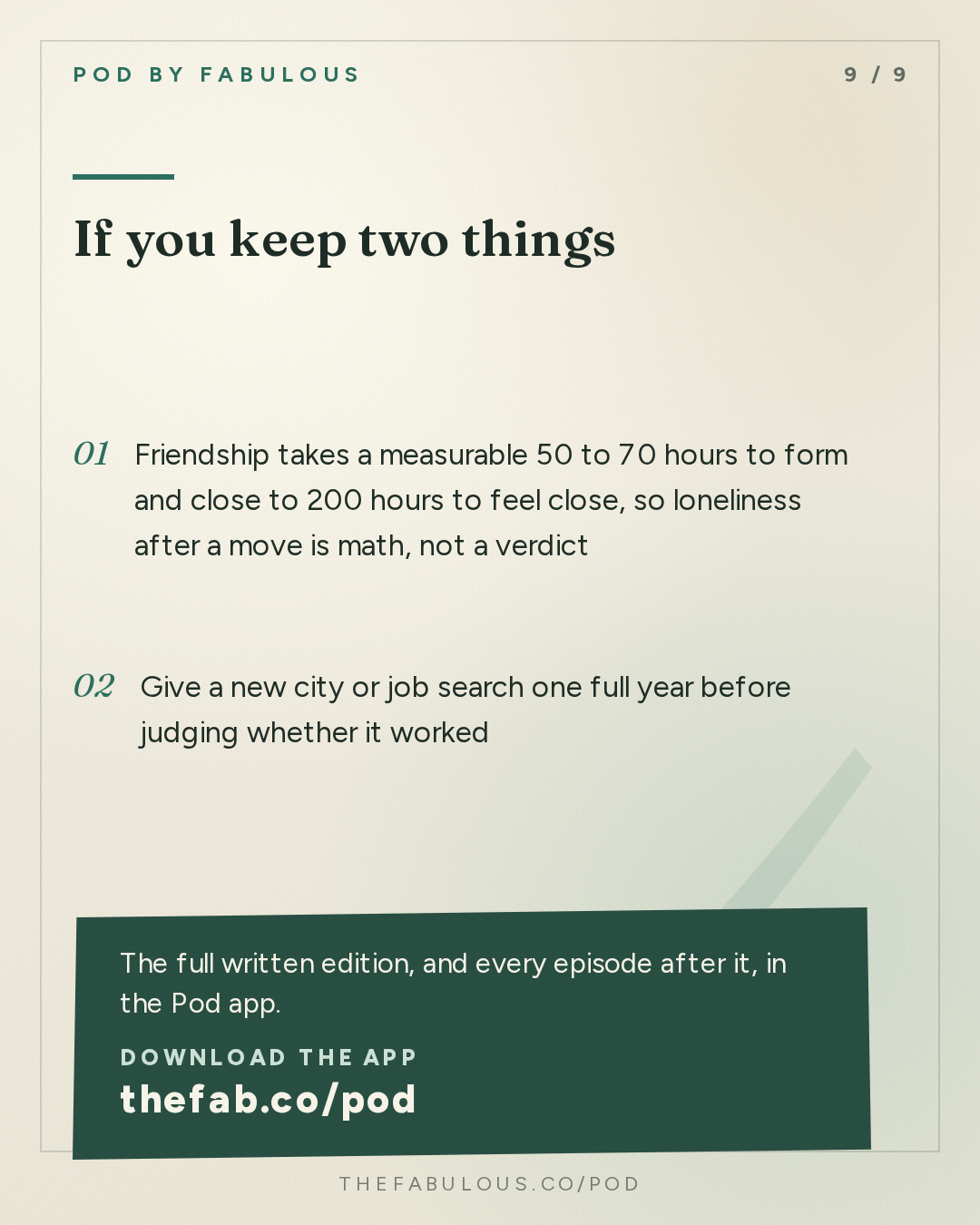
- Friendship takes a measurable 50 to 70 hours to form and close to 200 hours to feel close, so loneliness after a move is math, not a verdict (05:41)
- Give a new city or job search one full year before judging whether it worked (05:14)
- After a final-round rejection, follow up a month later and adopt the belief 'I wasn't supposed to get that job' to stay in motion (13:52, 14:59)
- Use the deathbed test, imagining who surrounds you at life's end, to decide on children or other major life choices (24:24)
- Build a morning routine of small kept promises, like making the bed and delaying caffeine, to train self-trust before the day gets chaotic (44:08)
The episode in cards
By the numbers
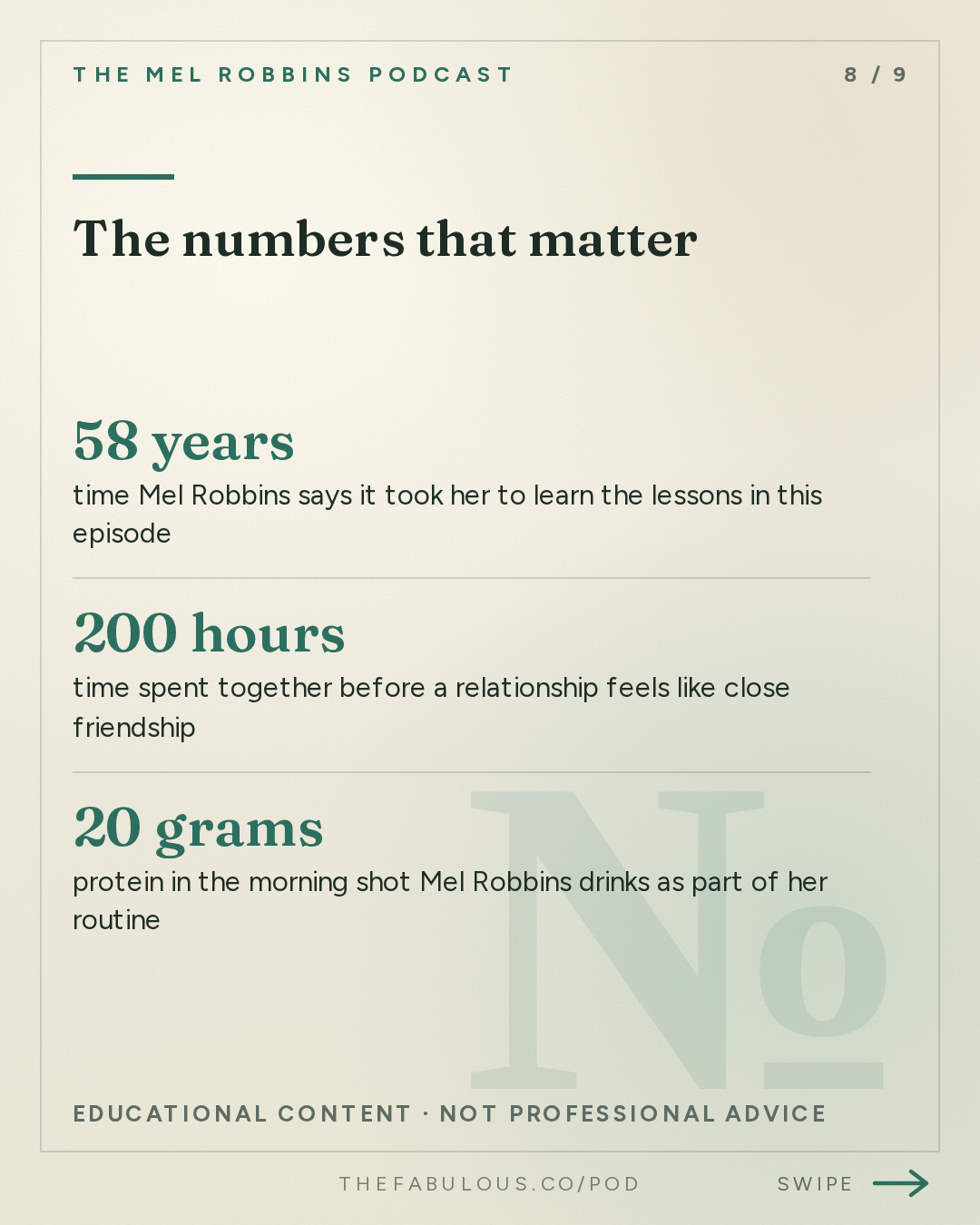
- 58 years time Mel Robbins says it took her to learn the lessons in this episode
- 200 hours time spent together before a relationship feels like close friendship
- 20 grams protein in the morning shot Mel Robbins drinks as part of her routine
In their words
“I didn't get that job because I wasn't supposed to.”
“Intention sets the direction, right? But systems are what will get it done”
“Some of your new best friends should be your old friends.”
“What if it all works out?”
Protocols
-
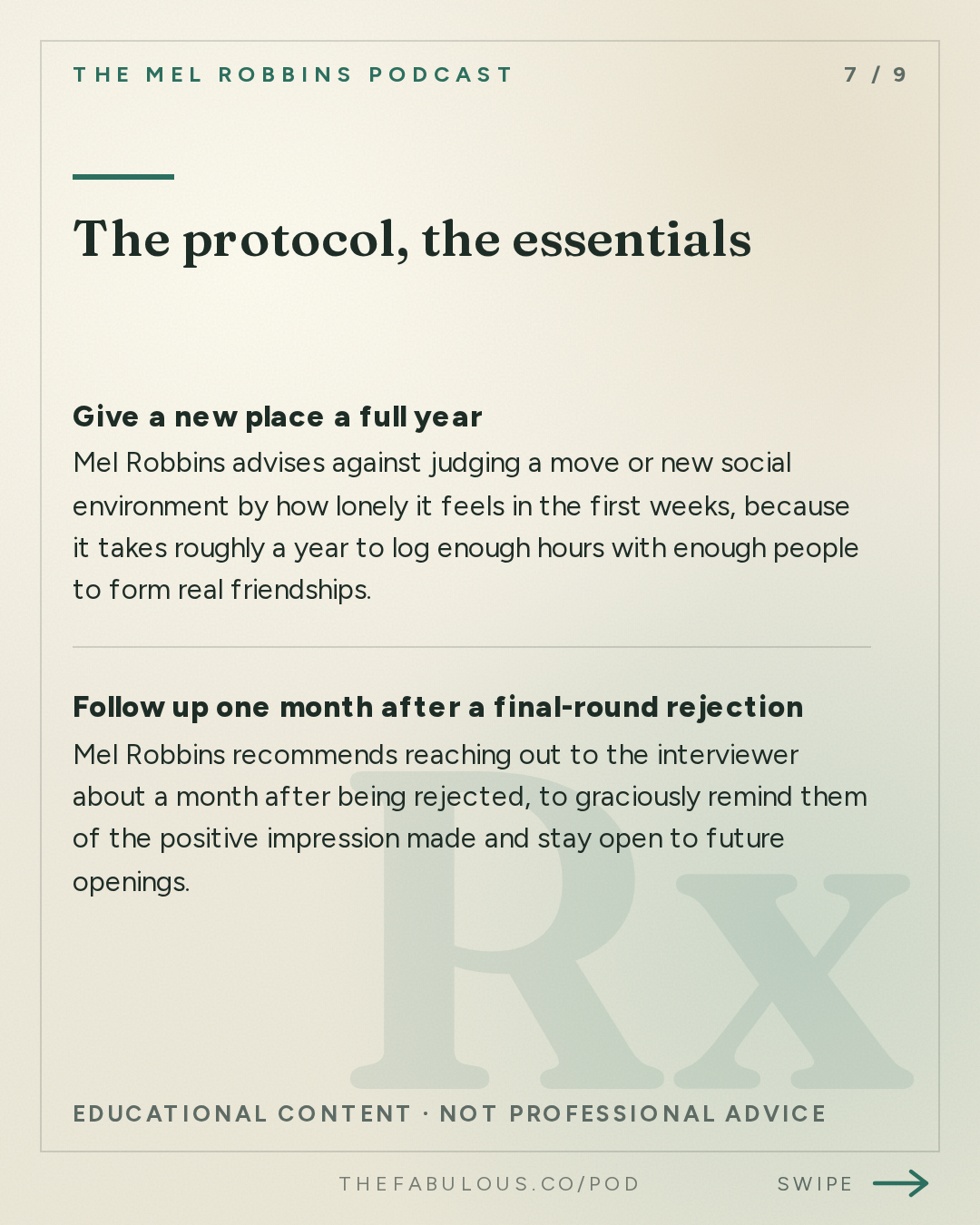
Give a new place a full year
Mel Robbins advises against judging a move or new social environment by how lonely it feels in the first weeks, because it takes roughly a year to log enough hours with enough people to form real friendships.
one-time, over a 12-month window
-
Follow up one month after a final-round rejection
Mel Robbins recommends reaching out to the interviewer about a month after being rejected, to graciously remind them of the positive impression made and stay open to future openings.
once, roughly 30 days after rejection
-
Run the deathbed test before a major life decision
Mel Robbins suggests closing your eyes and imagining who is present at the end of your life, then using that image, rather than present-day logistics, to decide questions like whether to have children.
as needed, before major irreversible decisions
-
Run the Perfect Day exercise for career clarity
Mel Robbins describes closing your eyes, time traveling ten years into the future, and imagining an ideal ordinary day in sensory detail, using whatever images surface as clues to what you actually want now.
as needed, when feeling stuck in a career
-
Build a seven-step morning routine of kept promises
Mel Robbins follows a routine of getting up without checking the phone, making the bed, setting an intention in the mirror, putting on exercise clothes laid out the night before, drinking a protein and fiber shot, drinking water before coffee to let adenosine clear, and walking outside for daylight, treating each step as a promise kept to herself.
daily
Questions this episode answers
How long does it actually take to make a new friend?
Research cited by Mel Robbins found it takes between 50 and 70 hours with someone before a relationship starts to feel like friendship, and close to 200 hours before it feels like close friendship (05:41). She recommends giving a new city or social environment a full year before judging whether it worked (05:14).
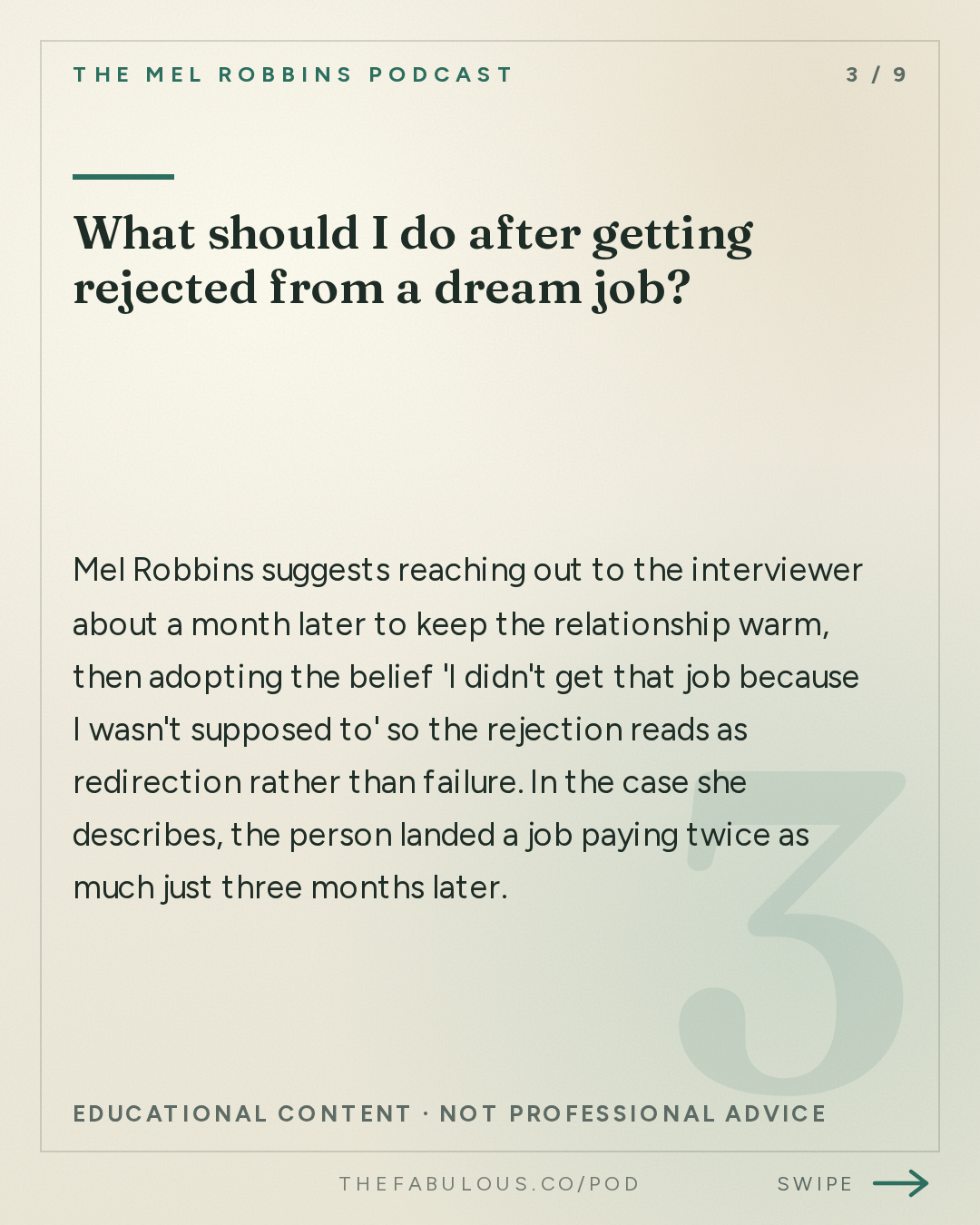
What should I do after getting rejected from a dream job?
Mel Robbins suggests reaching out to the interviewer about a month later to keep the relationship warm, then adopting the belief 'I didn't get that job because I wasn't supposed to' so the rejection reads as redirection rather than failure (13:52, 14:59). In the case she describes, the person landed a job paying twice as much just three months later (15:36).
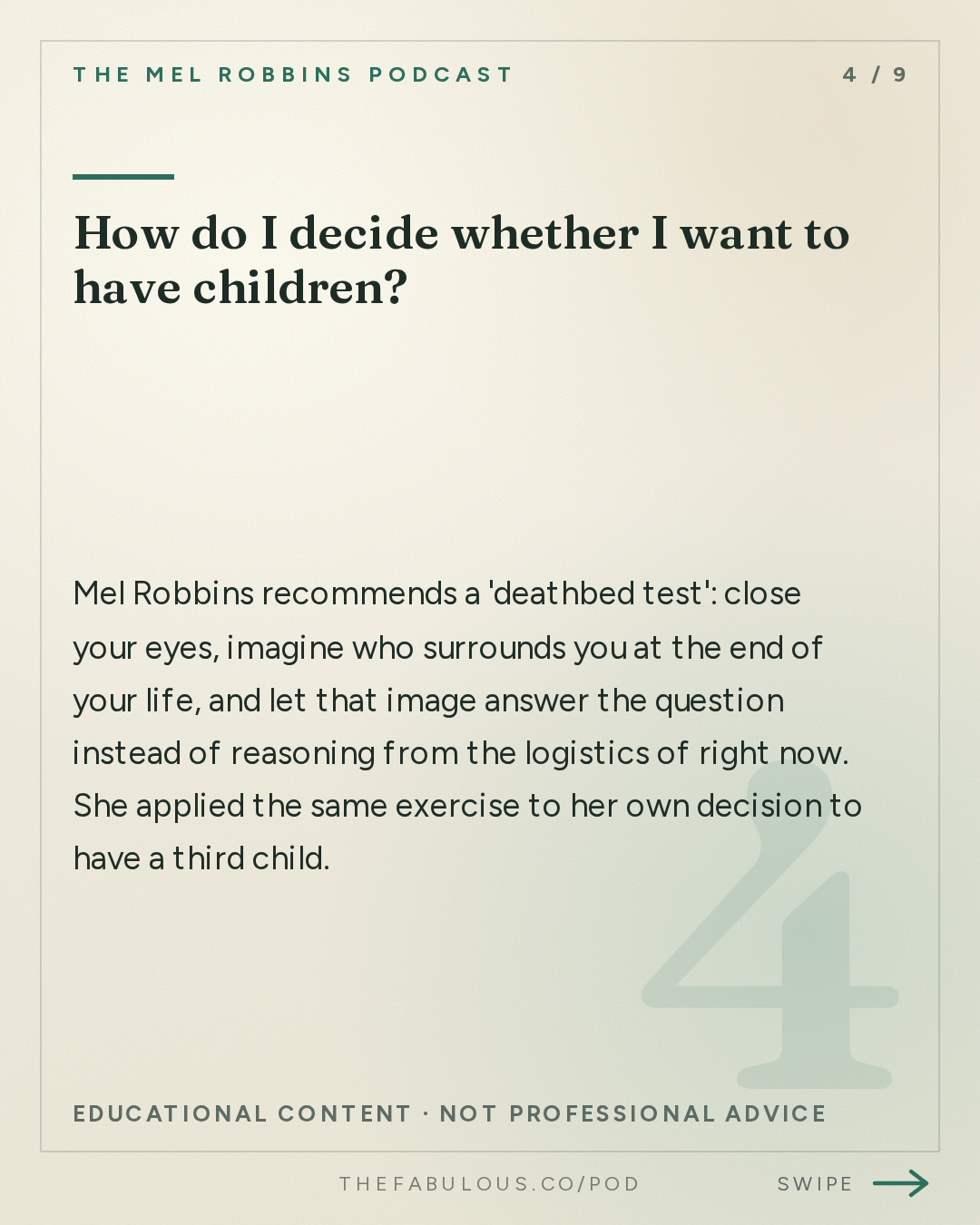
How do I decide whether I want to have children?
Mel Robbins recommends a 'deathbed test': close your eyes, imagine who surrounds you at the end of your life, and let that image answer the question instead of reasoning from the logistics of right now (24:24). She applied the same exercise to her own decision to have a third child (24:52).
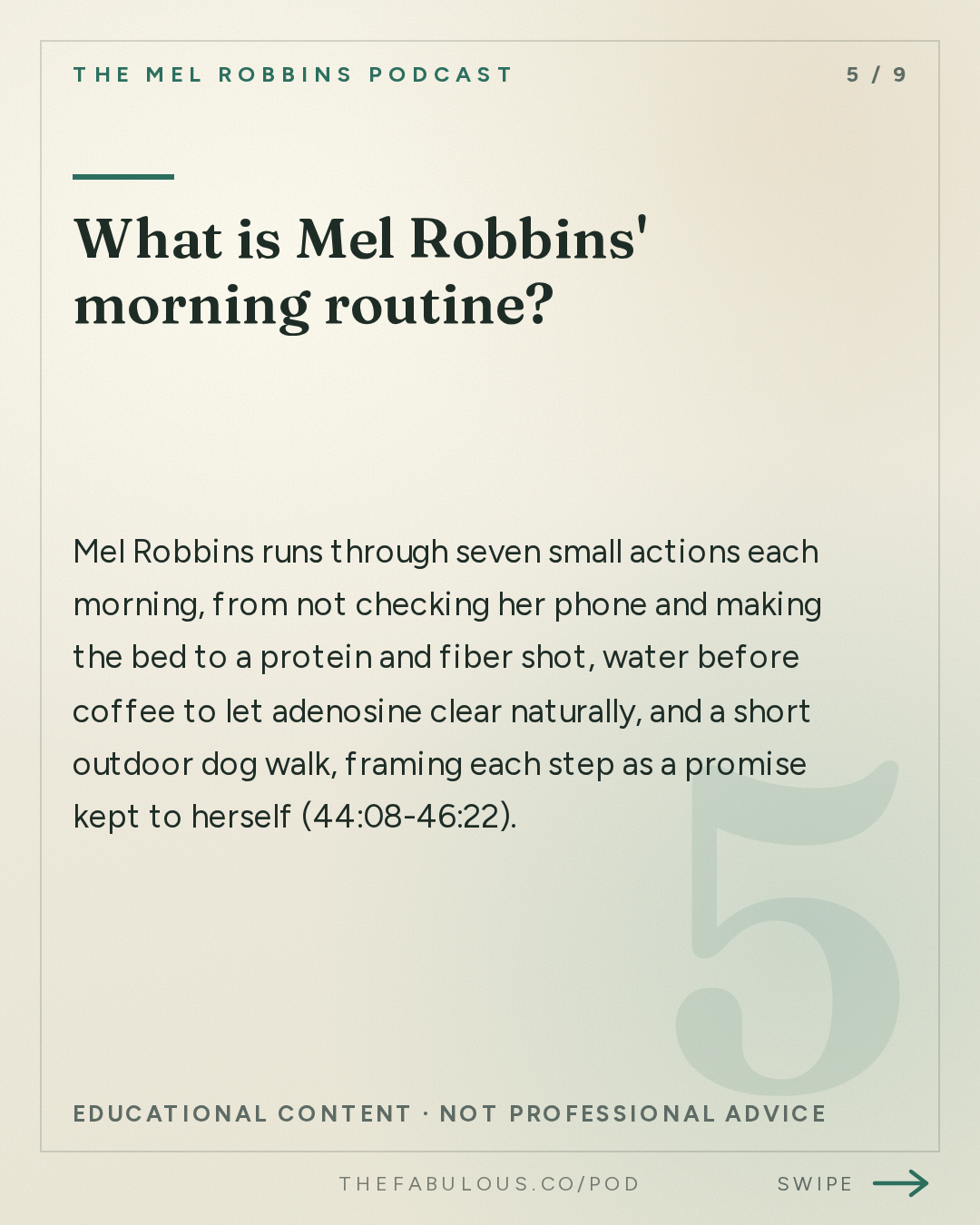
What is Mel Robbins' morning routine?
Mel Robbins runs through seven small actions each morning, from not checking her phone and making the bed to a protein and fiber shot, water before coffee to let adenosine clear naturally, and a short outdoor dog walk, framing each step as a promise kept to herself (44:08-46:22).
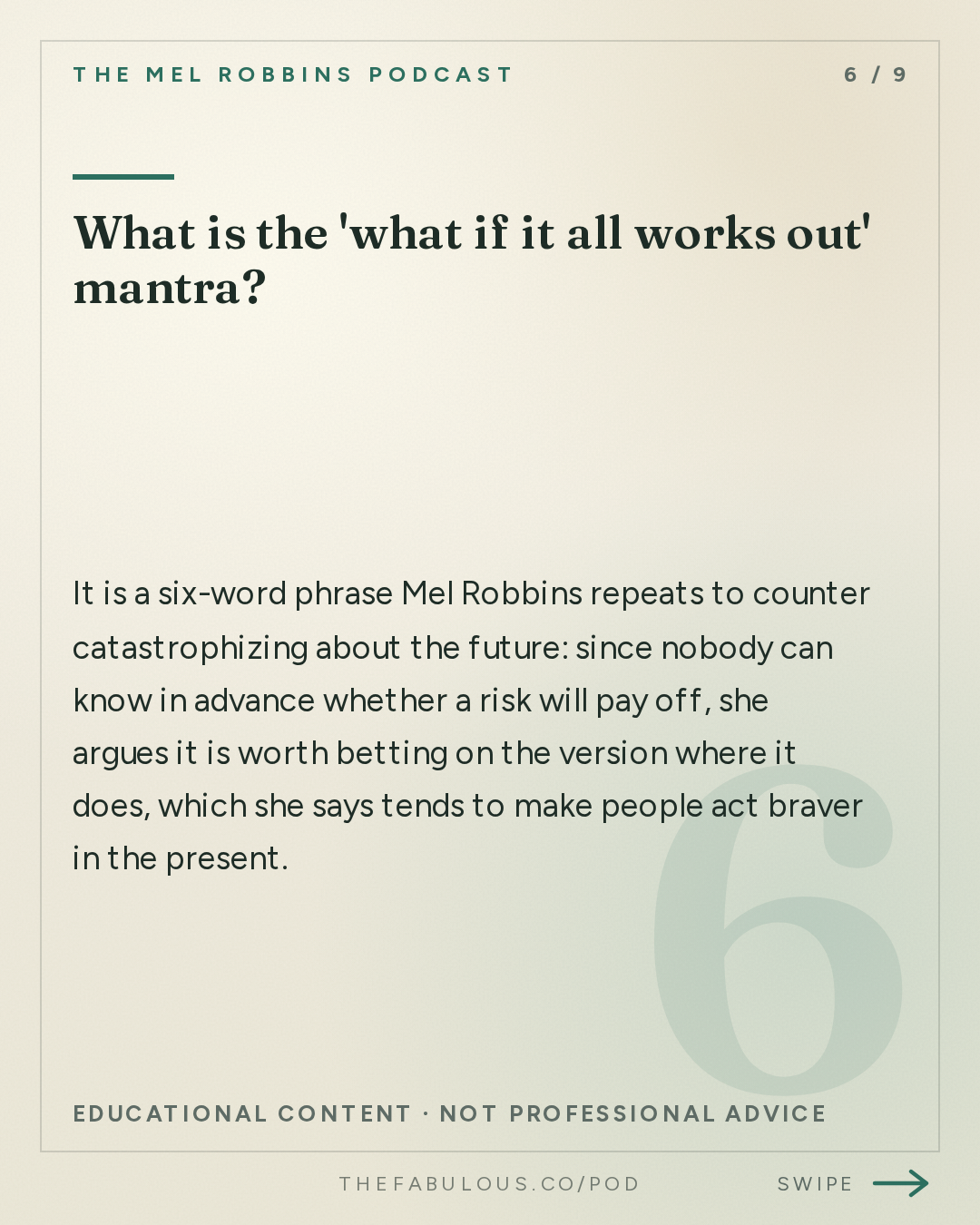
What is the 'what if it all works out' mantra?
It is a six-word phrase Mel Robbins repeats to counter catastrophizing about the future: since nobody can know in advance whether a risk will pay off, she argues it is worth betting on the version where it does, which she says tends to make people act braver in the present (49:16).
The full read, in cards
Go deeper
- Friendship formation research (hours-to-friendship study) — found it takes 50 to 70 hours to feel like friends and close to 200 hours to feel like close friends
- Perfect Day exercise — visualization technique from a prior podcast conversation with author Martha Beck, used to clarify career and life direction
Mentioned
Mel Robbins · Ben · Survivor · Adam Grant · Wharton School of Business · Martha Beck · Atomic Habits · The Psychology of Money · The Let Them Theory
More from this show and category
Vinh Giang's Guide to Confident Communication
Communication coach Vinh Giang coaches three podcast staffers live to tame shaky voices, stop interrupting, and speak up in groups. His toolkit: star jumps to burn adrenaline, a four-archetype vocal scale from Friend to Coach, and games that force listening before responding.
Vinh Giang's 9 Habits for Clearer Speaking
Communication expert Vinh Giang says insecurity in speech comes from rambling, filler words, and non-functional body language, not a lack of things to say. He teaches a 3-2-1 framework for structuring answers, a 3 to 5 second pause before tough questions, and control of posture, volume, and vocal melody so speakers sound, then feel, confident.
PMOS vs PCOS: New Diagnosis Criteria Explained
OBGYN Dr. Thais Aliabadi argues that PCOS (now renamed PMOS), endometriosis, and PMDD are routinely misdiagnosed as anxiety or stress. She traces each to a physical mechanism, insulin resistance, immune dysfunction, hormone-sensitive brain circuits, and gives exact diagnostic criteria and treatments, including a new blood test and a window-dosed SSRI protocol.
Tyrer-Cuzick Breast Cancer Risk Calculator Explained
OB-GYN Dr. Thais Aliabadi shows how a free two-minute risk calculator and annual pelvic ultrasounds can catch breast and ovarian cancer early. She shares her own breast cancer diagnosis, explains the Tyrer-Cuzick tool, genetic testing by age 25, fallopian tube removal to cut ovarian cancer risk, and decade-by-decade screening protocols for heart disease and dementia.
