
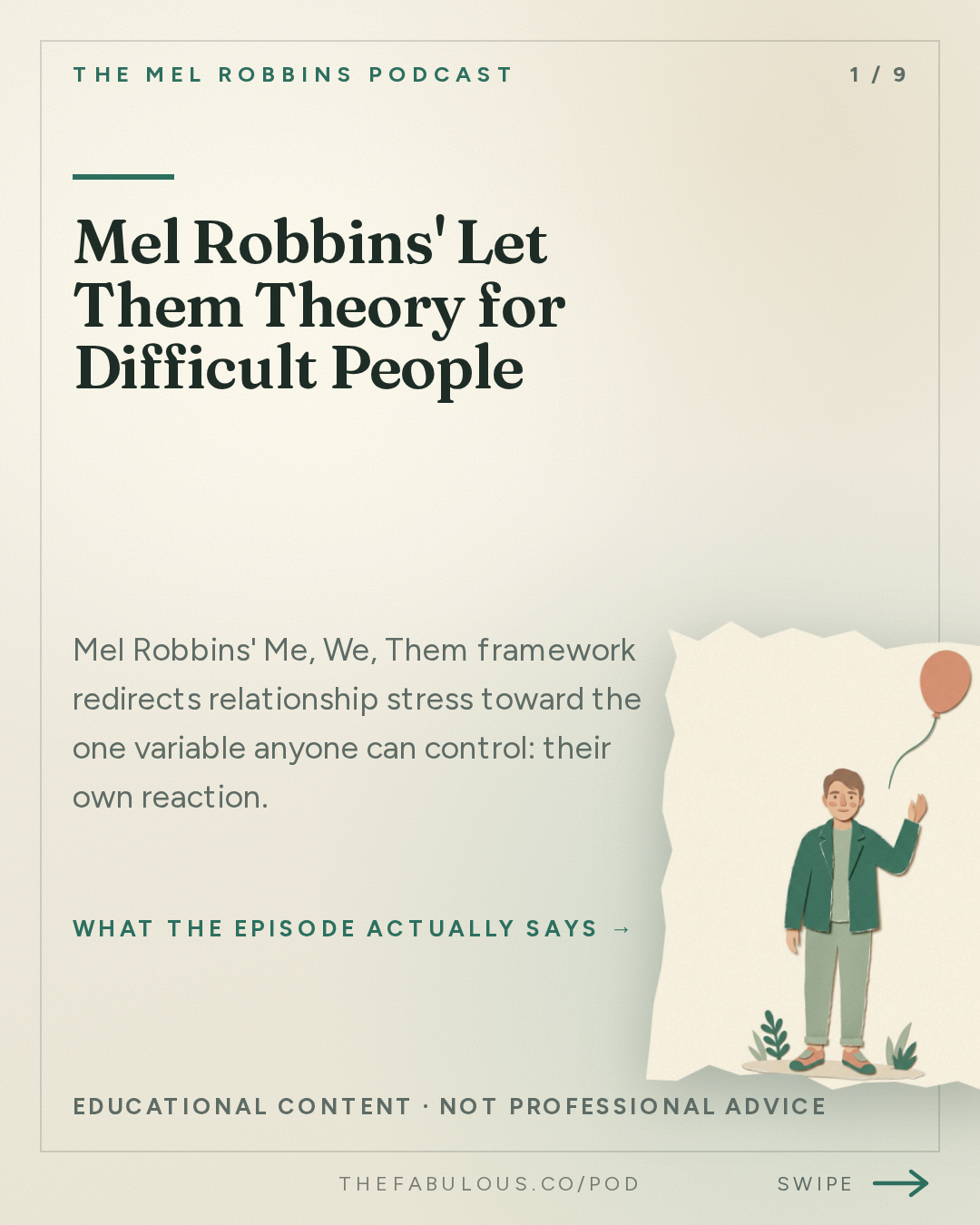
Mel Robbins' Let Them Theory for Difficult People
Let Them: How to Handle Difficult People & Take Back Your Peace and Power
▶ Listen to the full episode More from The Mel Robbins Podcast
The brief
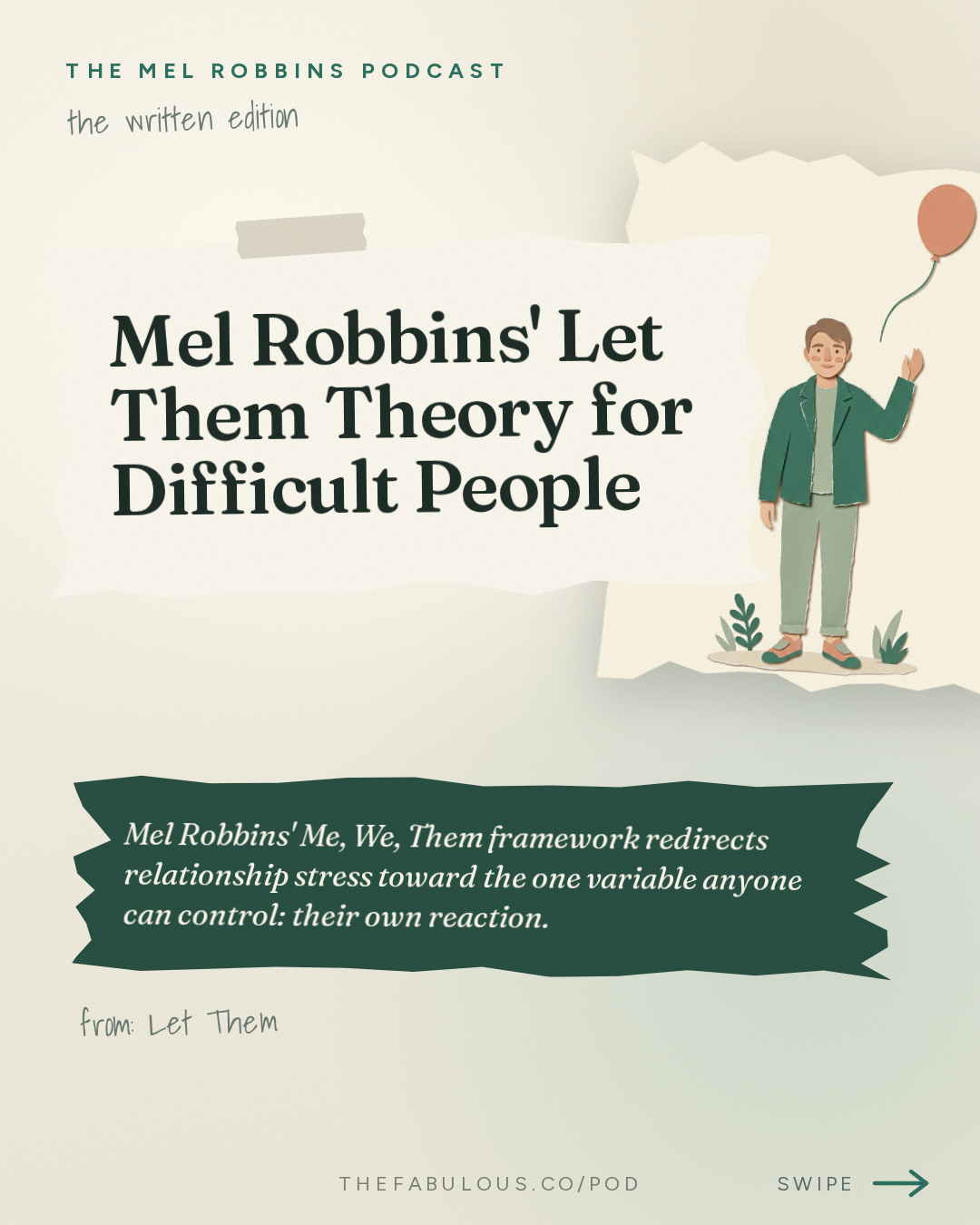
Mel Robbins' Me, We, Them framework redirects relationship stress toward the one variable anyone can control: their own reaction. She names three habits that wreck relationships (expecting others to change, letting their behavior dictate your mood, assuming they 'should' know what you need) and offers a script from therapist Terry Real for saying the hard thing without blame.
Ask this episode anything
Pod's AI answers from the episode itself, with the minute mark so you can hear it yourself.
Or start with one of these
Ask this episode
Pod's AI listens to the whole episode to answer, and points you to the minute it comes from.
The rest of this answer, and any question after it
Answers come from the episode itself, never from a summary of it.
Continue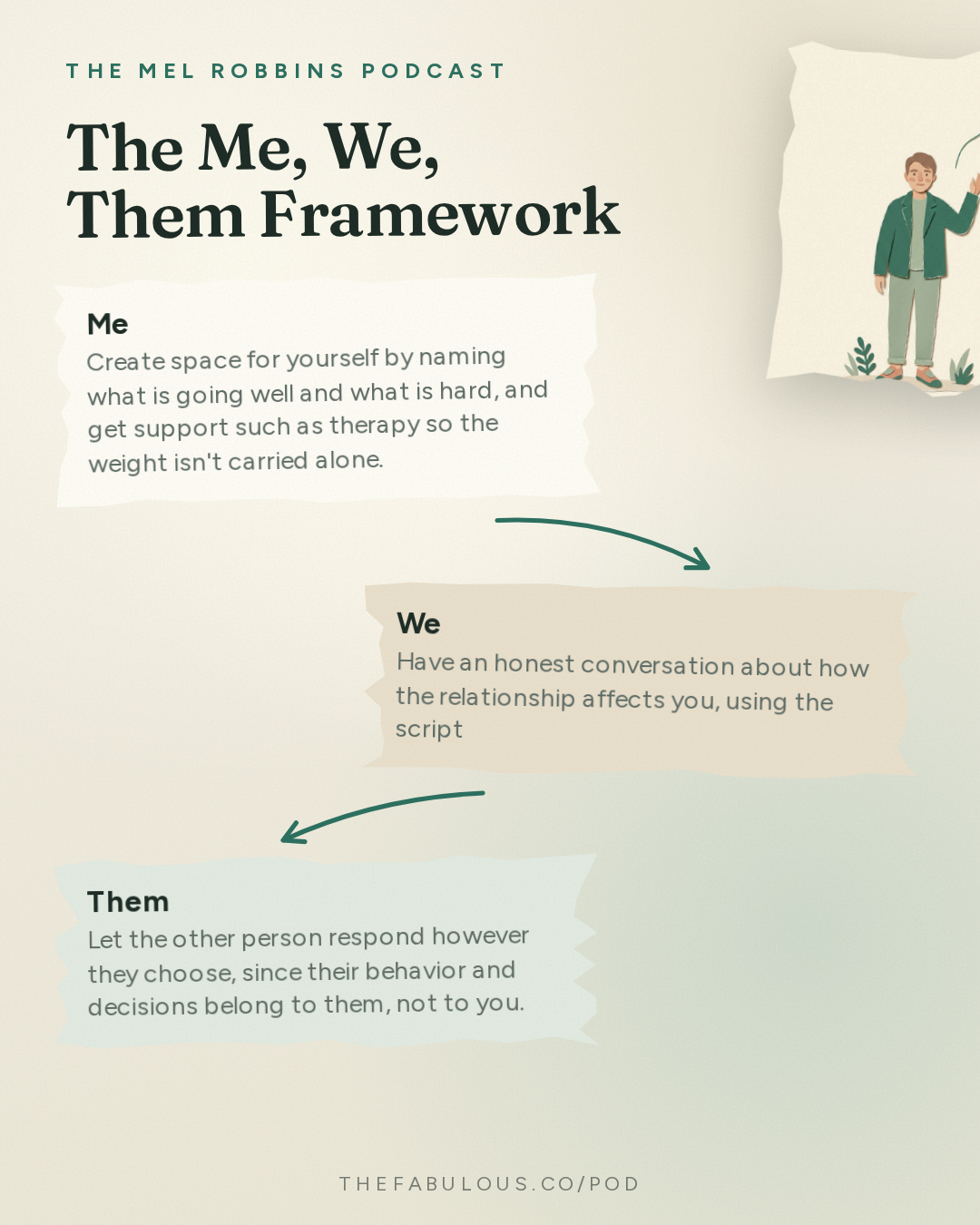
Key takeaways
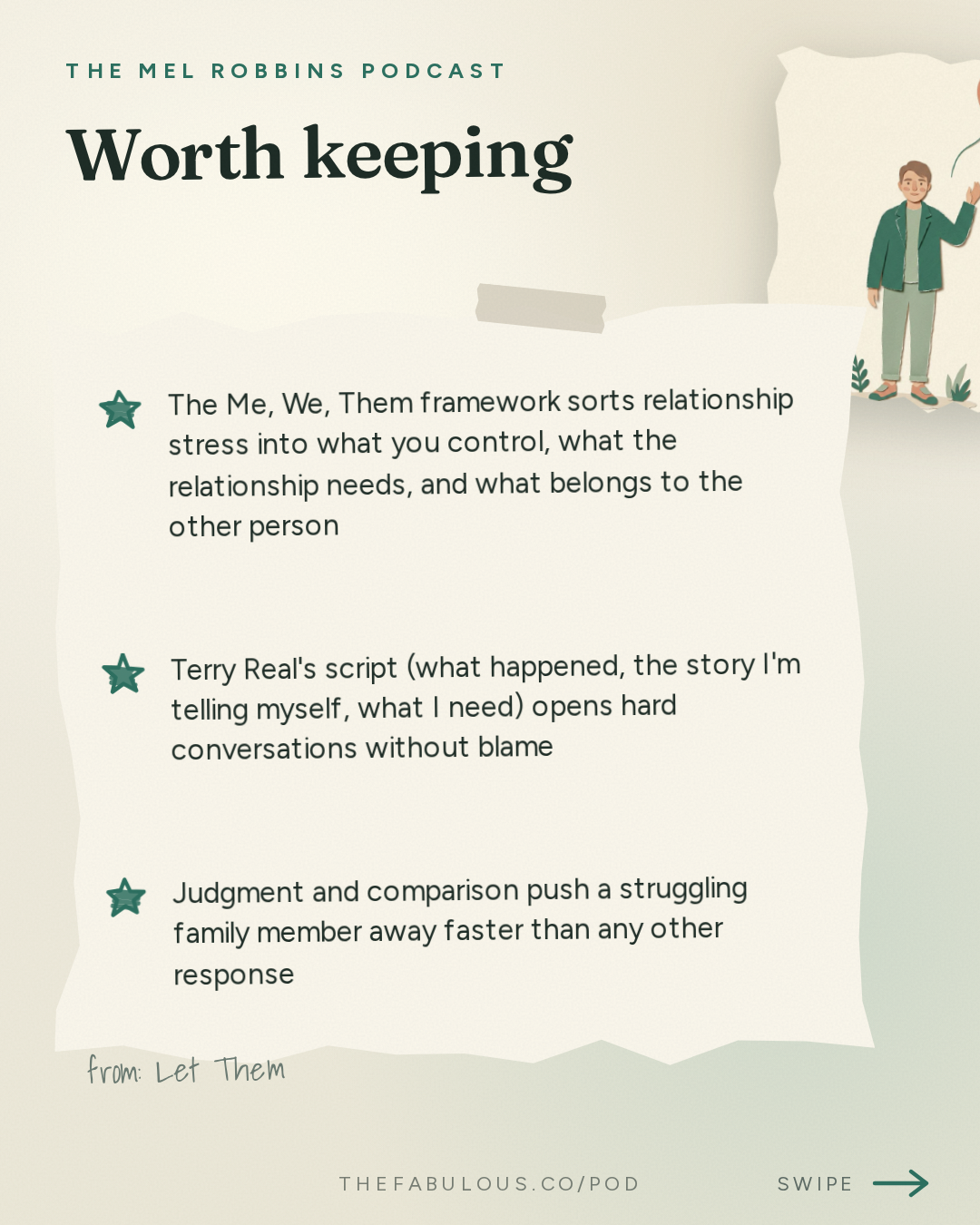
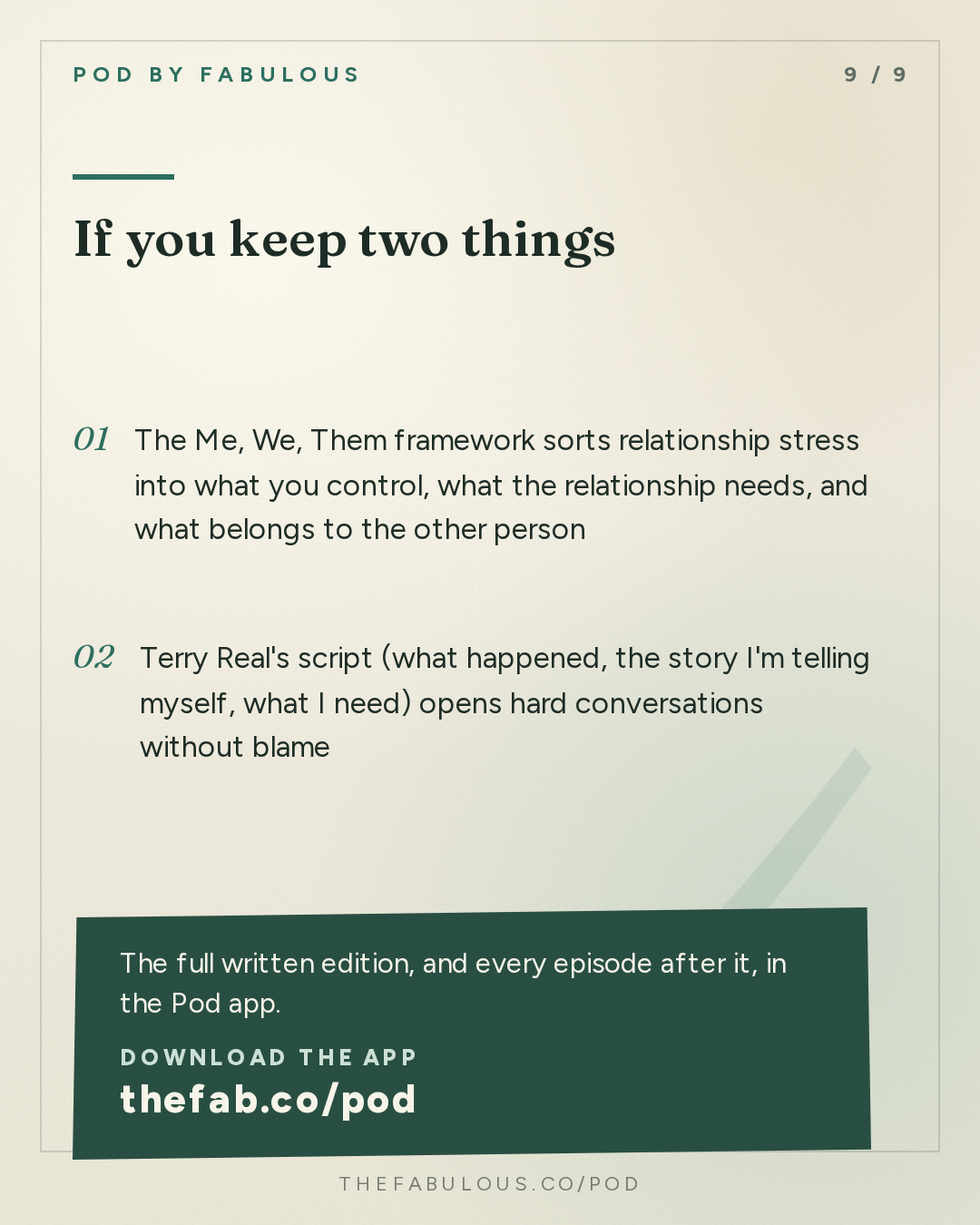
- The Me, We, Them framework sorts relationship stress into what you control, what the relationship needs, and what belongs to the other person
- Terry Real's script (what happened, the story I'm telling myself, what I need) opens hard conversations without blame (13:11)
- Judgment and comparison push a struggling family member away faster than any other response (25:08)
- Asking if someone could do something, instead of assuming they should, prevents resentment built on mind reading (42:53)
- Family visits often sour after three days, so changing the setting or leaving early can protect the relationship (39:27)
The episode in cards
Seven empty water glasses, scattered across a one-bedroom apartment, do not sound like the raw material for a crisis of faith in a relationship. But that is exactly what they became for one woman, according to a story Mel Robbins tells midway through this episode. Her boyfriend kept leaving glasses everywhere, and somewhere between the second glass and the seventh, the mess stopped being a mess. It became evidence. Evidence that he didn't respect her, that he thought she was the maid, that he simply didn't care (43:53). Nothing about the water had changed. Everything about the story she was telling herself had.
That gap, between what someone does and what we decide it means, is the real subject of this hour. Robbins, the host of The Mel Robbins Podcast and author of The Let Them Theory, a book she says more than 11 million people read in its first year (00:28), returns to the idea she is best known for and applies it to the question she gets asked more than any other: what do you do about the genuinely difficult people in your life? Not strangers. The mother who won't take her medication. The adult son who seems stuck. The friend who turned cruel. The stepmother who runs the house like a customs checkpoint.
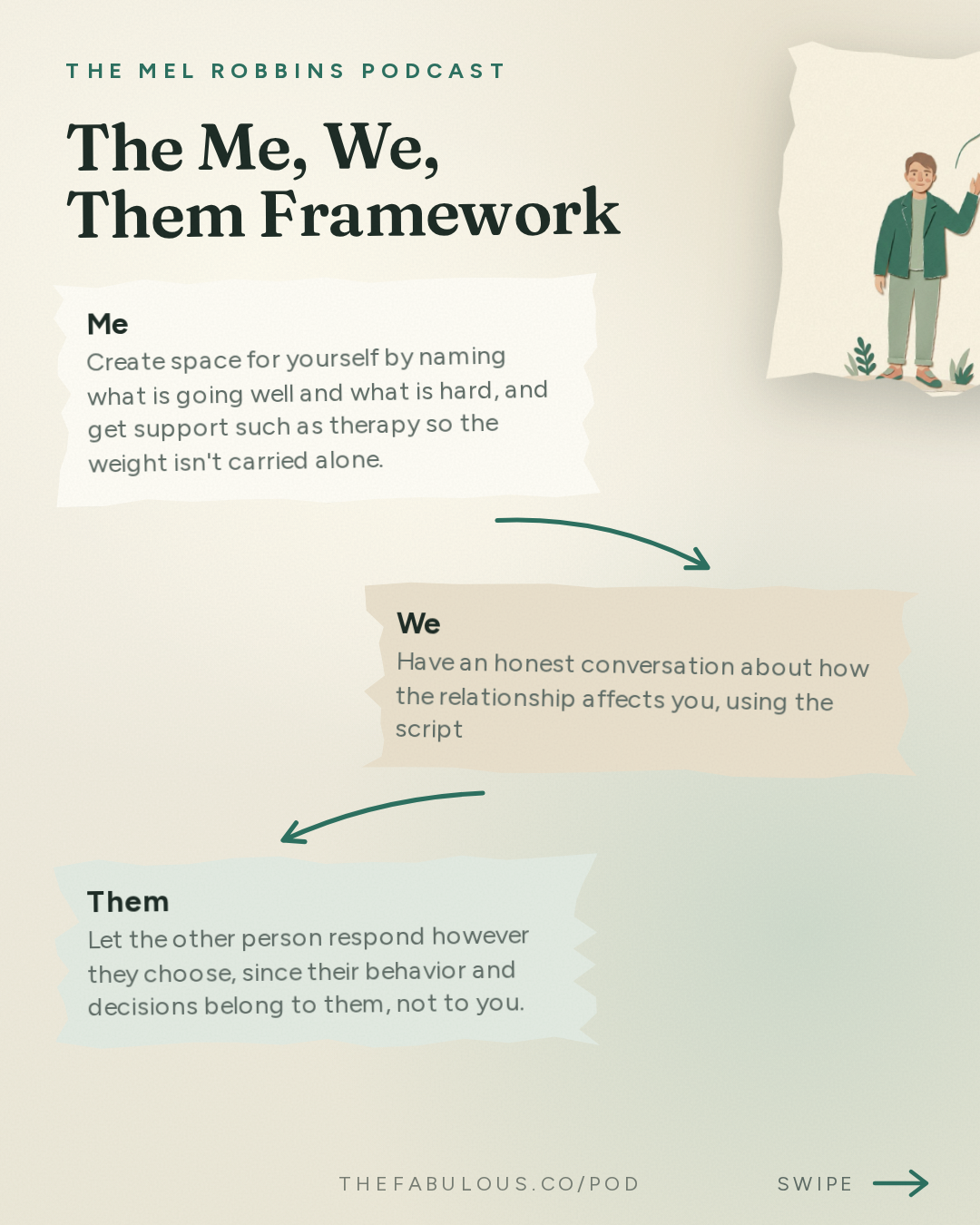
Robbins' answer starts with a blunt diagnosis: most of us are making the same three mistakes. We expect other people to change. We let their behavior control our own. And we assume they 'should' already know what we need, which quietly requires them to read our minds (42:53). Her fix is a three-part sorting tool she calls Me, We, Them: what can I control about myself, what can I control about the relationship, and what belongs entirely to the other person and is therefore not mine to carry (10:41). The Let Them theory, she reminds listeners, was never permission to give up on people. It is a boundary that shows what is actually in your control and what never was (11:07).
The clearest test case is a listener named Teresa, a school administrator who comes home each night to a second job: managing her 68-year-old mother's diabetes and liver disease, a mother who cancels doctor's appointments and eats frozen burritos instead of the meals Teresa cooks (07:19). Teresa's question, in her own words, was how to support her mother 'without losing myself in the process' (08:21). Robbins' answer is to stop trying to force the mother to change and start using the framework. The Me part means naming what's going well (Teresa is showing up, and that says something good about her) and getting support so she isn't carrying the weight alone. The We part means one honest conversation about how the relationship affects Teresa, not another lecture about what her mother should be eating.
"If you change nothing, nothing changes." — Mel Robbins [10:18]
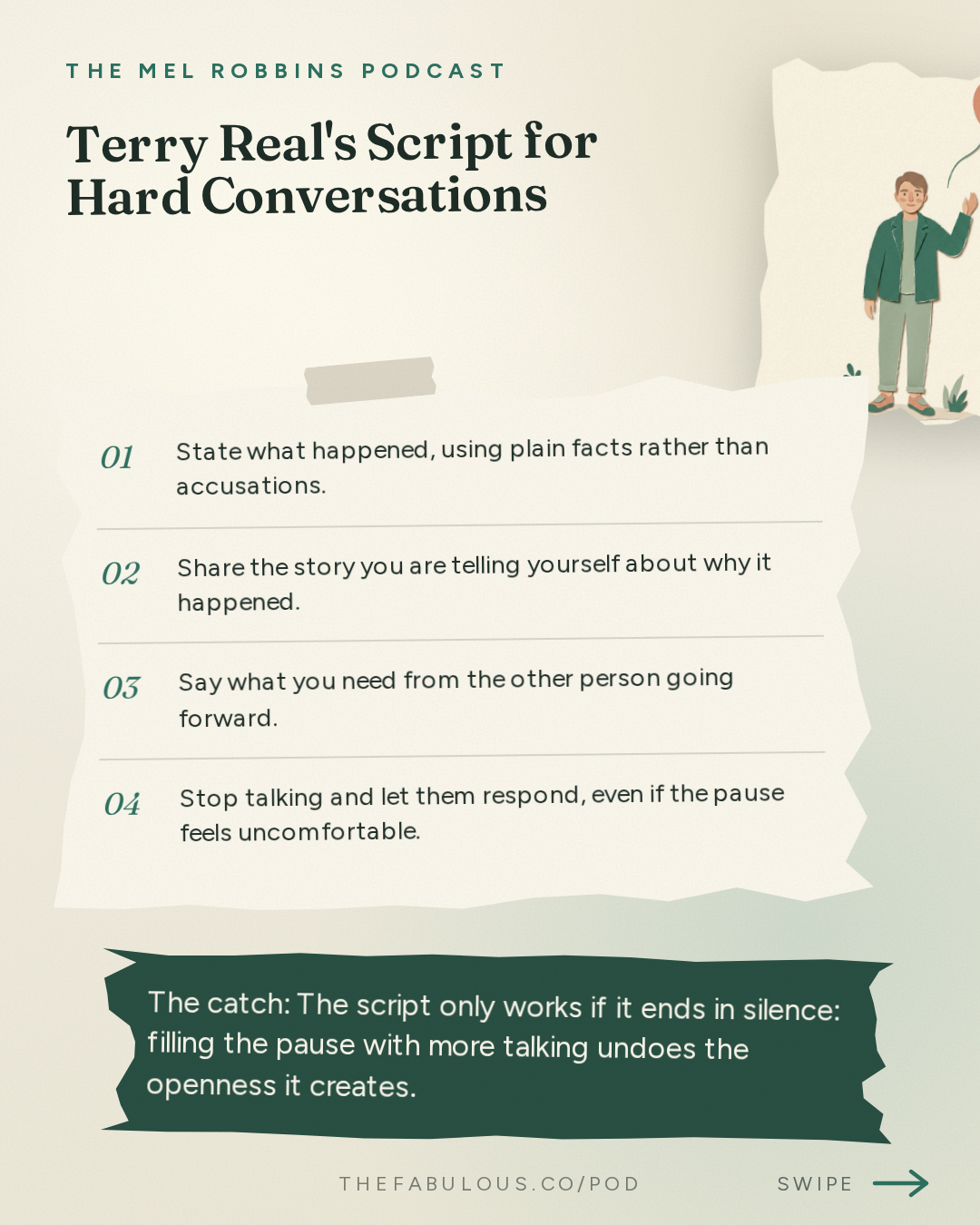
For that We conversation, Robbins borrows a formula from therapist Terry Real, who has appeared on the podcast before: state what happened, then the story you are telling yourself about it, then what you need (13:11). Applied to Teresa's mother, it might sound like naming the wasted meals and the canceled appointments, saying the story is 'you don't want help,' and asking if that's true. Then, crucially, stopping and letting the other person answer (14:10). If the mother says she just wants to eat what she wants, that answer is the Them part doing its work. Teresa doesn't have to like it. She does have to let it stand.
"Give her the dignity of her own experience, and give yourself your life back." — Mel Robbins [17:22]
When the Relationship Is Already Over
Not every situation needs all three steps. A listener named Serena wrote in about a friend of 17 years who, after Serena started making real changes in her life, turned jealous and tried to sabotage her relationships and reputation. Three years after the friendship ended, Serena was still shrinking herself, dressing and posting more cautiously, afraid of being torn down again (30:50). Robbins' point here is sharp: since there is no relationship left, the We step gets crossed off entirely. There is nothing to negotiate with someone who is no longer in the room. What remains is Me (act like the confident person you want to be again) and Them (let her be jealous, let her judge, since her opinion no longer has a vote). "Her behavior three years ago may have controlled you then," Robbins says, "but the problem is it's still controlling your behavior today" (31:50).
A similar logic applies to family gatherings that curdle after a few days. Robbins tells the story of a friend whose stepmother posts a list of house rules on the back of the front door and corrects every visitor's behavior nonstop, turning what should be time with her father into a walk across eggshells (38:07). Robbins' practical fix leans on an old line: fish and family both start to stink after three days (39:27). Her advice is concrete: leave by day three, get a hotel instead of sharing a roof, or meet a difficult relative at a restaurant instead of their house, where the rules and the mood are harder to escape (39:45). The relationship worth protecting, in this case, is with the father, not the stepmother, so the honest conversation goes to him directly.
Should Versus Could
The third mistake, thinking someone 'should' already know what we need, is the one Robbins says she has made in nearly every relationship of her own, including her 30-year marriage to her husband, Chris (45:19). The habit is subtle because it hides inside a double standard: people judge themselves by their intentions but judge everyone else by their behavior (45:44). Snap at someone when exhausted, and it's easy to explain it away. Watch someone else leave seven water glasses around an apartment, and it becomes proof of who they are.
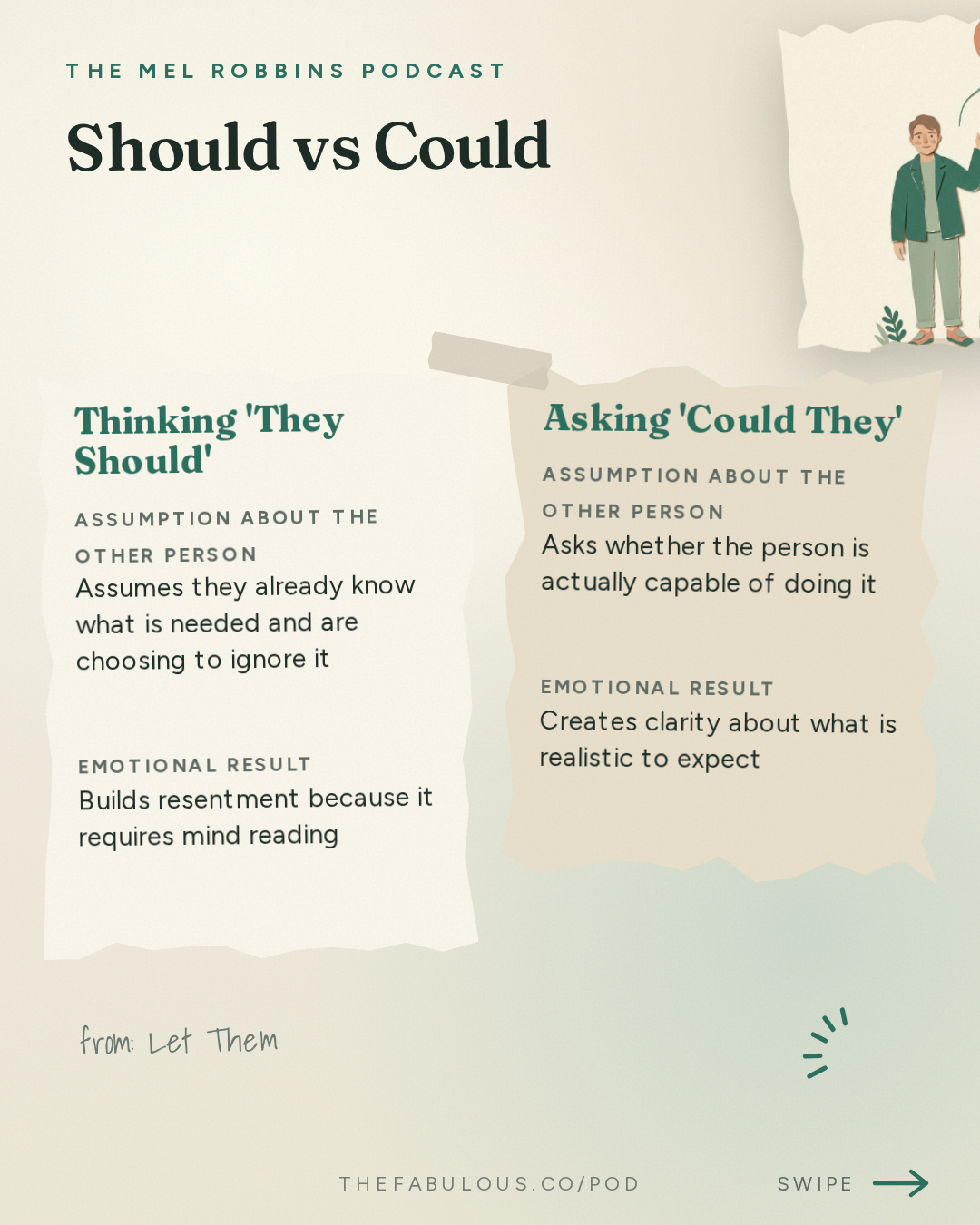
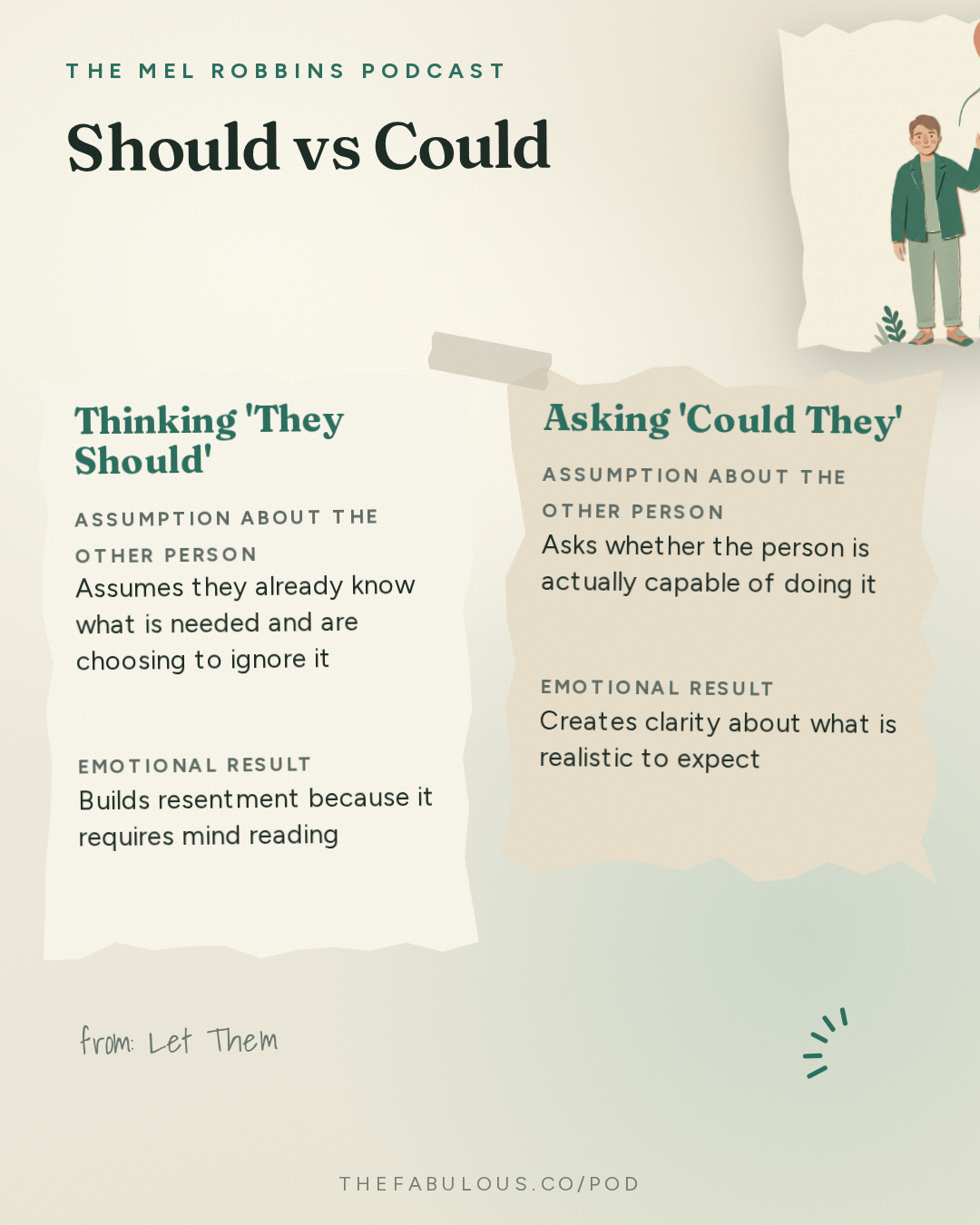
Robbins' proposed swap is to trade 'should' for 'could': instead of assuming someone knows what's needed and is choosing to ignore it, ask whether they are actually capable of doing it. She applies this to her own life, describing a long, frustrating dynamic with someone whose inability to change, she eventually understood through therapy, came from a mental illness rather than indifference (49:00). "It was very helpful for me," she says, "to really stop saying they should, and understand that they can't, because they're not capable of making the changes that I deserve to have made" (49:28). That distinction, between won't and can't, doesn't erase the hurt, but it changes what a person does next: negotiate, or accept.
"The dance feels different when you're no longer dancing on eggshells." — Mel Robbins [41:44]
By the end of the hour, the framework has been run through a caregiving crisis, a stalled adult child, a betrayal by an old friend, an overbearing stepmother, and a pile of dirty water glasses, and it holds up across all of them because it never asks anyone to fix another person. It asks them to sort the mess into three piles: what's mine, what's ours to talk about honestly, and what's theirs to decide. Robbins is careful to say the goal was never to turn a difficult person into an easy one. "The goal," she says, "is to stop making your life harder because they're difficult" (51:41). That's a smaller promise than transformation, and a more honest one. Nobody in this episode gets a rescued mother, a fixed son, or an apology from an old friend. What they get, if the framework works, is their own attention back.
By the numbers
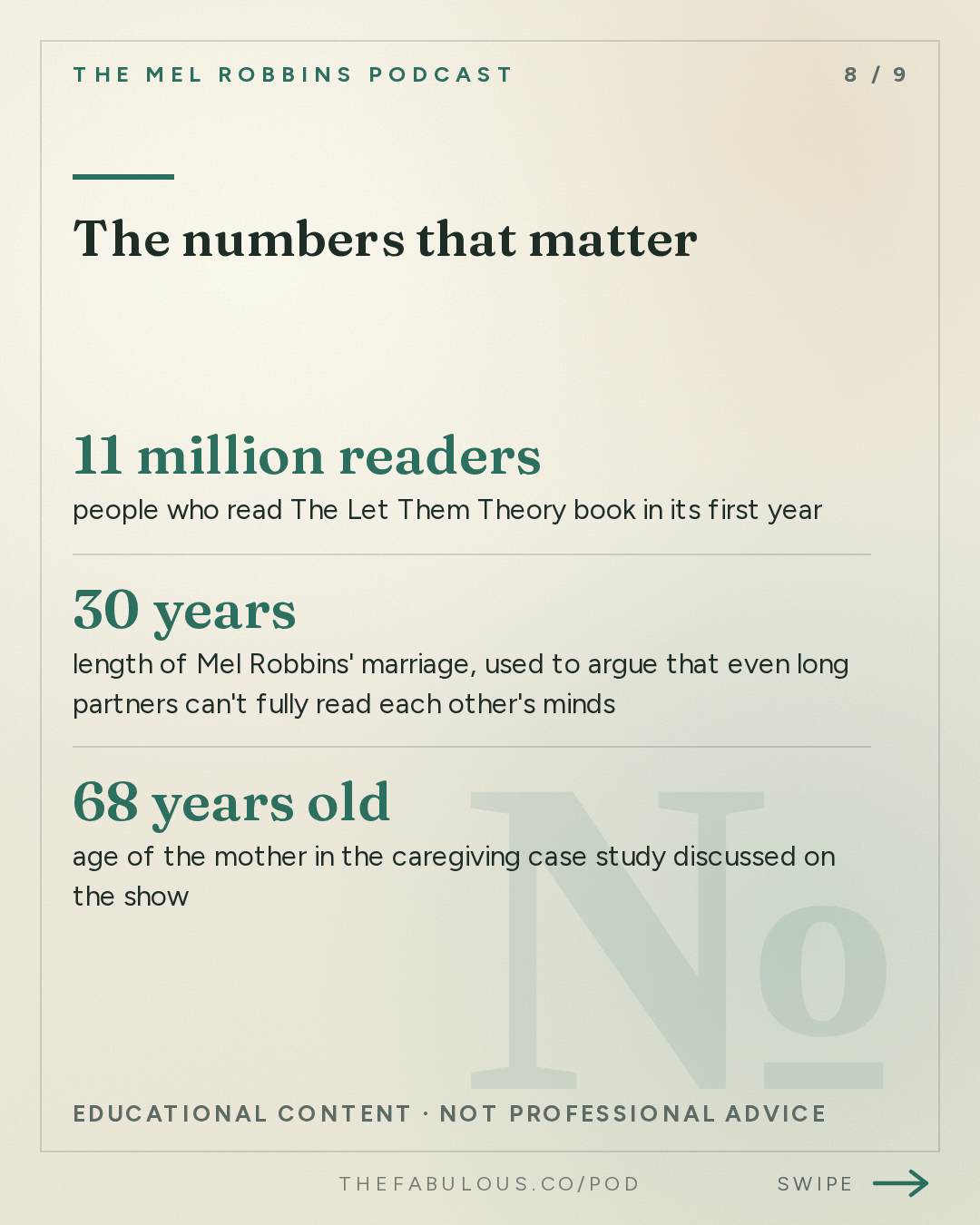
- 11 million readers people who read The Let Them Theory book in its first year
- 30 years length of Mel Robbins' marriage, used to argue that even long partners can't fully read each other's minds
- 68 years old age of the mother in the caregiving case study discussed on the show
In their words
“If you change nothing, nothing changes.”
“Give her the dignity of her own experience, and give yourself your life back.”
“People change when they're willing to do the work to change for themselves.”
“The dance feels different when you're no longer dancing on eggshells.”
Protocols
-
Open a hard conversation with Terry Real's script
Mel Robbins recommends saying three things in order: what happened, the story you are telling yourself about it, and what you need from the other person. The catch, she says, is that after stating the need, you have to stop talking and let the other person respond, even if the pause feels uncomfortable or the answer disappoints you.
Use whenever a relationship dynamic needs to be addressed directly
-
Leave before day three of a tense family visit
Mel Robbins advises ending a multi-day family gathering, or changing its setting to a restaurant or hotel, once the dynamic turns tense, since she says both fish and family start to stink after three days. The catch is that this decision works best made in advance, not in the middle of an argument.
Applies to any multi-day stay with family members prone to friction
-
Ask 'could they' before assuming 'they should'
Mel Robbins tells listeners to replace the assumption that someone already knows what is needed and is choosing to ignore it with the question of whether that person is actually capable of it. The catch is that if someone is not capable, because of addiction or mental illness, no amount of conversation will produce the change, so the response has to shift from confrontation to acceptance.
Apply before confronting anyone about an unmet expectation
Questions this episode answers
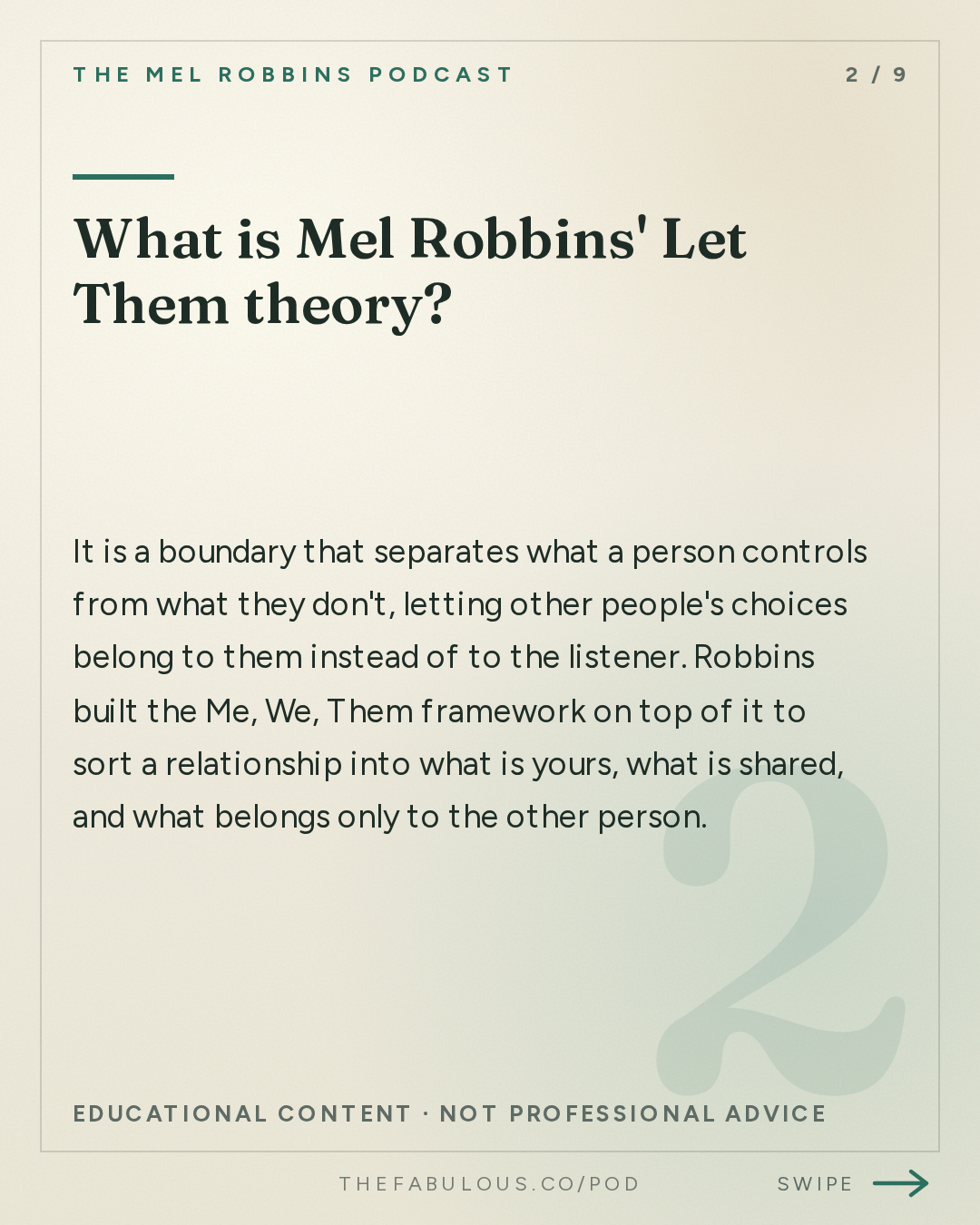
What is Mel Robbins' Let Them theory?
It is a boundary that separates what a person controls from what they don't, letting other people's choices belong to them instead of to the listener (11:07). Robbins built the Me, We, Them framework on top of it to sort a relationship into what is yours, what is shared, and what belongs only to the other person (10:41).
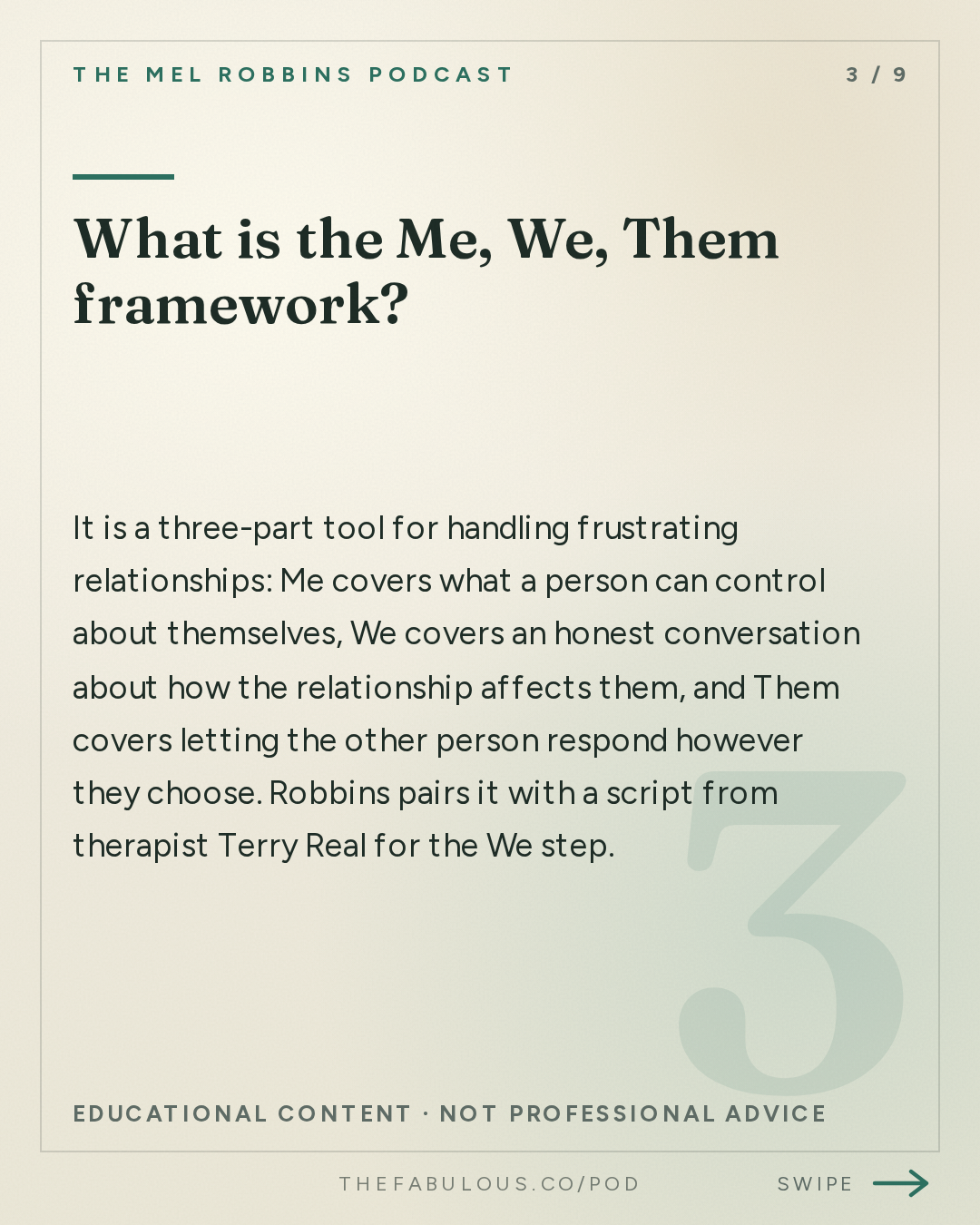
What is the Me, We, Them framework?
It is a three-part tool for handling frustrating relationships: Me covers what a person can control about themselves, We covers an honest conversation about how the relationship affects them, and Them covers letting the other person respond however they choose (10:41). Robbins pairs it with a script from therapist Terry Real for the We step (13:11).
What is the Terry Real communication script?
The formula is to state what happened, then the story being told about it, then what is needed, and then to stop talking and let the other person respond (13:11). Robbins says the pause after stating the need is the hardest and most important part of the conversation (14:10).
How does Mel Robbins say to handle an unmotivated adult child?
She advises replacing judgment and comparison to siblings with encouragement, since judgment and comparison are what push a struggling person away fastest (25:08). The advice comes from a caller whose 27-year-old son moved home after a breakup and works a job he dislikes (22:56); Robbins tells parents to trust the person can succeed on their own timeline (26:02).
How long should family visits last before things get tense?
Mel Robbins repeats the saying that fish and family both start to stink after three days, and recommends leaving, booking a hotel, or meeting at a restaurant instead of a house once a visit turns tense (39:27).
What is the difference between thinking someone 'should' do something and asking if they 'could'?
Thinking someone should do something assumes they already know what's needed and are choosing not to do it, which sets up resentment because it requires mind reading (42:53). Asking if they could considers whether the person is actually capable, given factors like mental illness or addiction that Robbins says can make change genuinely impossible (49:28).
The full read, in cards
Go deeper
- The Let Them Theory — Mel Robbins' book on the underlying boundary concept, read by 11 million people in its first year
- Terry Real's communication formula — a three-step script for hard conversations, first taught by therapist Terry Real on the podcast
Mentioned
Mel Robbins · Terry Real · Teresa · Terry (listener) · Serena · Kendall · The Let Them Theory
More from this show and category
James Sexton's Guide to the Six Stages of Divorce
Divorce attorney James Sexton maps the six stages of divorce and gives scripts for telling a spouse and a 48-hour safety plan. He explains why an avoided conversation gets more expensive with time, why grief means the love was real, and how to actually help someone else going through it.

How to Share the Mental Load With Your Partner
Mental load coach Zach Watson says men often confuse doing a chore with owning it, and that sharing the mental load makes men happier too. He recommends the Fair Play card system, weekly 'build meetings,' and naming emotions precisely to cut defensiveness and split invisible labor fairly.

Cher's Life Advice on Love, Money, and Leaving
Cher tells the hosts of We Can Do Hard Things how she survived a controlling marriage to Sonny Bono and chose to leave instead of ending her life. She describes losing all ownership of Cher Enterprises, advice from Lucille Ball, and the bumper car philosophy that carried her through decades of setbacks.

Stacey Abrams' 10 Steps to Authoritarianism, Explained
Stacey Abrams argues the United States is now a "competitive authoritarian" country: elections still happen, but power is hoarded and unaccountable (07:58). She lays out ten warning steps toward autocracy and ten matching steps back to freedom, then applies both to the midterms six weeks out, urging two hours a week of targeted local action (62:33).
