
Body Language Tricks for Instant Confidence
Body Language Expert: 6 Psychological Tricks to Turn Awkwardness into Confidence
▶ Listen to the full episode More from The Mel Robbins Podcast
The brief
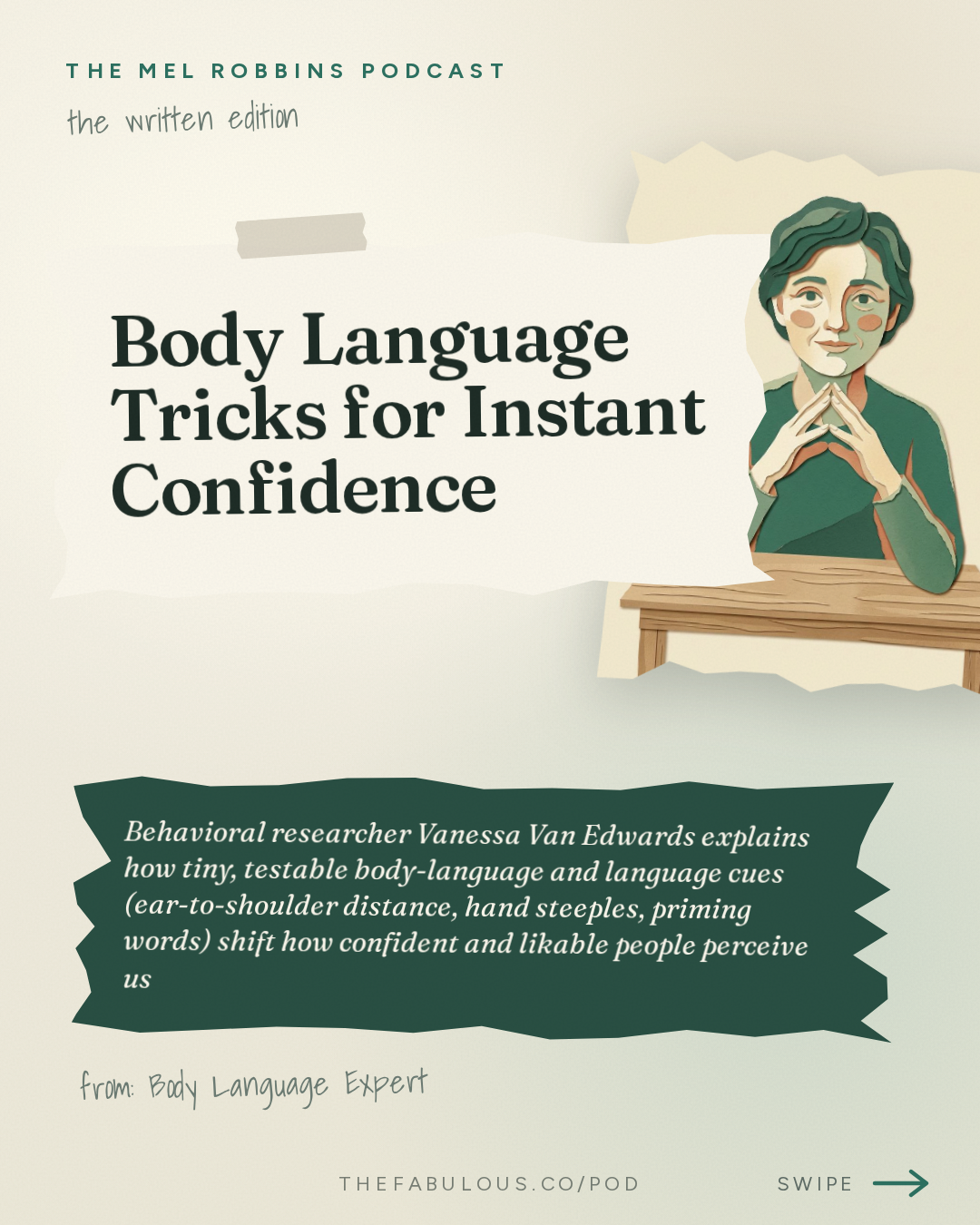
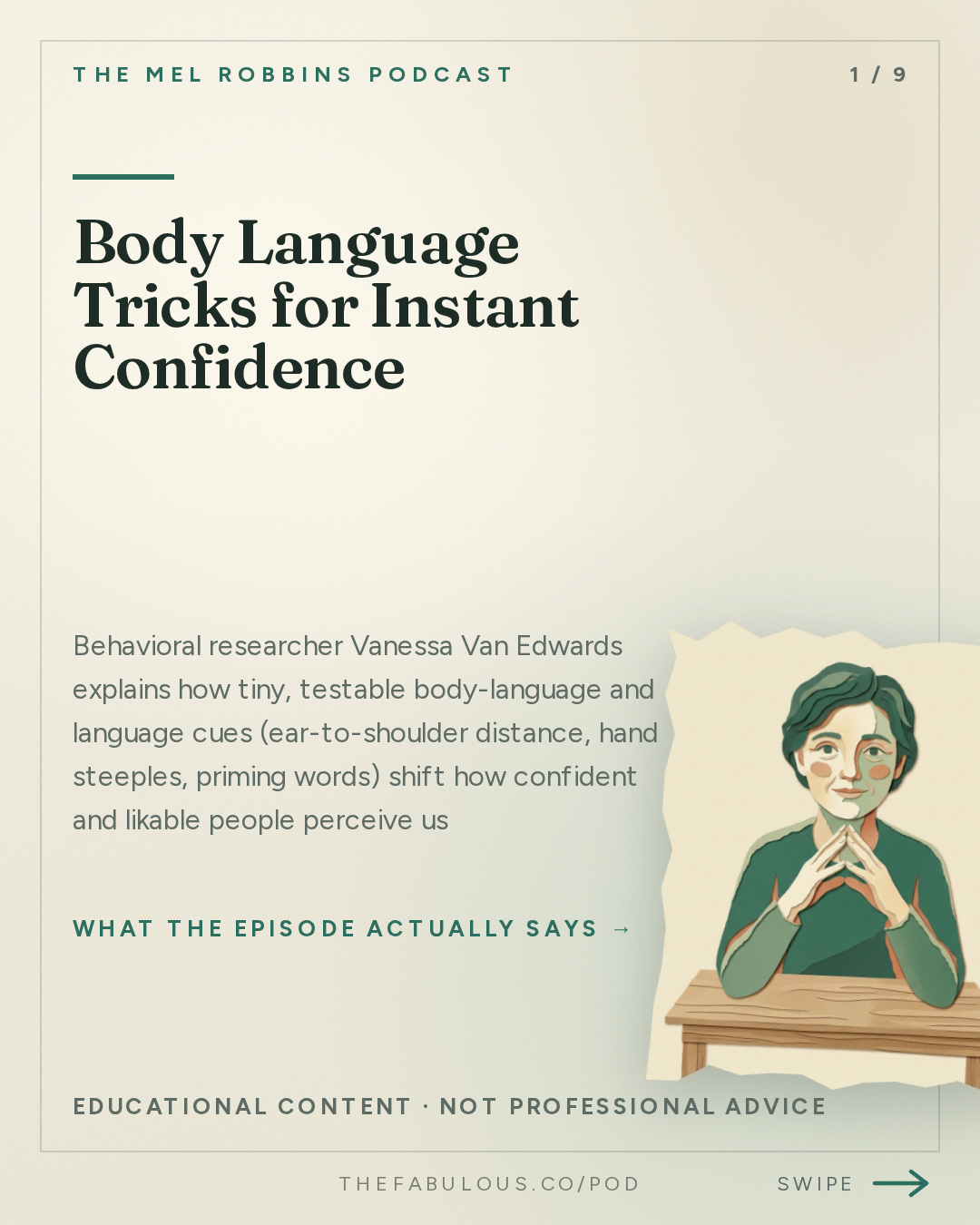
Behavioral researcher Vanessa Van Edwards explains how tiny, testable body-language and language cues (ear-to-shoulder distance, hand steeples, priming words) shift how confident and likable people perceive us, and how an A-B-C-D task audit stops burnout by clarifying which work and relationships actually deserve energy.
Ask this episode anything
Pod's AI answers from the episode itself, with the minute mark so you can hear it yourself.
Or start with one of these
Ask this episode
Pod's AI listens to the whole episode to answer, and points you to the minute it comes from.
The rest of this answer, and any question after it
Answers come from the episode itself, never from a summary of it.
Continue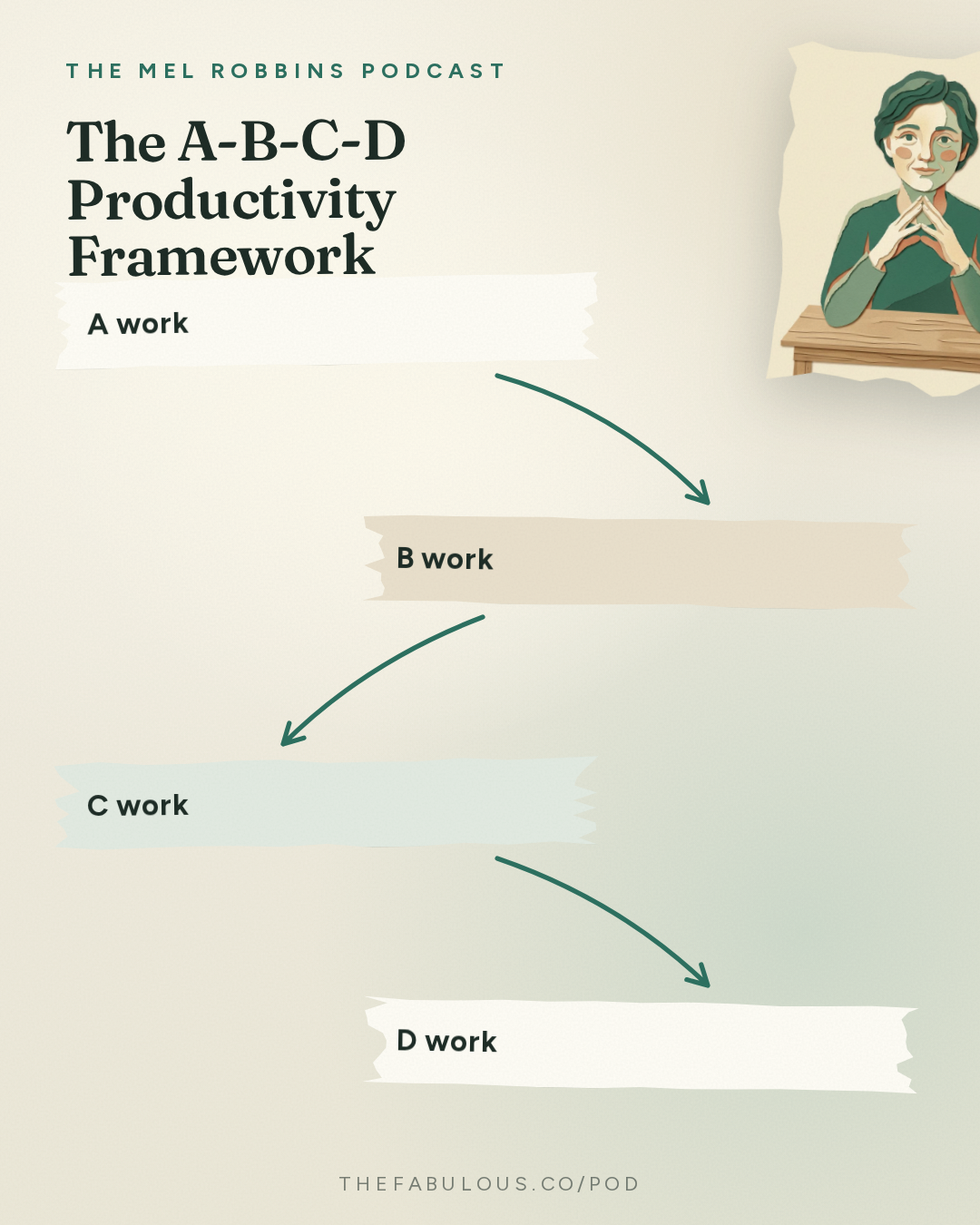
Key takeaways
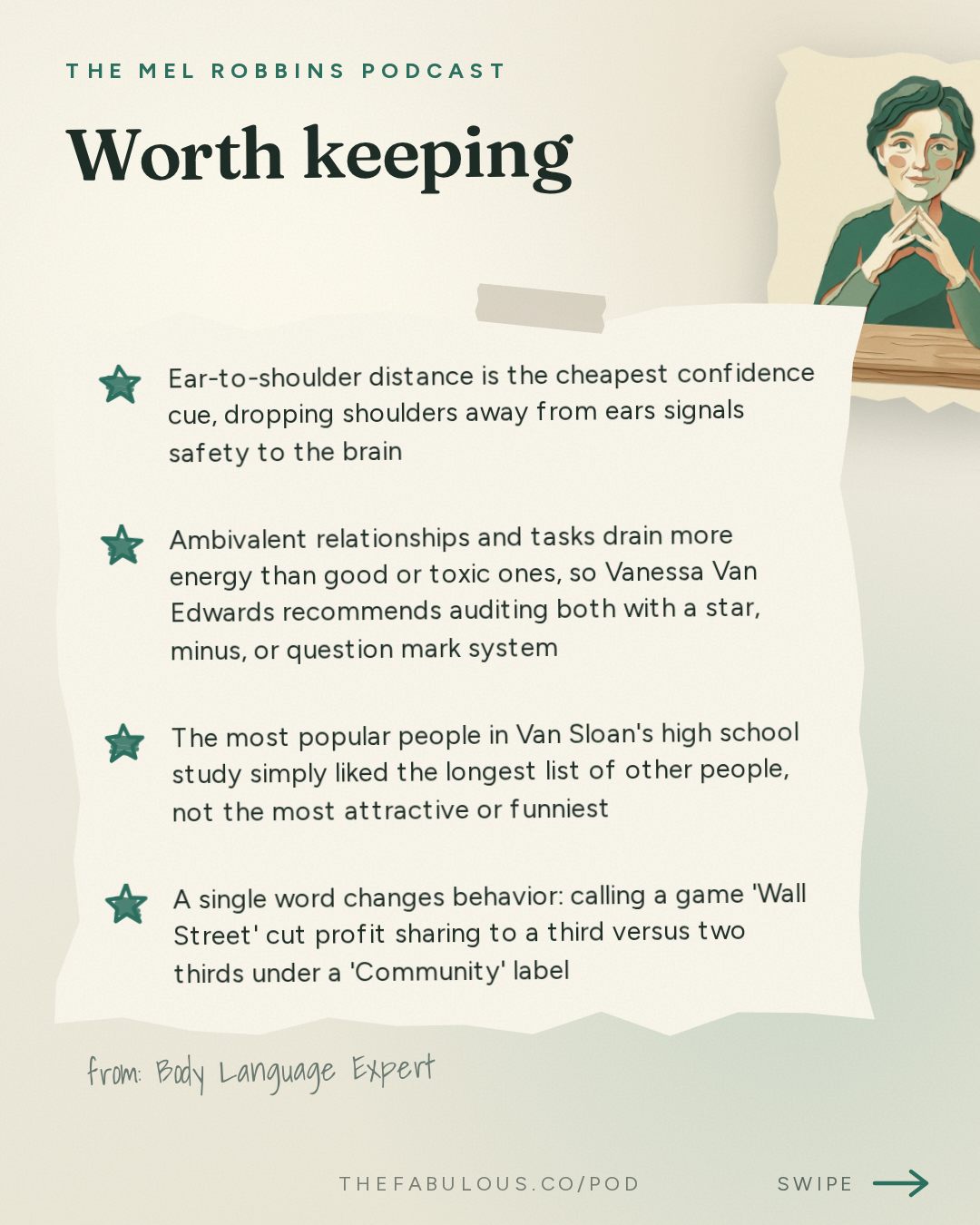
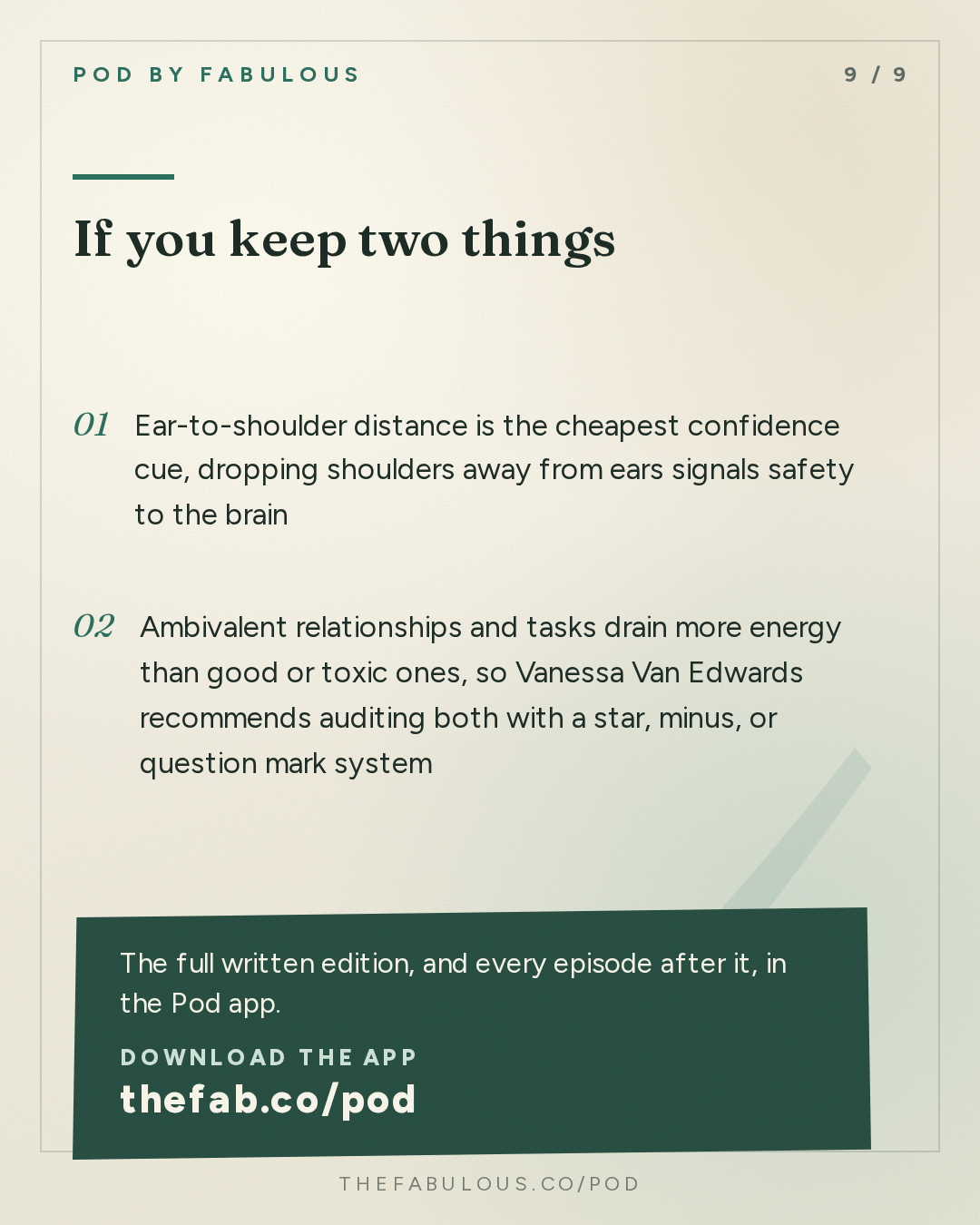
- Ear-to-shoulder distance is the cheapest confidence cue, dropping shoulders away from ears signals safety to the brain (32:53)
- Ambivalent relationships and tasks drain more energy than good or toxic ones, so Vanessa Van Edwards recommends auditing both with a star, minus, or question mark system (11:52)
- The most popular people in Van Sloan's high school study simply liked the longest list of other people, not the most attractive or funniest (17:48)
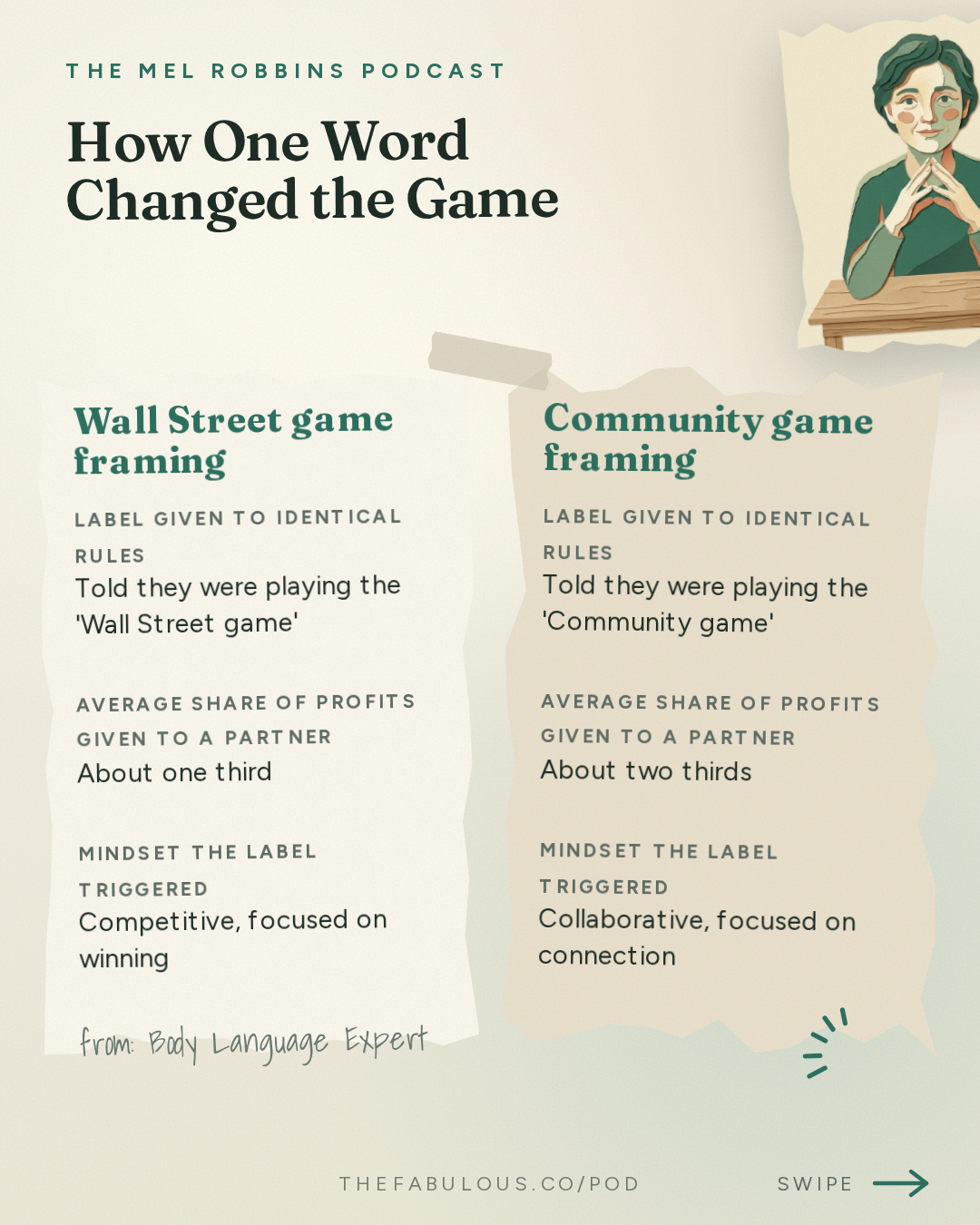
- A single word changes behavior: calling a game 'Wall Street' cut profit sharing to a third versus two thirds under a 'Community' label (50:17)
- Sitting within 25 feet of a high performer lifts personal performance by 15%, while sitting near a low performer drops it 30% (64:44)
The episode in cards
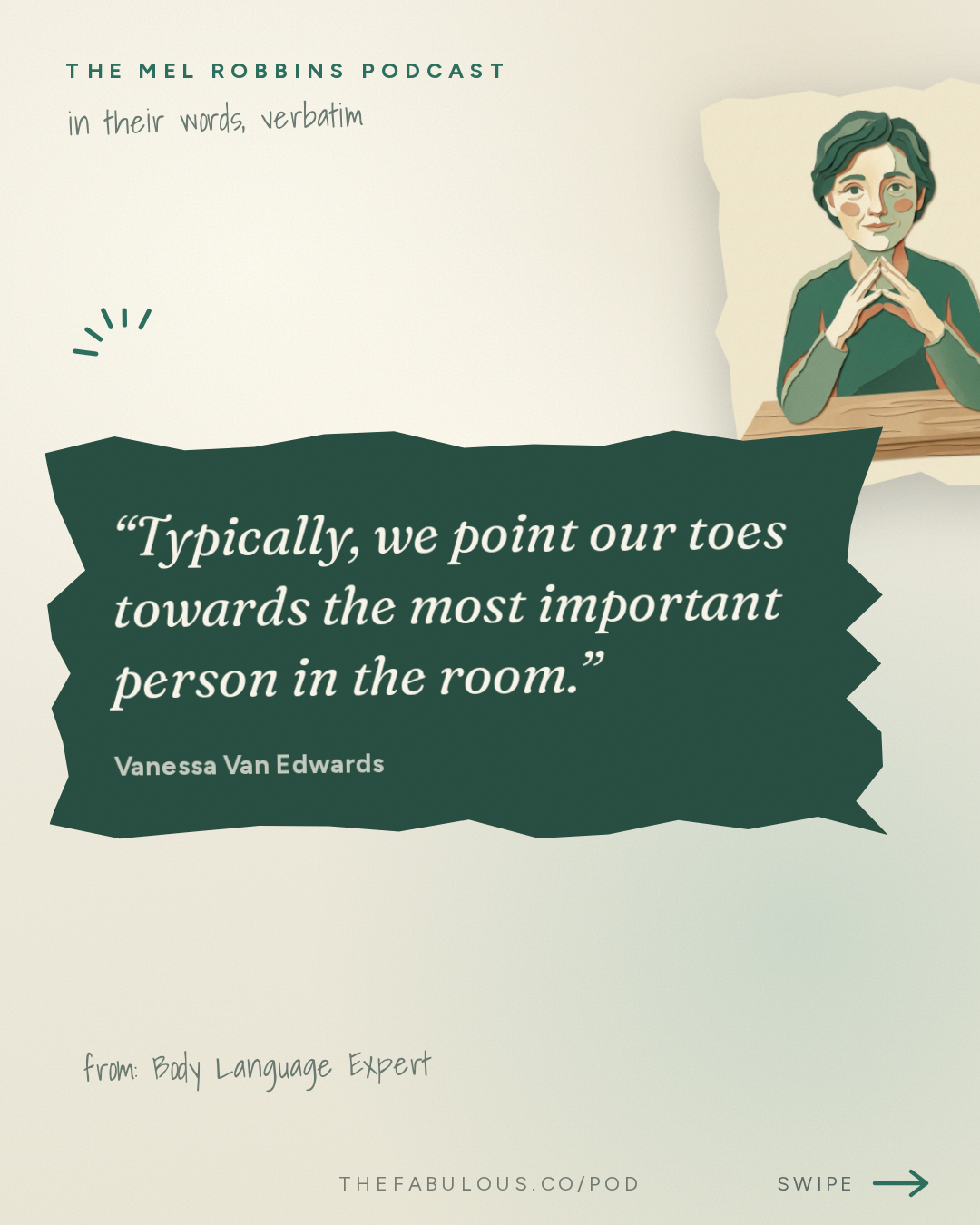
Walk into a crowded room and the room has already sized everyone up before a word is spoken. Feet do the confessing. Behavioral researcher Vanessa Van Edwards, who teaches at Harvard University's Professional and Executive Development program and founded the research lab Science of People, says people unconsciously point their toes toward whoever they consider most important in a room (30:57). Nobody trains this. That is exactly why it interests her: the body runs on autopilot, and autopilot, it turns out, can be studied, measured, and rebuilt.
Van Edwards spent two decades cataloguing the small, repeatable behaviors of high achievers, and her claim is that confidence is less a personality trait than a set of shortcuts. High performers, she says, enjoy the process of chasing a goal and not just the finish line, say no to draining people more easily, and know who they are well enough to broadcast it (06:12). Everyone else, she argues, burns out trying to prove they deserve to be there.
The first shortcut is energy accounting. Van Edwards splits daily energy into two currencies: social energy, spent on conversation and conflict management, and work energy, spent on tasks. Most people budget only the second, forgetting that a chatty commute or an obligatory lunch can drain a battery just as fast as a hard deadline (08:35). The costliest leak, she says, is not a bad relationship or a hated task. It is an ambivalent one, the friend or chore that inspires a shrug rather than a yes or no. "It's like an app running in the background. It's draining you without even realizing it," she says (11:52). Her fix is almost clerical: list every person in your life, star the ones worth rearranging a schedule for, mark the dreaded ones with a minus, and put a question mark next to anyone you would not notice missing. Then stop seeing the question marks for a while and see if anything changes (14:09).
That audit connects to a study Van Edwards calls one of the most useful things she has ever read. Researcher Van Sloan looked at what actually makes teenagers popular, testing athleticism, GPA, humor, and looks across multiple high schools. One variable predicted popularity everywhere: the length of the list of people a student genuinely liked (17:48). The most popular kids were not working the room with long conversations. They were simply naming people in hallways, a scattering of small acknowledgments. "Likability is about spreading likability, and it starts with you," Van Edwards says (18:37). She adds a caveat from psychologist Dr. Barbara Wild's lab: authentic smiles measurably lift a viewer's mood, while faked ones produce no change at all, good or bad (22:31). Faking warmth will not backfire, but it will not do much either.
Oddly, the fastest route to likability is not polish but its opposite. Psychologist Richard Wiseman had an actress demonstrate blenders in a shopping mall, sometimes flawlessly, sometimes spilling a smoothie. Bystanders rated the clumsier version as more likable every time (24:20). "What a gift to know that your mistakes make you more likable," Van Edwards says (25:10), because perfection reads as concealment, and a small, visible flaw reads as trust.
The Grammar of the Body
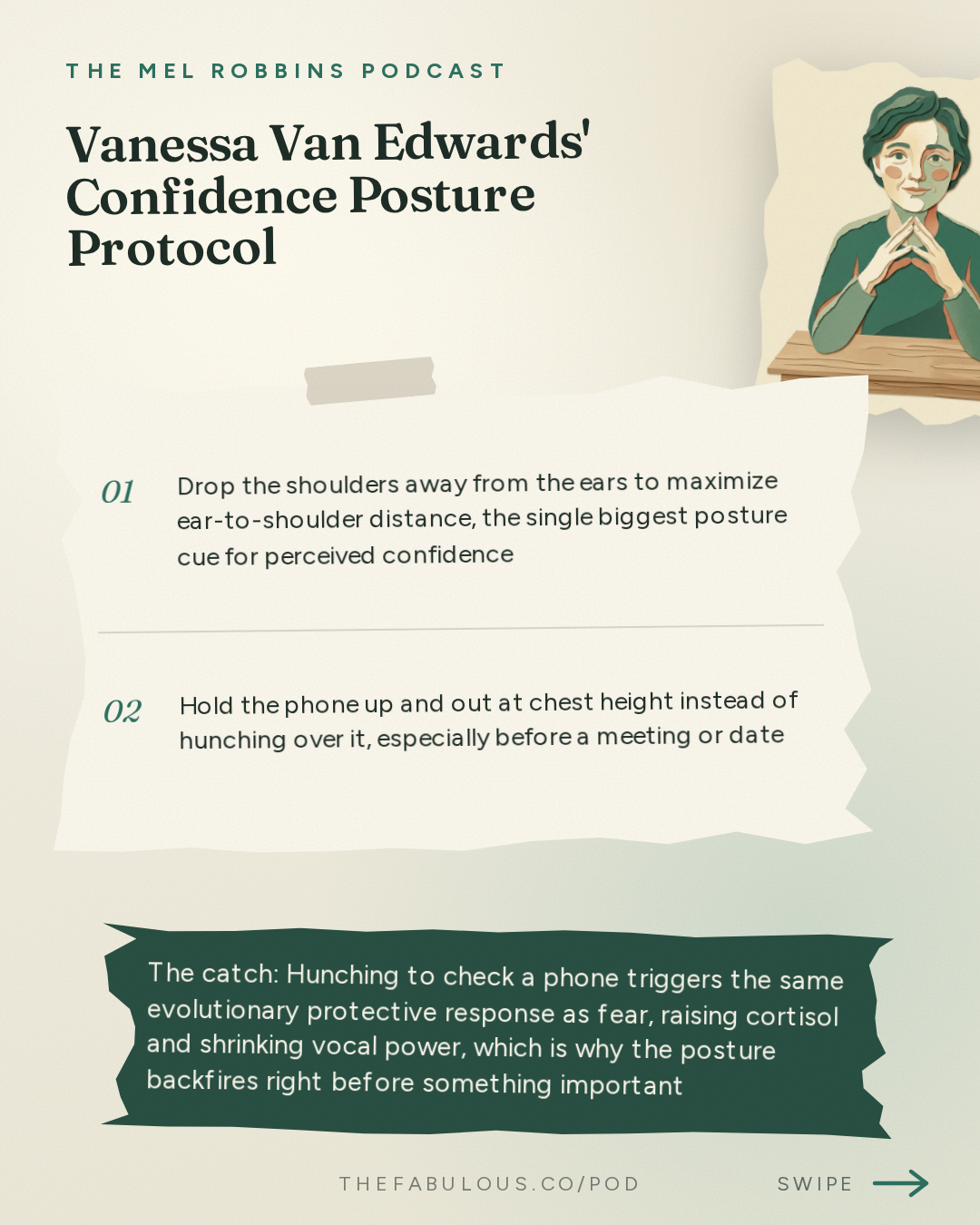
Van Edwards' most concrete material is postural. Researchers at the University of British Columbia studying athletes across genders and races found that winners, right after winning, consistently widen their stance, drop their shoulders, and tilt their chin up (32:03). Van Edwards isolates one measurement inside that pose that nobody talks about: the distance between earlobe and shoulder. Widening it, she says, is the single cheapest confidence cue available, changing perceived competence, vocal power, and even how safe the brain feels (32:53). The mechanism is evolutionary. Hunching protects the throat from an imagined attacker, so a raised, tucked posture tells the nervous system it is under threat, releasing cortisol, drying the mouth, and shrinking vocal range (36:27). The catch: most people strike exactly that defensive posture dozens of times a day, unknowingly, while checking a phone before a date or a presentation (37:42). Her fix is to hold the phone up and out at chest height rather than hunching over it, which keeps the jugular visible and the chest open (37:56).
The same logic extends to furniture. Crossed arms and a caved chest measurably make people answer questions with shorter sentences and more refusals (39:02). Van Edwards recommends chairs with armrests, elbows out rather than pinned to the ribs, and a swivel toward whoever is speaking, which research shows increases the sense of being on the same page (41:42). Hands matter too: in studies of videotaped leaders, one gesture was rated as most charismatic above all others, the steeple, fingertips touching lightly with a gap between the palms (42:47). Gestures, Van Edwards notes, are also harder to fake than words. Try saying "I have three ideas" while holding up five fingers and the mismatch feels almost physically uncomfortable, which is why she argues gestures can carry as much as 400 percent more information than speech alone (45:20).
The Economics of Attention
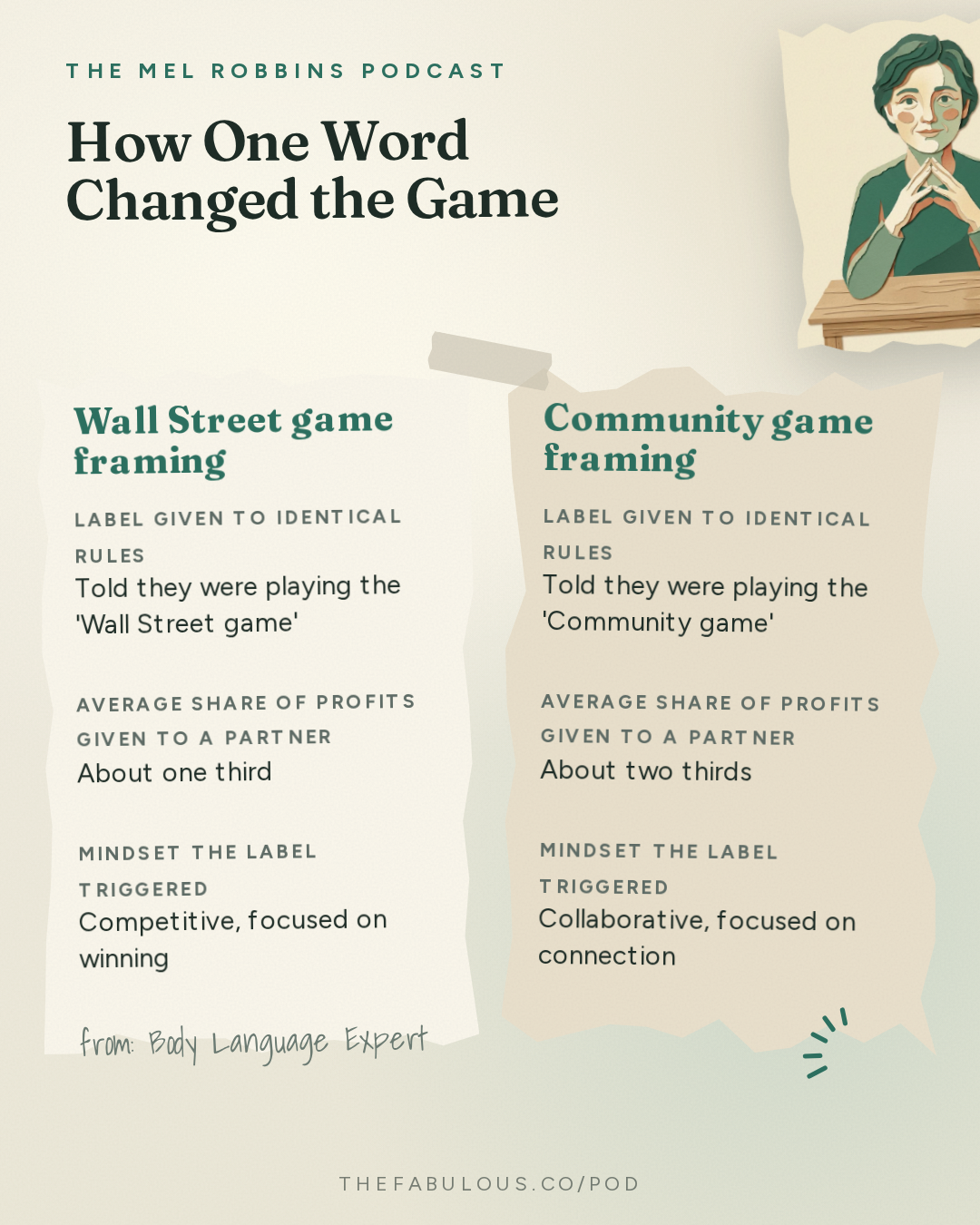
Words carry their own hidden signals, and Van Edwards' favorite study involves nothing more than what a game is called. Researchers split participants into two identical negotiation games, changing only the label: one group was told they were playing the "Wall Street game," the other the "Community game." The Wall Street group shared roughly a third of their profits with a partner; the Community group shared roughly two thirds (50:17). A single word had reorganized behavior. Van Edwards applies the same principle to calendar invites, arguing that a meeting titled "collaborative session" primes cooperation while "sync call" primes nothing at all (50:59). A related study found that sprinkling achievement-oriented words like "win" or "master" into otherwise identical task instructions doubled the time people spent working and raised their enjoyment of it (57:06).
Conversation itself runs on the same autopilot. Van Edwards ran a speed-networking experiment with 500 participants across three events testing different opening questions. "What's your story?" produced the most polarized ratings: extroverts loved it, introverts and ambiverts, people who sit between the two temperaments, rated it among the worst (62:50). The highest-rated openers were lower stakes: "What's been the highlight of your week?" or "Working on anything exciting?" (64:21), both of which prompt the brain to search for something positive rather than defend an identity.
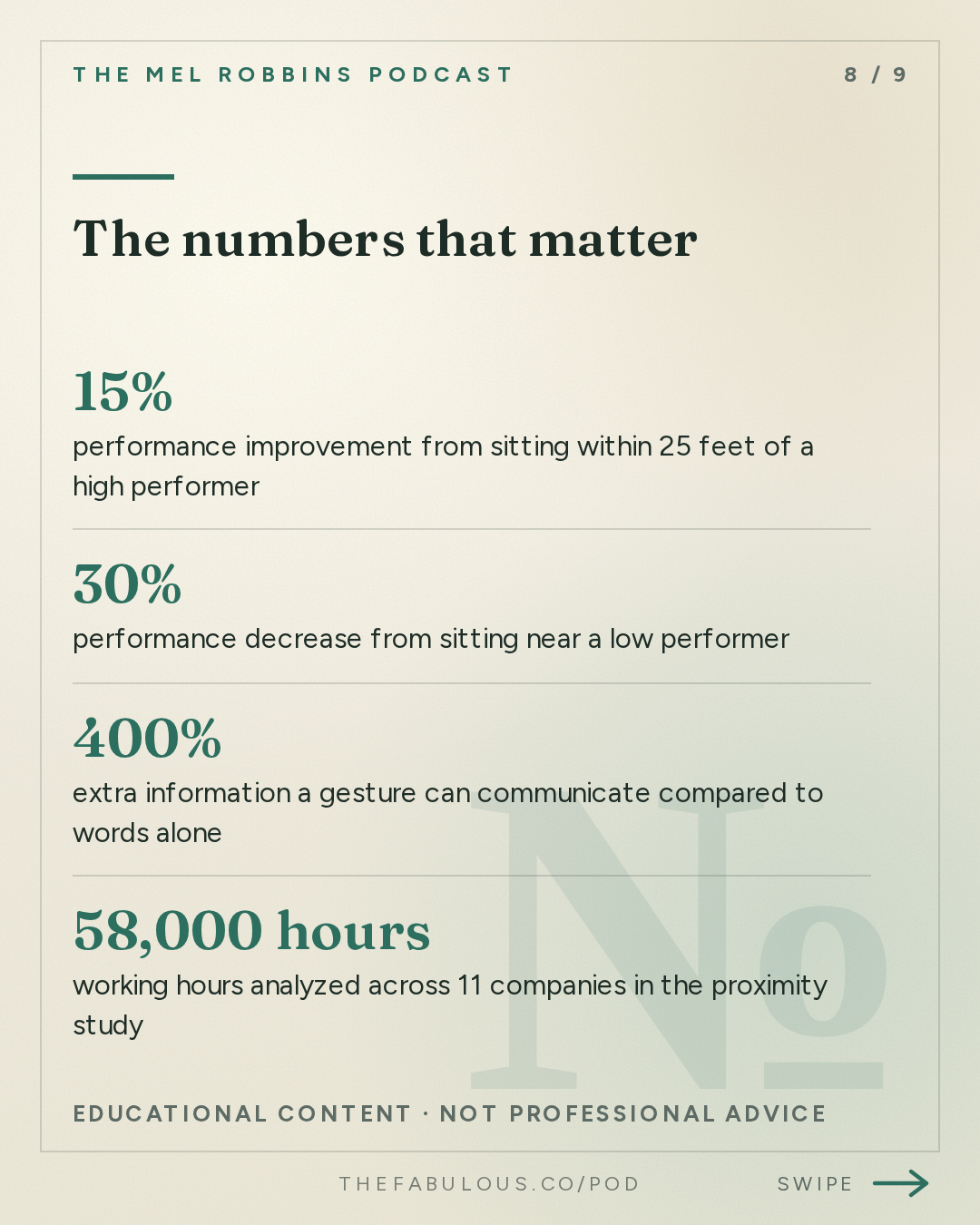
Positioning matters as much as phrasing. Analyzing 58,000 working hours across 11 companies, researchers found that sitting within 25 feet of a high performer raised an individual's own performance by 15 percent, while sitting near a low performer dropped it by 30 percent (64:44). Van Edwards ties this to a separate fMRI study in which people who smelled sweat collected from first-time skydivers, without knowing what they were smelling, showed activation in their own fear centers (66:47). Confidence and fear both appear to be somewhat contagious. At networking events, she has tracked foot traffic and found the worst place to stand is right by the entrance, where people are still mentally scanning the room; the best spot is just past the bar, the few seconds after someone takes a first sip and turns to face the room (69:40).
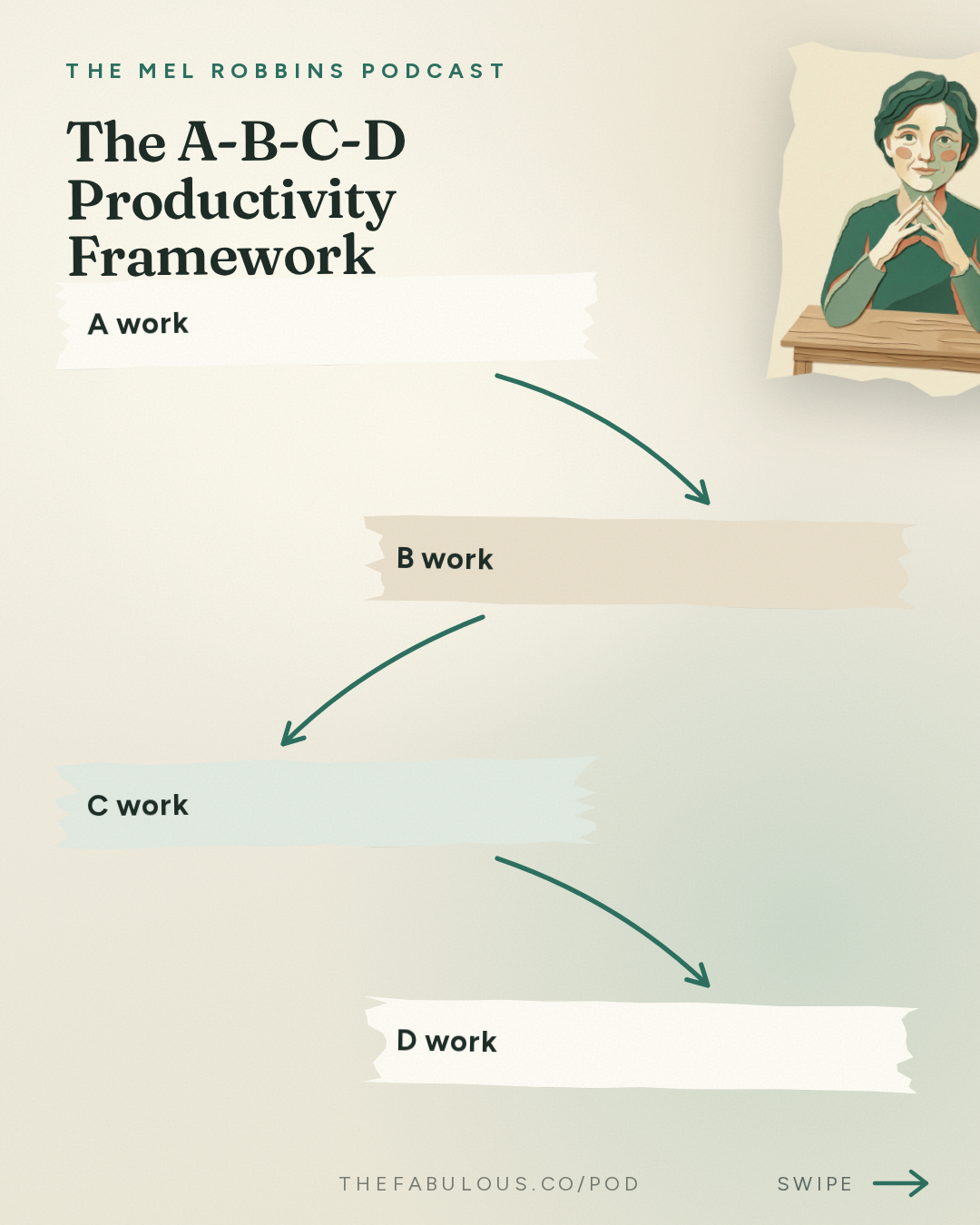
Van Edwards closes with a productivity framework she calls A-B-C-D work: list tasks (and relationships) in four columns by whether they produce flow and mastery (A), competence without flow (B), mild embarrassment (C), or genuine harm (D), then spend the day protecting A and giving away as much of C and D as possible (72:22). Applied to her own work with Mel Robbins in real time, the exercise reframed burnout not as evidence of laziness but as a sign of working hard in the wrong places. As Van Edwards put it near the end of the conversation, "it's okay to try a little bit less hard, and just do it in different ways" (87:32). The through-line of the whole hour is the same: the body and the calendar are both already telling on a person. The work is learning to read the signal before it reads someone else.
By the numbers
- 15% percent performance improvement from sitting within 25 feet of a high performer
- 30% percent performance decrease from sitting near a low performer
- 400% percent extra information a gesture can communicate compared to words alone
- 58,000 hours working hours analyzed across 11 companies in the proximity study
- 25 feet radius within which a colleague's performance becomes contagious
In their words
“Burnout is not a sign of success, right? We are not gonna have any more, and I hope that maybe we can challenge ourselves. Do not compete for who is busiest.”
“Likable is about spreading likability, and it starts with you”
“What a gift to know that your mistakes make you more likable.”
“Typically, we point our toes towards the most important person in the room.”
“Trying hard enough. It actually probably means you're trying really, really hard, and it's okay to try a little bit less hard, and just do it in different ways”
Protocols
-
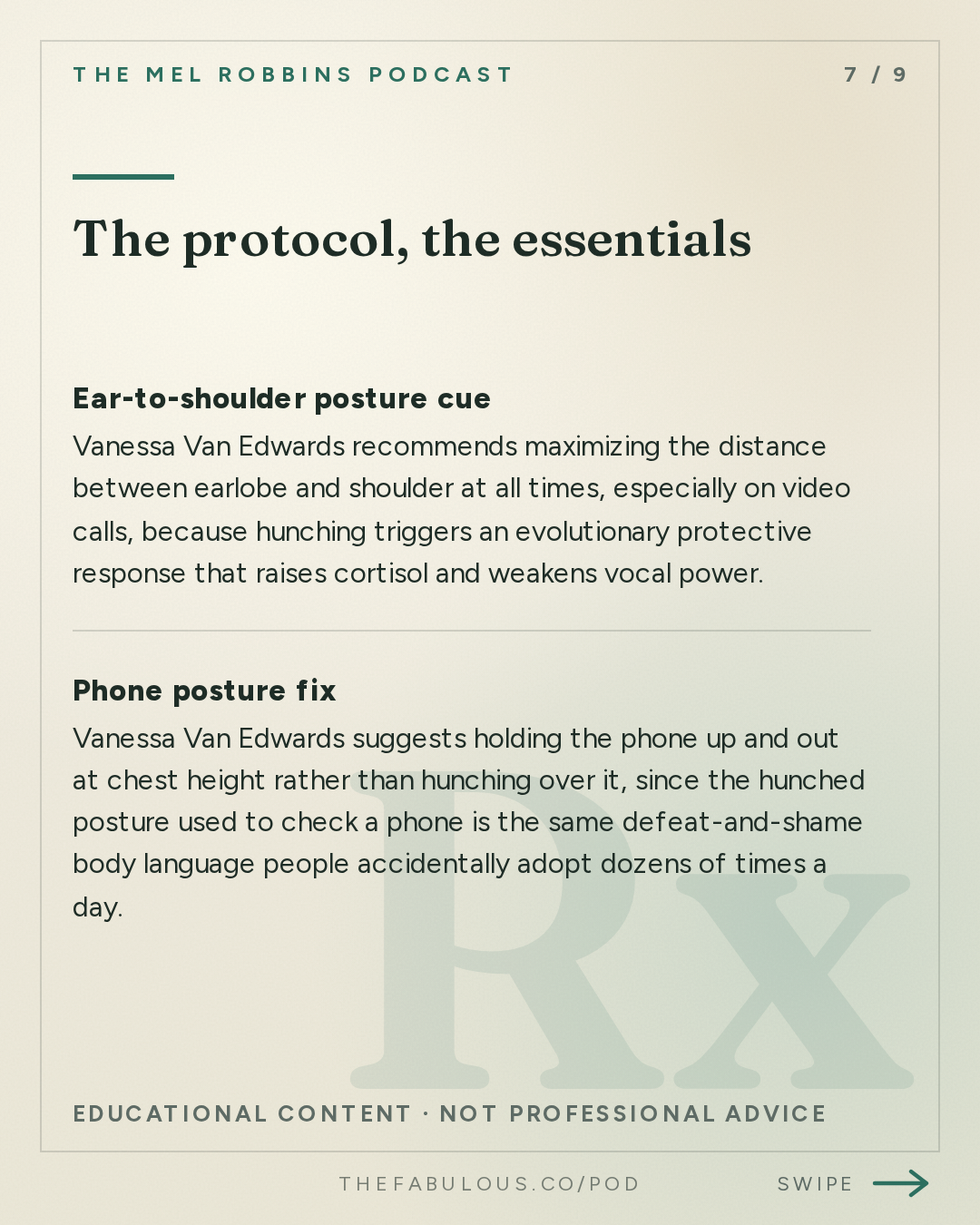
Ear-to-shoulder posture cue
Vanessa Van Edwards recommends maximizing the distance between earlobe and shoulder at all times, especially on video calls, because hunching triggers an evolutionary protective response that raises cortisol and weakens vocal power.
Continuously, and especially before meetings, dates, or presentations
-
Phone posture fix
Vanessa Van Edwards suggests holding the phone up and out at chest height rather than hunching over it, since the hunched posture used to check a phone is the same defeat-and-shame body language people accidentally adopt dozens of times a day.
Every time the phone is checked before something important
-
A-B-C-D task audit
Vanessa Van Edwards has people sort every task and relationship into four columns: A work that produces flow and mastery, B work that is competent but not exceptional, C work done at an embarrassing average, and D work done worse than most people, then structure the day around protecting A work and delegating C and D work.
Reviewed daily, weekly, and for every new project
Questions this episode answers
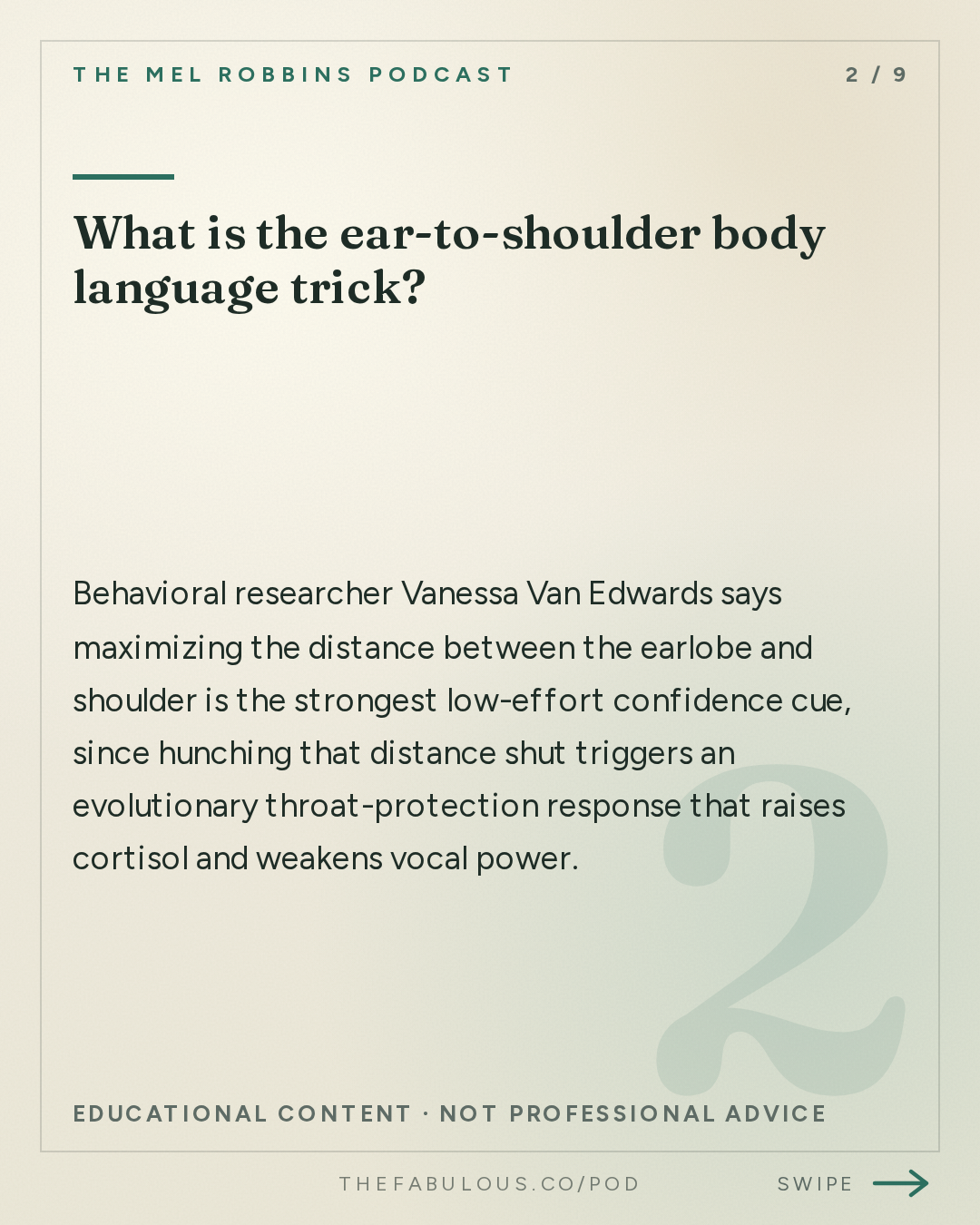
What is the ear-to-shoulder body language trick?
Behavioral researcher Vanessa Van Edwards says maximizing the distance between the earlobe and shoulder is the strongest low-effort confidence cue, since hunching that distance shut triggers an evolutionary throat-protection response that raises cortisol and weakens vocal power (32:53).
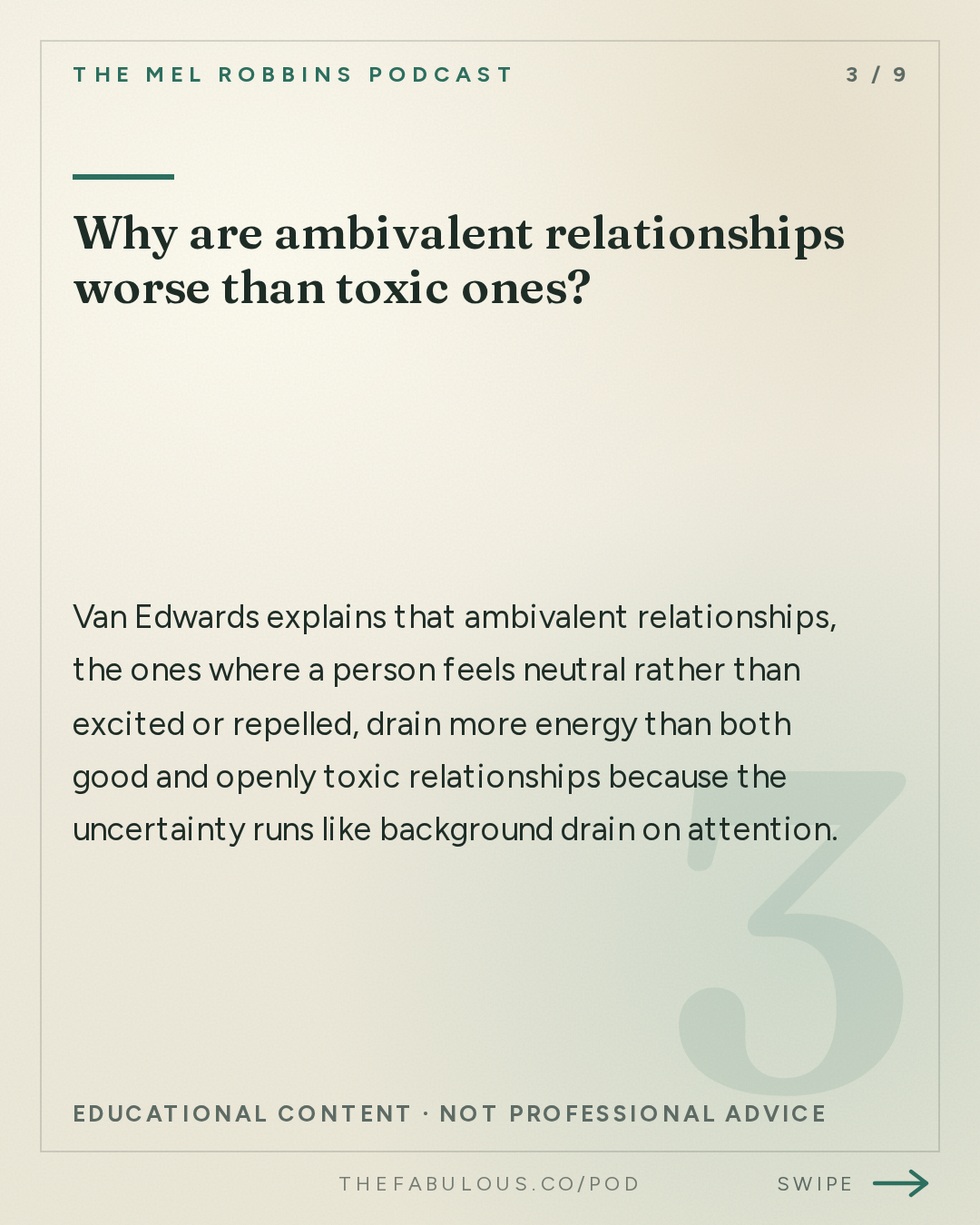
Why are ambivalent relationships worse than toxic ones?
Van Edwards explains that ambivalent relationships, the ones where a person feels neutral rather than excited or repelled, drain more energy than both good and openly toxic relationships because the uncertainty runs like background drain on attention (11:52).
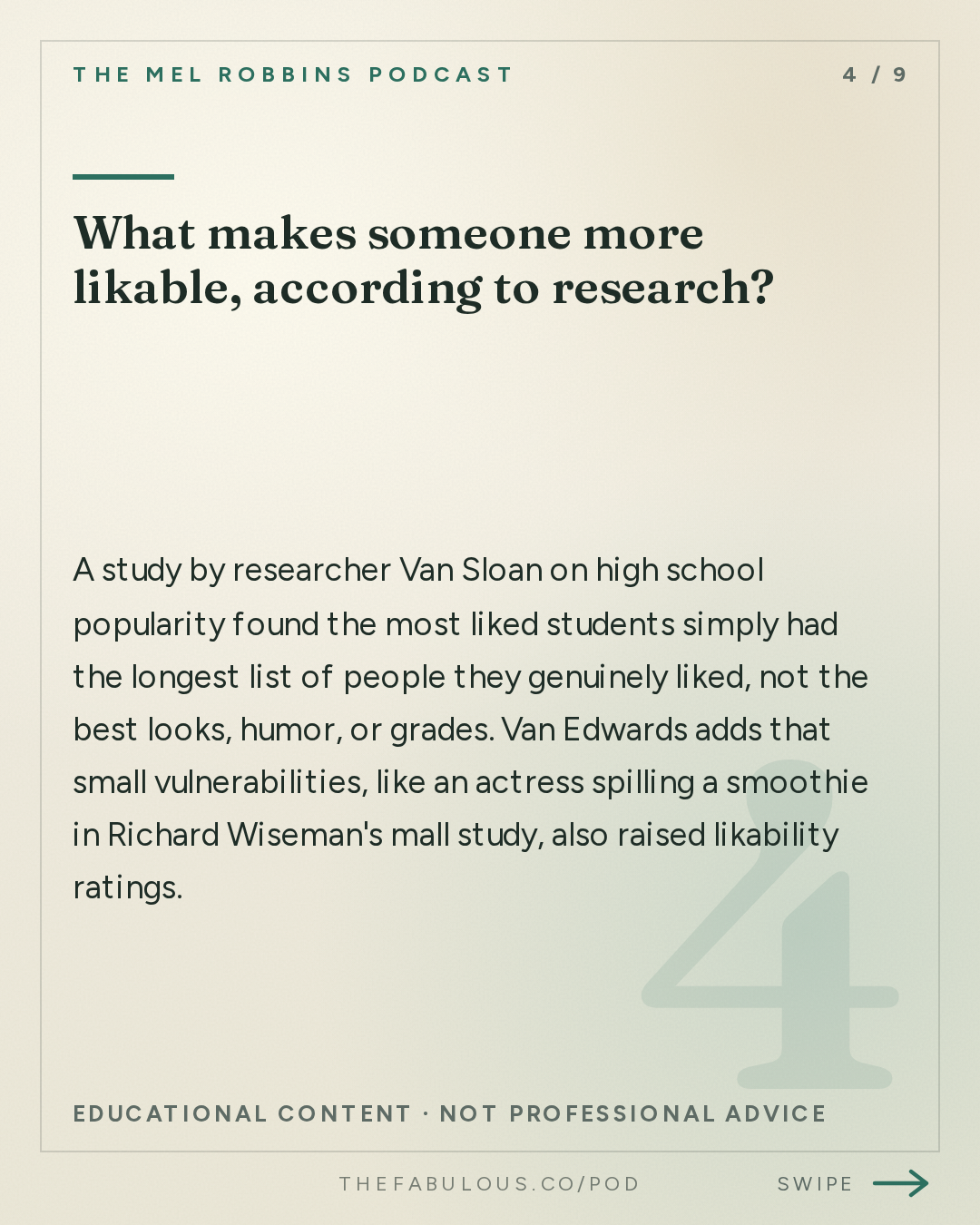
What makes someone more likable, according to research?
A study by researcher Van Sloan on high school popularity found the most liked students simply had the longest list of people they genuinely liked, not the best looks, humor, or grades (17:48). Van Edwards adds that small vulnerabilities, like an actress spilling a smoothie in Richard Wiseman's mall study, also raised likability ratings (24:20).
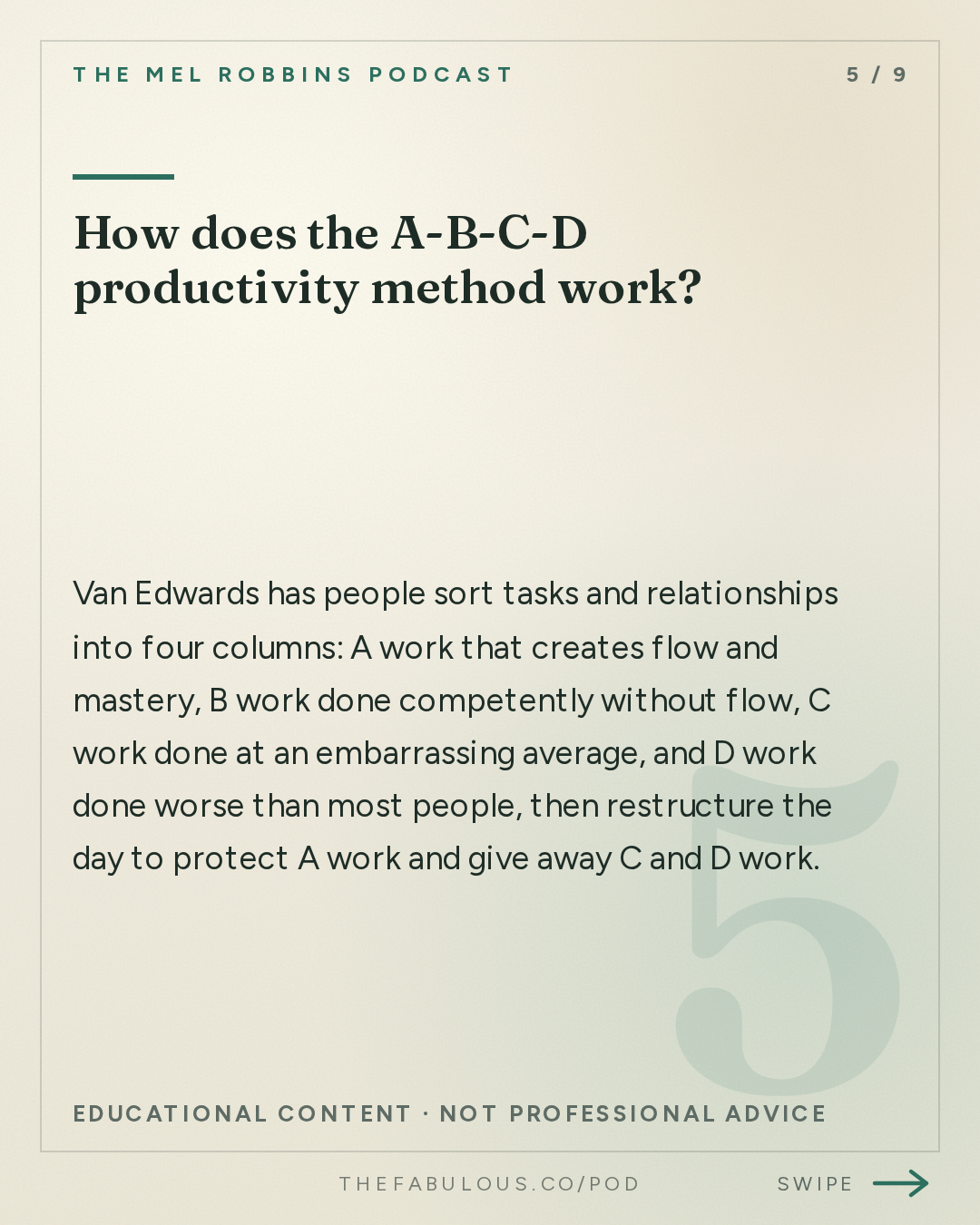
How does the A-B-C-D productivity method work?
Van Edwards has people sort tasks and relationships into four columns: A work that creates flow and mastery, B work done competently without flow, C work done at an embarrassing average, and D work done worse than most people, then restructure the day to protect A work and give away C and D work (72:22).
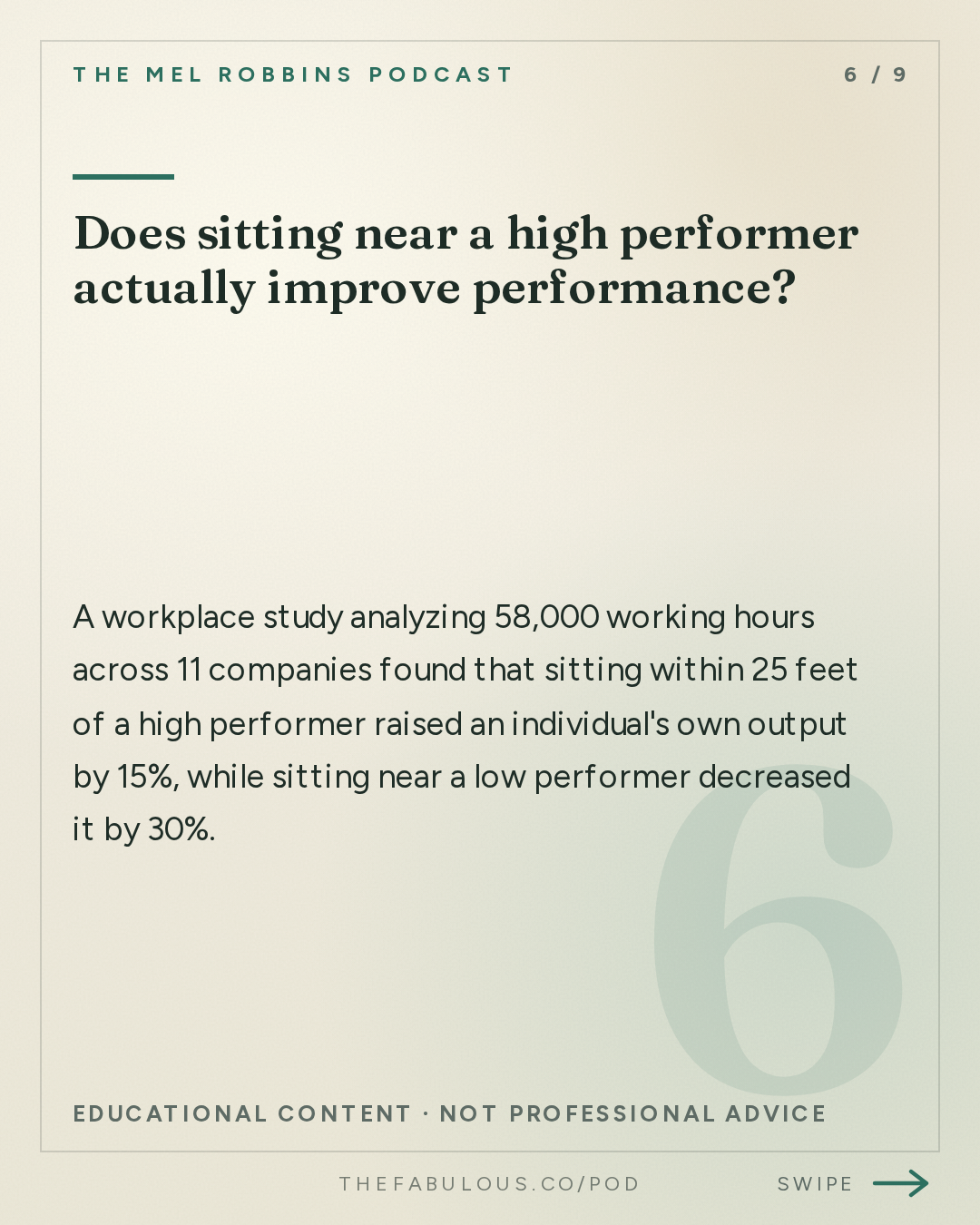
Does sitting near a high performer actually improve performance?
A workplace study analyzing 58,000 working hours across 11 companies found that sitting within 25 feet of a high performer raised an individual's own output by 15%, while sitting near a low performer decreased it by 30% (64:44).
The full read, in cards
Go deeper
- Van Sloan high school popularity study — found the most popular students had the longest list of people they genuinely liked, not the most athletic or attractive
- Dr. Barbara Wild smiling study — showed authentic smiles improved a viewer's mood while faked smiles produced no mood change
- Richard Wiseman smoothie demonstration study — found an actress who spilled a smoothie was rated more likable than when she performed flawlessly
- University of British Columbia athlete posture study — found winning athletes across genders and cultures take the same expansive pride pose after victory
- Wall Street vs. Community game priming study — found labeling an identical game 'Wall Street' cut profit sharing roughly in half compared to labeling it 'Community'
- 58,000-hour workplace proximity study — found sitting near a high performer raises output 15% while sitting near a low performer cuts it 30%
- Fear-sweat fMRI study — found people who smelled sweat from first-time skydivers showed activation in their own fear centers without knowing what they smelled
Mentioned
Vanessa Van Edwards · Harvard University · Science of People · Amy Cuddy · Richard Wiseman · Dr. Barbara Wild · Pygmalion effect
More from this show and category
Mel Robbins' Let Them Theory for Difficult People
Mel Robbins' Me, We, Them framework redirects relationship stress toward the one variable anyone can control: their own reaction. She names three habits that wreck relationships (expecting others to change, letting their behavior dictate your mood, assuming they 'should' know what you need) and offers a script from therapist Terry Real for saying the hard thing without blame.
James Sexton's Guide to the Six Stages of Divorce
Divorce attorney James Sexton maps the six stages of divorce and gives scripts for telling a spouse and a 48-hour safety plan. He explains why an avoided conversation gets more expensive with time, why grief means the love was real, and how to actually help someone else going through it.

How to Share the Mental Load With Your Partner
Mental load coach Zach Watson says men often confuse doing a chore with owning it, and that sharing the mental load makes men happier too. He recommends the Fair Play card system, weekly 'build meetings,' and naming emotions precisely to cut defensiveness and split invisible labor fairly.

Cher's Life Advice on Love, Money, and Leaving
Cher tells the hosts of We Can Do Hard Things how she survived a controlling marriage to Sonny Bono and chose to leave instead of ending her life. She describes losing all ownership of Cher Enterprises, advice from Lucille Ball, and the bumper car philosophy that carried her through decades of setbacks.
