
Benefits of Art for Brain Health, Explained
What Art Does For Your Brain
The brief
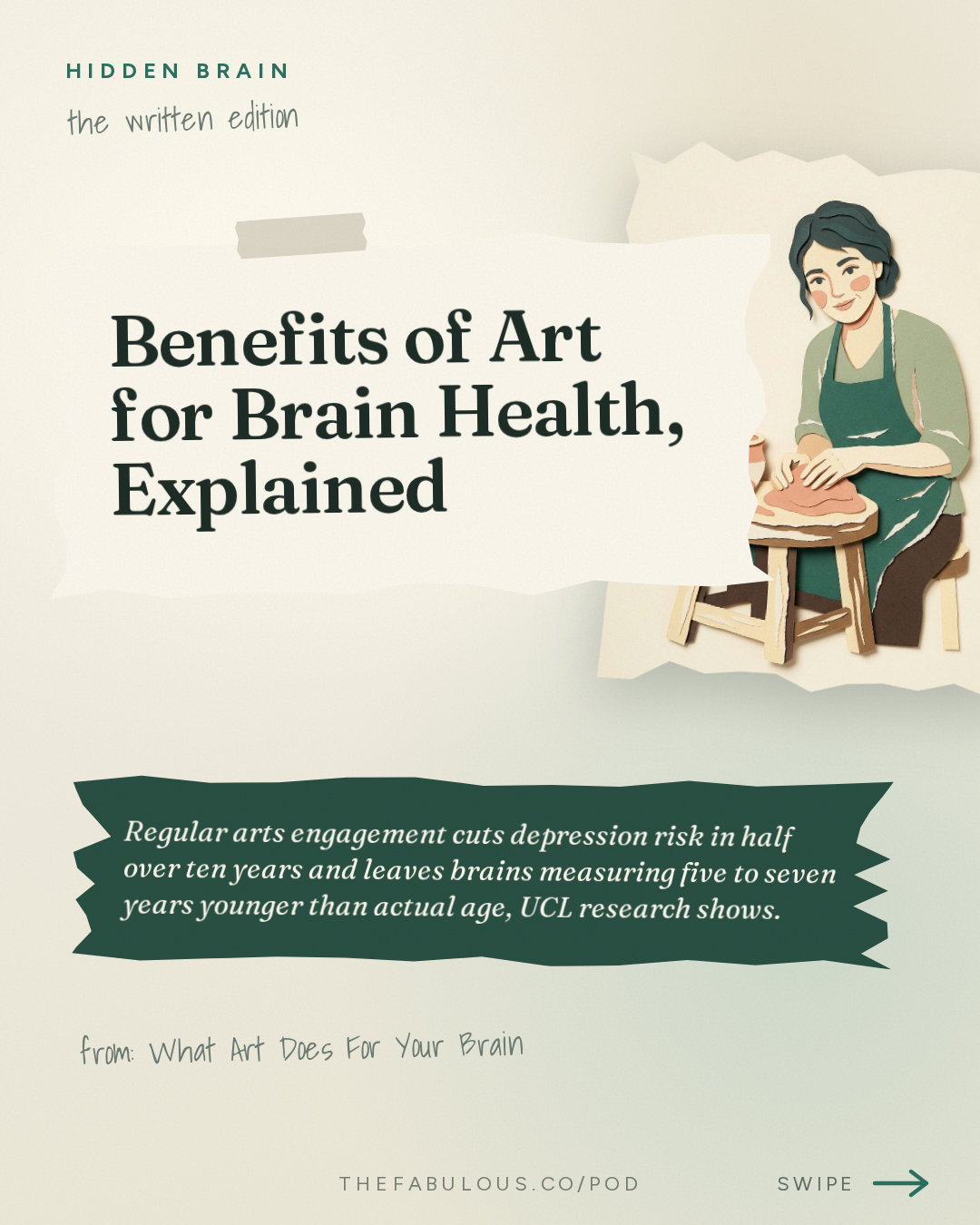
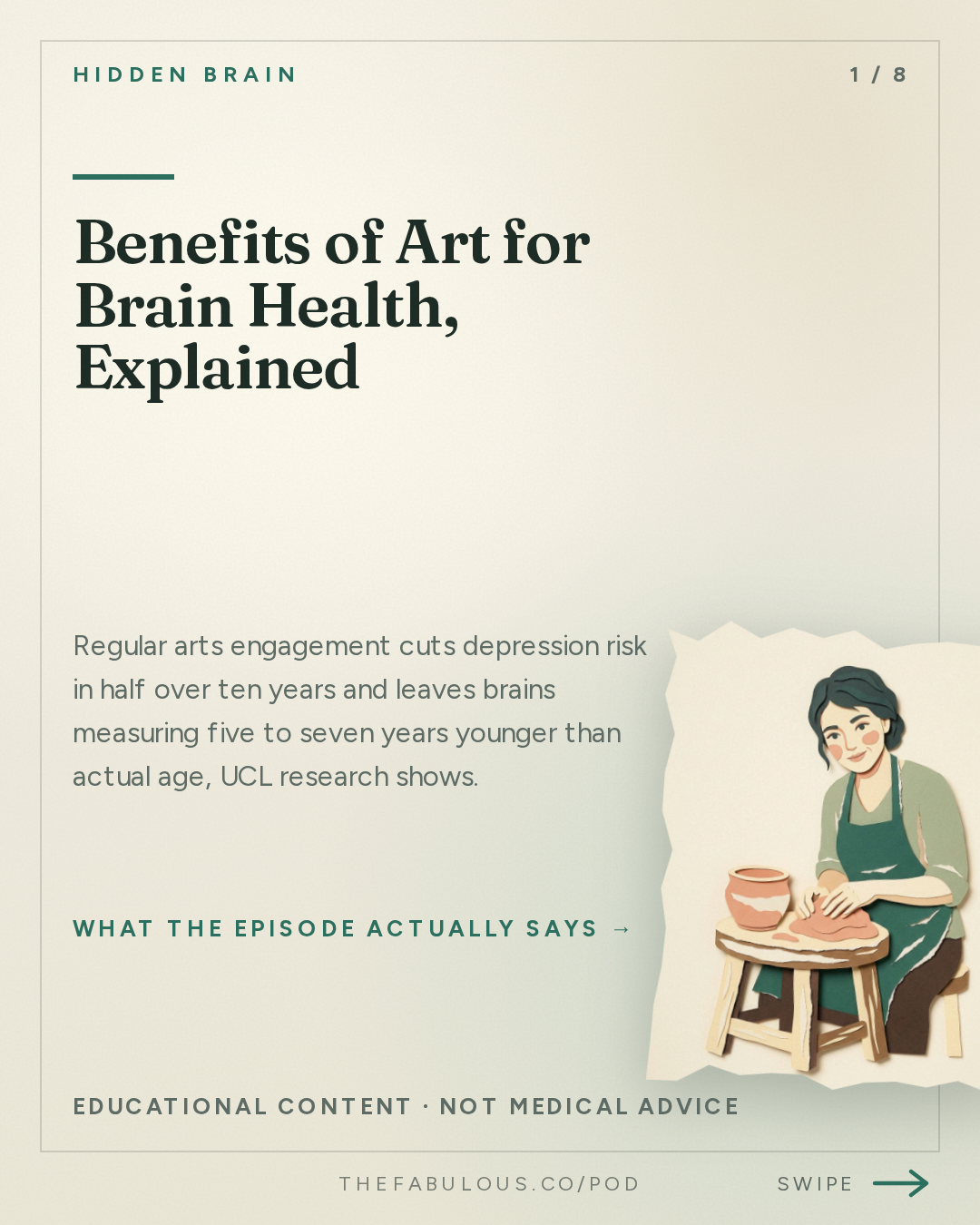
Regular arts engagement cuts depression risk in half over ten years and leaves brains measuring five to seven years younger than actual age, UCL research shows. Psychobiologist Daisy Fancourt's cohort studies tie the effect to dopamine, emotional distance from difficult art, and cognitive reserve, holding even with 10 to 20 minutes of daily practice.
Three thousand years before anyone scanned a brain, the Old Testament already had a treatment plan. King Saul, tormented by fits of despair, did not send for a physician. His advisors sent for a shepherd boy named David, who played the lyre until the king's mind settled. For centuries this has read as legend, a nice story about music and mood. The strange thing is that it now reads more like a case study.
University College London psychobiologist Daisy Fancourt spent her twenties finding out why. As a student she worked in pediatric hospital wards, running singing sessions, and what she saw did not look like entertainment. A premature baby in a neonatal intensive care unit who would not stop crying and would not eat began feeding again within minutes once his mother sang a lullaby along with the staff (06:14). In an emergency department, a boy with severe burns who was waiting on delayed morphine stopped calling out for pain relief the moment a theater troupe began performing at his bedside; he was laughing instead (07:28). Fancourt kept seeing this and kept running into colleagues who filed it under "nice extra," not medicine. That gap between what she was witnessing and what the research could prove became her career.
The Chemistry of Almost
Fancourt's first finding is about the brain's reward system, the network of neurons that releases dopamine, a chemical linked to pleasure and motivation. People engaging with art report feeling happier, and brain imaging backs this up: art activates the same dopaminergic pathways as other rewards (13:11). The counterintuitive part is timing. Dopamine does not just show up at a song's chorus or a novel's final reveal. It shows up in the anticipation.
"Arts experiences are constantly about tension and resolution and anticipating what might happen and seeing if we're right or having our expectations thwarted," Fancourt says (13:56).
That is why a mediocre song can still give a listener chills right before the hook returns, and why a detective novel is most gripping in the chapter before the reveal. The brain is a prediction machine, and art is built to keep it guessing.
This also explains a puzzle that has nagged philosophers for centuries: why people pay money to feel scared or sad. Horror movies, heavy metal, tragic novels, these should be aversive, yet millions seek them out. Fancourt's answer is what she calls aesthetic distance.
"Because we know it's art, our brain treats us a little bit differently, so we've got a little bit of an aesthetic distance between us and that arts experience," she says (15:26).
The fear or sadness is real, but the brain also knows nothing has to be done about it. That gap lets people rehearse emotional responses without paying the cost of the real event, something Fancourt compares to exposure therapy. Children reading the same ghost story over and over are doing exactly this, practicing fear in a setting where fear cannot actually hurt them (17:23). Lose that distance, as Fancourt admits she does with horror films, and the benefit flips into plain distress (17:46).
The regulation goes further than watching. A US study that induced sadness in participants by showing them images of funerals and suffering found that people given free rein to draw or write expressively calmed down faster and more completely than people asked to copy shapes or solve puzzles (20:16). Structure alone does not do it. The freedom to make something of one's own does. Fancourt sees this in her own toddlers, who reach for crayons when upset, sometimes scribbling in anger and sometimes drawing calm shapes, without ever being taught to (21:03).
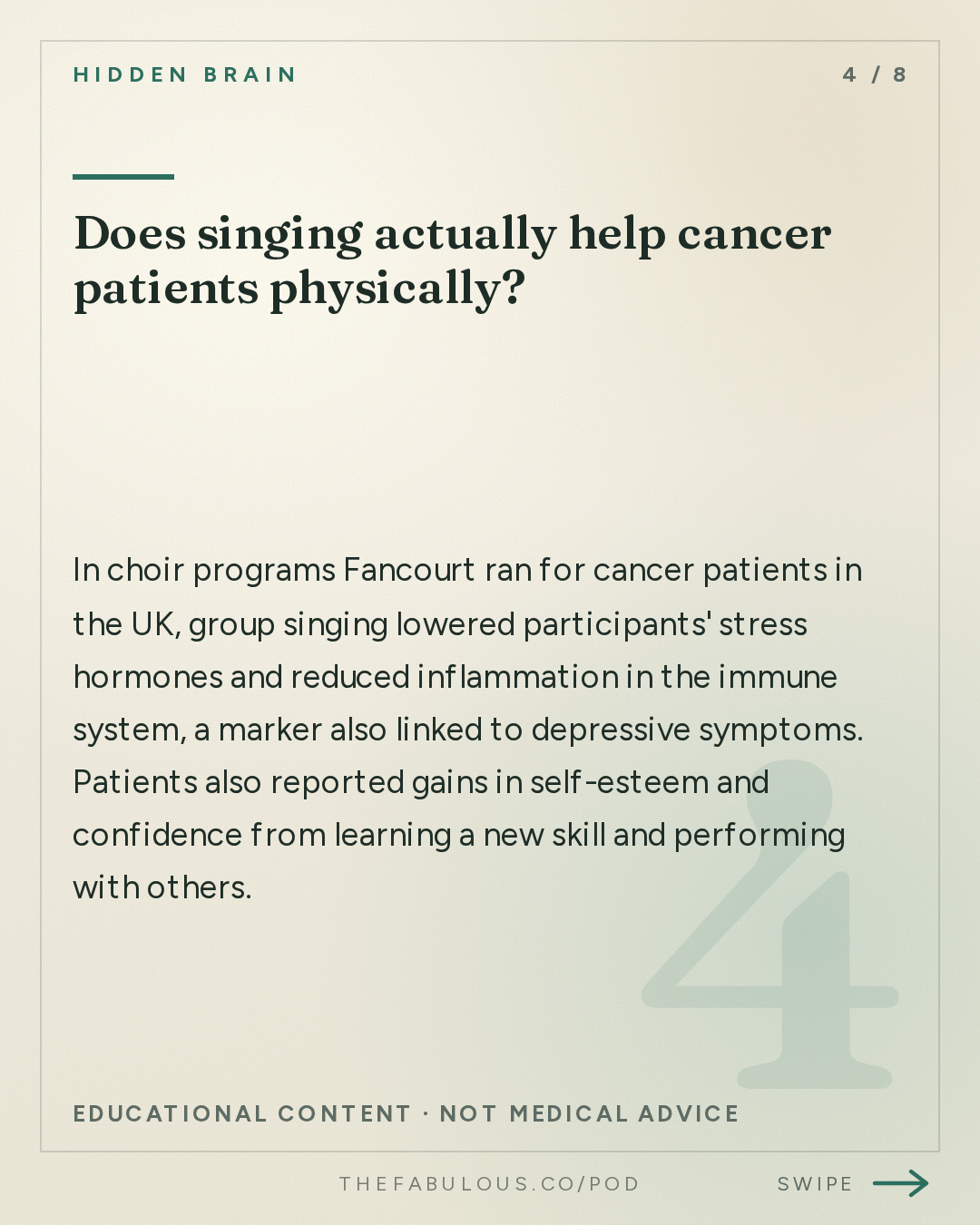
Group singing adds a physiological layer. In choirs Fancourt ran for cancer patients in the UK, singing together lowered participants' stress hormones and reduced inflammation in the immune system, a marker also linked to depressive symptoms (22:18). Patients also reported a return of confidence and self-esteem that cancer treatment had stripped away, simply from learning a new skill and performing it with others (22:40). Mastery, it turns out, is portable. Fancourt tells the story of an attorney named Shay who felt her life had gone gray, took a week-long music course at Berkeley College on impulse, and ended up restructuring her career around singing and songwriting (25:42). The confidence built through one skill spilled into decisions about work, friendships, and identity that had nothing to do with music.
The Ten-Year Number
The most striking evidence comes from Fancourt's work as an epidemiologist, a scientist who studies patterns of health across large populations. Tracking tens of thousands of people over years using UK and US cohort data, her team found that people with a regular arts hobby have roughly half the risk of developing depression over the following ten years, a relationship that holds up after statistically accounting for wealth, genetics, and demographics (28:45).
"People who engage regularly in the arts and have an artistic hobby actually have about half the risk of developing depression over the next 10 years," Fancourt says (28:45).
The obvious objection is reverse causation: maybe happy people take up hobbies, not the other way around. Fancourt's team tested this directly, tracking whether arts engagement predicted future depression risk in people who were not currently depressed, and found the arrow points more strongly from art to mood than the reverse (29:52).
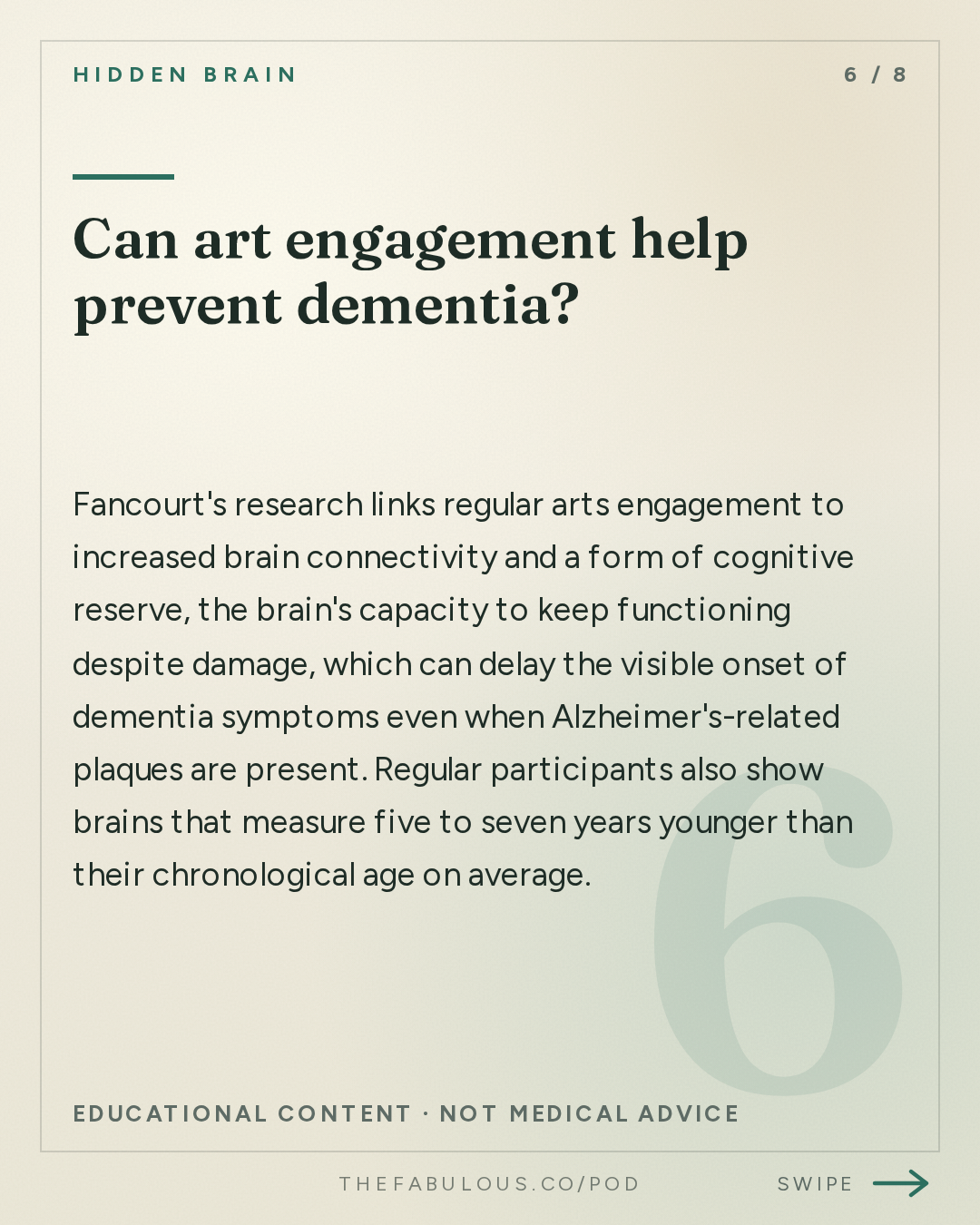
A parallel body of work looks at cognitive decline. Because engaging with art recruits so many brain regions at once, visual processing, memory, motor control, emotion, Fancourt calls it a whole brain workout (30:38). Neuroimaging shows increased connectivity between brain regions in people who engage with art regularly, and over time this shows up as younger-looking brains: on average five to seven years younger than chronological age among amateur and professional artists heading into older adulthood (31:43). The mechanism is something researchers call cognitive reserve, the brain's capacity to keep functioning despite damage. Even when a brain accumulates the plaques associated with Alzheimer's disease, higher cognitive reserve delays the point at which symptoms become visible (32:02). Notably, brain-training apps, which exercise a single cognitive skill at a time, have not shown comparable results in large trials, because they lack the breadth of stimulation that art provides (33:14).
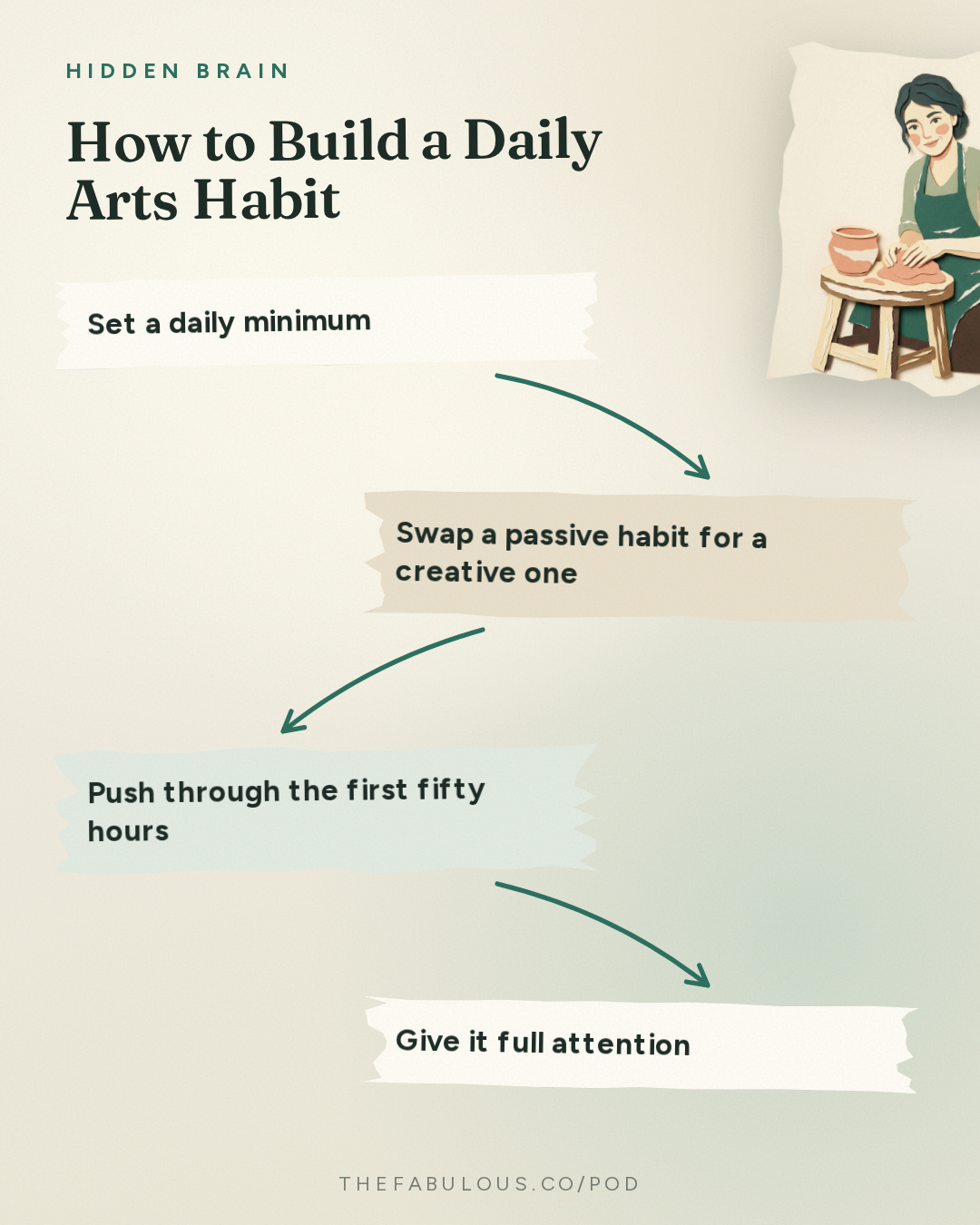
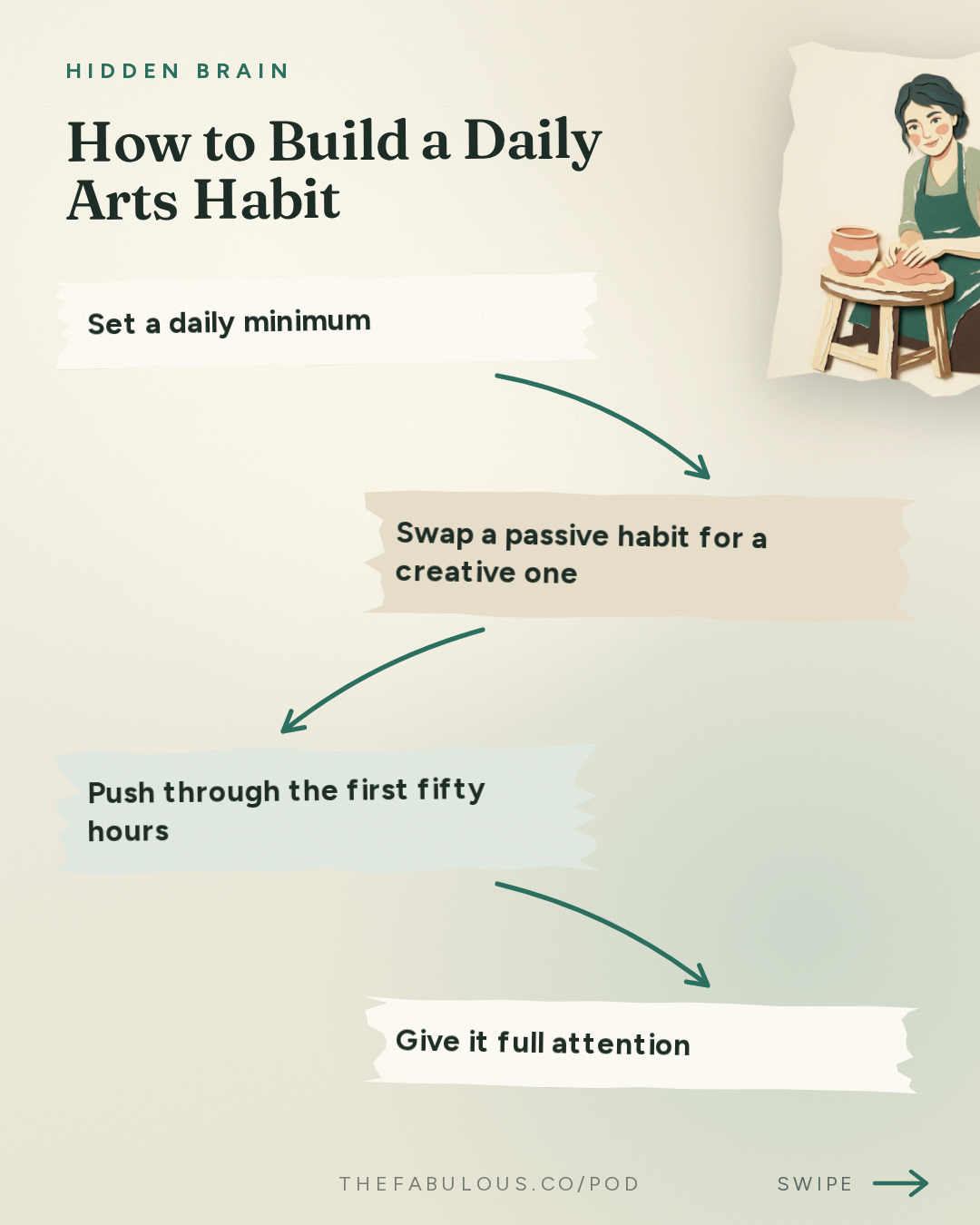
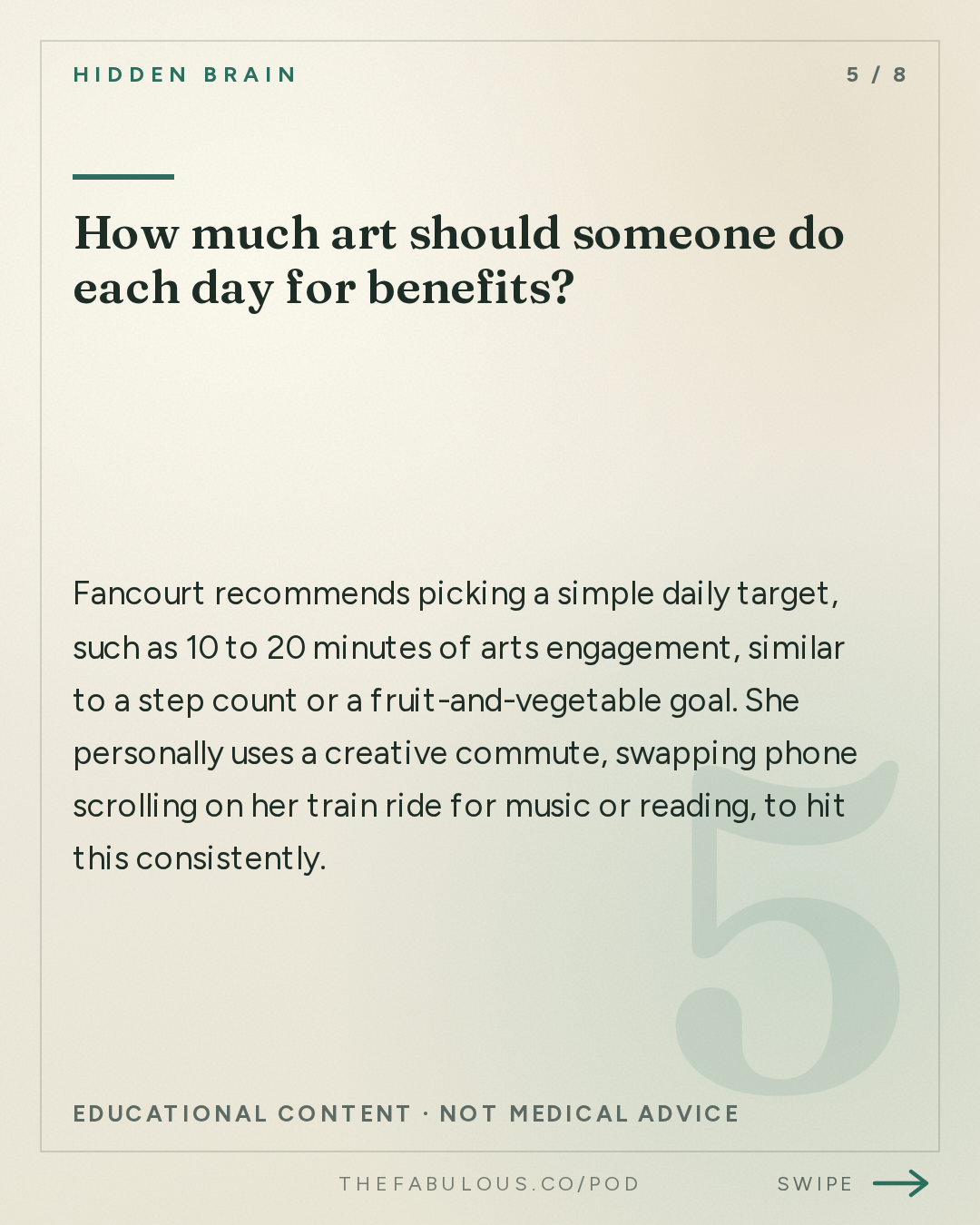
None of this requires talent. Fancourt's practical advice sounds almost boring: pick a daily target, the way people aim for 10,000 steps or five servings of vegetables, and try 10, 15, or 20 minutes of art a day (36:59). She calls her own version a "creative commute," swapping phone scrolling on the train for music or a book (37:26). Consistency matters more than intensity; a single four-hour session does less for long-term brain health than short daily sessions sustained over months. For anyone starting a new craft, she cites research suggesting about fifty hours of practice is roughly the point where skill catches up enough to produce flow, the sense of complete absorption that makes an activity self-sustaining (39:29). And attention matters as much as time: art half-noticed in the background still helps a little, but giving it full focus increases dopamine release and produces measurable synchronization between brain regions, which is why savoring a piece of music, like lingering over dessert instead of rushing it, produces two to three times the enjoyment (47:55).
There is a social layer too. Fancourt's research finds that people who sing or dance together bond emotionally faster than people who simply talk or exercise together (51:38), which may explain why a couple's ballroom dancing habit, or two friends meeting at a gallery instead of a bar, tends to leave a deeper mark than dinner does.
What connects a shepherd calming a tormented king to a UCL lab running cohort studies is not mysticism. It is a nervous system built to respond to tension, distance, and made things, whether that made thing is a lyre, a lullaby, or a Tuesday night pottery class. The evidence now suggests the ancient instinct to reach for art in hard moments was not superstition. It was diagnosis.
Ask this episode anything
Pod's AI answers from the episode itself, with the minute mark so you can hear it yourself.
Or start with one of these
Ask this episode
Pod's AI listens to the whole episode to answer, and points you to the minute it comes from.
The rest of this answer, and any question after it
Answers come from the episode itself, never from a summary of it.
ContinueKey takeaways
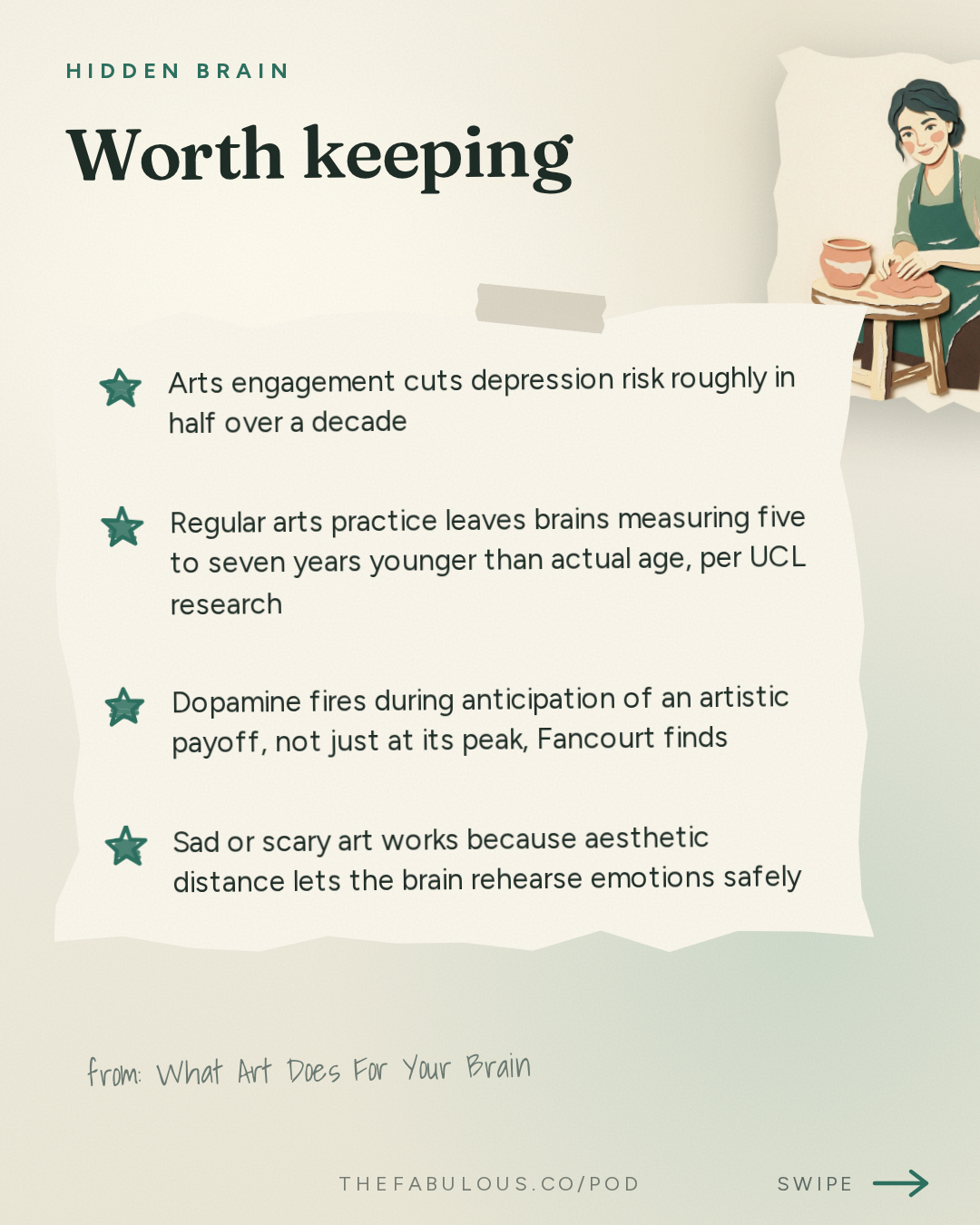
- Arts engagement cuts depression risk roughly in half over a decade
- Regular arts practice leaves brains measuring five to seven years younger than actual age, per UCL research
- Dopamine fires during anticipation of an artistic payoff, not just at its peak, Fancourt finds
- Sad or scary art works because aesthetic distance lets the brain rehearse emotions safely
- Ten to twenty minutes of daily arts practice builds a habit more reliably than occasional long sessions
The episode in cards
By the numbers
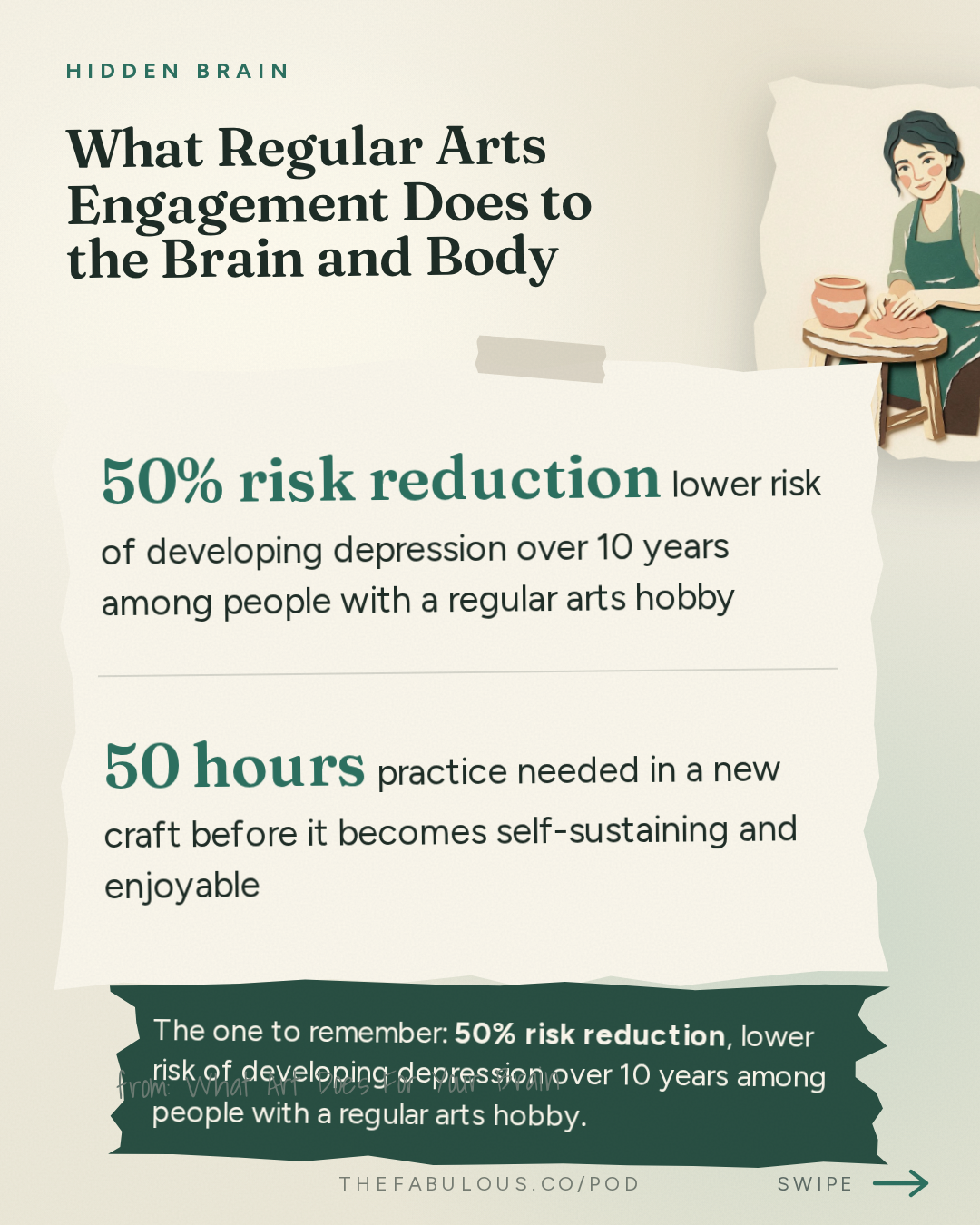
- 50% risk reduction lower risk of developing depression over 10 years among people with a regular arts hobby
- 50 hours practice needed in a new craft before skill supports flow and self-sustained enjoyment
In their words
“Arts experiences are constantly about tension and resolution and anticipating what might happen and seeing if we're right or having our expectations thwarted.”
“Because we know it's art, our brain treats us a little bit differently, so we've got a little bit of an aesthetic distance between us and that arts experience.”
“When we sing, we reduce our levels of stress hormones- Hmm ... and we also reduce inflammation- Hmm ... in our immune”
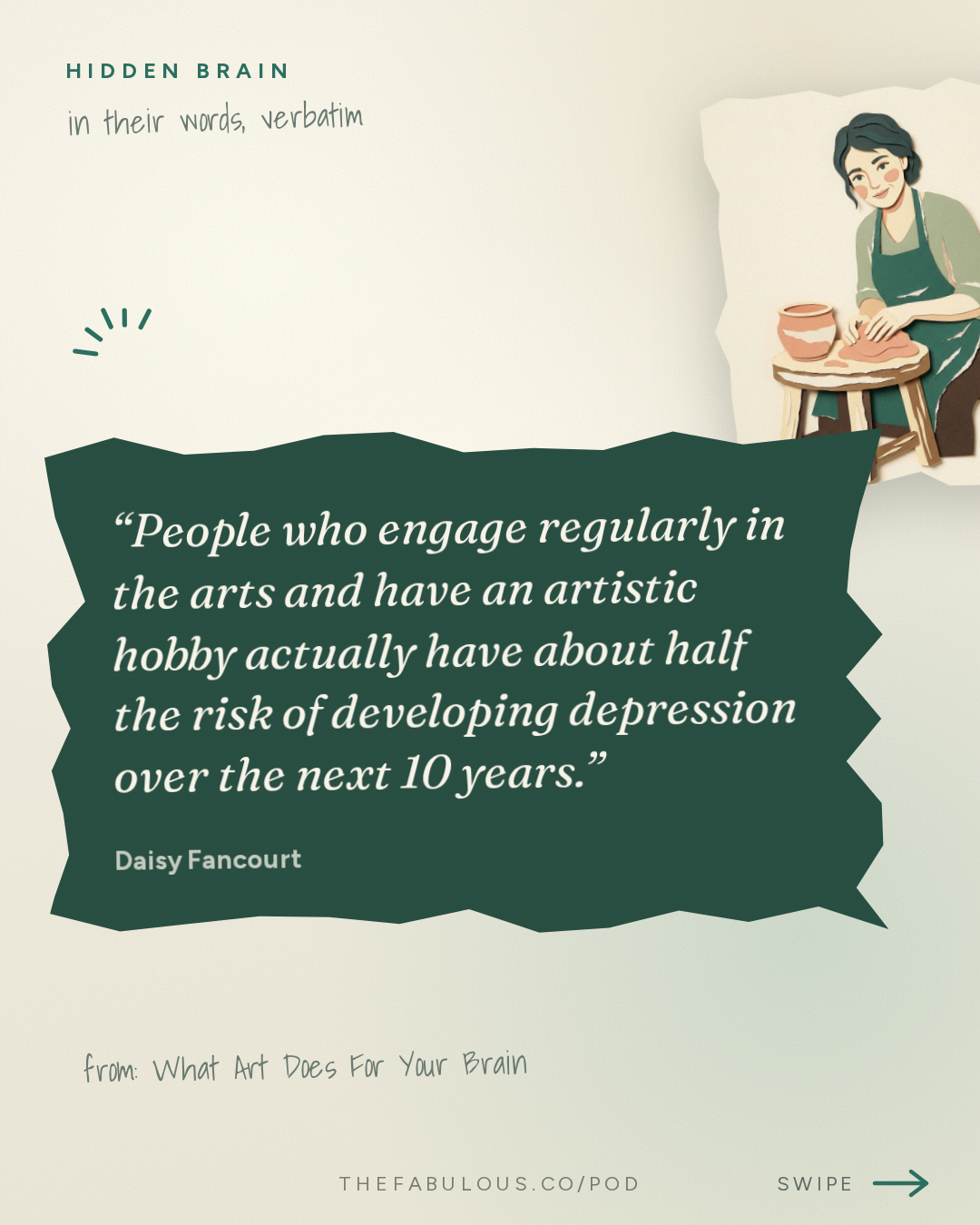
“People who engage regularly in the arts and have an artistic hobby actually have about half the risk of developing depression over the next 10 years.”
“If we do arts with people, so if we sing or we dance with people, we actually become emotionally closer with them faster than if we just talk or if we exercise with them.”
Protocols
-
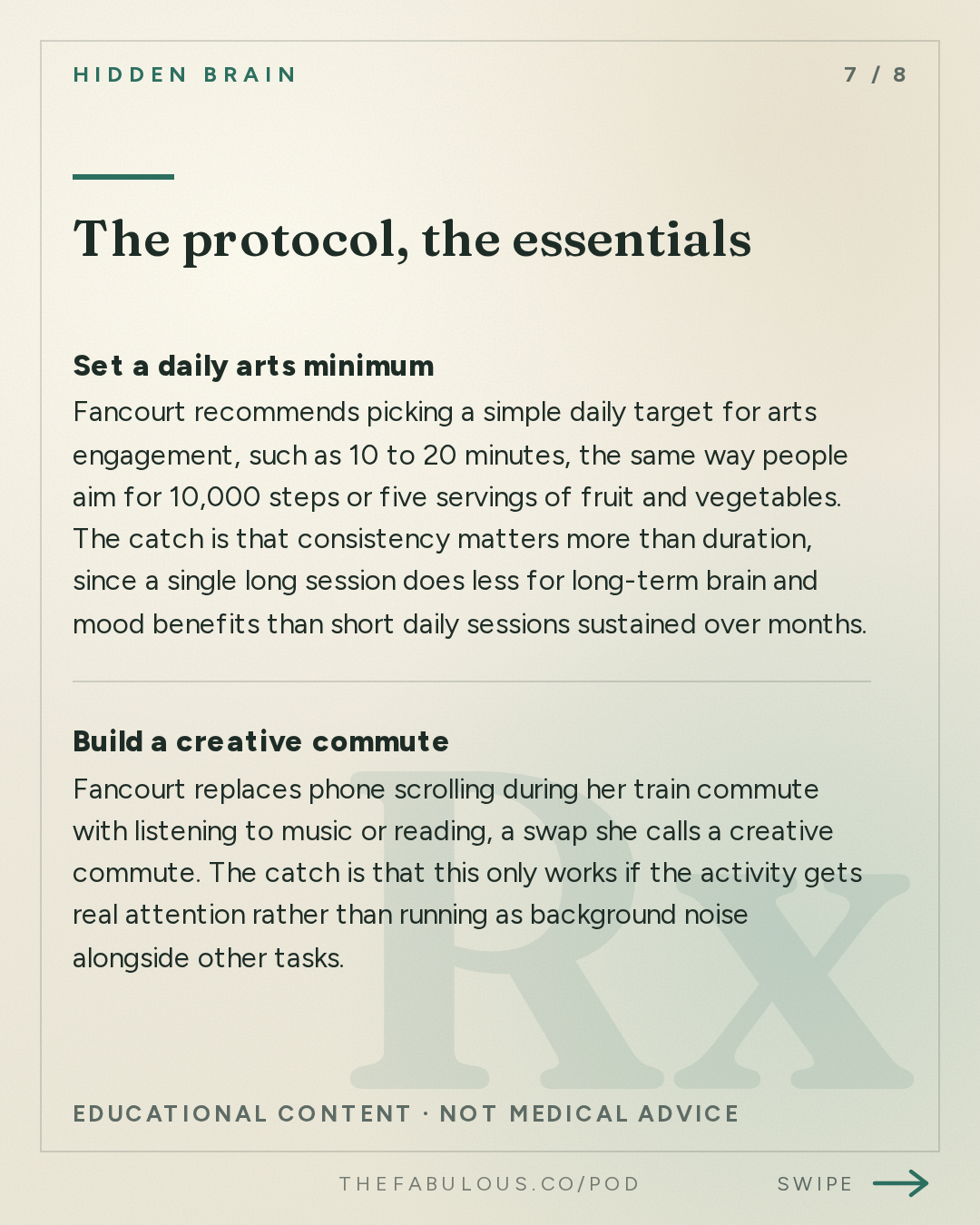
Set a daily arts minimum
Fancourt recommends picking a simple daily target for arts engagement, such as 10 to 20 minutes, the same way people aim for 10,000 steps or five servings of fruit and vegetables. The catch is that consistency matters more than duration, since a single long session does less for long-term brain and mood benefits than short daily sessions sustained over months.
daily
-
Build a creative commute
Fancourt replaces phone scrolling during her train commute with listening to music or reading, a swap she calls a creative commute. The catch is that this only works if the activity gets real attention rather than running as background noise alongside other tasks.
daily, during an existing commute
-
Push through the first fifty hours
Fancourt advises sticking with a new artistic hobby, such as learning an instrument or a craft, for roughly fifty hours before judging it, since that is about when skill develops enough to produce flow and self-sustained enjoyment. The catch is that people should expect the first few weeks to feel uncomfortable and give themselves that runway before deciding whether the hobby is for them.
one-time threshold per new hobby
-
Give art full attention at least sometimes
Fancourt suggests deliberately setting aside time to engage with art with full, undivided attention rather than always relegating it to the background, since focused attention raises dopamine release and produces stronger emotional and brain effects. The catch is that passive, background listening still helps a little, so the goal is adding focused sessions, not eliminating casual ones.
as often as possible, ideally daily
Questions this episode answers
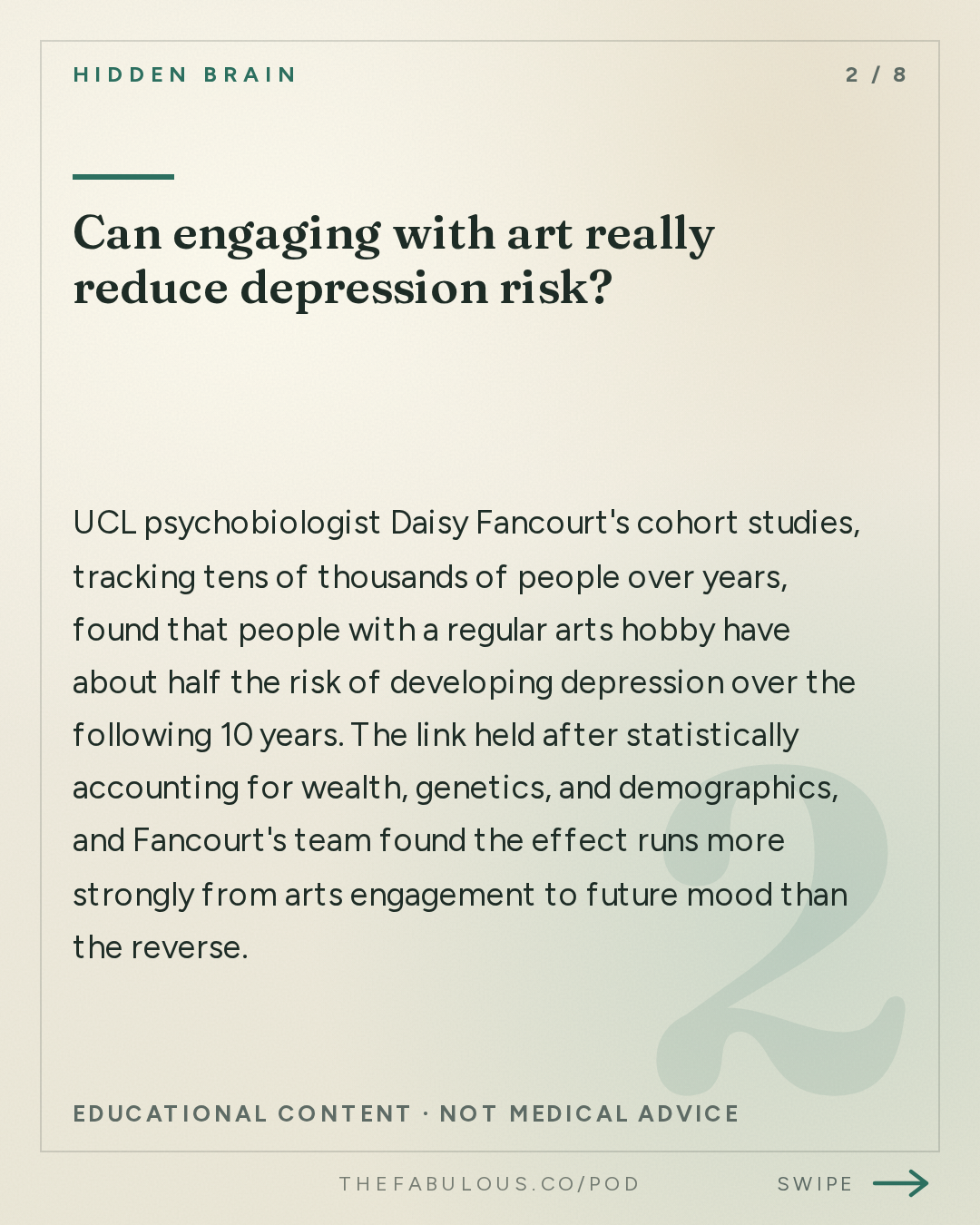
Can engaging with art really reduce depression risk?
UCL psychobiologist Daisy Fancourt's cohort studies, tracking tens of thousands of people over years, found that people with a regular arts hobby have about half the risk of developing depression over the following 10 years (28:45). The link held after statistically accounting for wealth, genetics, and demographics, and Fancourt's team found the effect runs more strongly from arts engagement to future mood than the reverse (29:52).
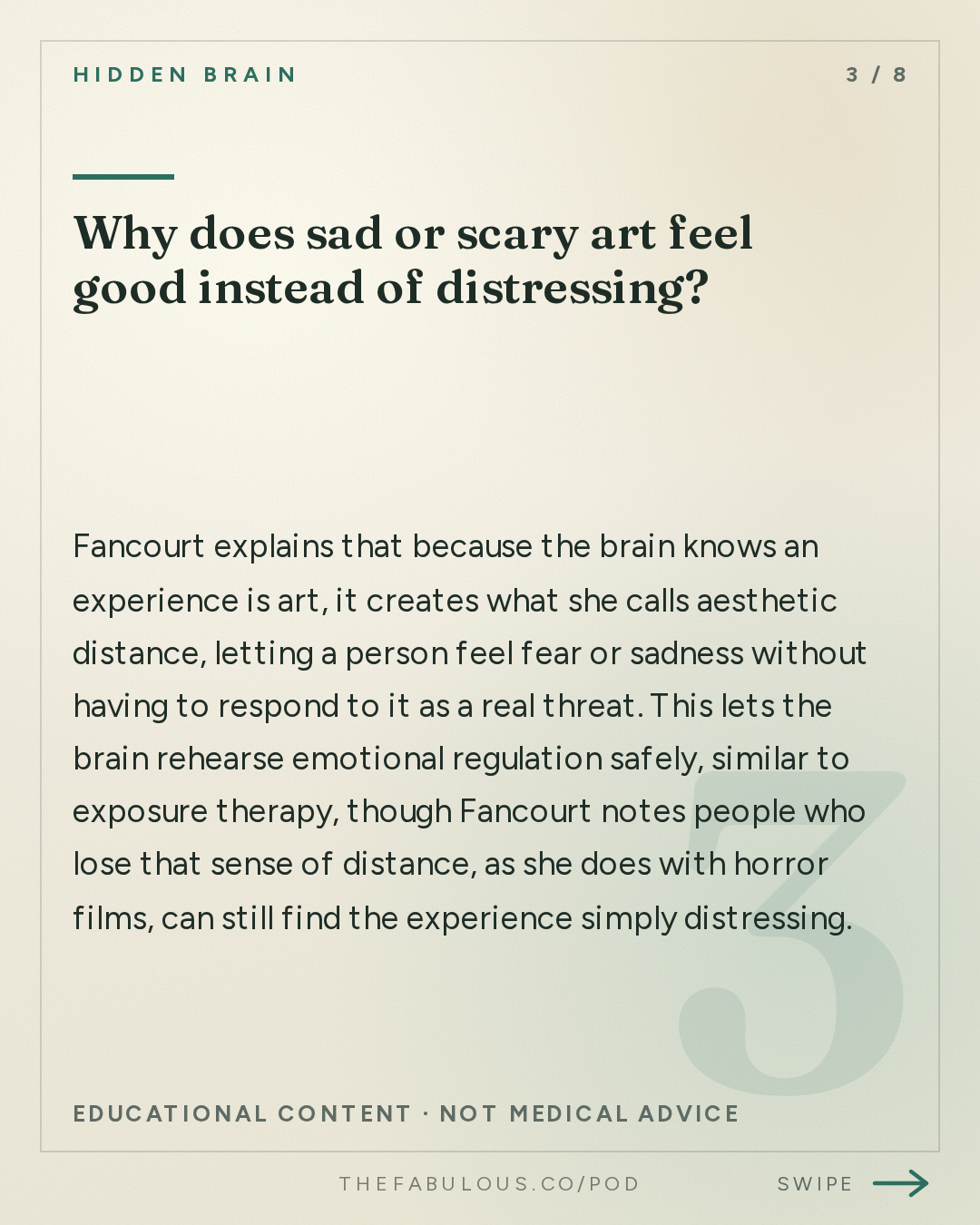
Why does sad or scary art feel good instead of distressing?
Fancourt explains that because the brain knows an experience is art, it creates what she calls aesthetic distance, letting a person feel fear or sadness without having to respond to it as a real threat (15:26). This lets the brain rehearse emotional regulation safely, similar to exposure therapy, though Fancourt notes people who lose that sense of distance, as she does with horror films, can still find the experience simply distressing (17:46).
Does singing actually help cancer patients physically?
In choir programs Fancourt ran for cancer patients in the UK, group singing lowered participants' stress hormones and reduced inflammation in the immune system, a marker also linked to depressive symptoms (22:18). Patients also reported gains in self-esteem and confidence from learning a new skill and performing with others (22:40).
How much art should someone do each day for benefits?
Fancourt recommends picking a simple daily target, such as 10 to 20 minutes of arts engagement, similar to a step count or a fruit-and-vegetable goal (36:59). She personally uses a creative commute, swapping phone scrolling on her train ride for music or reading, to hit this consistently (37:26).
Can art engagement help prevent dementia?
Fancourt's research links regular arts engagement to increased brain connectivity and a form of cognitive reserve, the brain's capacity to keep functioning despite damage, which can delay the visible onset of dementia symptoms even when Alzheimer's-related plaques are present (32:02). Regular participants also show brains that measure five to seven years younger than their chronological age on average (31:43).
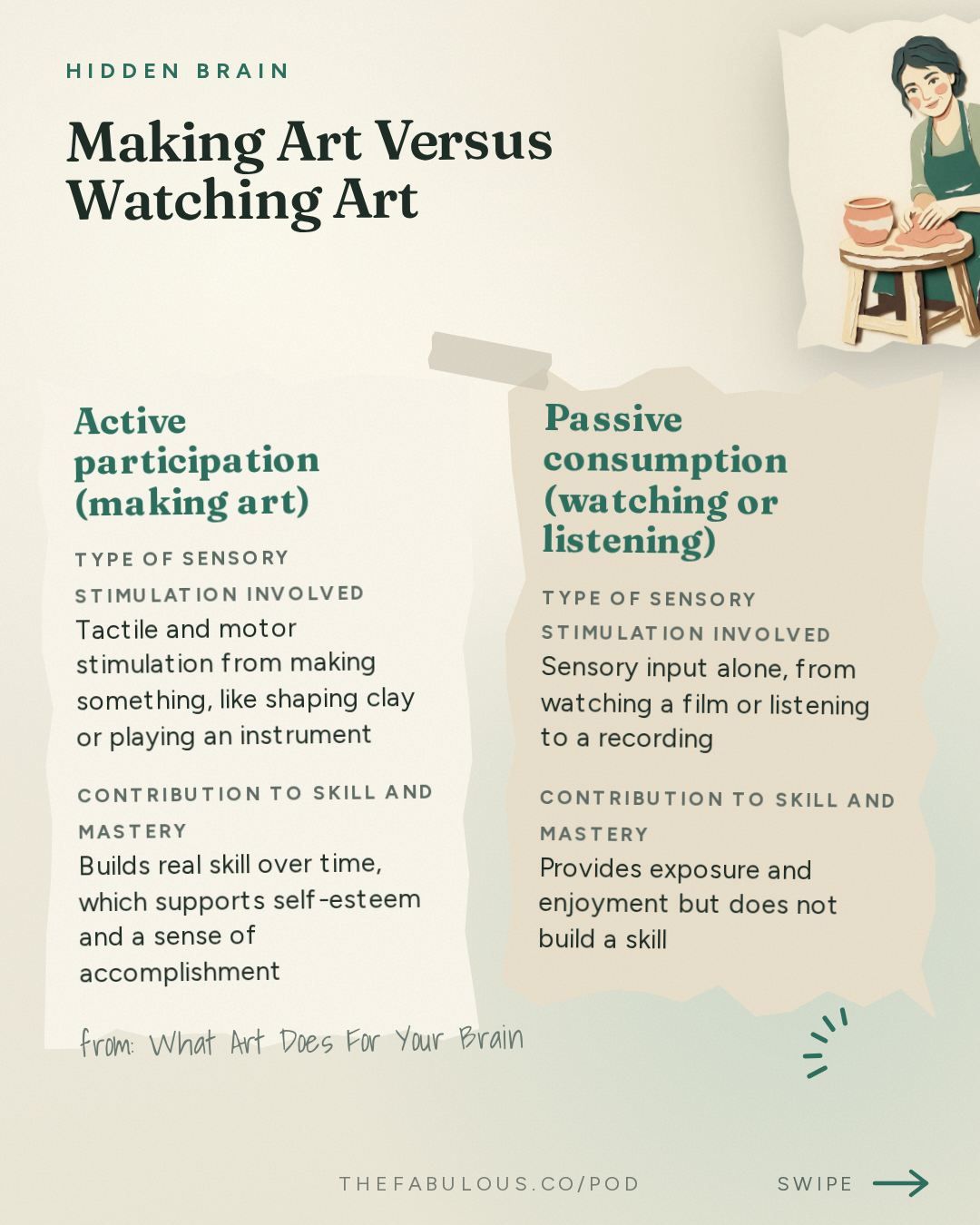
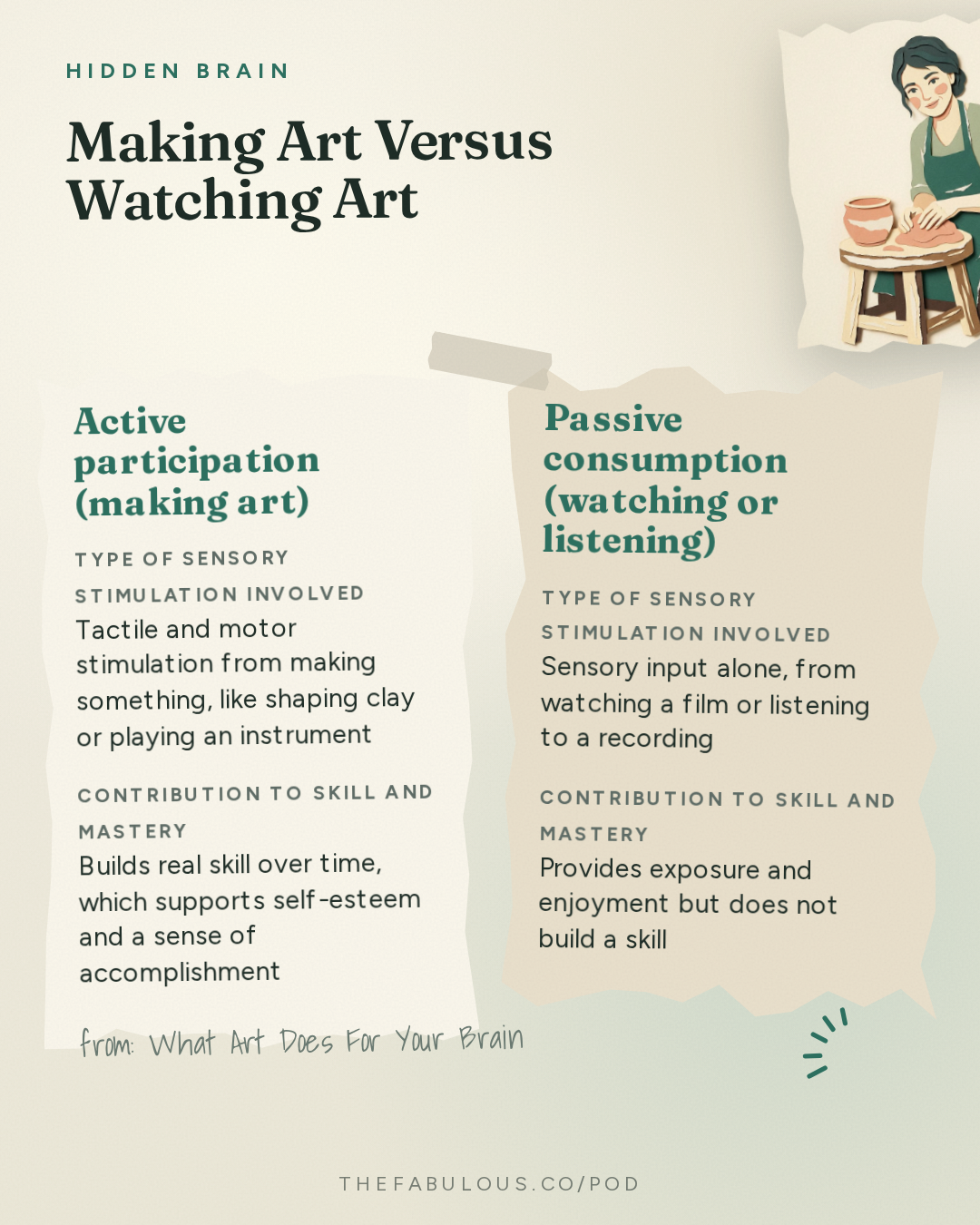
Is it better to make art or just watch and listen to it?
Fancourt says both offer real mental health benefits, but making art adds tactile and motor stimulation plus skill-building that supports self-esteem, benefits passive consumption does not provide (43:43). For outcomes like pain and mobility specifically, active participation adds extra benefit from that hands-on engagement (44:10).
The full read, in cards
Go deeper
- Art Cure: The Science of How the Arts Save Lives — Daisy Fancourt's book synthesizing her cohort and clinical research on how arts engagement affects mental health, physical health, and brain aging
Mentioned
Daisy Fancourt · University College London · Art Cure: The Science of How the Arts Save Lives · Oxford University · Chickenshed · Colton Scrivner · Berkeley College
More from this show and category
How Sleep Deprivation Affects Decisions
Sleep deprivation degrades ethical judgment and decision-making in novel situations, contributing to disasters from train crashes to BP's 2005 explosion. Chronic pain, meanwhile, is reshaped by fear, relationships, and mindset as much as by tissue damage, per sleep researcher Chris Barnes and pain psychologist Rachel Zoffness.
Why Am I Unhappy? The Psychology Behind It
Psychologists George Loewenstein and Alison Ledgerwood argue that most unhappiness starts inside the mind, not from outside events. Loewenstein traces it to the hedonic treadmill and guilt over our own feelings; Ledgerwood traces it to a negativity bias built to spot threats. Their shared fix: notice good moments without suppressing bad ones, and ask whether a reaction fits now or an old pattern (96:51).
How to Build Agency: Martin Seligman's Method
Martin Seligman argues that agency, the belief that our actions can change outcomes, is a skill built through specific exercises, not an inherited trait. He describes three tools, disputing catastrophic thoughts, graded task assignment, and writing about a best possible self, backed by decades of research on optimism and helplessness.
Seligman on Learned Helplessness and Optimism
Psychologist Martin Seligman found that helplessness is learned, and so is optimism. His research links explanatory style to depression risk, predicts success at West Point and in sales, and traces a psychological theory of human progress from ancient Greece to St. Augustine to modern China.
