
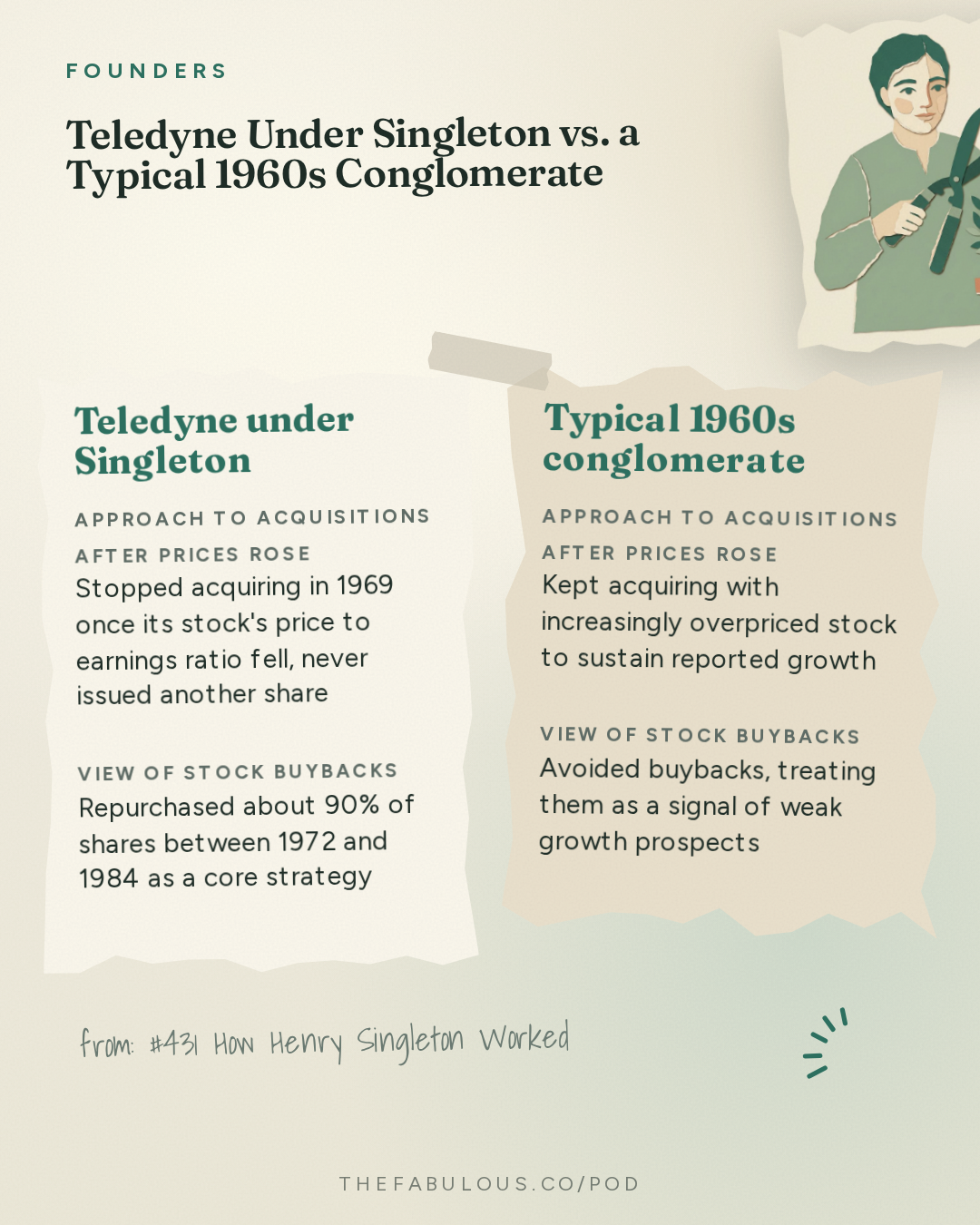
Henry Singleton's Teledyne Strategy Explained
#431 How Henry Singleton Worked
The brief
Henry Singleton ran Teledyne from 1961 to 1990, compounding shareholder returns at 20.4% a year through radical capital allocation. He kept corporate staff under 50 people for 40,000 employees, repurchased 90% of Teledyne's shares between 1972 and 1984, and concentrated stock bets in five companies he knew well.
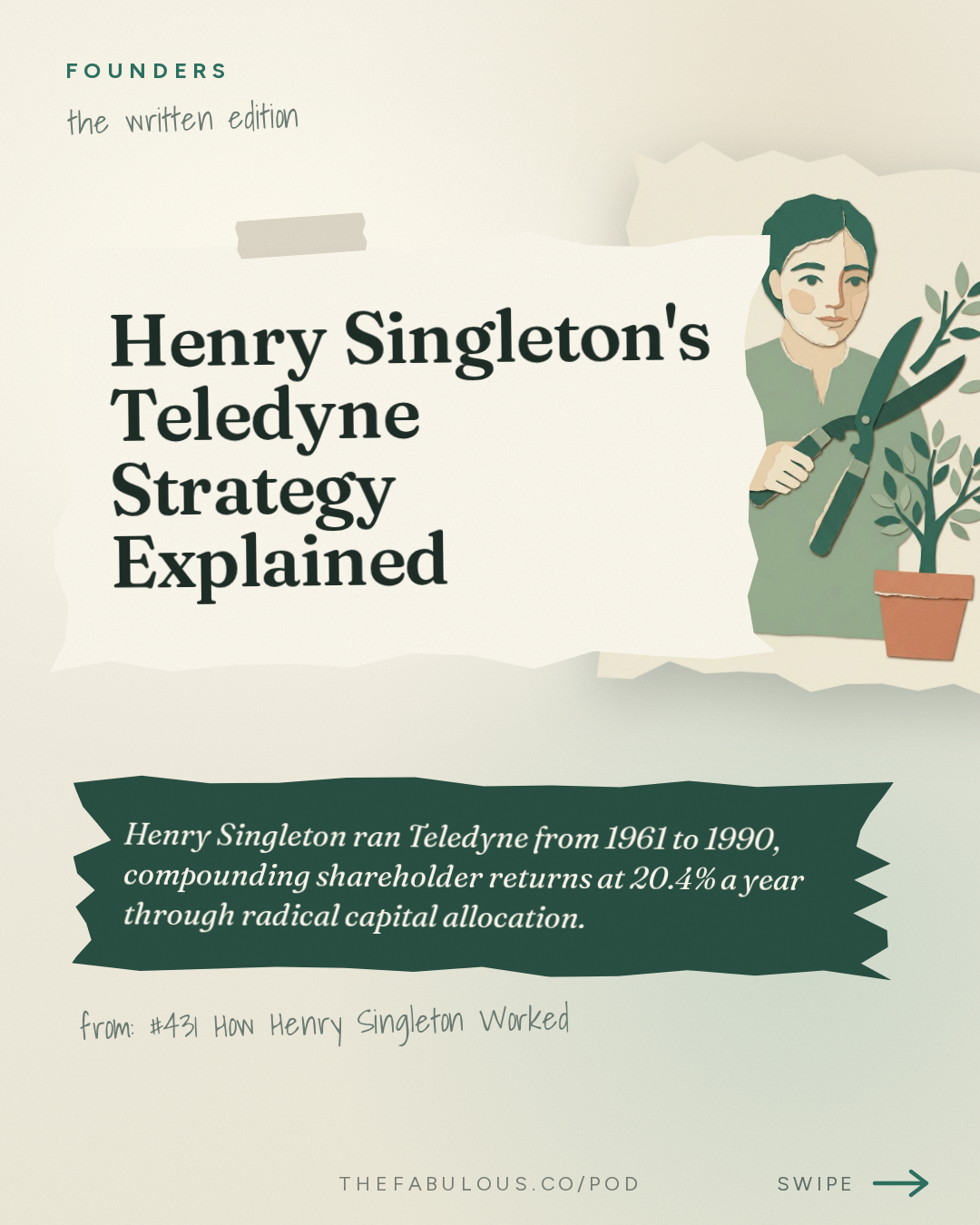
In 1972, buying back your own stock was considered a confession of failure. The thinking on Wall Street was simple: a company that repurchased shares instead of reinvesting in growth was a company that had run out of ideas. Henry Singleton looked at that logic, decided it was backwards, and spent the next twelve years proving it. Between 1972 and 1984, across eight separate tender offers, he bought back roughly 90 percent of the outstanding shares of Teledyne, the conglomerate he founded (00:22). Charlie Munger, who did not hand out compliments cheaply, later said no one had ever bought his own shares that aggressively (11:04). It is one of the reasons a dollar invested with Singleton in 1963 was worth 180 dollars by 1990, when he stepped down, a run that compounded at 20.4 percent a year for almost three decades (01:09).
Singleton's path to that record ran through an unusual set of rooms. He programmed MIT's first student computer as part of his doctoral thesis in electrical engineering, won the Putnam Medal as the country's top college mathematician in 1939, and played chess blindfolded well enough that colleagues remember him catching an opponent's illegal move three turns after it happened (05:24). During the Second World War he worked on technology that helped Allied ships evade radar. In the 1950s he built a guidance system still used in aircraft today (00:00). None of that is standard preparation for running a company. It turned out to be exactly the preparation Teledyne needed.
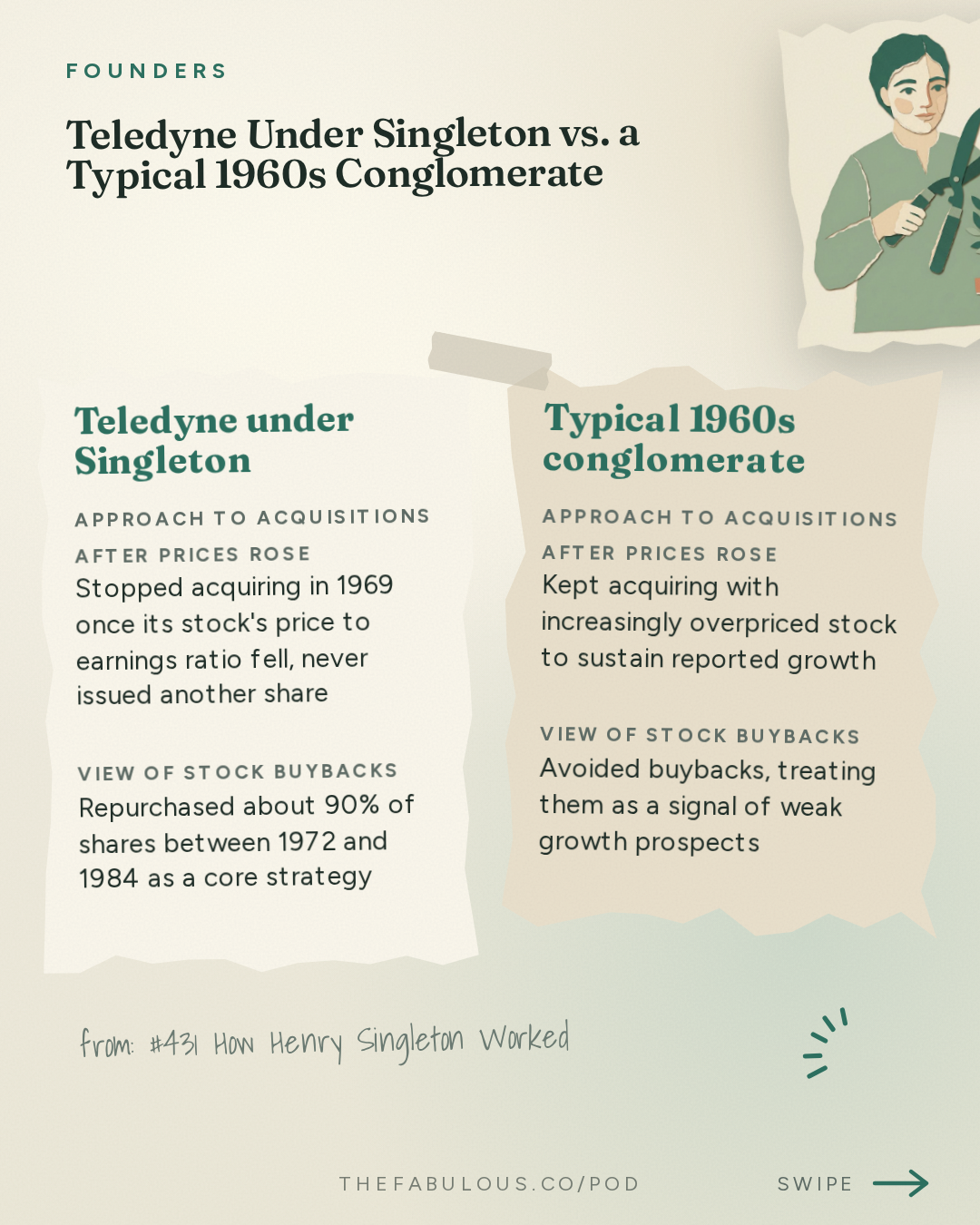
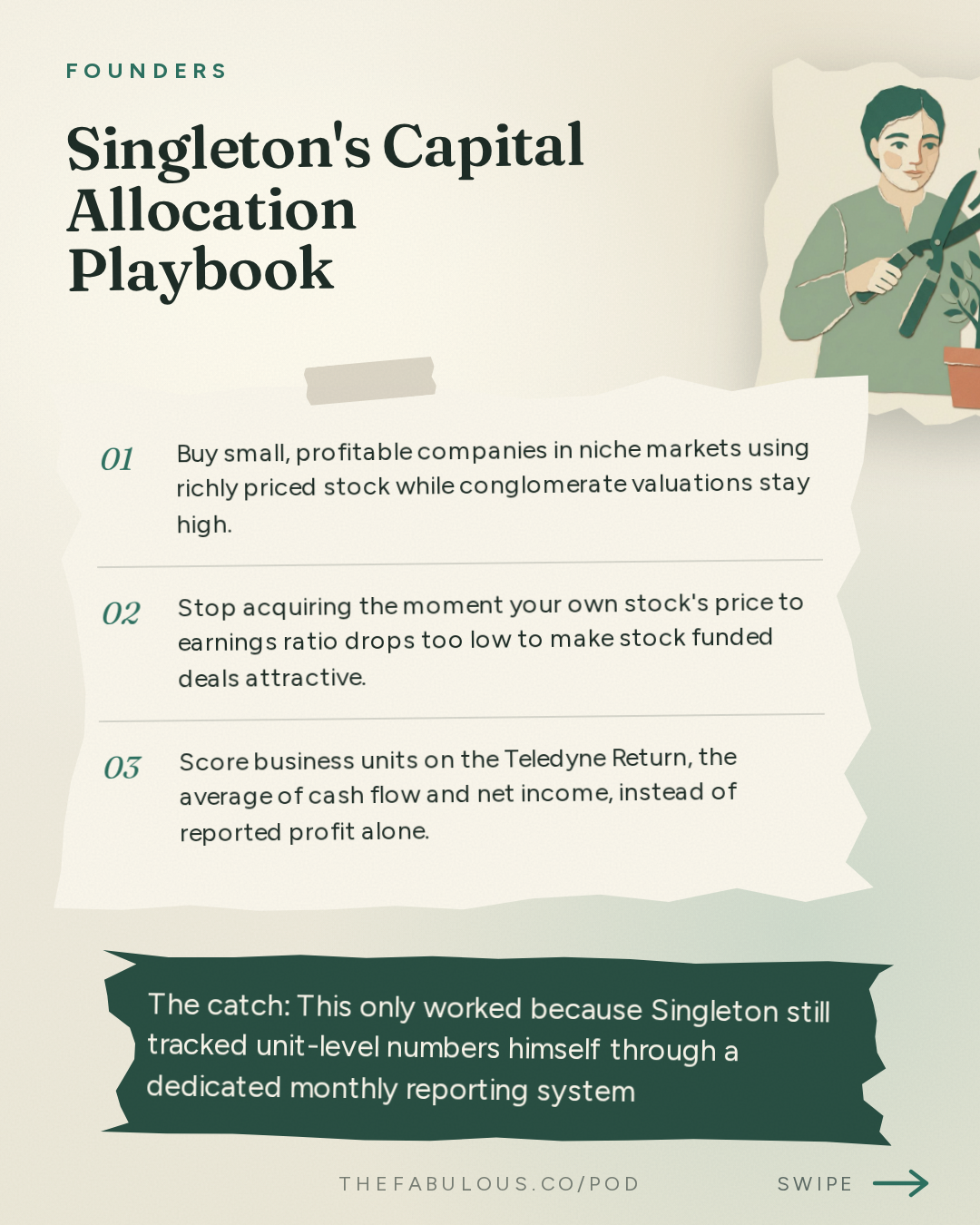
He founded Teledyne in 1960 with his colleague George Kozmetsky, when he was 43 years old and had never run a company before (05:43). The timing mattered. Conglomerates, companies built by acquiring businesses across unrelated industries, were the hot stocks of the era, and their high price to earnings ratios (the multiple investors pay for a dollar of profit) gave them a cheap currency: their own richly valued shares. Between 1961 and 1969, Singleton used that currency to buy 130 companies, almost all of them paid for in stock rather than cash (06:43). But he was choosy in a way his peers were not. He avoided turnarounds and stuck to profitable, growing businesses in niche markets, the kind that, as one division head told the author, sold 'high-margin products that were sold by the ounce, not the ton' (07:09). Then, in 1969, he stopped completely. Teledyne's own stock had gotten too cheap to use as acquisition currency, so Singleton fired his acquisition team and never issued another share (07:48).
The Discipline of Ignoring Wall Street
What Singleton did next is the part of the story worth sitting with. Wall Street in the 1970s prized smooth, growing quarterly earnings per share above almost everything else. Singleton refused to manage to that number. He built Teledyne's accounting to maximize cash flow instead, and warned investors up front what that would cost them in appearances.
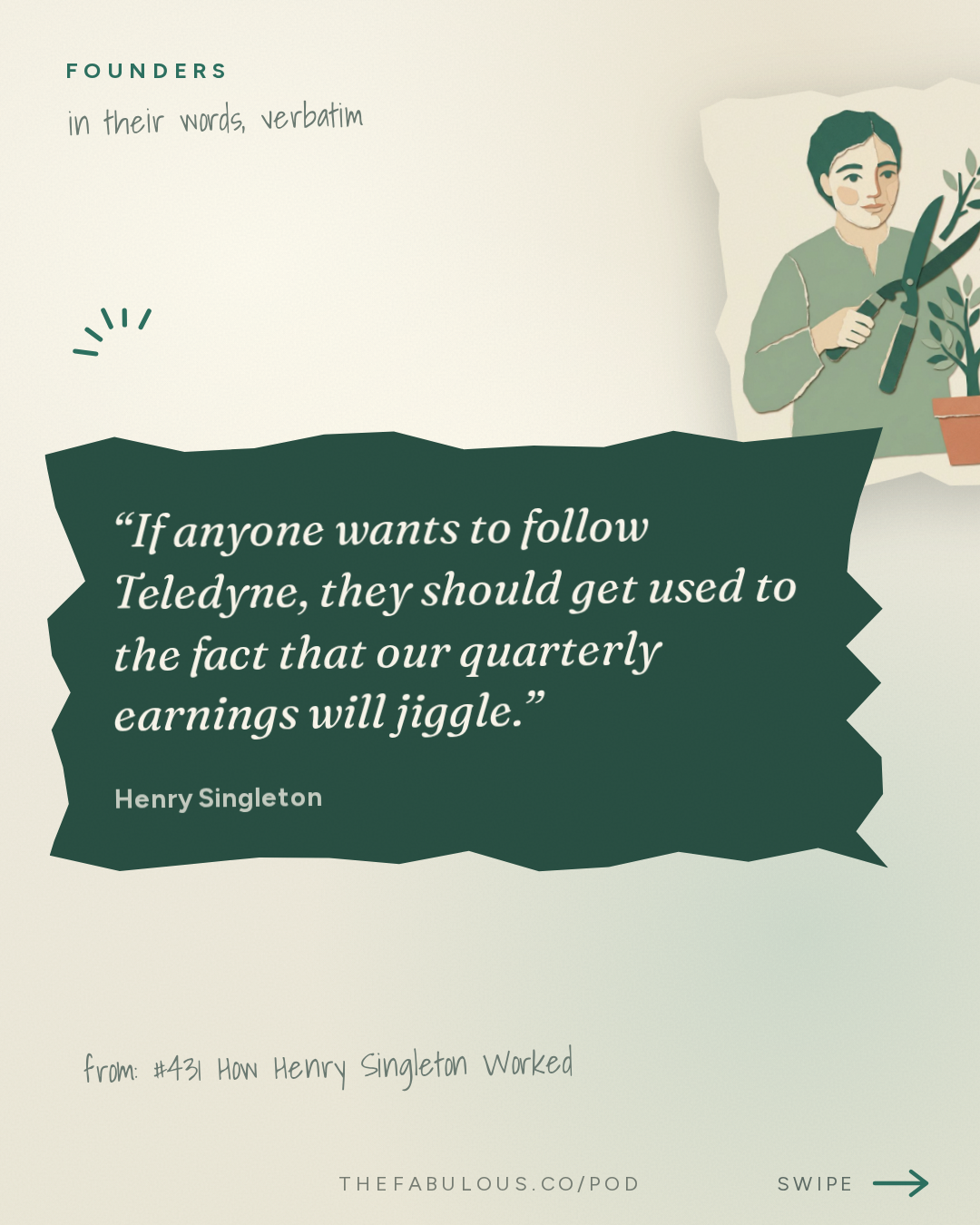
"If anyone wants to follow Teledyne, they should get used to the fact that our quarterly earnings will jiggle." Henry Singleton, [09:42]
To make that discipline stick inside the company, he invented a metric he called the Teledyne Return: the average of a business unit's cash flow and its net income (38:38). If a division reported a million dollars in profit but generated only half a million in actual cash, its Teledyne Return was 750,000 dollars, and managers were paid on that number, not the flattering one. The point was to close off a classic trick: boosting reported earnings by piling up inventory or extending easy credit while the underlying cash position quietly rots. Singleton wanted one honest number at headquarters, even while he handed almost everything else to the people running the businesses.
That handoff was close to absolute. Teledyne's corporate headquarters employed fewer than 50 people to oversee a company with 40,000 total employees, and it had no human resources department and no investor relations department at all (08:56). Business unit presidents, many of them the founders of the companies Teledyne had acquired, ran their own operations and reported results monthly. Singleton's rationale, repeated by people who worked with him, was almost dismissive of the alternative: "Why bother them if they are doing their job?" (37:18).
Decentralization freed Singleton to spend nearly all of his time on the one job he thought actually mattered. Warren Buffett, the Nebraska-based investor who built Berkshire Hathaway, later argued that capital allocation, deciding where a company's cash should go, is the rarest skill among CEOs, because most executives rise through marketing or engineering or operations and never practice it before they are handed the checkbook (01:32). Singleton treated it as his entire job description, and he treated his own stock as one of the available places to put money. His logic for the buybacks, once Teledyne's shares looked cheap to him in 1972, was that repurchasing was self-catalyzing, like coiling a spring that would eventually release. Across the tender offers, that bet generated a 42 percent compound annual return for the shareholders who sold and, more importantly, for the ones who stayed (11:23).
He applied the same concentrated instinct to the stock portfolios of Teledyne's insurance subsidiaries once he took direct control of them in the mid-1970s bear market. Rather than diversify broadly, he put more than 70 percent of the combined equity portfolios into just five companies, with a full 25 percent in a single stock, his former employer Litton Industries (13:18). It looked reckless to outside observers, who assumed he was quietly preparing a wave of hostile takeovers. He was not. He simply bought businesses he understood, at prices near record-low earnings multiples, and left it there.
A Genius Measured Against Time
The comparison to Warren Buffett is not incidental; it is the reason many investors know Singleton's name at all. Both men built organizations that let them focus on capital allocation instead of daily operations. Both saw themselves as investors first and managers second. Both ran thin corporate staffs, avoided quarterly guidance to analysts, and used insurance company portfolios as engines for long-term stock investing. William Thorndike, author of the book The Outsiders, calls Singleton a proto-Buffett, and the parallels are close enough that reading about one explains habits in the other (16:03).
Yet the two men were not identical, and Charlie Munger, Buffett's longtime business partner at Berkshire Hathaway, drew the distinction precisely. He rated Singleton's raw intelligence in the top one one-thousandth of one percent and called him, flatly, the smartest person he had ever met.
"Henry Singleton was the smartest single human being I've ever known in my entire life." Charlie Munger, [44:24]
But Munger added a qualifier worth remembering: Singleton was smarter, but Buffett had thought about investing longer. Singleton did not start Teledyne until 43 and did not take direct control of its stock portfolios until his fifties, then largely stopped at 70 when he retired. Buffett started as a boy and was still compounding capital in his nineties. Genius, in Munger's accounting, is not the same as accumulated hours, and the two men's records diverged partly because one of them simply started decades earlier (45:04).
Singleton's contrarianism did not stop at the office door. He was, by some accounts, the third-largest private landowner in the United States when he died, and he never sold a single piece of real estate in his life, a house, a ranch, or empty land (42:43). After leaving Teledyne he spent his final years running that ranch the way he had run the company: he insisted on signing every check himself, calling it a form of discipline that taught him the details of the business (43:44). It was the same instinct that once had him lying on the floor of the public relations department, personally debating the exact proportions of the Teledyne logo (36:25), and the same instinct behind his early bet on a struggling young computer company. Asked why he backed Apple when dozens of competing startups looked identical, Singleton said he figured most first-time computer buyers would be intimidated by anything technical, but nobody could be intimidated by a machine named after a piece of fruit (47:49).
Buffett once said it was a crime that business schools did not study Henry Singleton, and that the combined record of the top 100 business school graduates of his era would not match Singleton's own (44:05). The claim is easy to test against the numbers: a 20.4 percent annual return sustained for nearly thirty years, a 90 percent reduction in share count achieved while the stock still compounded, and a company that ran 130 profit centers with only one losing money in a given year (27:31). What is harder to teach in a classroom is the temperament behind those numbers: a willingness to ignore analysts, decline dividends, let quarterly earnings jiggle, and wait, sometimes for years, for a cheap price before acting at all.
Ask this episode anything
Pod's AI answers from the episode itself, with the minute mark so you can hear it yourself.
Or start with one of these
Ask this episode
Pod's AI listens to the whole episode to answer, and points you to the minute it comes from.
The rest of this answer, and any question after it
Answers come from the episode itself, never from a summary of it.
ContinueKey takeaways
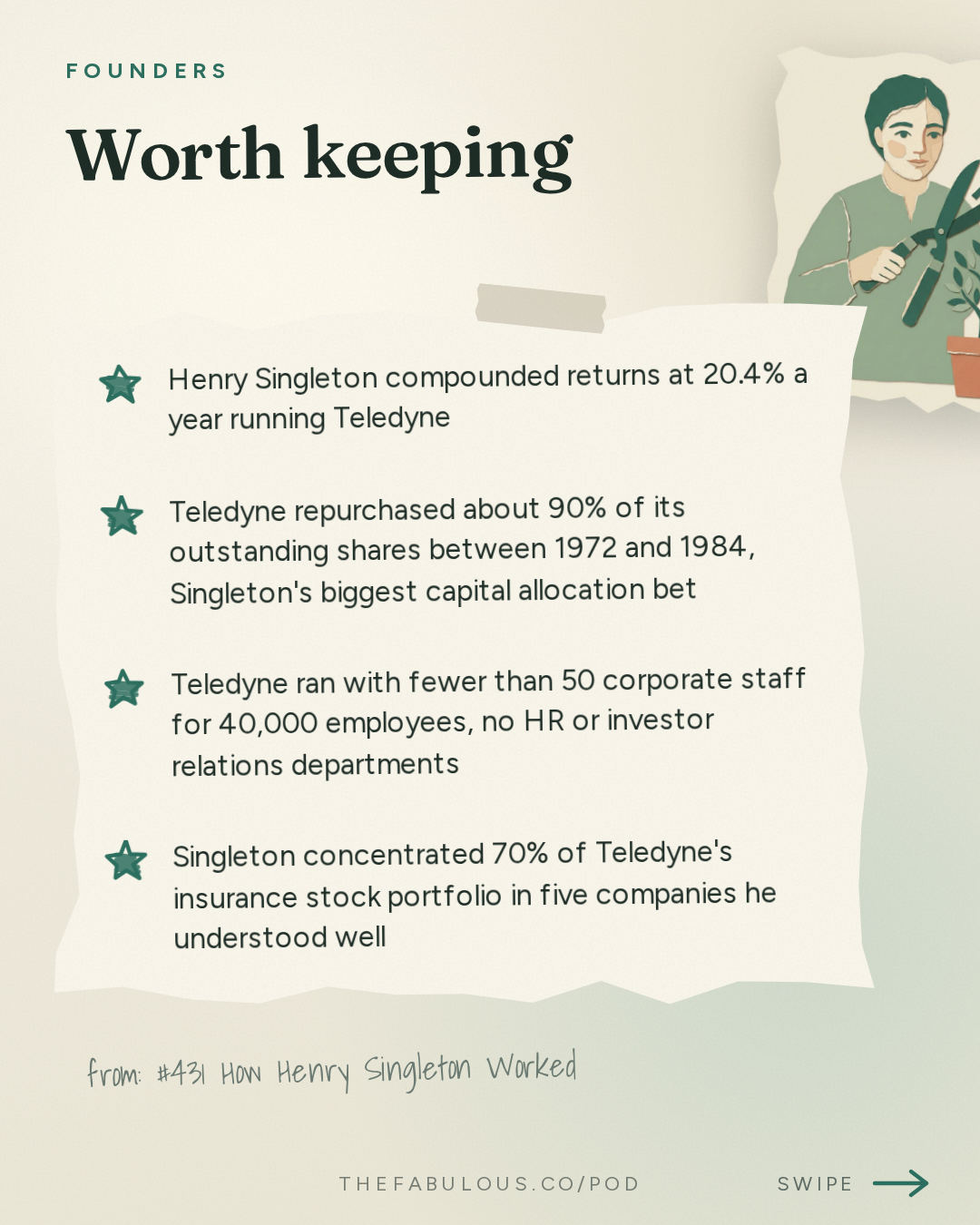
- Henry Singleton compounded returns at 20.4% a year running Teledyne
- Teledyne repurchased about 90% of its outstanding shares between 1972 and 1984, Singleton's biggest capital allocation bet
- Teledyne ran with fewer than 50 corporate staff for 40,000 employees, no HR or investor relations departments
- Singleton concentrated 70% of Teledyne's insurance stock portfolio in five companies he understood well
- Charlie Munger called Henry Singleton the smartest person he ever met, smarter than Warren Buffett
The episode in cards

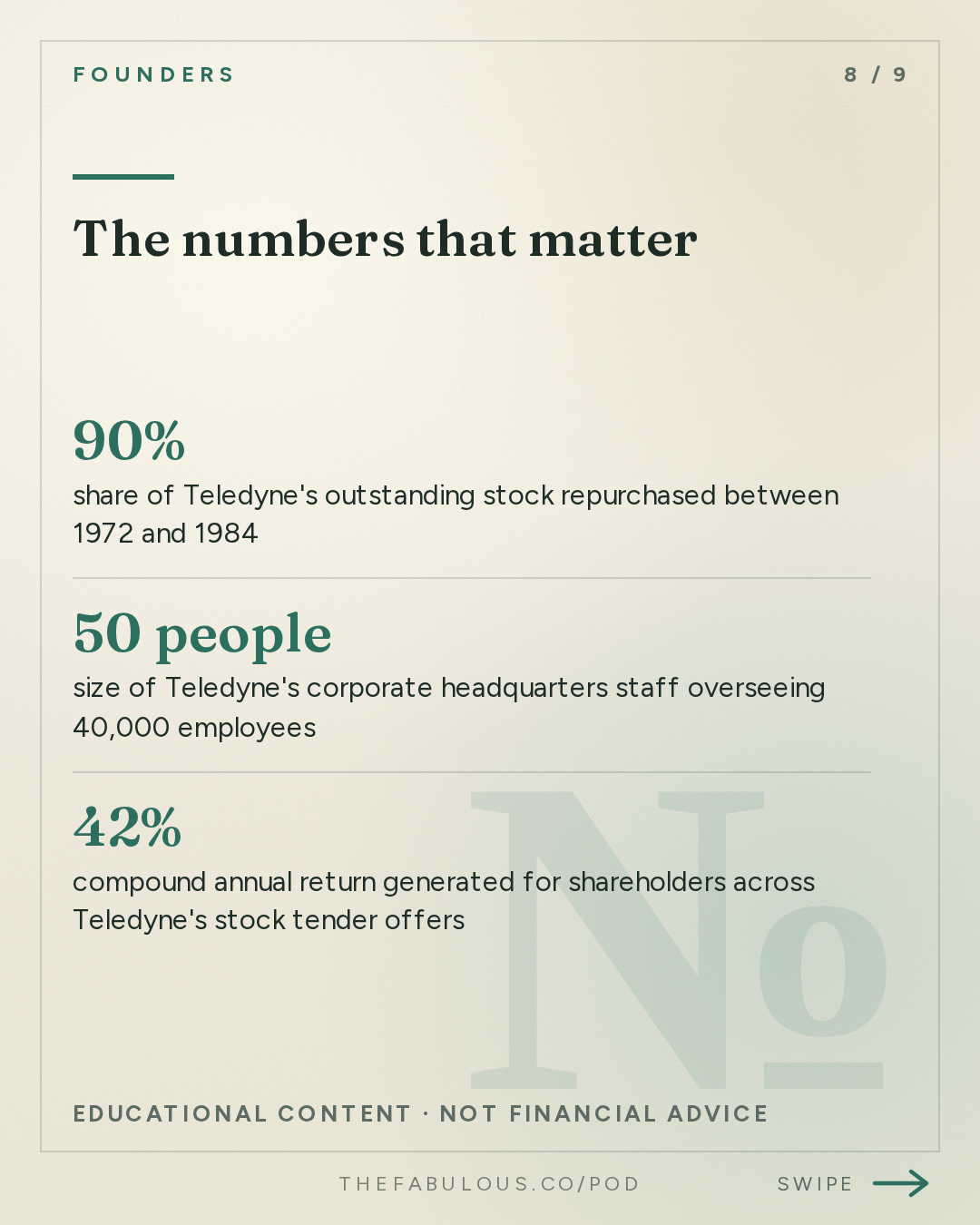
By the numbers
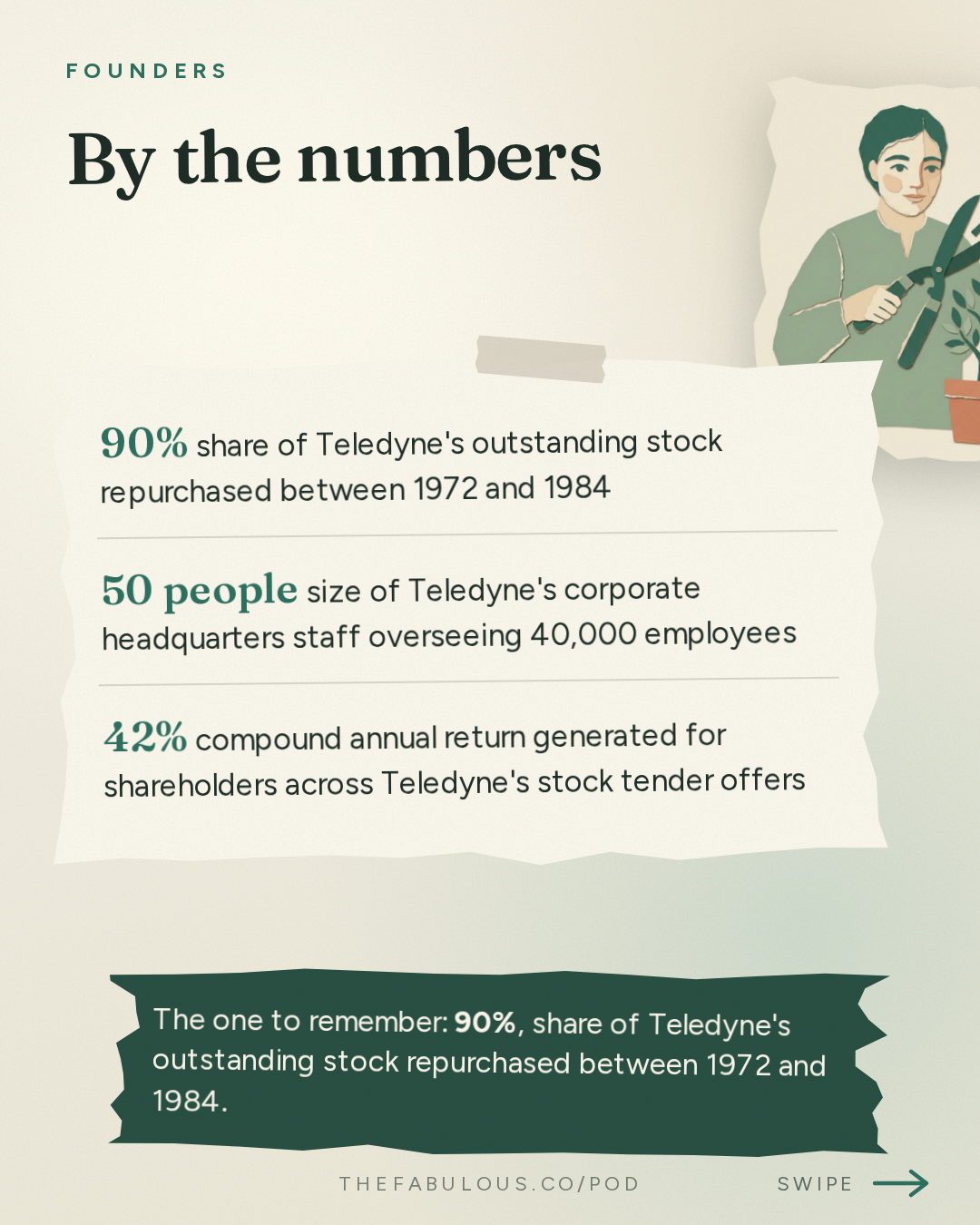
- 90% percent share of Teledyne's outstanding stock repurchased between 1972 and 1984
- 50 people size of Teledyne's corporate headquarters staff overseeing 40,000 employees
- 42% percent compound annual return generated for shareholders across Teledyne's stock tender offers
In their words
“If anyone wants to follow Teledyne, they should get used to the fact that our quarterly earnings will jiggle.”
“Why bother them if they are doing their job?”
“I like to steer the boat each day rather than plan ahead way into the future.”
“Henry Singleton was the smartest single human being I've ever known in my entire life.”
Protocols
-
Maximize cash flow over reported earnings
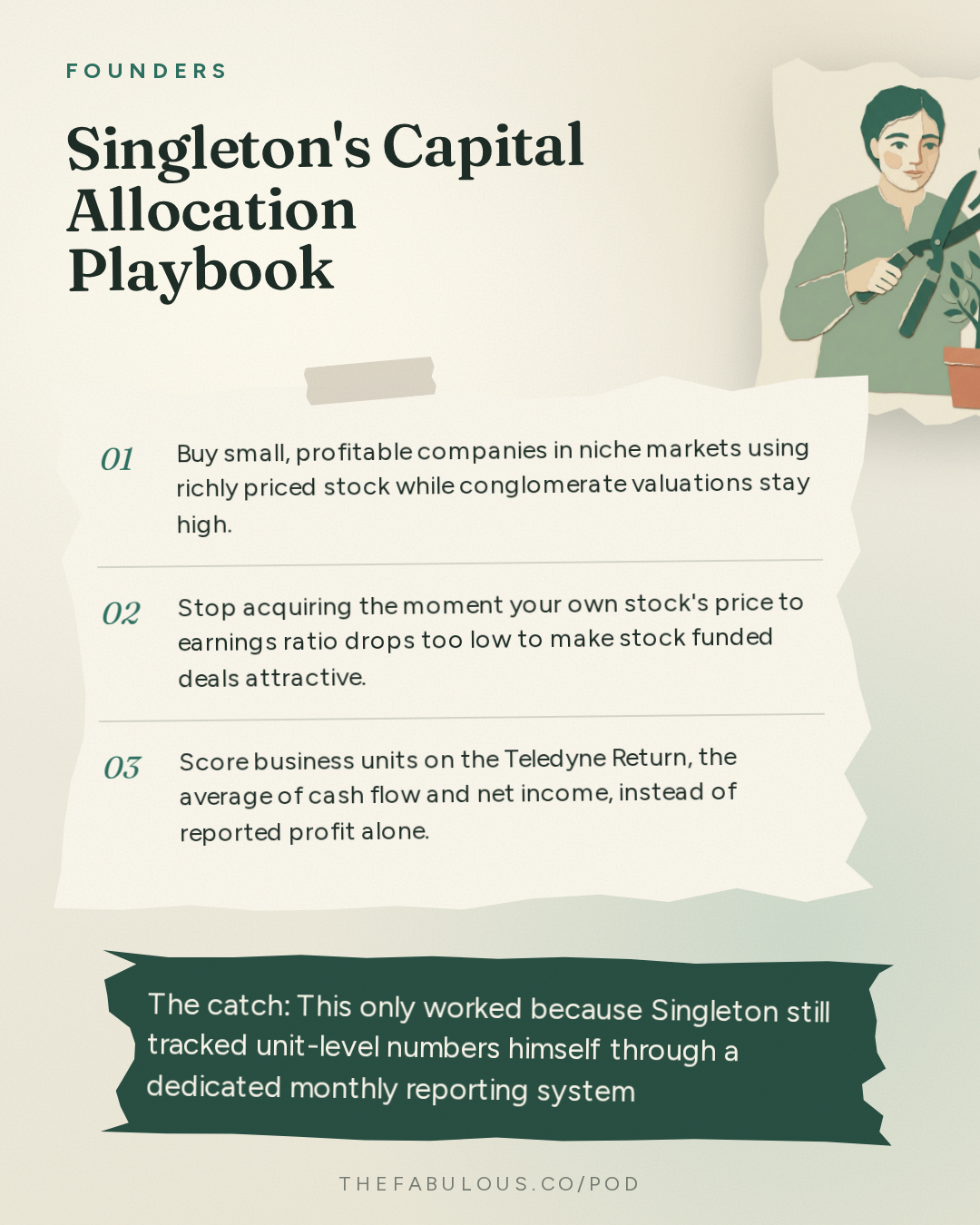
Singleton designed Teledyne's accounting to optimize free cash flow rather than reported earnings, and he told investors directly that quarterly earnings would fluctuate as a result.
Standing company policy from 1970 onward
-
Score managers on the Teledyne Return, not raw profit
Singleton averaged each business unit's cash flow and net income into a single number called the Teledyne Return, and he tied manager bonuses to that number so nobody could inflate earnings by tying up cash in inventory or receivables.
Applied to monthly unit reporting
-
Stop acquiring once your stock gets expensive to use as currency
Singleton halted every acquisition in 1969 once Teledyne's price to earnings ratio fell too low to make stock funded purchases worthwhile, and the company never issued another share afterward.
One permanent strategic shift
-
Buy back stock aggressively when it is cheap
Singleton concluded in 1972 that Teledyne's shares were undervalued and launched the first of eight tender offers, eventually repurchasing about 90 percent of outstanding shares by 1984.
Eight tender offers over twelve years
-
Leave a business unit alone once it is performing
Singleton kept Teledyne's operating units small and gave their managers full autonomy, and he said outright that he saw no reason to intervene if a unit was doing its job.
Standing management philosophy
Questions this episode answers
What was Henry Singleton's investment strategy at Teledyne?
Singleton focused on capital allocation rather than operations, running Teledyne with a corporate staff of fewer than 50 people for 40,000 employees (08:56). He prioritized cash flow over reported earnings and used a custom metric called the Teledyne Return, the average of cash flow and net income, to evaluate business units (38:38).
How many shares did Teledyne repurchase under Henry Singleton?
Teledyne repurchased about 90 percent of its outstanding shares between 1972 and 1984, across eight separate tender offers (00:22, 11:04). Charlie Munger, Warren Buffett's longtime business partner, said no company had ever bought back its own shares that aggressively (11:23).
What is the Teledyne Return metric?
The Teledyne Return is the average of a business unit's cash flow and its net income, used to strip out accounting profit that was not backed by actual cash (38:38). Singleton used it to pay manager bonuses, which discouraged inflating earnings by piling up inventory or extending easy credit to customers (39:16).
How does Henry Singleton compare to Warren Buffett?
Investor and author William Thorndike calls Singleton a proto-Buffett, noting both men focused on capital allocation, ran decentralized organizations, and avoided quarterly guidance to analysts (16:22). Charlie Munger later said Singleton had more raw intelligence than Buffett, but that Buffett had spent far more accumulated years thinking about investing (44:44).
Why did Teledyne stop making acquisitions in 1969?
Teledyne had used its own richly priced stock to fund 130 acquisitions between 1961 and 1969, but once the stock's price to earnings ratio fell, that currency stopped being attractive for buying other companies (06:43, 07:48). Singleton dismissed his acquisition team and the company never issued another share afterward.
Did Henry Singleton pick individual stocks, or only run Teledyne's operations?
Singleton personally directed the stock portfolios of Teledyne's insurance subsidiaries starting in the mid-1970s, putting over 70 percent of the combined portfolios into just five companies, including 25 percent in his former employer Litton Industries (13:18). He favored businesses he knew well, bought at low earnings multiples.
The full read, in cards
Go deeper
- The Outsiders — profiles eight unconventional CEOs, including Henry Singleton, and their capital allocation records
- Distant Force: A Memoir of the Teledyne Corporation and the Man Who Created It — memoir by former Teledyne president George Roberts detailing Singleton's day-to-day management style
- The Sphinx Speaks — a rare 1979 interview with Singleton describing Teledyne's 130 profit centers and cash-focused accounting
Mentioned
Henry Singleton · Teledyne · Warren Buffett · Charlie Munger · MIT · Litton Industries · George Kozmetsky · Claude Shannon · The Outsiders · Distant Force · William Thorndike · George Roberts · Howard Hughes · Apple
More from this show and category
The Tycoons: How Carnegie and Rockefeller Built America
Charles R. Morris's book The Tycoons compares how Carnegie, Rockefeller, Gould, and Morgan each built the post-Civil War American economy. Carnegie cut costs and scaled steel, Rockefeller out-managed rivals in oil, Gould mastered railroad finance, and Morgan tried to impose order, together creating the infrastructure that let consumer brands like Procter & Gamble emerge.
Ari Emanuel's Roll the Calls, Summarized
Ari Emanuel's memoir Roll the Calls traces his rise from a dyslexic mailroom assistant to the billionaire founder of Endeavor. It shows how rage, relentless phone volume, and a 1994 near-fatal car accident drove him to found Endeavor, merge with William Morris, and buy the UFC and WWE before Endeavor was valued at $13 billion.
Jeremy Stern's Mark Zuckerberg Profile Explained
Mark Zuckerberg has modeled himself on Augustus Caesar for decades, fighting what journalist Jeremy Stern calls the dictator's dilemma. Stern's profile shows how Zuckerberg counters corporate isolation with raw data and MMA training, building a $1.6 trillion empire of 3.6 billion users while insisting he will never stop.
Sam Walton's Core Business Strategies
Sam Walton built Walmart on four simple habits: cost control, copying competitors, small-town focus, and constant willingness to change course. He lost his first store over a missing lease clause, learned to fly a plane to scale faster, and copied ideas from JC Penney and Sol Price on his way to becoming America's richest man.
