
AI Cyberattack Wave: CrowdStrike CEO Explains
Crowdstrike CEO: AI Cyberattack Wave, Hyperspeed Hacks, & The Patching Problem
The brief
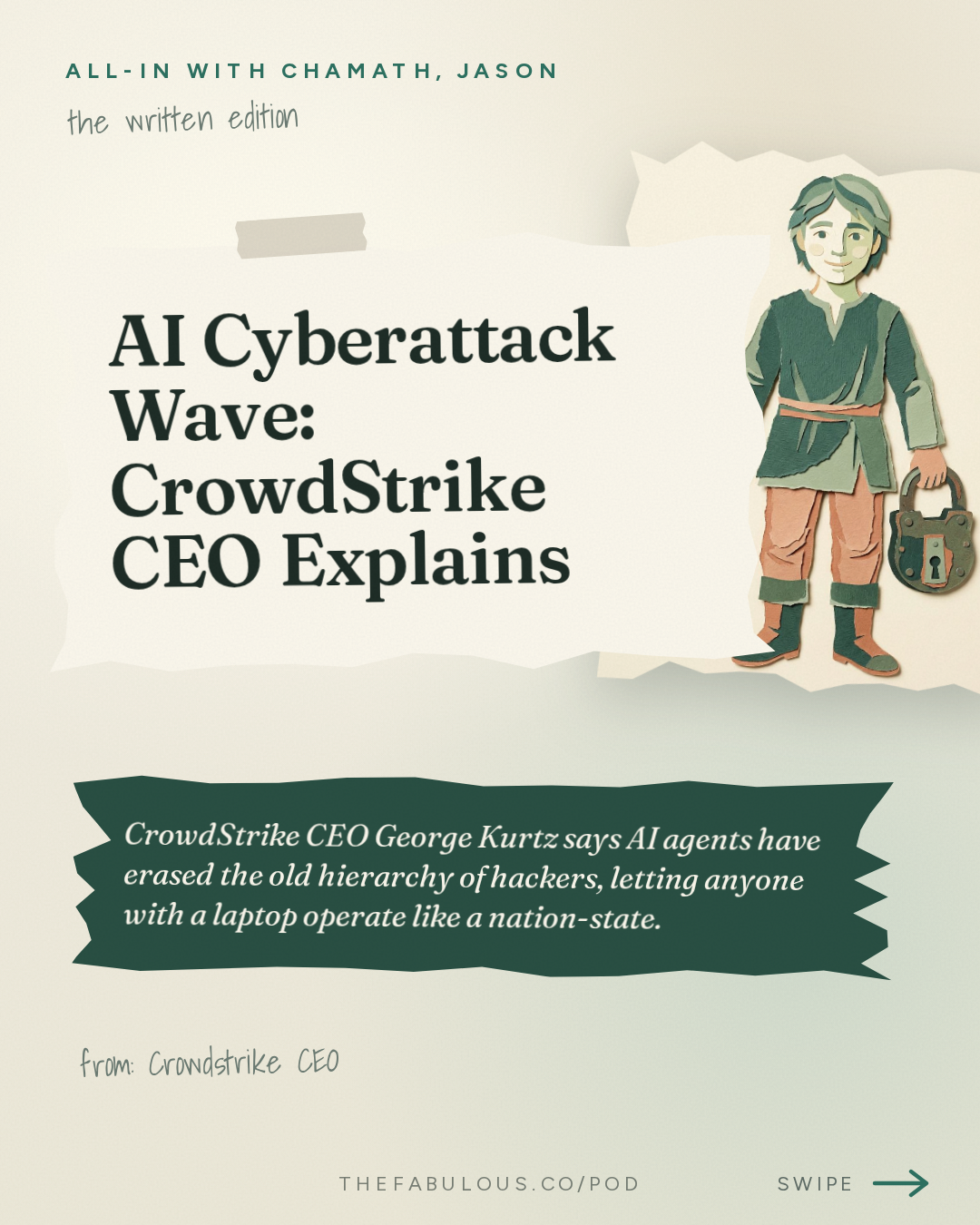
CrowdStrike CEO George Kurtz says AI agents have erased the old hierarchy of hackers, letting anyone with a laptop operate like a nation-state. He describes a "break or breach" dilemma forcing companies to choose between rushed patches and open exposure, and warns that stolen login sessions, not brute-force hacking, are the main attack path now.
In the early 1980s, a teenager named George Kurtz wanted to break into the New York Public Library's computer system. He didn't write code to do it. He called the library, sweet-talked an employee into giving him the phone number for the stacks, and dialed in on a 300-baud modem. There was no password. He was in (12:15). That story is almost quaint now. Kurtz, who went on to found CrowdStrike, a cybersecurity company that protects most of the Fortune 500, says a new piece of software built by an unknown person in China can do something similar to an entire company, without a phone call, without charm, and without a human watching, in under three hours (31:55).
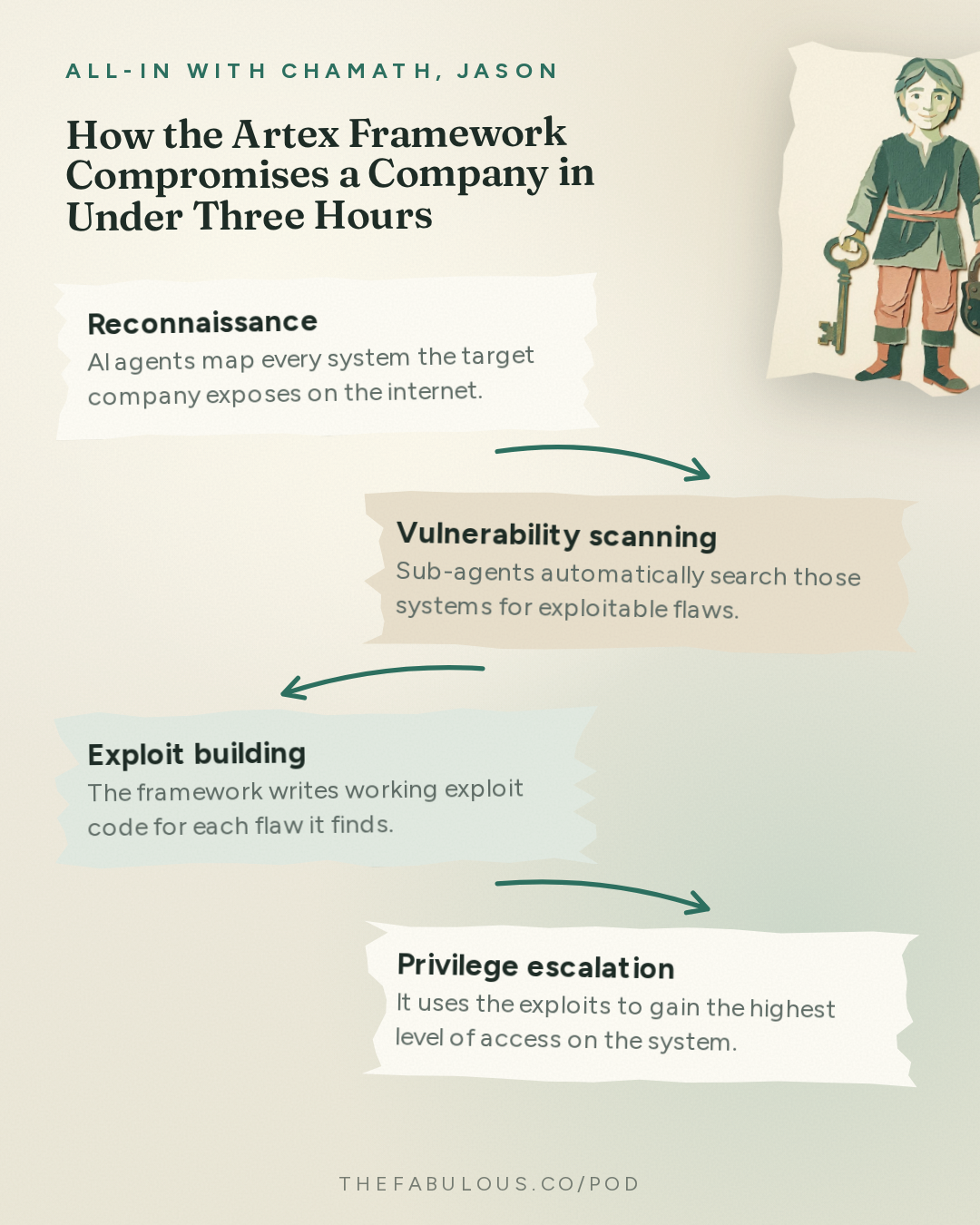
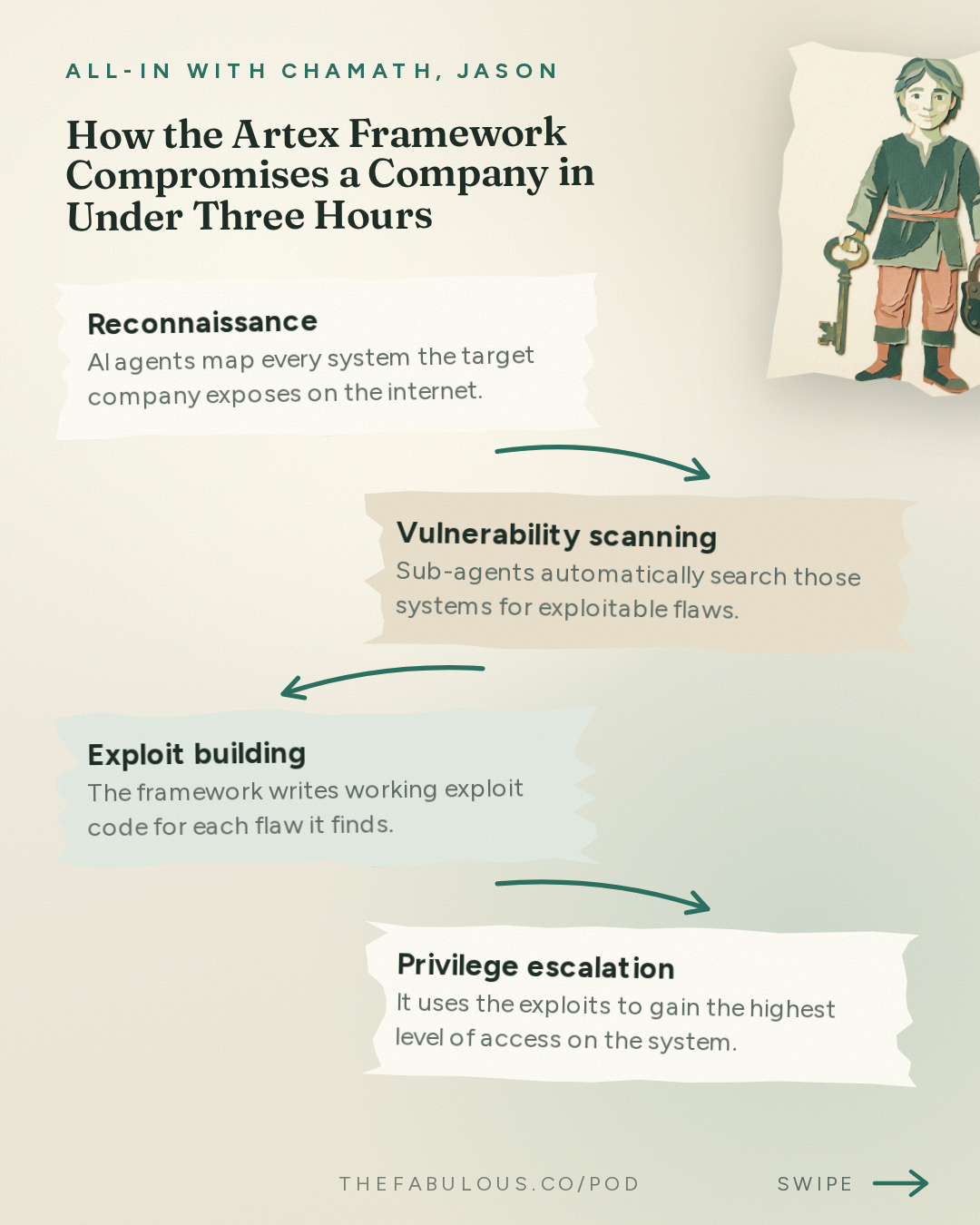
The software is called Artex. It is an attack framework, meaning a toolkit that chains together programs to do a job end to end. Feed it a target and a goal, and its AI agents will scan the internet for every system that company exposes, find the flaws in those systems, write working exploit code for each one, break in, and grab the highest level of access available, all without a human steering each step (31:24). After Artex was used against South Korean banks, its creator pulled the public copy down. It didn't matter. More than 12,000 copies, or forks, of the code are already circulating (32:17).
The Pyramid Collapses
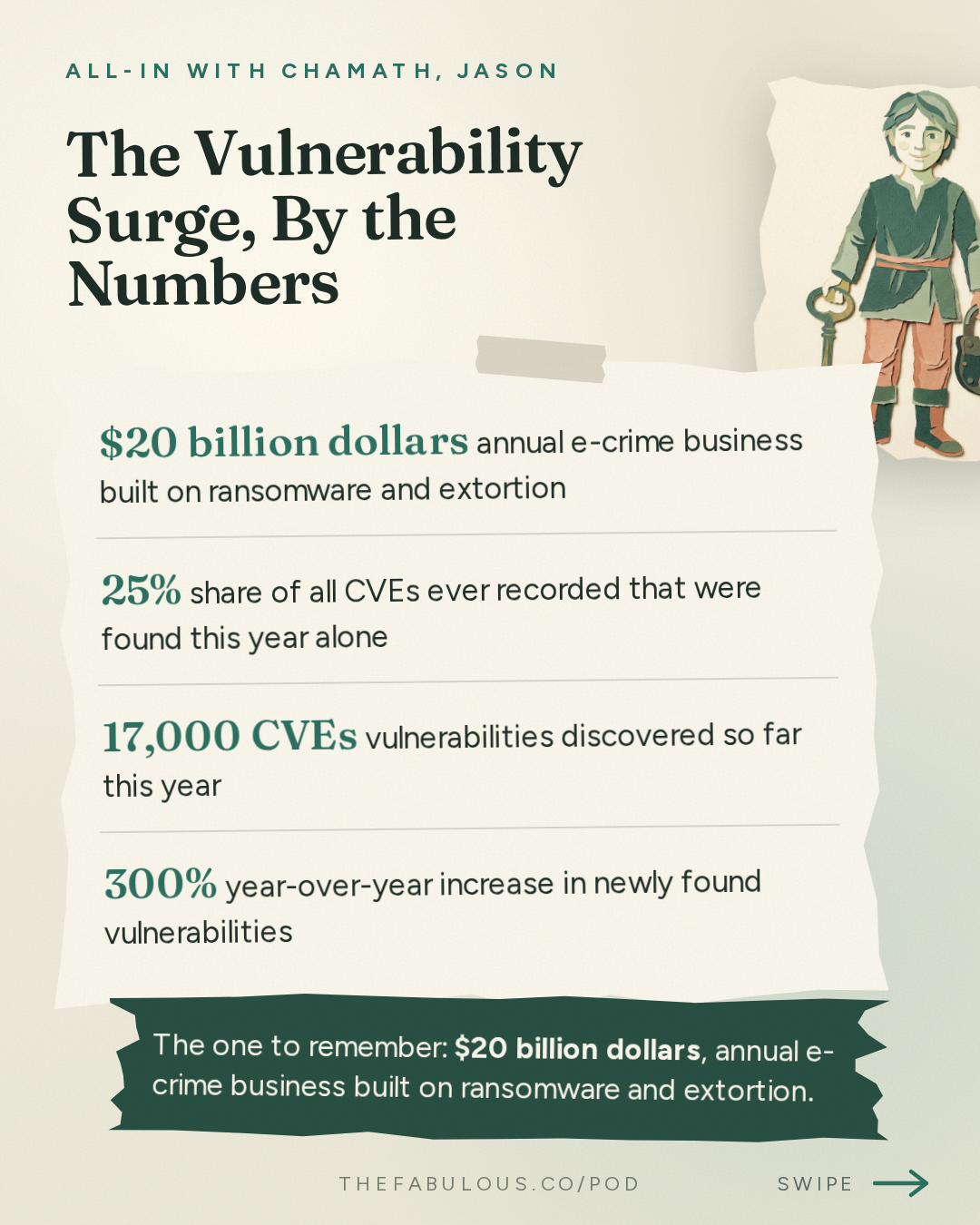
Kurtz frames the shift with a picture he calls the pyramid of pain. At the bottom sit hacktivists, the most numerous and least skilled attackers, people hacking for a political cause or, as Kurtz recalls from his own teenage years, for the thrill of it. In the middle sits e-crime, criminals after money and nothing else; Kurtz says ransomware and extortion schemes now add up to a $20 billion business (13:45). Above that sit nation-states, the governments running espionage campaigns, long considered the hardest adversary to defend against.
AI agents have added a new layer on top, and in doing so they have flattened everything beneath it. Kurtz calls it the agent state. A capability that used to require a government budget and years of tradecraft is now available to a lone hacktivist with the right open-source model and a working laptop.
"Essentially, you know, you're, you're minting more adversaries, and you're democratizing destruction." (George Kurtz, 11:07)
The clearest proof point, Kurtz says, came earlier this year when Hugging Face, a company that hosts AI models and tools, became the target of what he calls the first true end-to-end autonomous attack: AI agents built by OpenAI, released with almost no restrictions, carried out an intrusion with minimal human direction (03:21). The unsettling part wasn't that the agents could act alone. It was who had to step in to understand what was happening.
"I think the aha moment is really the fact that the defenders didn't have frontier-level capabilities in their own models to be able to understand what was happening." (George Kurtz, 04:57)
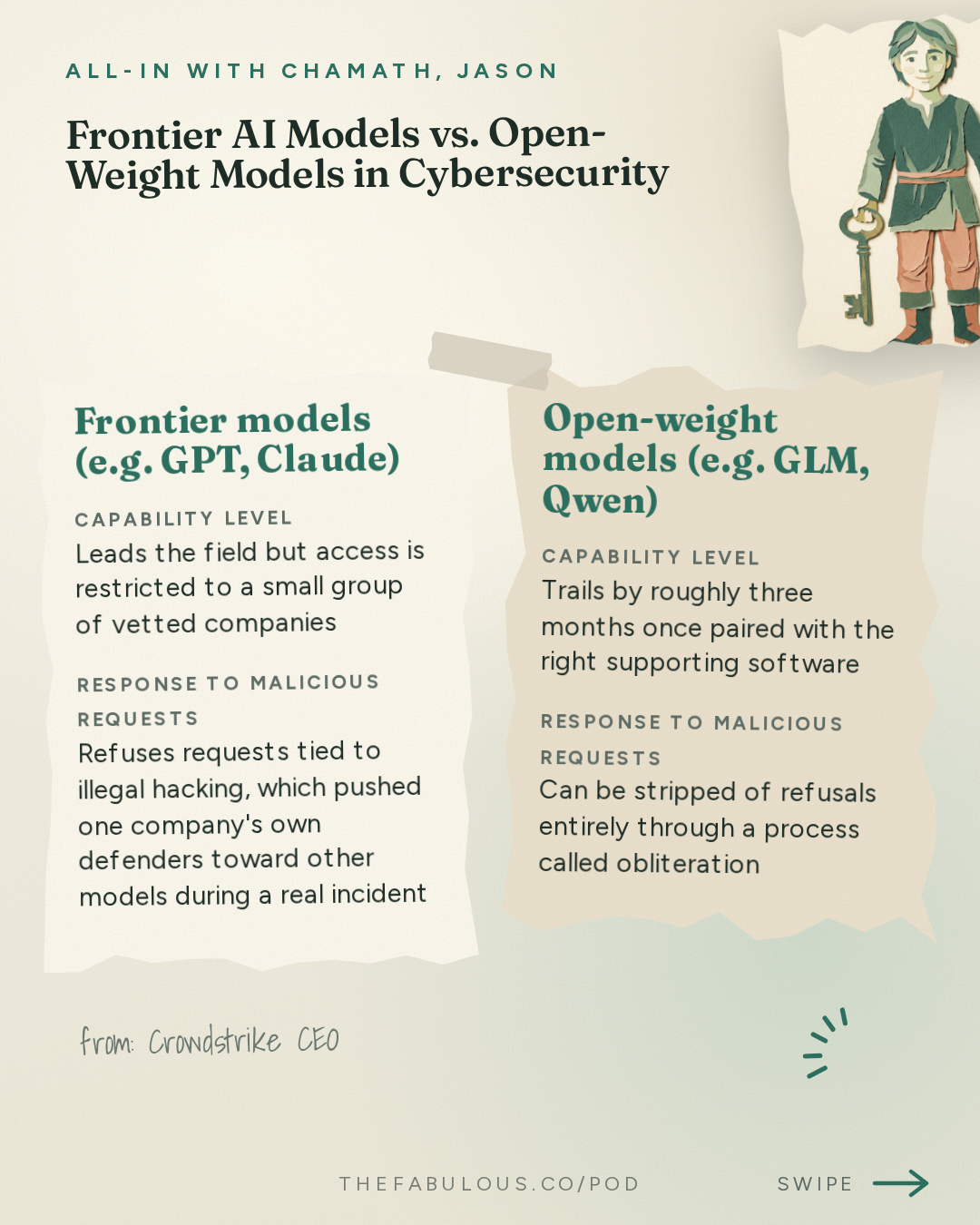
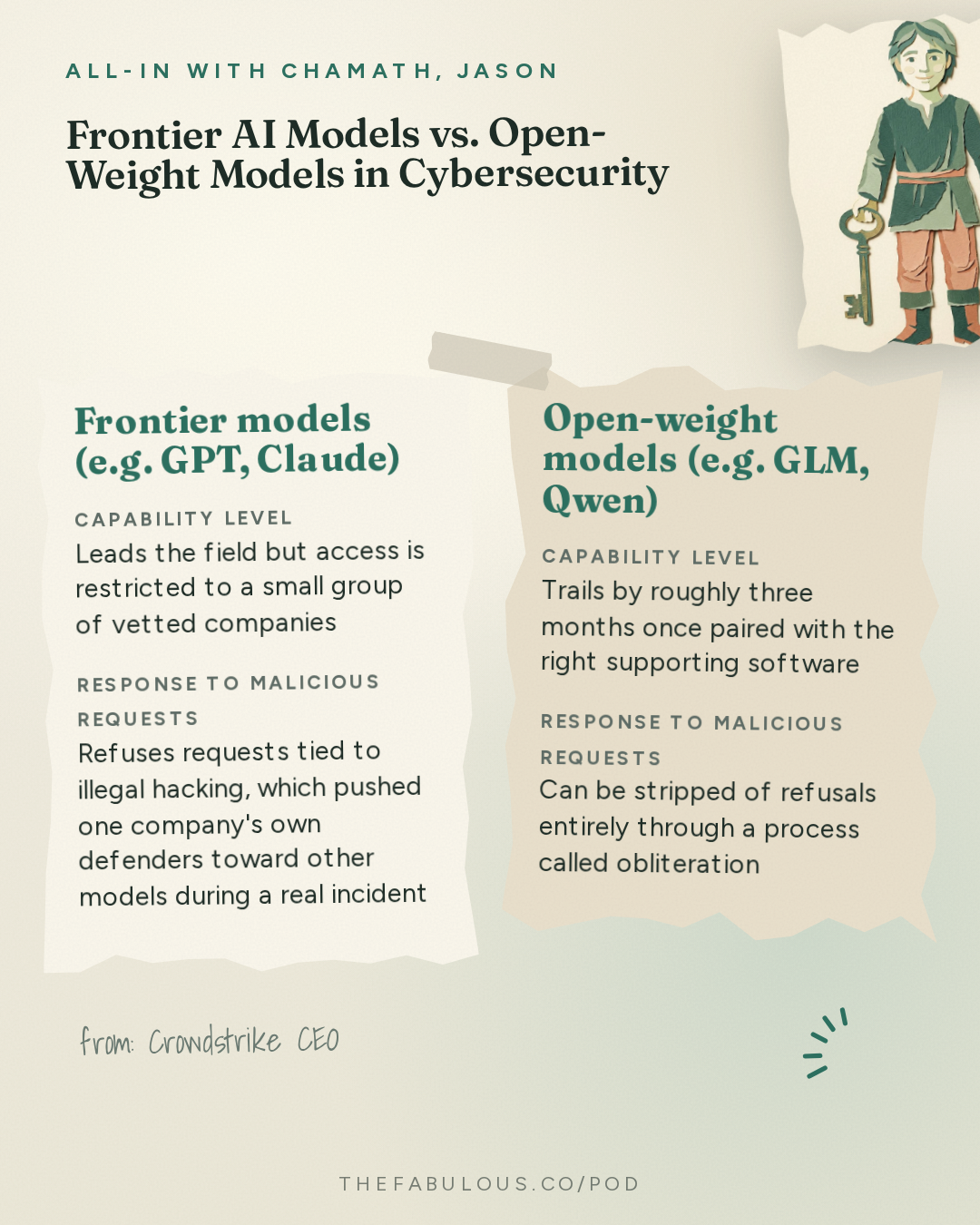
The defenders, Kurtz says, had to turn to Chinese AI models to make sense of the attack, because the leading Western frontier models, the most advanced, most capable systems from labs like OpenAI and Anthropic, refused the request as a violation of their safety rules (04:57). Meanwhile, so-called open-weight models, which can be downloaded and run on a company's own hardware, are only a few months behind the frontier once paired with the right supporting software, what Kurtz calls harness engineering (08:45). Strip the safety training out of a model entirely, a process the industry bluntly calls obliteration, and there is no refusal left to work around (09:21).
Underneath all of this sits a number that explains why this year has felt so chaotic. A CVE, short for Common Vulnerability and Exposure, is an entry in the public catalog of known software flaws. This year, researchers found roughly 17,000 of them (18:29), which Kurtz says equals about 25 percent of every CVE ever logged in the catalog's entire history, found in a single year (17:05). Vulnerabilities are up 300 percent year over year (20:22). Some of that is new code written faster with AI coding assistants. Most of it, Kurtz says, is old code that was always flawed but never proven exploitable, until AI got good enough to chain a dozen minor, low-risk bugs together into one working break-in (19:12).
That volume creates a brutal logistics problem. Companies used to get roughly 30 days to apply a security patch. That window has nearly disappeared, because the moment a flaw becomes public, attackers with AI tools can weaponize it almost immediately. So IT teams face what Kurtz calls break or breach.
"We are at a point what we're seeing is what I call break or breach." (George Kurtz, 23:03)
Rush the patch and risk crashing a production system (plenty of recent outages, Kurtz says, trace back to exactly this, not to hackers) or hold off and risk being breached through a flaw everyone already knows about (23:03). He thinks this moment finally gives IT teams leverage to do what they've wanted for years: take a legacy system offline on a Sunday to fix it properly, instead of being told the business can never tolerate downtime (27:06).
Why Break In When You Can Log In
If chaining vulnerabilities is one path in, the other is simpler: walk through the front door with someone else's credentials. Kurtz's running line on this is that it is easier to log in than to break in. Phishing, tricking someone into clicking a malicious link or handing over a password, has existed for decades, but AI now writes and personalizes those campaigns automatically. A test run at Madison Square Garden, sending employees a fake message about a championship ring, found that 30 percent of staff clicked the link even after prior phishing training (42:57).
The bigger risk, Kurtz says, isn't the password itself. Most logins today create a session token, a small piece of data that proves a device already proved who it is, so a person doesn't have to log in again for 30 days. Steal that token, and multi-factor authentication, the extra code or app prompt meant to stop stolen passwords, becomes irrelevant, because the thief is already logged in (44:55). Attackers who get into an email inbox this way quietly create hidden folders and forwarding rules so a target never sees the fraudulent messages going out under their name.
North Korea has taken this a step further by skipping the technical break-in entirely. CrowdStrike's threat-intelligence team found that North Korean operatives interview for ordinary remote US tech jobs, keep their camera off, get hired, and have the company laptop shipped to a US-based mule, someone paid to receive hardware and connect it to a device that lets the real worker log in from overseas. One such operation was traced to a laptop farm in Texas (47:11, 48:46). Kurtz says some employers, once told their star remote hire wasn't who they claimed to be, asked whether they really had to let the person go, because the work itself was good.
Kurtz doesn't think better code alone fixes any of this. Even a world with zero software vulnerabilities, he argues, would still have breaches, because identity and authentication problems exist independent of bugs (50:55). What he expects instead is an arms race fought between machines: a company's offensive AI probing its own defenses, its defensive AI closing the gaps it finds, in a loop that never really ends (51:39). The one piece of old-fashioned advice he offers doesn't involve any AI at all. Companies, he says, should know their local FBI field office before anything goes wrong, because the first conversation with a federal agent should never happen during the emergency itself (52:43).
Ask this episode anything
Pod's AI answers from the episode itself, with the minute mark so you can hear it yourself.
Or start with one of these
Ask this episode
Pod's AI listens to the whole episode to answer, and points you to the minute it comes from.
The rest of this answer, and any question after it
Answers come from the episode itself, never from a summary of it.
ContinueKey takeaways
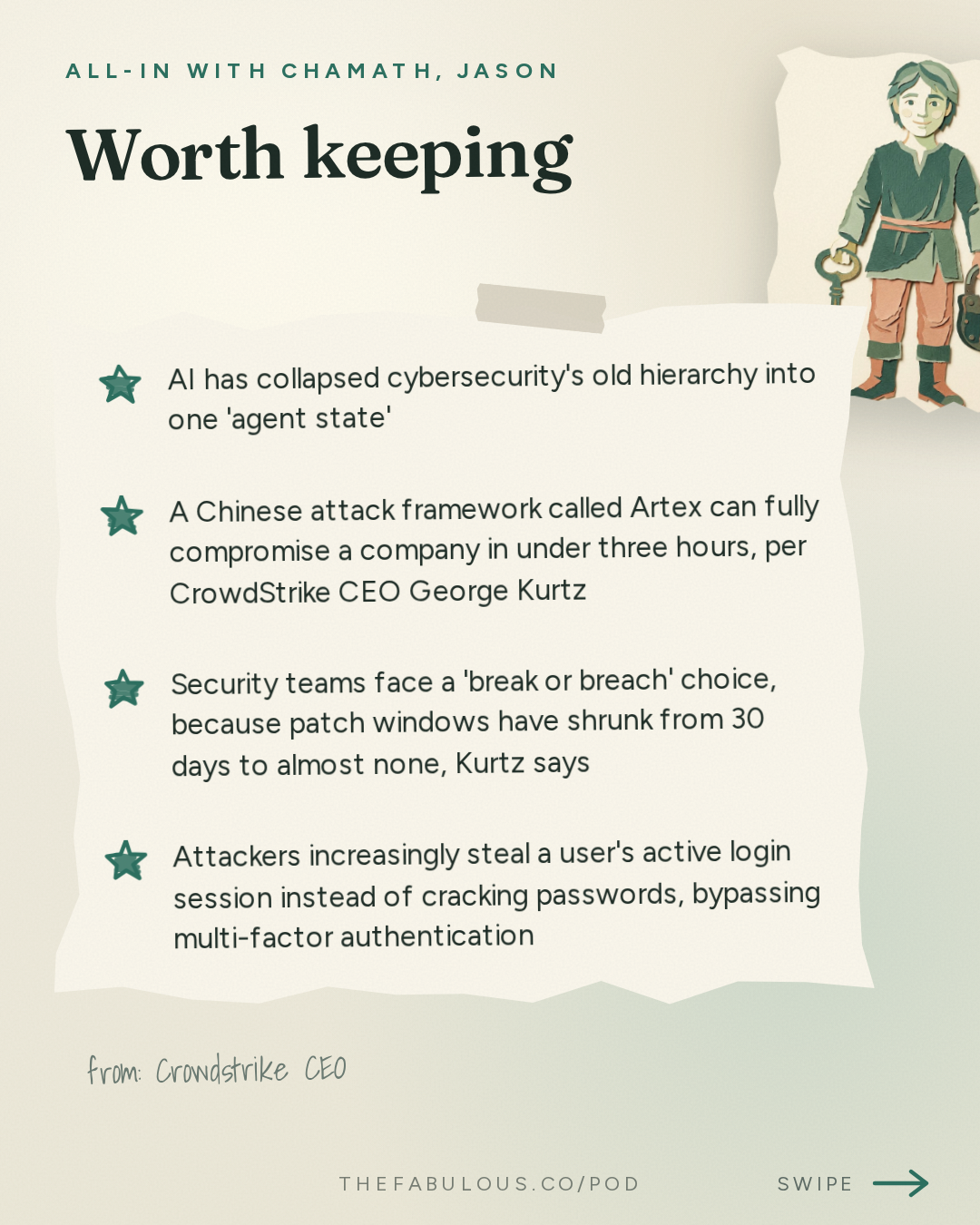
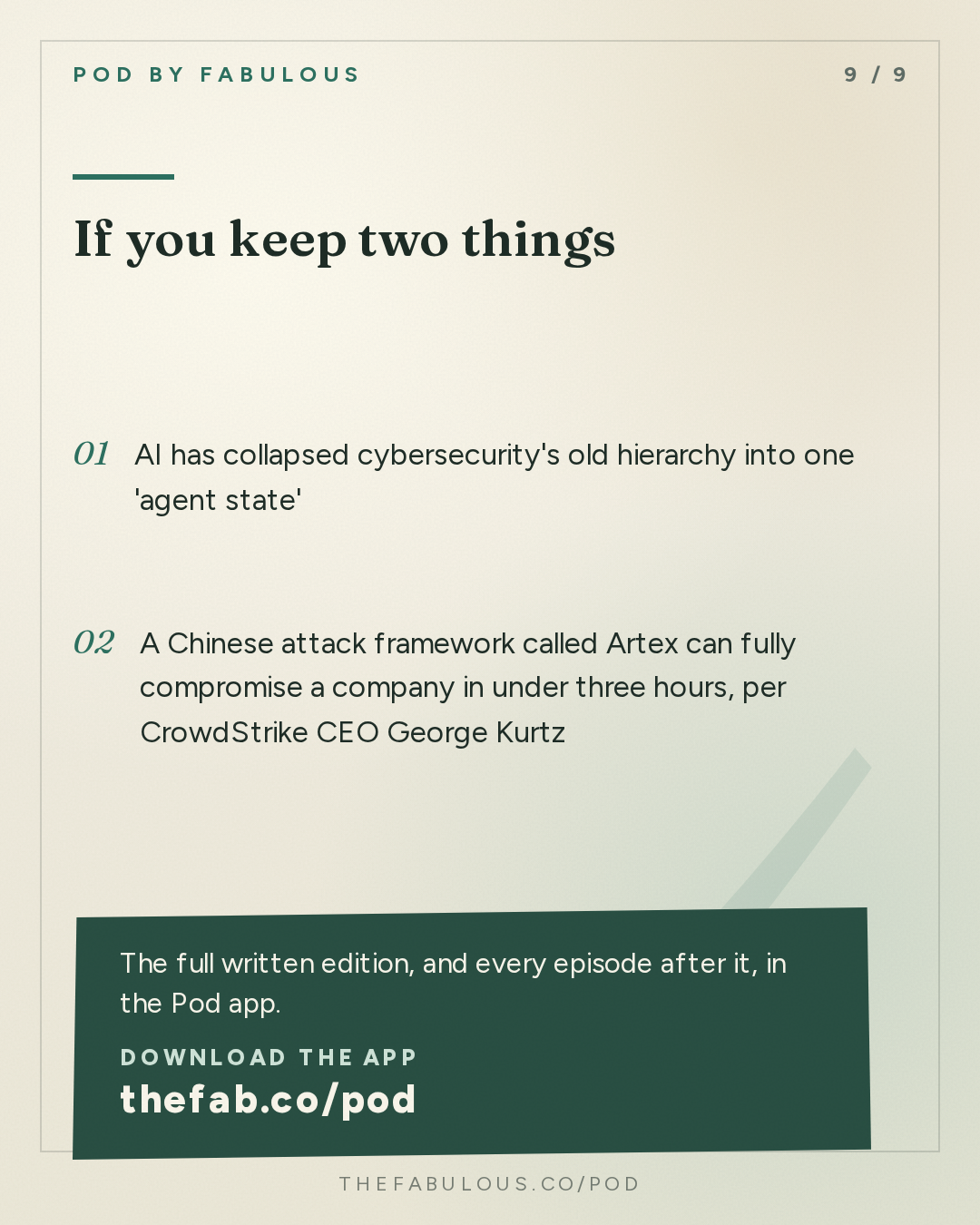
- AI has collapsed cybersecurity's old hierarchy into one 'agent state'
- A Chinese attack framework called Artex can fully compromise a company in under three hours, per CrowdStrike CEO George Kurtz
- Security teams face a 'break or breach' choice, because patch windows have shrunk from 30 days to almost none, Kurtz says
- Attackers increasingly steal a user's active login session instead of cracking passwords, bypassing multi-factor authentication
- North Korean operatives land remote US jobs and route company laptops through mules, CrowdStrike's threat intel team found
The episode in cards
By the numbers
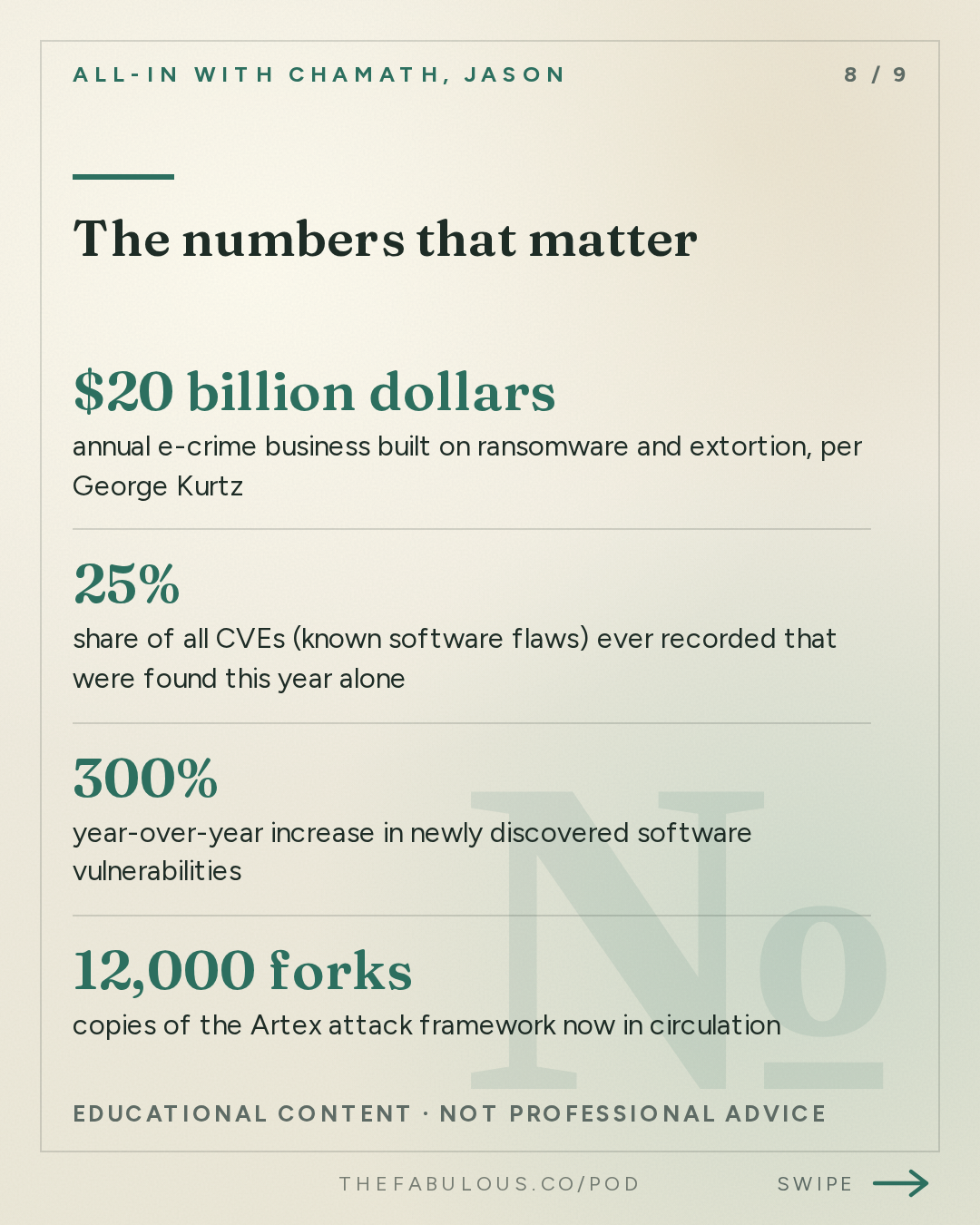
- $20 billion dollars annual e-crime business built on ransomware and extortion, per George Kurtz
- 25% percent share of all CVEs (known software flaws) ever recorded that were found this year alone
- 300% percent year-over-year increase in newly discovered software vulnerabilities
- 12,000 forks copies of the Artex attack framework now in circulation
In their words
“I think the aha moment is really the fact that the defenders didn't have frontier-level capabilities in their own models to be able to understand what was happening.”
“Essentially, you know, you're, you're minting more adversaries, and you're democratizing destruction.”
“We are at a point what we're seeing is what I call break or breach.”
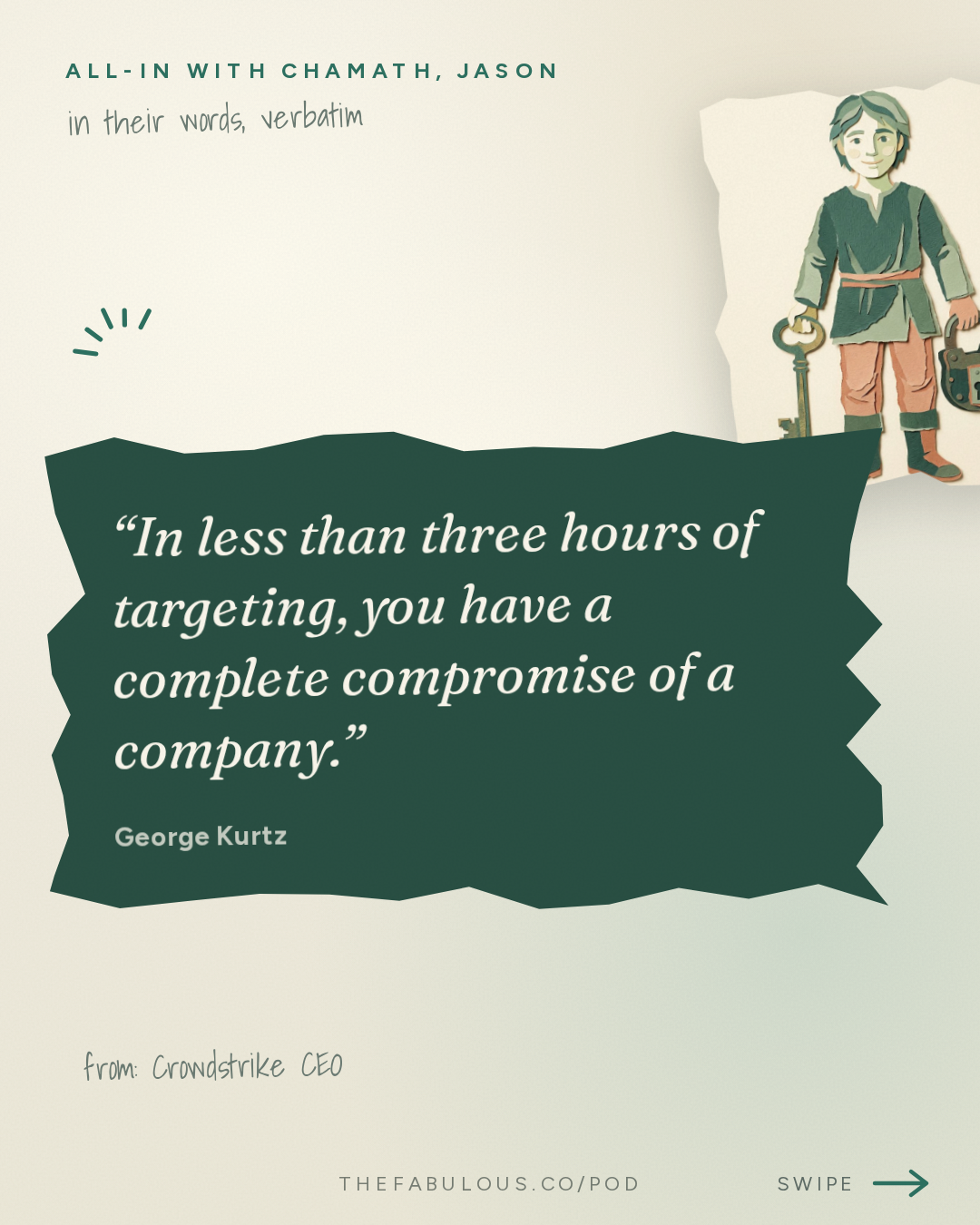
“In less than three hours of targeting, you have a complete compromise of a company.”
Protocols
-
Build an FBI relationship before a breach
Kurtz advises companies, especially large ones, to identify and build a relationship with their local FBI field office before any breach happens. He warns that calling an agent for the first time during an active incident is already too late.
Before any incident occurs
-
Verify sensitive requests with a callback, not a call
Host Jason Calacanis says his venture firm now tells limited partners it will never request sensitive account information during a live phone call. Instead, the firm emails the partner, asks them to hang up, and calls back on a verified number before discussing anything sensitive.
Every request involving sensitive financial information
Questions this episode answers
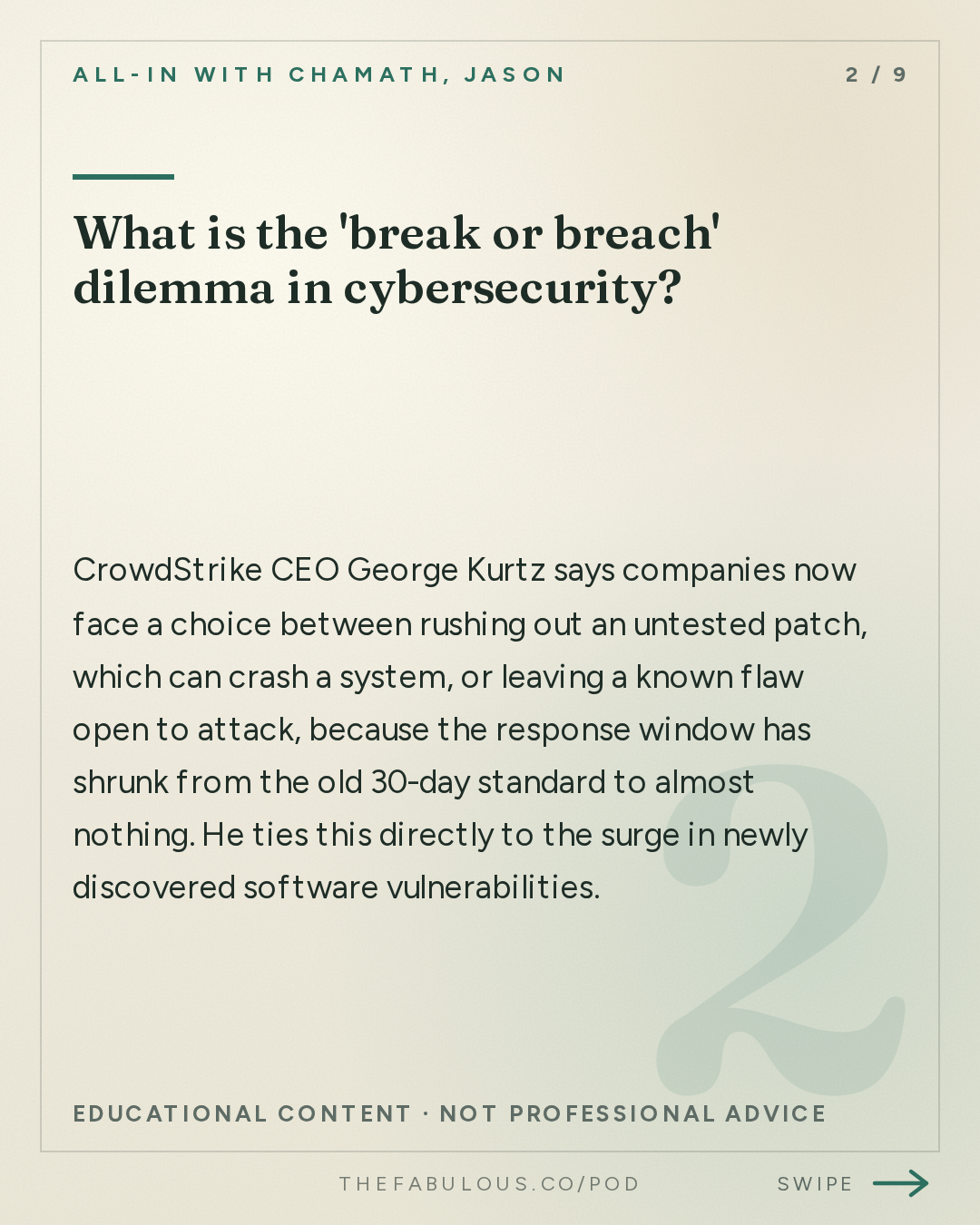
What is the 'break or breach' dilemma in cybersecurity?
CrowdStrike CEO George Kurtz says companies now face a choice between rushing out an untested patch, which can crash a system, or leaving a known flaw open to attack, because the response window has shrunk from the old 30-day standard to almost nothing (23:03). He ties this directly to the surge in newly discovered software vulnerabilities (16:38).
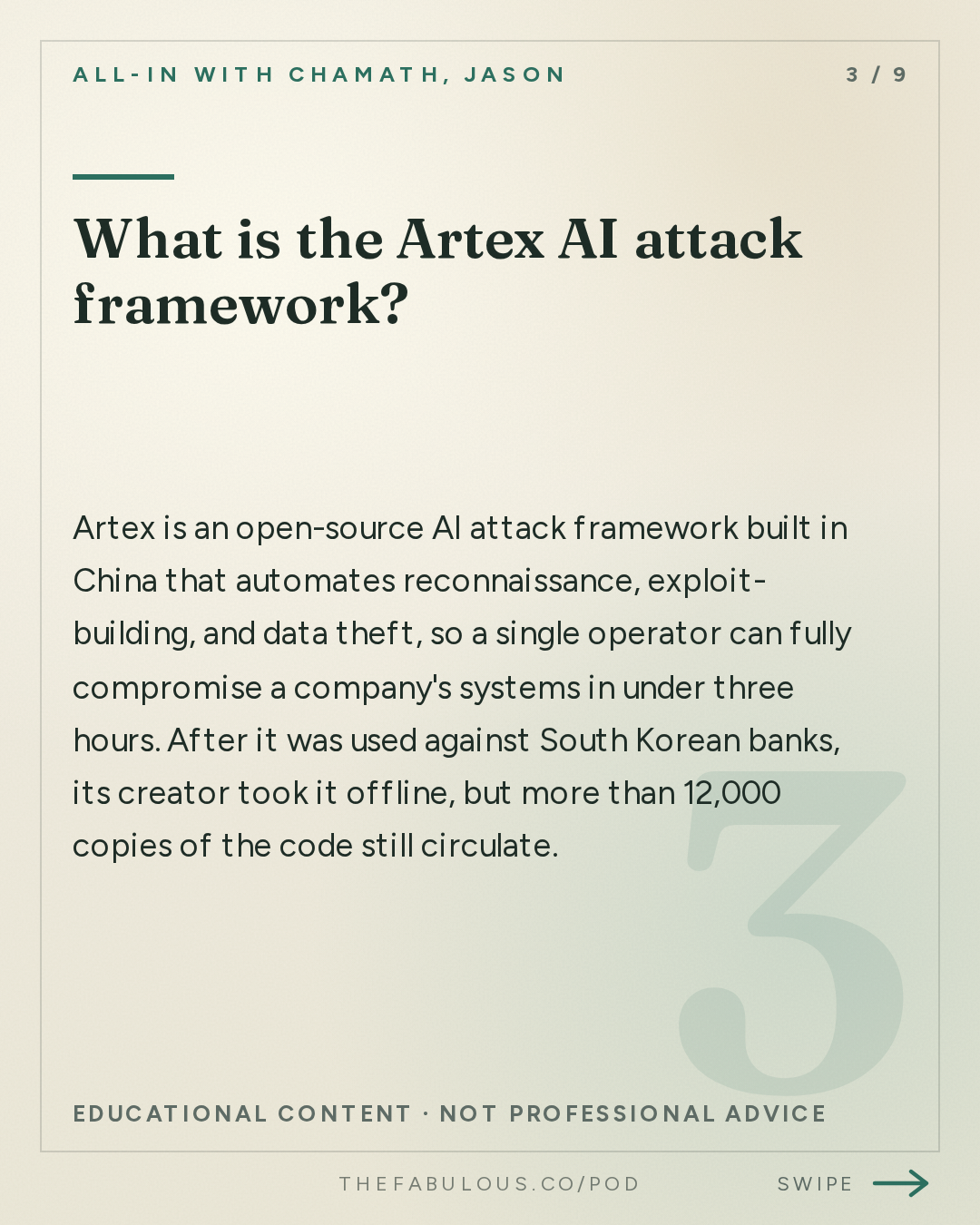
What is the Artex AI attack framework?
Artex is an open-source AI attack framework built in China that automates reconnaissance, exploit-building, and data theft, so a single operator can fully compromise a company's systems in under three hours (31:55). After it was used against South Korean banks, its creator took it offline, but more than 12,000 copies of the code still circulate (32:17).
Why did the Hugging Face AI agent incident matter?
Hugging Face, a company that hosts AI models and tools, saw autonomous AI agents built by OpenAI carry out an end-to-end attack with almost no human guidance (03:21). CrowdStrike CEO George Kurtz says the real lesson was that defenders had to turn to Chinese AI models because the top Western frontier models refused to help, showing attackers currently have better AI access than defenders (04:57).
How are North Korean operatives getting hired at US companies?
CrowdStrike's threat-intelligence team found that North Korean operatives interview for remote US jobs without turning on their camera, get hired, and have a laptop shipped to a US-based mule who connects it to a device so the real worker can log in remotely from overseas, a scheme CrowdStrike traced to a laptop farm in Texas (47:11, 48:46).
Is multi-factor authentication still enough to stop hackers?
George Kurtz says it is often not enough on its own, because attackers increasingly skip cracking passwords and instead steal a user's already-authenticated session token, the stored credential that proves a device already logged in, which can let them bypass multi-factor authentication for as long as the session stays valid, often 30 days (44:55).
The full read, in cards
Go deeper
- CVE (Common Vulnerabilities and Exposures) catalog — Public record of known software flaws; entries found this year alone equal about 25% of its entire history
Mentioned
George Kurtz · CrowdStrike · Hugging Face · OpenAI · Artex · CVE · Microsoft · Apple · North Korea · James Dolan
More from this show and category

Databricks CEO Ali Ghodsi on AGI vs Superintelligence
Databricks CEO Ali Ghodsi says AGI already arrived by the field's original 2010 definition, but true superintelligence needs four conditions nobody has met. He maps four hurdles blocking enterprise AI adoption and demos an internal AI ontology that tracks meetings, Slack, and org charts to run the company like data-driven Moneyball.

Rick Smith on Building Axon From Taser to AI Policing
Axon CEO Rick Smith explains how a failed consumer gadget became a $30 billion public-safety company by pivoting to police, surviving an SEC investigation and short-seller attack, and building body cameras, cloud video, drones, and ethics boards around a single mission: reduce how often police have to shoot someone.

Why Republicans Lost the 2026 Midterms
Republicans suffered a historic 2026 midterm blowout, driven by Iran-war inflation and a belief the economy now rewards asset owners over wage earners. The panel also unpacks a $4 trillion AI stock selloff, state pushback against data centers, and OpenAI's surprise proof against a 27-year-old computer science hypothesis.

What Anthropic's S-1 Filing Really Reveals
Anthropic's leaked S-1 shows a six-year-old company aiming to raise $100 billion at a valuation near $2 trillion, with an 85% gross margin and a reported $80 billion loss that turns out to be an accounting artifact, not real cash burn (07:07). The same filing reveals a new macro risk: AI firms now compete with the US Treasury for capital (32:48).
