
Matteo Franceschetti on AI Replacing Teams at Eight Sleep
20VC: 7 Predictions for How AI Changes the World: Labour, Engineering, Social Media, GrokBots Buying Cybercabs and more with Matteo Franceschetti, Co-Founder @ Eight Sleep
The brief
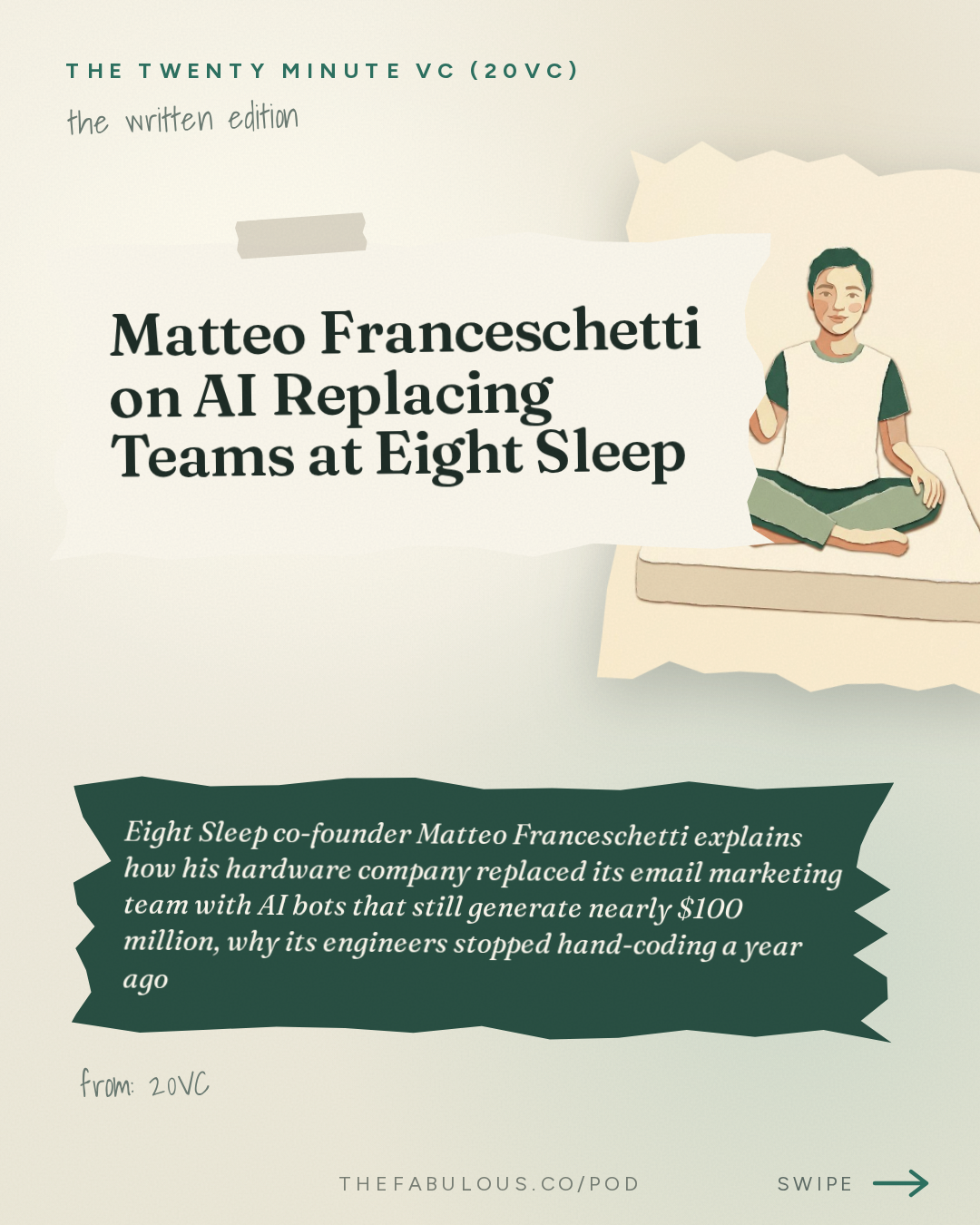
Eight Sleep co-founder Matteo Franceschetti explains how his hardware company replaced its email marketing team with AI bots that still generate nearly $100 million (17:41), why its engineers stopped hand-coding a year ago (19:42), and why he thinks today's children will never need to work for money (60:12).
A year ago, the engineers at Eight Sleep stopped writing code. Not because the company stopped building things, but because it built something else first: an internal fleet of AI agents that now write the code while people supervise. Matteo Franceschetti, co-founder of the sleep tech company Eight Sleep, mentions this almost as an aside on The Twenty Minute VC with Harry Stebbings. It turns out to be the clearest thread through an unusually candid conversation about what happens to a company's org chart once intelligence gets cheap.
Eight Sleep sells a sleep-tracking cover that fits over a mattress and connects to a subscription service on top of the hardware. The company now sells in 35 countries, including China, and Franceschetti has done this show before, which is partly why the second conversation runs looser and more specific than the first.
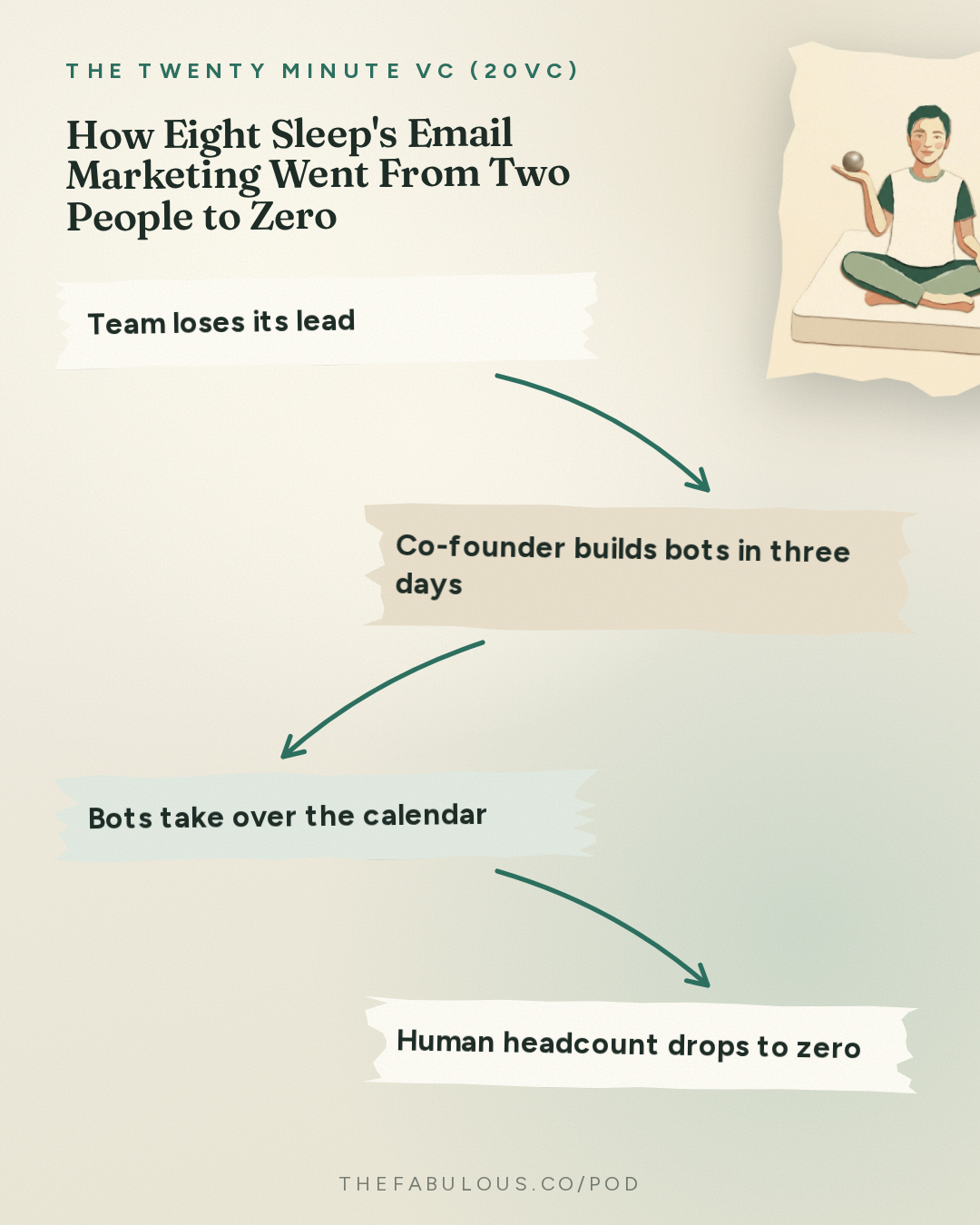
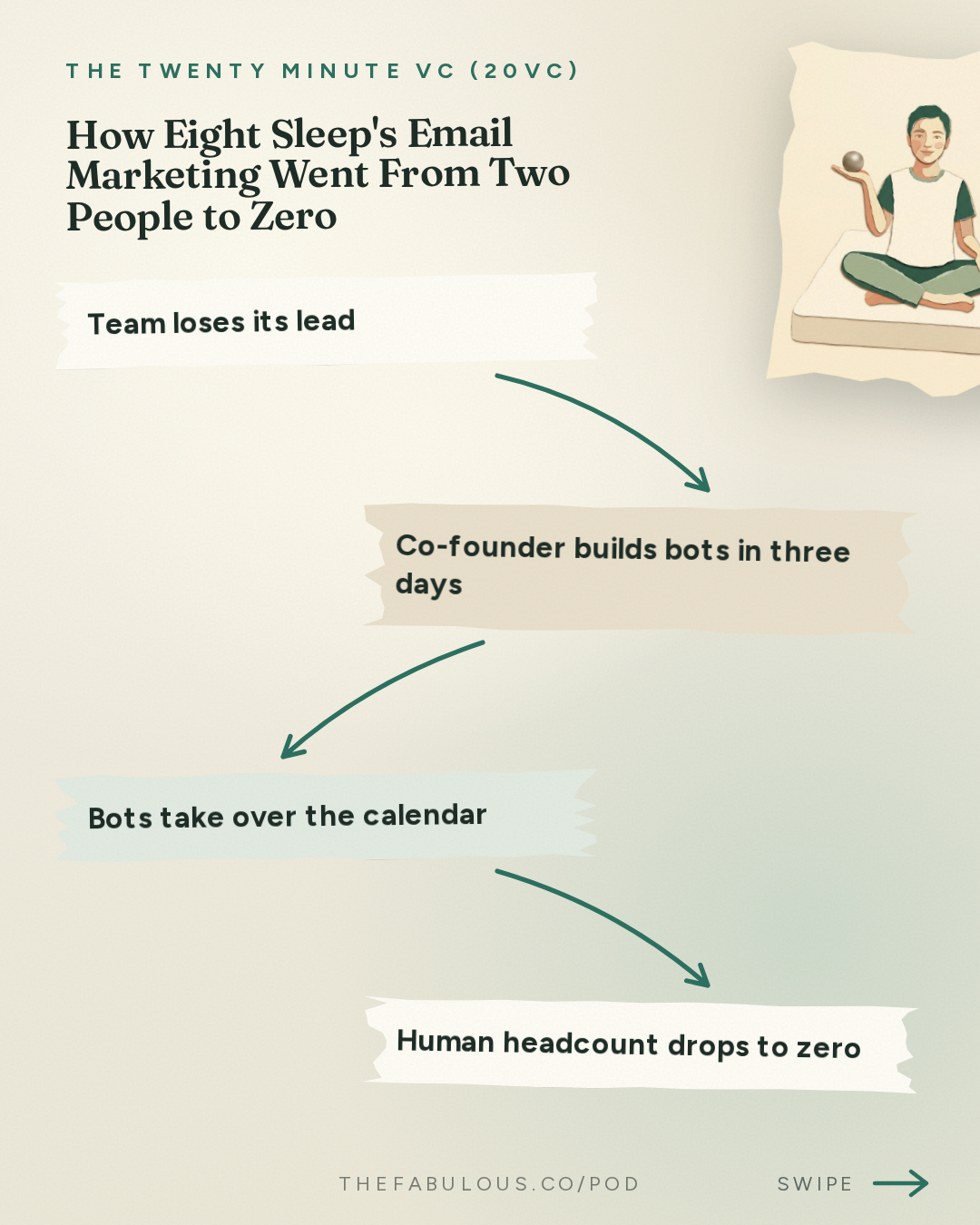
The clearest evidence for the coding claim is not the claim itself. It is what happened to the email marketing team. The employee running it quit (17:10). Rather than hire a replacement, Franceschetti's co-founder and wife, Alexandra Zatarain, spent three days building bots, using the AI model Claude, that now handle the entire email calendar: when to send an email, to whom, and with what copy, based on historical performance data (17:21). The channel now runs with a human headcount of zero and still produces close to $100 million in revenue (17:41).
"Our engineers stopped coding around a year ago." — Matteo Franceschetti [19:42]
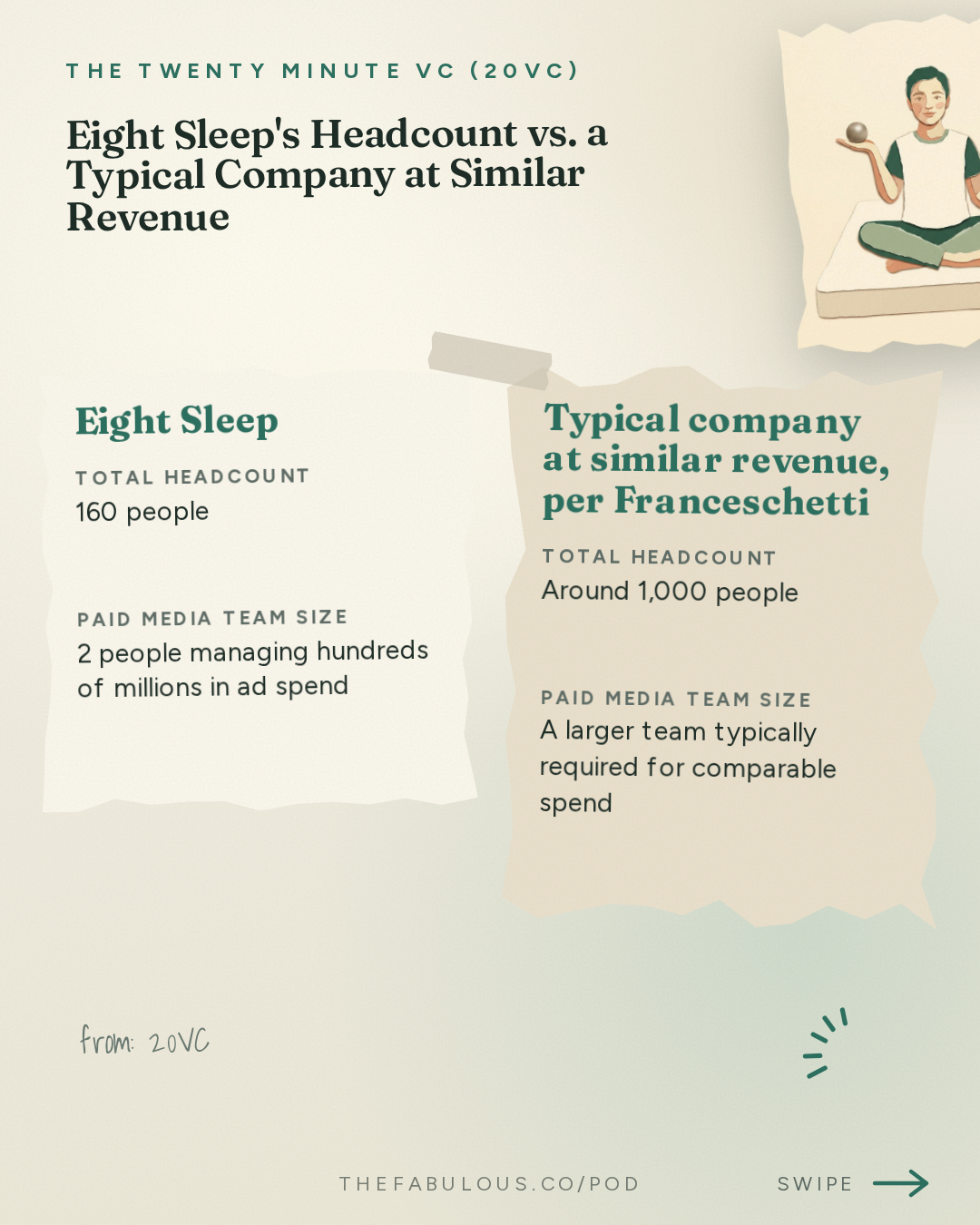
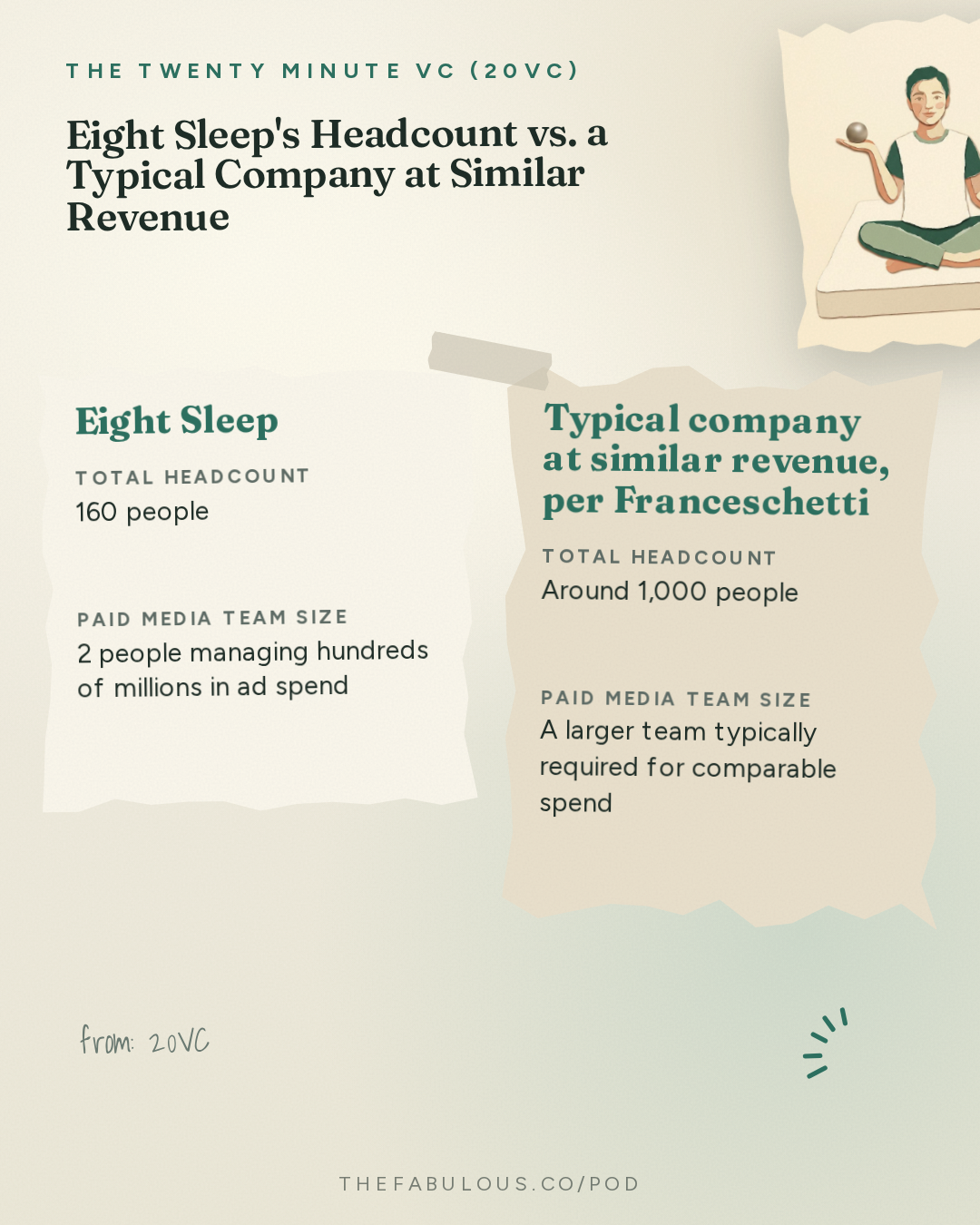
The same logic runs through the rest of the company. Eight Sleep has 160 employees total (56:47). Its paid media team, which manages hundreds of millions of dollars in ad spend, is two people (57:10). Its finance team is four people, where Franceschetti estimates a comparable company at Eight Sleep's revenue would run a team of twenty (58:45). He describes his organizing principle as building "teams of two": two people, ideally excellent, given responsibility for an area that would normally require a department, with AI agents doing the layer of work in between. The result, he says, is revenue per employee higher than Apple's (56:47).
Behind those small teams sits a group that did not exist six months before this conversation: an internal AI tools team, built to construct and maintain the thousands of agents used across the company. Franceschetti keeps it deliberately close to the data engineering team, since every marketing or finance agent needs reliable access to the same backend numbers, whether that is revenue by country or cost of acquiring a customer by channel (58:01).
The Discipline Behind the Story
It would be easy to read all this as an AI hype story, but the more interesting part of the conversation is how unglamorous the underlying discipline is. Franceschetti says hardware founders reliably underestimate their bill of materials, the itemized cost of every component in a product, and their total cost of goods sold by at least 50% in the first year (07:25). He also treats word of mouth as a metric to track rather than a vague compliment: organic word of mouth drives about 40% of Eight Sleep's revenue even at its current scale (08:06), and he says this is one of the first things he now checks as an angel investor sizing up other consumer companies.
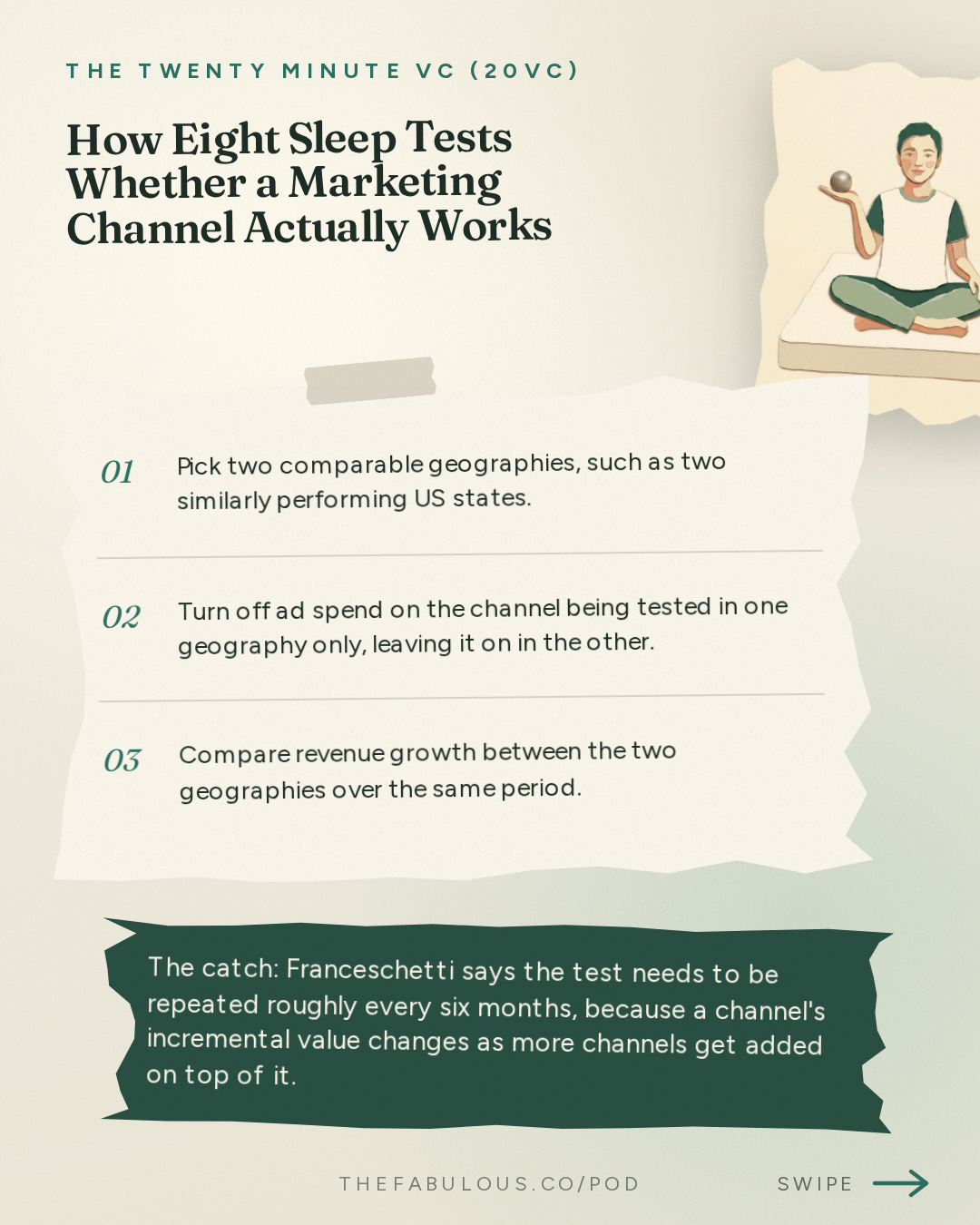
On paid marketing, Franceschetti's rule is to scale one channel at a time. Start with the largest platform, usually Meta, set a hard cap on cost-per-acquisition, and let the team spend as much as it wants as long as it stays under that cap (10:50). Every six months or so, the company runs an incrementality test: it turns a channel off in one region, such as one state, while leaving it on in a comparable region, and compares the growth rates to isolate what that channel is actually worth (09:10). The reason is that platform-reported cost of acquisition cannot be trusted on its own; Franceschetti says Meta's own attribution understates the true cost by about 20% (09:30).
Brand building follows a similar rule: prove the relationship before signing a check. Eight Sleep's partnership with the Formula One driver Charles Leclerc began years before it was a formal deal, when Franceschetti, a lifelong motorsport fan, tried to sponsor Leclerc while he was still racing in Formula Two, long before Eight Sleep had any real money to offer (35:32). By the time the two actually worked together, Leclerc had already been sleeping on the product for two years without either side knowing it. Franceschetti says roughly 80% of Formula One drivers now sleep on an Eight Sleep product, though most of those relationships stay private (39:18). His rule for any athlete deal is the same: the person has to already use and like the product, and he insists on a direct relationship rather than one filtered through a manager, since otherwise, in his telling, it just becomes a financial transaction that never turns into real word of mouth (38:04).
That same principle, proof before commitment, carries into how Eight Sleep entered a market with almost no overlap with how it sells everywhere else.
"Chinese don't buy on websites. There is no e-commerce as we know it." — Matteo Franceschetti [28:42]
Chinese consumers buy almost everything through super-apps such as WeChat and RedNote rather than through a company's own site, which meant Eight Sleep had to rebuild its entire go-to-market approach from nothing (28:20). Franceschetti also argues the country's manufacturers, having already out-designed European automakers on electric vehicles, are positioned to do the same with humanoid robots, a market he compares to what cars represented in the 1960s (25:36).
What Happens When Intelligence Is Free
The boldest part of the conversation is not about Eight Sleep at all. Franceschetti predicts that children born today will never need to work for money, because by the time they are adults, AI will have automated most of the jobs that currently support households (60:12). He does not treat this as pure upside. He expects taxation to shift toward the companies whose margins improve most from AI, to fund something like a universal basic income (61:50), and he calls university "100% useless" for anyone planning a career as a Silicon Valley entrepreneur (61:50), a claim that says more about the founder culture he operates in than about universities generally.
He is more measured about nearer-term shifts: a personal AI agent one day buying and operating a self-driving robotaxi on its owner's behalf, the way his own AI assistant already books errands for him (30:22); the slow normalization of letting AI systems hold financial information, which he compares to the discomfort people felt entering a credit card number online two decades ago (29:36). None of it reads as certainty. It reads as a founder thinking out loud about the edges of a system he is already living inside, where the same tools that eliminated his email marketing team are quietly rewriting what a company, and eventually a career, is for.
Near the end, Franceschetti offers a plainer frame for all of it: a pyramid with health at the base, relationships in the middle, and purpose at the top, in that order, because none of the higher layers matter if the one below it is missing (60:53). It is a modest thing to say after forty minutes of predictions about robots and automated labor, but it is also the quiet argument underneath the whole interview. The technology can take over the coding, the emails, and eventually the driving. What is left, in his telling, is the part of a job that was never really about output at all.
Ask this episode anything
Pod's AI answers from the episode itself, with the minute mark so you can hear it yourself.
Or start with one of these
Ask this episode
Pod's AI listens to the whole episode to answer, and points you to the minute it comes from.
The rest of this answer, and any question after it
Answers come from the episode itself, never from a summary of it.
ContinueKey takeaways
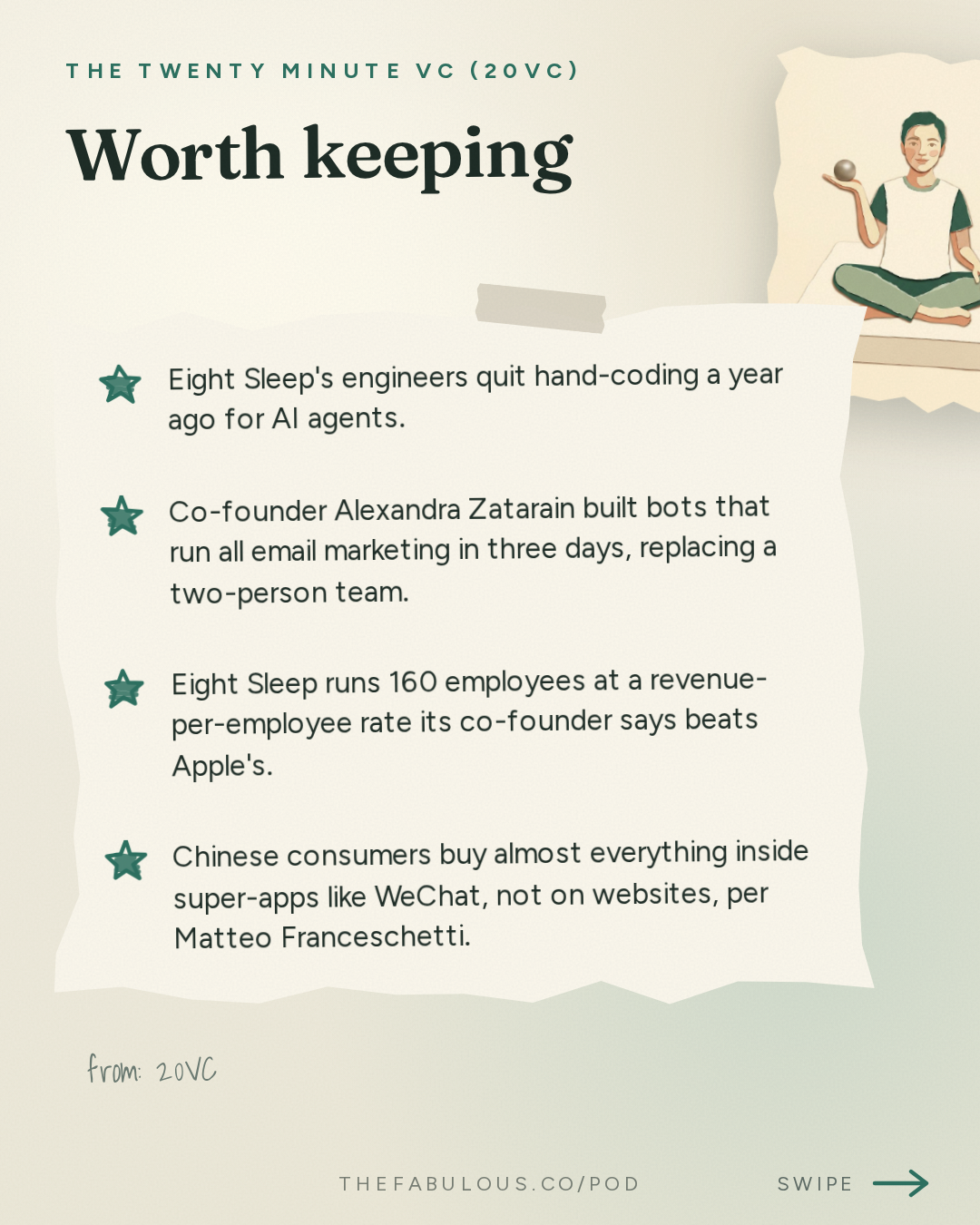
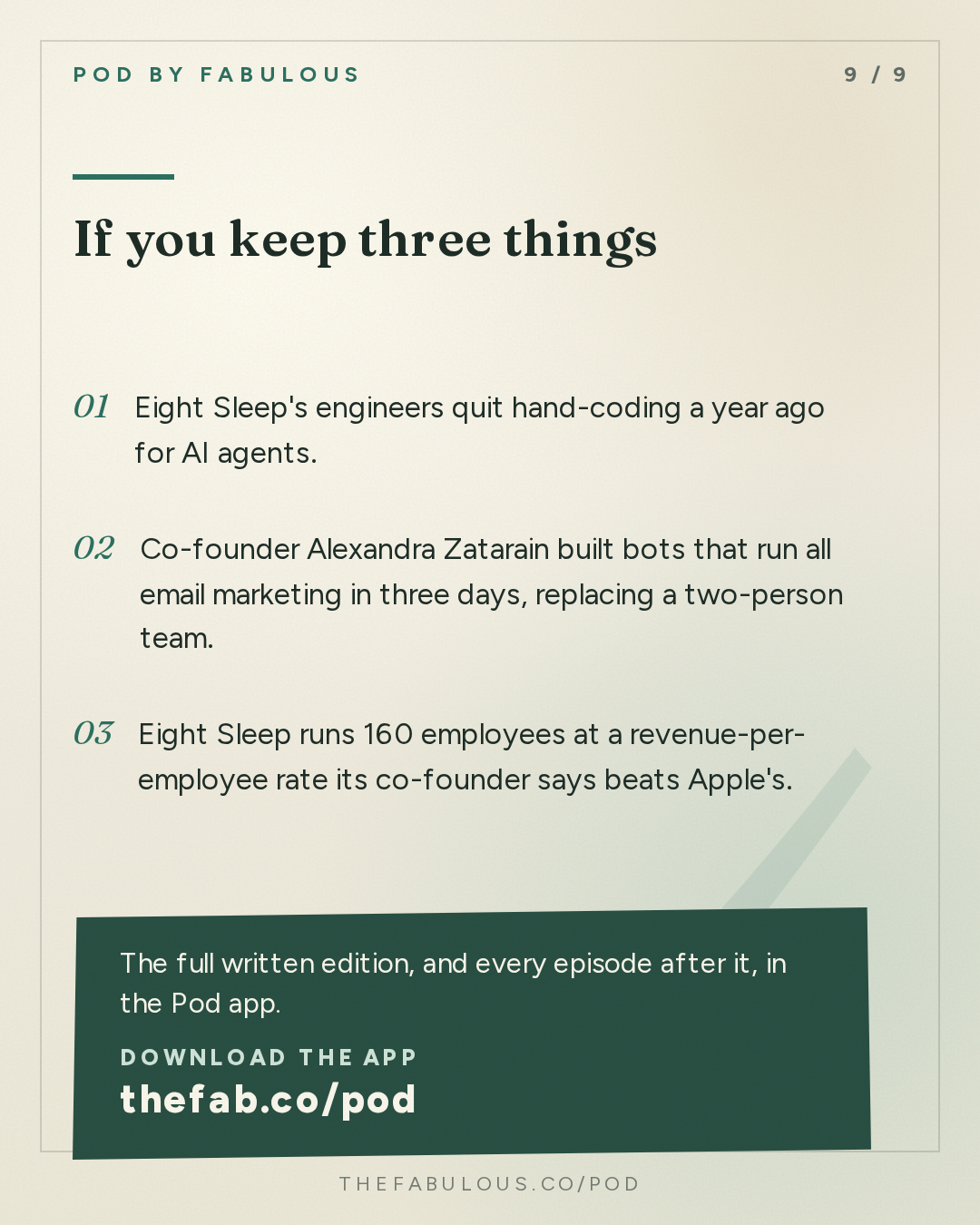
- Eight Sleep's engineers quit hand-coding a year ago for AI agents.
- Co-founder Alexandra Zatarain built bots that run all email marketing in three days, replacing a two-person team.
- Eight Sleep runs 160 employees at a revenue-per-employee rate its co-founder says beats Apple's.
- Chinese consumers buy almost everything inside super-apps like WeChat, not on websites, per Matteo Franceschetti.
- Franceschetti predicts AI will end paid work for today's children, who will work only by choice.
The episode in cards
By the numbers
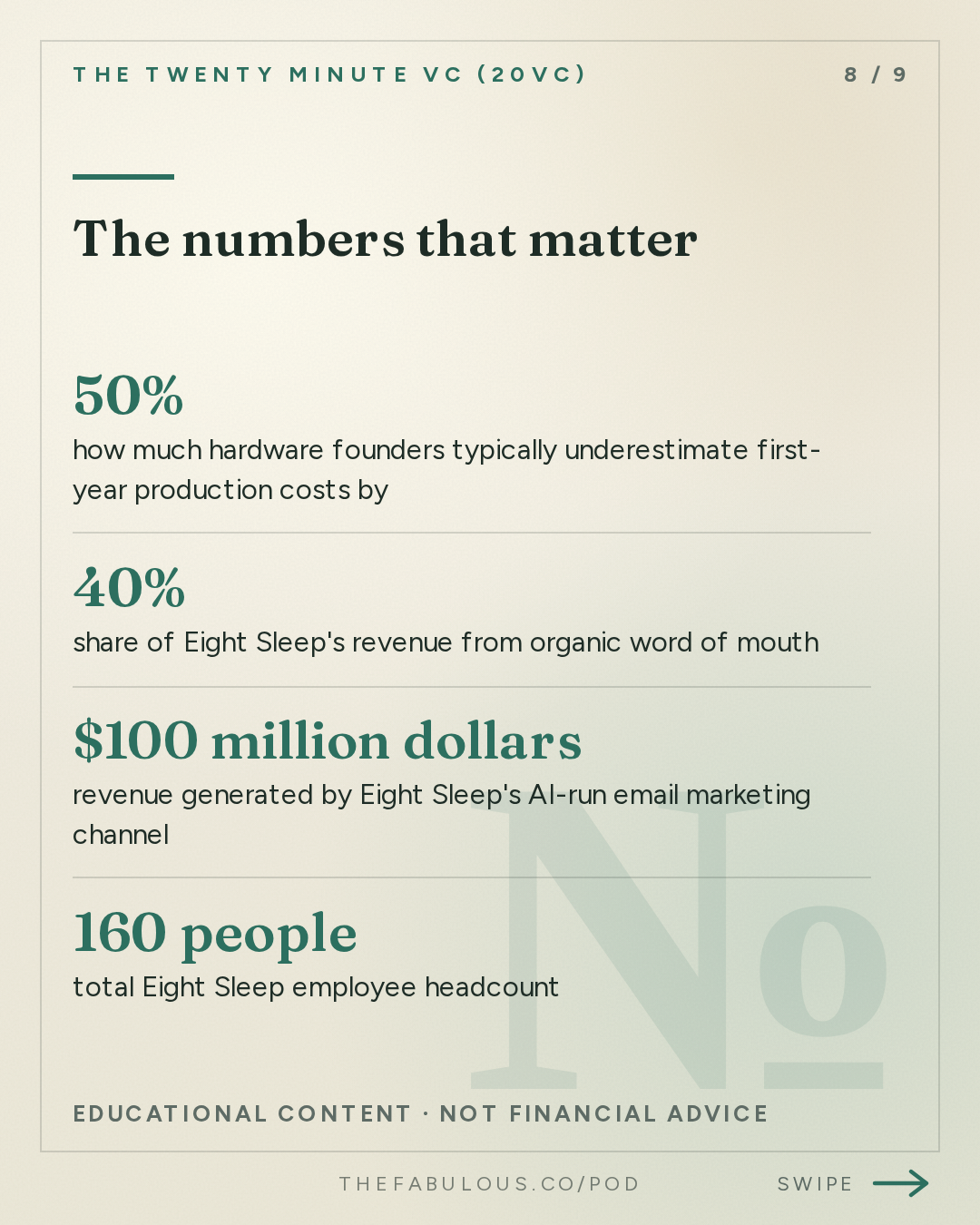
- 50% percent how much hardware founders typically underestimate first-year production costs by
- 40% percent share of Eight Sleep's revenue from organic word of mouth
- $100 million dollars revenue generated by Eight Sleep's AI-run email marketing channel
- 160 people total Eight Sleep employee headcount
- 2 people size of the paid media team managing hundreds of millions in ad spend
In their words
“A great brand with a shitty product goes nowhere.”
“Our engineers stopped coding around a year ago.”
“Chinese don't buy on websites. There is no e-commerce as we know it.”
“I'm the type of guy that when I have a goal, then you don't stop me. Like, I become a beast.”
Protocols
-
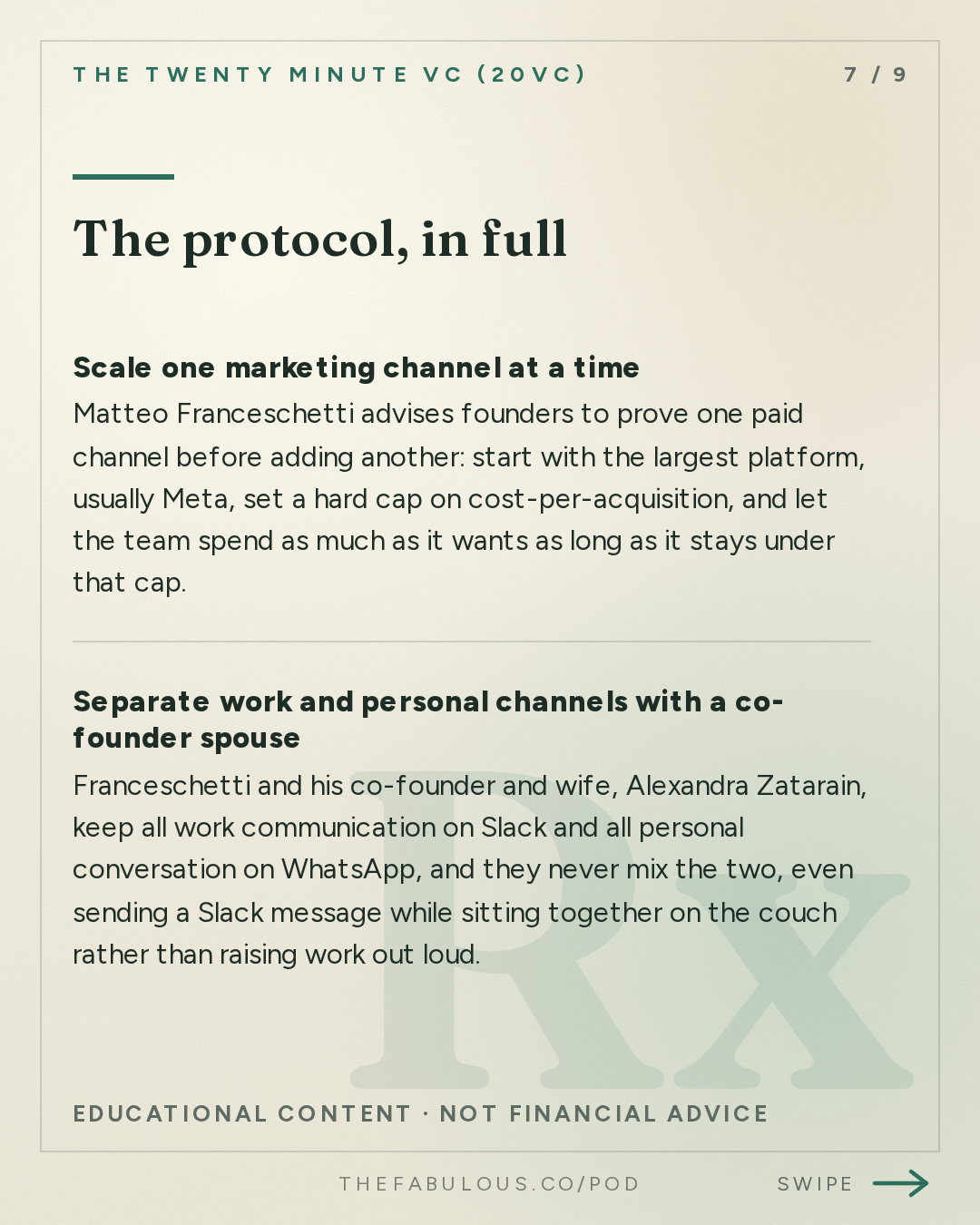
Scale one marketing channel at a time
Matteo Franceschetti advises founders to prove one paid channel before adding another: start with the largest platform, usually Meta, set a hard cap on cost-per-acquisition, and let the team spend as much as it wants as long as it stays under that cap.
Reassessed with an incrementality test roughly every six months
-
Separate work and personal channels with a co-founder spouse
Franceschetti and his co-founder and wife, Alexandra Zatarain, keep all work communication on Slack and all personal conversation on WhatsApp, and they never mix the two, even sending a Slack message while sitting together on the couch rather than raising work out loud.
Applied daily, with a soft cutoff around 10 pm for non-urgent Slack messages
Questions this episode answers
How did Eight Sleep replace its email marketing team with AI?
After the employee running email marketing left, co-founder Alexandra Zatarain used the AI model Claude to build bots that plan, write, and send every email, drawing on historical performance data to decide timing and copy (17:21). The channel now runs with zero human staff and still generates close to $100 million in revenue, according to co-founder Matteo Franceschetti (17:41).
Why did Eight Sleep's engineers stop writing code?
Co-founder Matteo Franceschetti says the company's engineers moved to overseeing hundreds of AI coding agents rather than writing code by hand about a year before this conversation, which let a small team ship products and meet regulations across 35 countries (19:42).
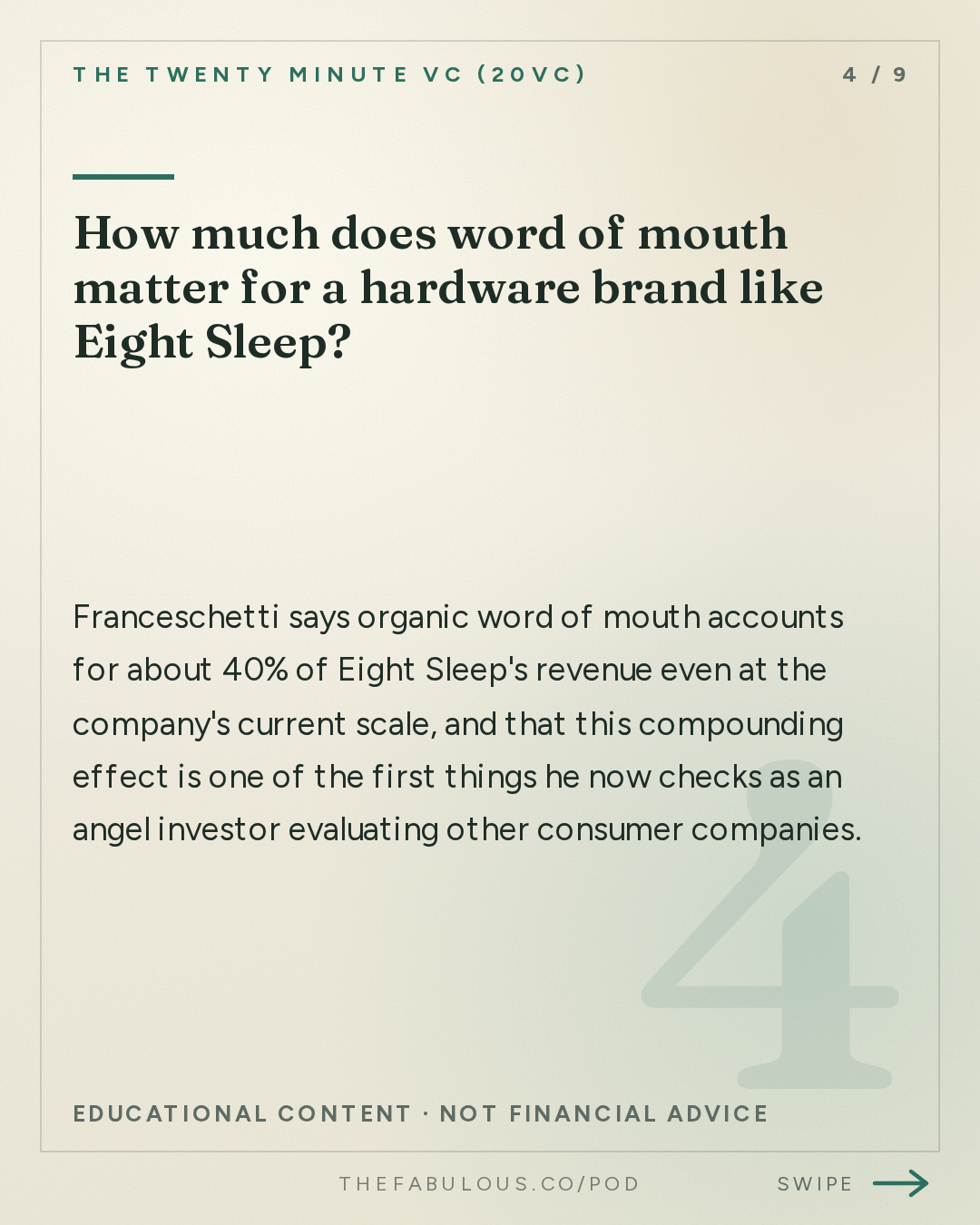
How much does word of mouth matter for a hardware brand like Eight Sleep?
Franceschetti says organic word of mouth accounts for about 40% of Eight Sleep's revenue even at the company's current scale, and that this compounding effect is one of the first things he now checks as an angel investor evaluating other consumer companies (08:06).
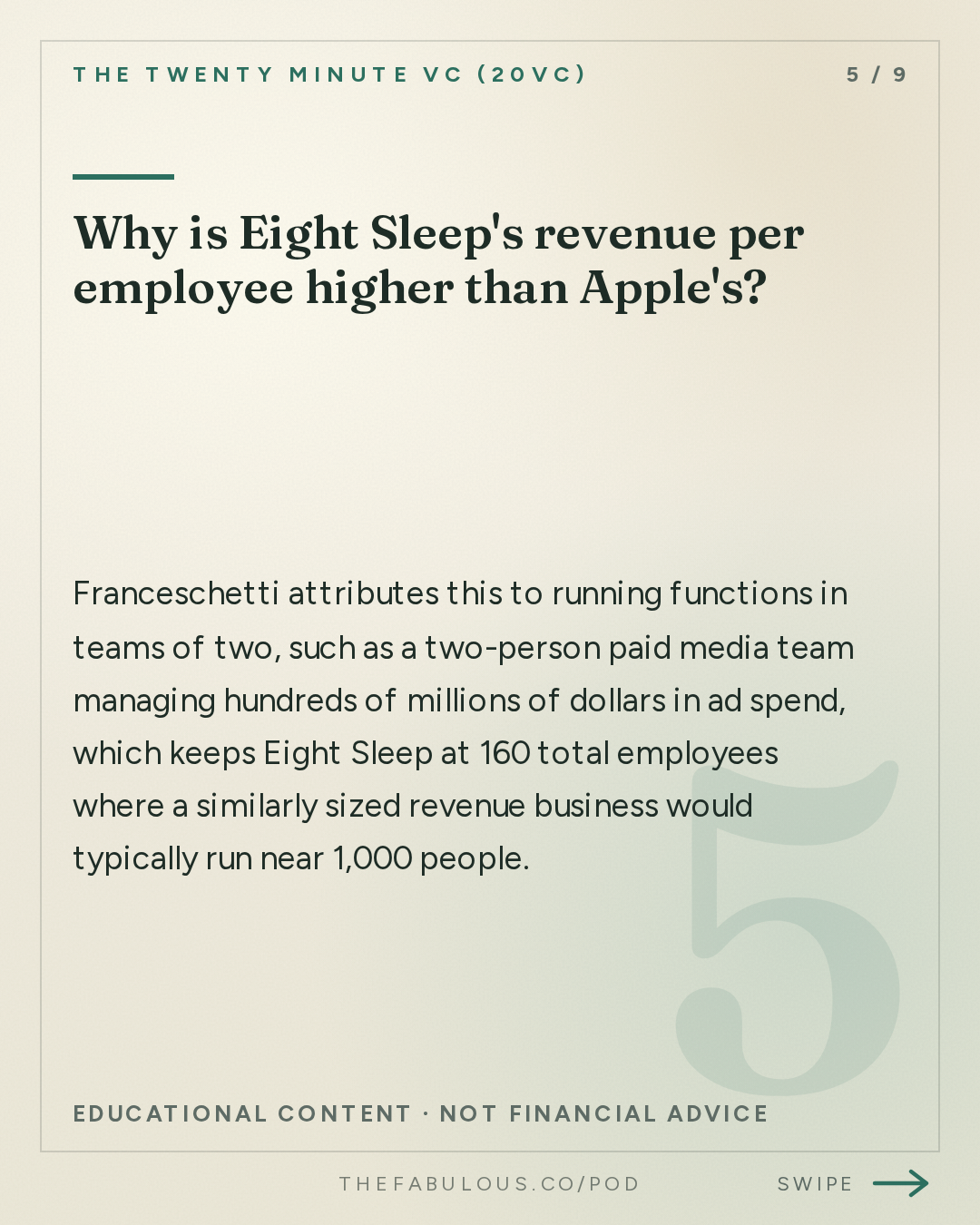
Why is Eight Sleep's revenue per employee higher than Apple's?
Franceschetti attributes this to running functions in teams of two, such as a two-person paid media team managing hundreds of millions of dollars in ad spend, which keeps Eight Sleep at 160 total employees where a similarly sized revenue business would typically run near 1,000 people (56:47).
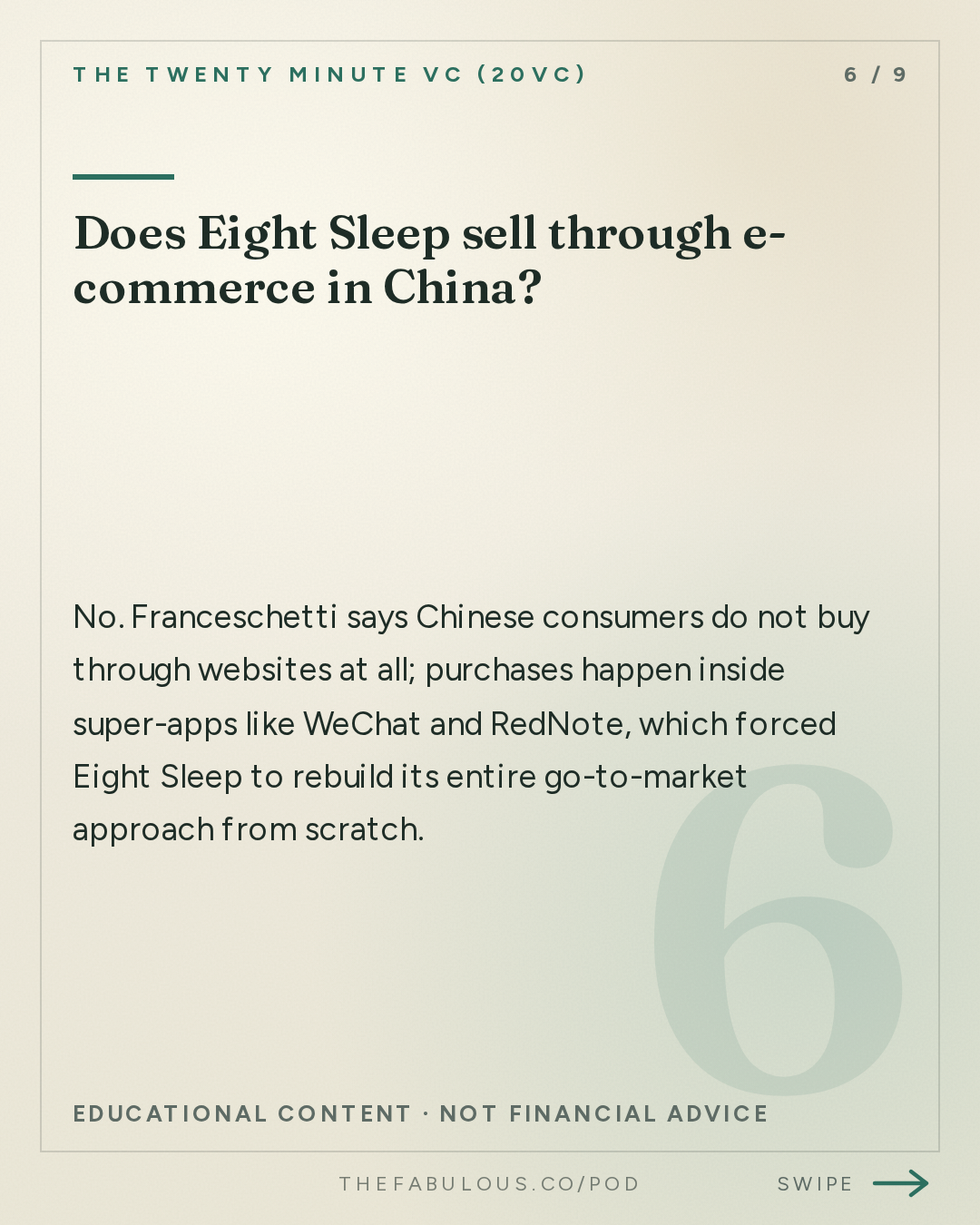
Does Eight Sleep sell through e-commerce in China?
No. Franceschetti says Chinese consumers do not buy through websites at all; purchases happen inside super-apps like WeChat and RedNote, which forced Eight Sleep to rebuild its entire go-to-market approach from scratch (28:20).
What is Eight Sleep's incrementality test for marketing channels?
The company periodically turns a channel off in one region, such as one state, while leaving it on in a comparable region, then compares revenue growth between the two to isolate the channel's true incremental contribution, since platform-reported cost-per-acquisition understates or overstates the real number by about 20%, according to Franceschetti (09:30).
The full read, in cards
Go deeper
- World Humanoid Robot Games — Humanoid robots competed in track and combat events, showing fast progress in movement and coordination
Mentioned
Matteo Franceschetti · Eight Sleep · Alexandra Zatarain · Claude · Anthropic · OpenAI · Charles Leclerc · Ferrari · Xiaomi · Keith Rabois
More from this show and category

Satya Nadella on AI Alignment and Zero Trust
Microsoft CEO Satya Nadella says AI alignment doesn't automatically emerge from scaling, so Microsoft built zero-trust tools to audit every agent action. He predicts commodity token usage will dominate within 24 months (08:47) and that firms will treat private AI evaluation benchmarks as core intellectual property (12:08).

Naveen Rao's Unconventional AI Strategy Explained
Naveen Rao, who sold MosaicML to Databricks for $1.3 billion, argues energy and hardware, not software, will decide AI's next decade. He projects a $10 trillion inference market within ten years, robotics growing 100 times bigger than coding agents, and warns that pure software investors are in trouble.

Is Venture Capital Broken? Billion-Dollar Math
Venture capital has split into two games: mega-funds need billion-dollar stakes in a handful of AI giants, while strong smaller startups go unfunded. CoreWeave slid 15-20% on AI demand fears (13:35), Anthropic posted $16.8B in Q3 revenue (19:07), Modal raised $750M at $15.75B (32:03), and Anduril trades near 40 times revenue at a $90B valuation (38:44).

Sameer Dholakia on Bessemer's AI Investing Playbook
Bessemer's Sameer Dholakia explains why his firm paid roughly 150x ARR for Anthropic, and why capital itself is now a moat in AI investing. He prices deals on next-twelve-months revenue, targets 10 to 15 times NTM multiples, and says Bessemer's new $5.75 billion in funds reflects venture splitting into giant platforms and extreme specialists.
