ADHD Daily Task OrganizerFocus & ADHD · ~10 min
About this template · Updated September 2026
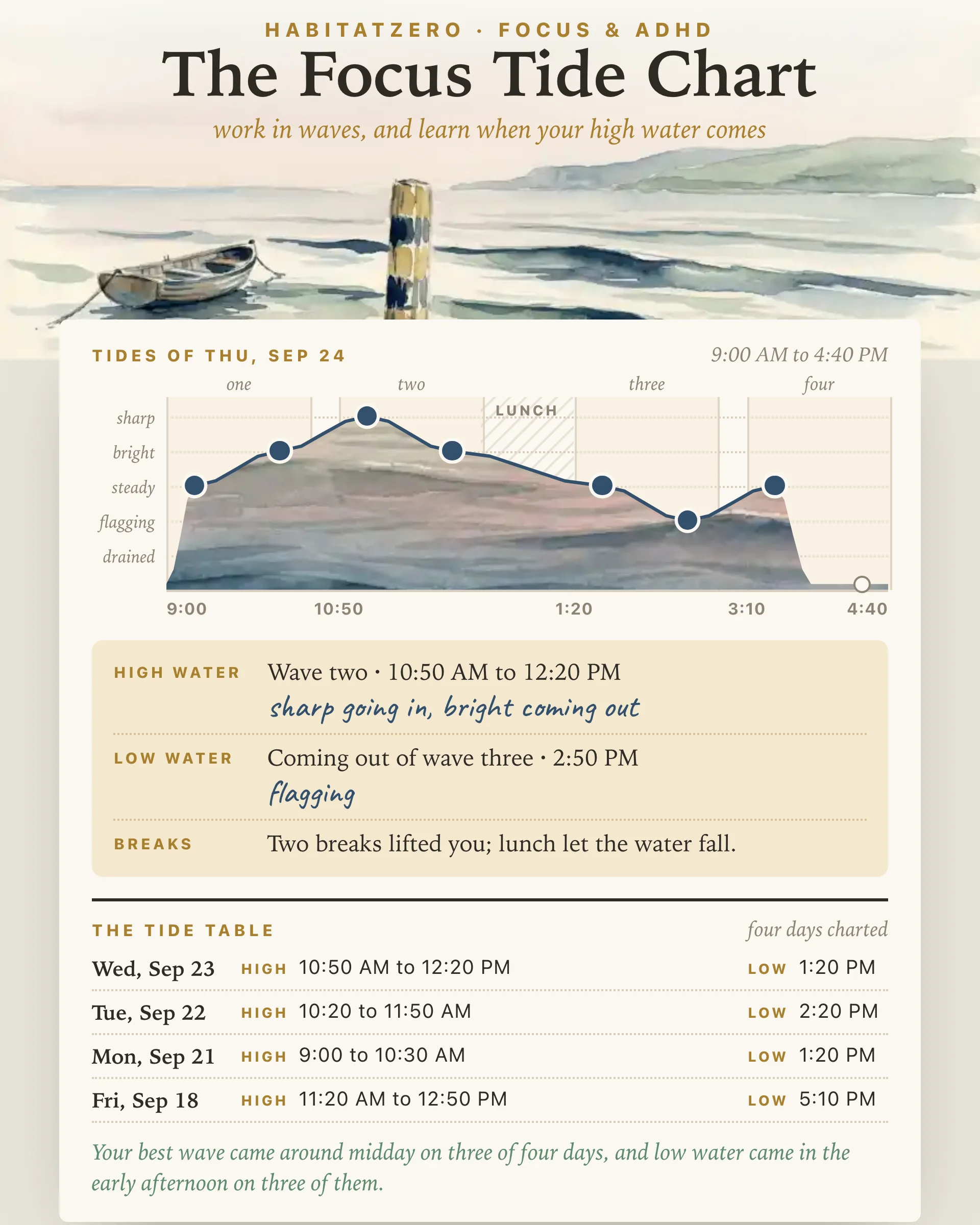
This page rests on an idea from Nathaniel Kleitman, the sleep researcher who proposed that the swing between REM and non-REM sleep, roughly every ninety minutes, is only the night shift of a basic rest-activity cycle that keeps turning while you are awake. He looked back on that proposal in Basic Rest-Activity Cycle, 22 Years Later. This chart is an independent practice sheet built on his idea, not affiliated with his work or with anyone who carried it on, and no researcher has endorsed it.
An ultradian rhythm is any cycle your body runs more than once a day. Sleep is the clearest case: through the night you sink from light sleep into deep sleep and climb back up into REM, again and again, in loops of about an hour and a half. A circadian rhythm, by contrast, takes a whole day to come around once, which is why you get sleepy at roughly the same hour every night. Kleitman's bet was that a shorter loop keeps running under the daily one in daylight too, so your alertness drifts up and down several times between breakfast and dinner.
The version you have probably met is the ninety-and-twenty rule: work in focused stretches of about ninety minutes, then rest for about twenty before the next one. This chart turns that rule into something you can test on yourself instead of taking it on faith.
The daytime cycle is real enough to measure and faint enough to argue about. Lavie, a sleep researcher at the Technion in Haifa, reviewed studies that used very different methods and found evidence for waking cycles in alertness of about an hour and a half. He also stressed how weak they are. How alert you are to begin with, the conditions around you and slower cycles that grow stronger in the second half of the day can all mask them. Expect a loose rhythm rather than a metronome, and one that some days hides entirely.
The afternoon slump is on firmer ground. Monk, at the University of Pittsburgh, describes a post-lunch dip in performance that shows up for some tasks and some people in the middle of the afternoon, even when nobody has eaten lunch, and a high-carbohydrate lunch makes it worse. If your chart keeps finding low water around two in the afternoon, you are in good company, and the sandwich may not be the whole story.
Rests have evidence of their own. A meta-analysis of short work breaks found that pauses of ten minutes or less gave people a small boost in vigor and eased fatigue, while their effect on overall performance fell short of significance. Longer breaks did more for performance, and recovering from draining tasks seemed to need more than ten minutes. That is a fair case for a real twenty-minute rest after a demanding wave, and a reason to check whether your rests restore you at all.
Set when your first wave starts, how many waves the day holds, up to five, and whether waves run seventy-five, ninety or one hundred five minutes, with rests of fifteen, twenty or thirty. Any break can become lunch, and every clock time on the page moves to match.
At the start of each wave, tap how your energy reads: drained, flagging, steady, bright or sharp. Tap again when the wave ends. The painted sea rises to your marks, so by evening the chart shows the shape of your day in one look.
Once two waves carry both marks, the chart names your high water, the wave that held up best, and your low water, your lowest mark and the clock time it fell at. It also says which breaks lifted you and which let the water fall. Stretch a wave or move lunch after marking, and the reading follows the new times.
The next morning the chart closes: it keeps its reading but takes no new marks. Start the new day and yesterday, if two of its waves were marked at both ends, goes into the tide table, which keeps ten days. From three days on, the table tells you where your best wave and your low water tend to land.
Save the work that needs your sharpest thinking for the window where high water keeps arriving, and plan it with the Deep Work Planner so the wave starts with a clear target. Give low water to email, errands or a walk. If the dip is deep and regular, a short rest with the Nap Timer may do more for you than another coffee.
If your rests keep letting the water fall, change what happens in them: step outside, move around, eat something light, look away from screens. If high water turns up late in the day every time, your daily clock may simply run late, and Lark or Owl can show you where your mornings and nights sit.
Chart ordinary workdays, ideally five or more, before you rearrange anything. One odd day, after a bad night or a marathon of meetings, tells you about that day and not about your rhythm. Skip days that are wall-to-wall meetings; they hold no waves to read.
It is any body rhythm that comes around more than once a day. The clearest example is sleep, which cycles from light to deep sleep and into REM roughly every ninety minutes. Hormone pulses, appetite and alertness also rise and fall on cycles shorter than a day.
A circadian rhythm completes one loop about every twenty-four hours, like the daily pull between sleeping and waking. Ultradian rhythms repeat several times inside that day, while infradian rhythms, such as the menstrual cycle, take longer than a day to come around.
Partly. Lab studies have picked up waves of alertness about an hour and a half apart during waking hours, but those waves are faint, and how alert you are to begin with, what you are doing and the time of day can hide them. Treat ninety minutes as a starting length and let your own marks adjust it.
No. Nathaniel Kleitman described the rest-activity cycle as a scientist and never set out a work schedule, and the ninety-and-twenty routine grew later out of popular writing about energy at work. This chart is an independent practice sheet with no link to any researcher or author.
The sample chart on this page is free to study without signing in. To mark your own waves and let the tide table gather your days, open the chart in HabitatZero, which costs nothing to use.
By the team behind Fabulous, the science-based self-care app used by over 30 million people.