Leaves on a StreamEmotional Fitness · ~3 min
About this template · Updated July 2026
Everyone runs a small public-relations department for themselves. It decides which reactions get shown, which wants get admitted, which feelings get relabeled as something more acceptable before release. The material it suppresses doesn't disappear — Carl Jung called that unclaimed inventory the shadow: the traits and impulses a person disowns to stay acceptable, which keep operating anyway, usually in disguise (APA Dictionary of Psychology: shadow).
Journaling for shadow work is the low-drama way to meet that inventory. No incense required, no dramatic excavation — just a pointed question, an unedited written answer, and the willingness to read what came out. The page is well suited to the job: putting difficult feelings into words is itself regulating, not just expressive — affect-labeling research finds that naming an emotion dampens the brain's alarm response to it (DOI: 10.1111/j.1467-9280.2007.01916.x), and the broader experimental literature on emotional disclosure through writing shows small but reliable benefits across dozens of studies (meta-analysis, DOI: 10.1037/0033-2909.132.6.823).
One boundary, stated plainly: this is a self-inquiry practice, not therapy, and it doesn't pretend to be. If the page turns up something heavy, the practice's kindest instruction is to let a professional or a trusted person be the next reader.
You don't find the shadow by digging; you find it by reading your own week. It has three reliable return addresses:
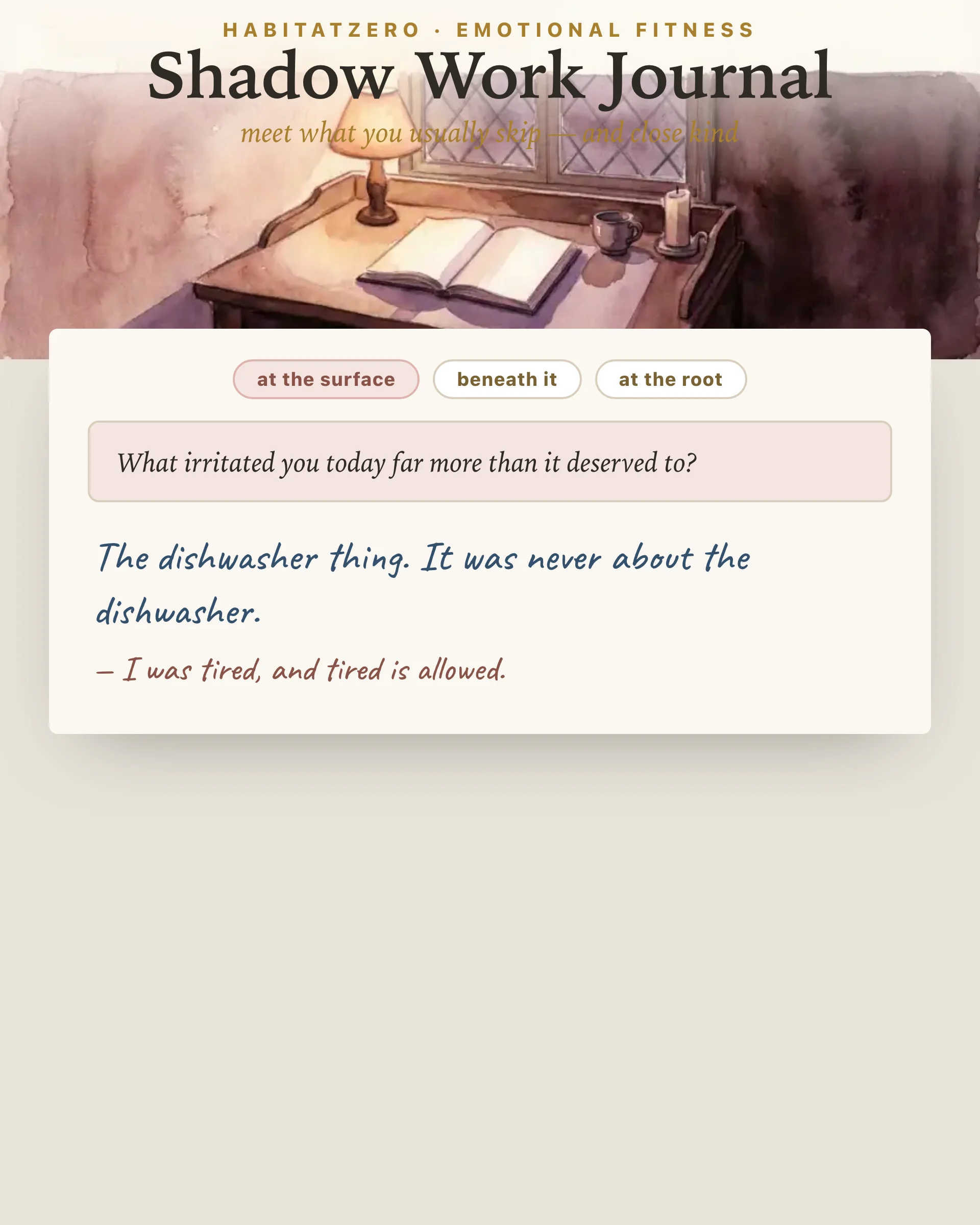
Oversized reactions. The irritation that outweighed its trigger by a factor of ten. Whatever got touched was already tender.
Envy and judgment. The people you can't stop critiquing and the people you can't stop watching are both carrying information — usually about a permission you haven't granted yourself.
The old roles. The peacemaker, the achiever, the easy one. Roles learned early run deepest, and under stress they take the wheel without asking.
This journal's three prompt decks map onto exactly those addresses — surface, beneath, root — and you choose the depth per session. That choice is a feature, not a cop-out: forcing depth on a tired night produces performance, and shadow work performed is shadow work postponed.
The predictable failure mode of shadow journaling is that it collapses into a nightly self-prosecution. You look at your envy, your pettiness, your old fear — and without a counterweight, looking becomes indicting.
So this journal enforces the counterweight mechanically: a session cannot be kept until you write one kind closing sentence to yourself. Not a compliment, not a silver lining — just kindness with your own name on it. I was tired, and tired is allowed. The ritual is look honestly, close warmly, stop. Sessions file into a drawer of thirty with their depth and date; when the drawer fills, you release one — which is, quietly, the whole lesson in miniature.
Pick at the surface. Take the prompt about today's oversized reaction, write the unfiltered version of what happened, and notice the gap between that draft and the one you'd have told out loud. That gap is the workshop. Close kind, keep the session, and come back when the week gives you the next loud signal — it will.
Shadow work is Carl Jung's name for getting acquainted with the parts of yourself you learned to hide — the envy, the anger, the needs that once earned disapproval. Journaling is its most practical form: a pointed question, an unedited answer, and enough honesty to notice what you usually filter out before anyone sees it, including you.
No. This journal is a self-inquiry practice, not treatment, diagnosis, or a substitute for professional support. It asks questions and holds your answers; it does not interpret you. If a session surfaces something heavy, the kind next step is bringing it to a professional or someone you trust.
Because the honest answer to how deep do you want to go tonight changes by the day. Surface prompts examine today's oversized reactions, the middle deck looks at envy and judgment as information, and the root deck visits the roles you learned early. Choosing shallow on a tired night is wisdom, not avoidance.
Because meeting your less-flattering parts without kindness curdles into self-criticism, which is the opposite of the practice. The journal literally will not keep a session until you write one kind sentence to yourself — the ritual is: look honestly, close warmly, stop.
Start where the energy is loudest: what irritated you more than it deserved to, which compliment was hard to accept, what joke you made that was carrying something serious. Oversized reactions are the shadow's return address — you rarely need to dig for it, only to read your own week.
Yes — sessions live with your HabitatZero worksheet answers and appear only on your own devices. Nothing is published anywhere, and releasing a session removes it from the drawer for good.
By the team behind Fabulous, the science-based self-care app used by over 30 million people.