Leaves on a StreamEmotional Fitness · ~3 min
About this template · Updated July 2026
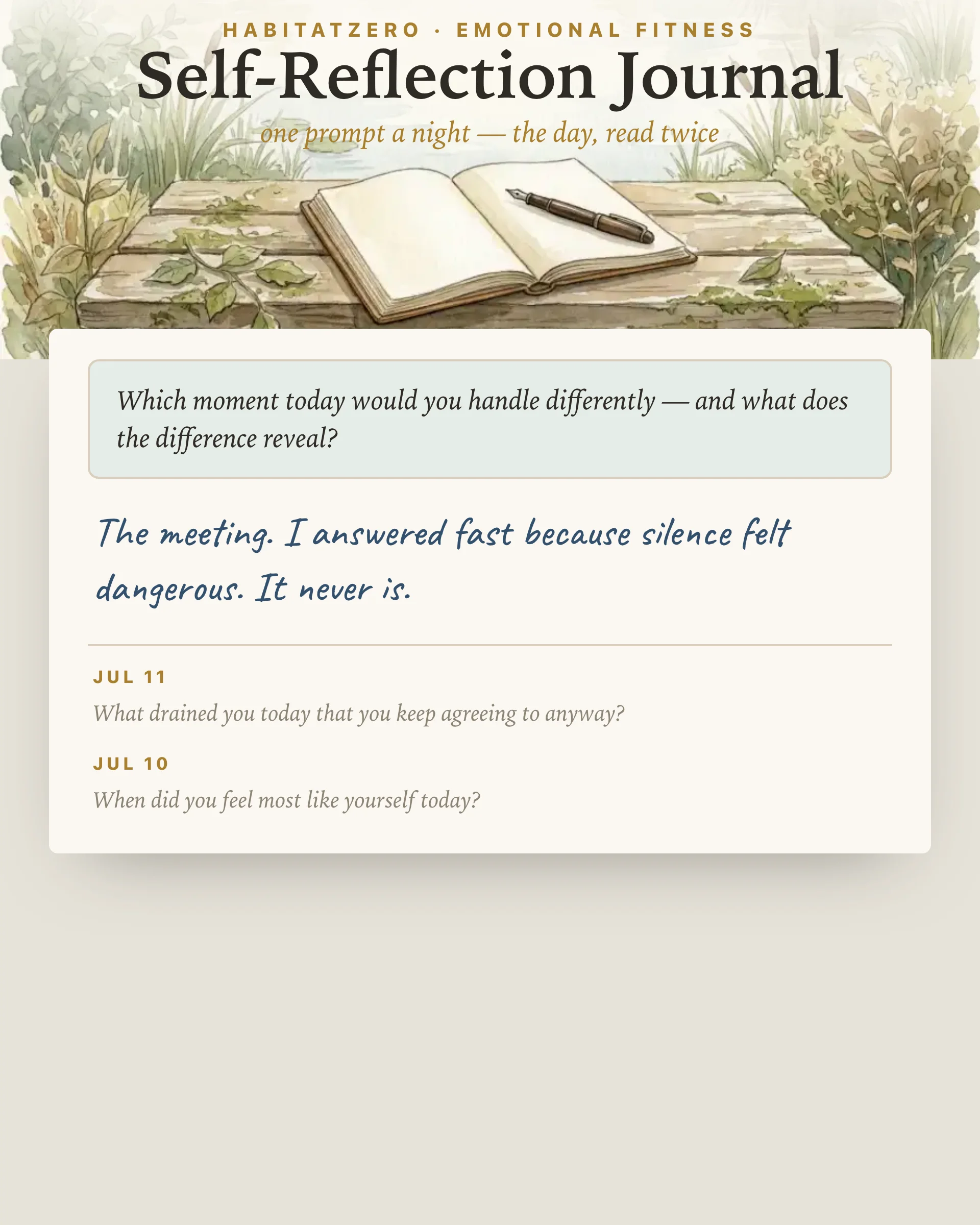
Most days get lived once and filed unread. The meeting happened, the snap at lunch happened, the strange relief when plans got canceled happened — and by ten p.m. the whole thing is a blur with a mood attached. Journaling for self reflection is the practice of reading the day a second time before filing it: not to record what happened, but to notice what it said.
The difference matters more than it sounds. Simply venting onto a page has real but modest effects; the larger gains show up when writing turns experience into structure. James Pennebaker's expressive-writing research found that people who moved from raw description toward causal, insight-flavored language — because, realize, understand — were the ones whose writing changed how they felt and functioned (APA Monitor's overview of the field). Reflection is that move, done on purpose.
There is also a plain performance case. A field experiment with new employees found that ending the day with fifteen minutes of written reflection improved subsequent performance measurably compared with simply doing more of the task — codified in the working paper Making Experience Count: The Role of Reflection in Individual Learning (DOI: 10.2139/ssrn.2414478). Experience teaches, but mostly when it is re-read.
The blank page's question — "describe your day" — invites a weather report. A pointed question invites a reckoning: what drained you today that you keep agreeing to anyway? is answerable in three sentences and rarely answerable comfortably.
Prompts also do quiet psychological work. Answering a question about yourself puts a half-step of distance between you and the day — closer to how you'd examine a friend's Tuesday than relive your own. That distance is not evasion; research on self-distancing shows that stepping back from an experience while examining it lets people make meaning from it with less rumination and less reactivation of the original sting (DOI: 10.1177/0963721411408883).
This journal keeps a deck of sixteen such questions in rotation — energy leaks, borrowed opinions, avoided sentences, moments of feeling most yourself — and deals one a night. If tonight's question misses, deal another. The useful one usually stings slightly.
One prompt, dealt. The page opens with a single question, not a menu. Constraint is the feature: answering one pointed question beats grazing across ten.
Ink, not typing-voice. Your answer goes down in handwriting-style ink. It reads like a note to yourself, because it is one — and entries that look personal get written more honestly than entries that look like paragraphs.
A shelf, not a landfill. Kept reflections stack newest-first with their date and the question that produced them, and the shelf caps at forty. The cap is deliberate. A reflection practice that only accumulates is a diary with extra steps; the value compounds when old entries get re-read and occasionally released. When the shelf fills, choosing what to let go of is its own small reckoning.
Reading the shelf is the practice. After two or three weeks, the entries start answering each other — the same boundary surfacing under three different questions, the same person appearing in every energy-leak answer. No single reflection tells you much. Forty of them, dated and prompted, tell you what a year of vague resolutions never will.
Take tonight's question at face value and write three sentences in your own hand. Don't polish; contradictions are data. Keep it, and let the shelf do the slow work — journaling for self reflection pays out not on the night you write, but on the night you re-read.
It is journaling with a rearview mirror: instead of recording what happened, you write about what the day revealed — the reaction that was older than its trigger, the yes you regretted by noon, the moment you felt most like yourself. One pointed question plus five honest minutes tends to surface more than a blank page asking you to describe your day.
A diary logs events; a reflection journal interrogates them. Here the prompt does the interrogating for you — you never face a blank page, and every entry is anchored to the question that produced it, so re-reading the shelf later shows how your answers to the same kinds of questions change.
Sixteen questions in rotation, each aimed at a different seam of the day: energy leaks, avoided conversations, borrowed opinions, moments of feeling most yourself. You can deal a different question any time — the useful prompt is usually the one that stings a little.
Nightly is the sweet spot, while the events are still warm, but the journal holds no streaks over your head. A few honest entries a week beat a perfect daily record of shallow ones — the shelf rewards depth, not attendance.
Because a pile you never re-read is storage, not reflection. Forty entries is roughly two months of steady practice — enough to see your patterns — and when the shelf fills, choosing which reflection to let go of is itself a small act of self-knowledge.
Your entries live with your HabitatZero worksheet answers and appear only on your own devices. Nothing you write is published anywhere, and letting a reflection go removes it from the shelf for good.
By the team behind Fabulous, the science-based self-care app used by over 30 million people.