Leaves on a StreamEmotional Fitness · ~3 min
About this template · Updated September 2026
Self-love has a marketing problem: it sounds like bubble baths and believing you're wonderful. The working version is plainer and far more repeatable — it's the moment after something stings, and the question of what you say to yourself next. Most of us say nothing, or worse. A self love journal is a place to practice saying something better, three lines at a time.
Each entry in this journal is the same small ritual, and the structure is doing deliberate work — it follows the shape that self-compassion research has mapped as the difference between people who recover warmly from bad moments and people who spiral: notice the pain plainly, meet it with kindness instead of judgment, and place it inside common humanity rather than private defect (Neff's foundational account: DOI 10.1080/15298860309032).
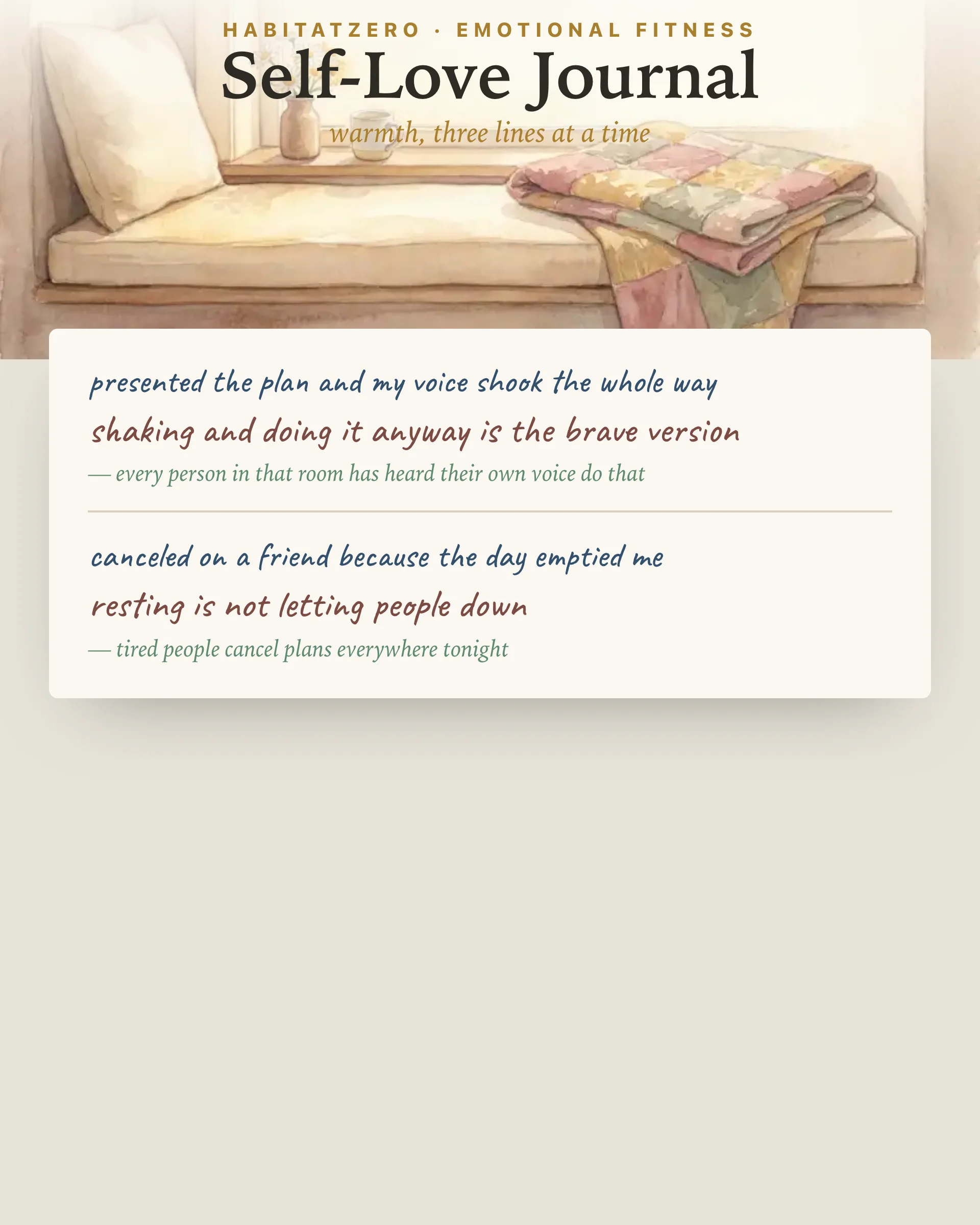
The moment that was hard. One line, stated flat: presented the plan and my voice shook the whole way through. No prosecution attached, no because I'm hopeless rider. Naming without indicting is a skill, and it's the first one this page trains.
The words you actually needed. Not an affirmation off a poster — the sentence you wished someone in the room had said, composed in your own voice: shaking and doing it anyway is the brave version, not the embarrassing one. Warmth you write yourself has a credibility that borrowed warmth never gets, because it knows the details.
And you're not the only one. The closing line widens the frame: every person in that room has heard their own voice do that. Hard moments do their worst damage when they feel like evidence of unique failure; one written sentence of shared humanity is the antidote, and it works even when it's obvious.
Entries stack into what this journal calls the quilt — capped at twenty-five squares. The cap matters for the same reason the practice does: warmth needs to be re-encountered, not just produced. A bounded collection gets wrapped up in on a bad night; an infinite scroll gets forgotten. When the quilt is complete, it's yours — a dated record of the exact sentences that help, written by the one person who always knew what they were.
There's also a quiet compounding effect. After a dozen entries, the second line starts arriving faster — sometimes in the moment itself, before anything gets written. That's the whole aim: the journal is training wheels for a voice, and the voice eventually rides on its own.
No part of this practice is gendered, aged, or reserved — hard moments and needed words work the same in every direction. And it pairs cleanly with a gratitude practice rather than replacing one: gratitude collects what the day gave you; these three lines supply what the day forgot to say.
One honest edge, stated without drama: this is a warmth habit, not treatment. If kindness toward yourself feels impossible rather than merely unfamiliar — if the inner weather stays heavy week after week — bring a mental-health professional into it. The quilt keeps. Gentleness is allowed to have backup.
Take the sting you're still carrying from today. One line for what happened. One line you needed to hear — write it like you'd text it to your closest friend, then read it addressed to you. One line for everyone else who'd understand. Tuck it in. That's a square, that's the practice, and twenty-four more make a quilt.
A short daily practice of writing warmth to yourself on purpose. This version uses three lines per entry: the moment that was hard, the words you actually needed to hear, and a reminder that others would understand — a structure drawn from research on self-compassion, which treats kindness toward yourself as a learnable habit rather than a personality trait.
They mirror the three moves that make self-kindness stick: noticing the pain without exaggerating or prosecuting it, responding with warmth instead of judgment, and remembering that struggle is shared rather than a private defect. Each line trains one move; together they take about five minutes.
It is a self love journal for anyone. The practice has nothing gendered in it — hard moments, needed words, and shared humanity work identically for everyone. If you found this page searching for a version for women, everything here applies; the entries are yours, in your voice, whoever you are.
Gratitude journaling collects what you appreciate; this practice supplies what was missing — the kind sentence nobody said at the moment you needed it. The two pair naturally: gratitude on the good days, three warm lines on the bruising ones. This page deliberately keeps to the second job.
Unfamiliar and fake are different feelings, and the first one fades. A useful test: write the words you would text a friend in the same situation, then read them addressed to yourself. Awkwardness at the start is the practice working on an untrained muscle, not a sign you are doing it wrong.
No — it is a warmth habit, not treatment. And one honest boundary: if kindness toward yourself feels impossible rather than just unfamiliar, or the inner weather stays heavy for weeks, that is a conversation for a mental-health professional. The journal keeps; gentleness can have backup.
By the team behind Fabulous, the science-based self-care app used by over 30 million people.