Leaves on a StreamEmotional Fitness · ~3 min
About this template · Updated August 2026
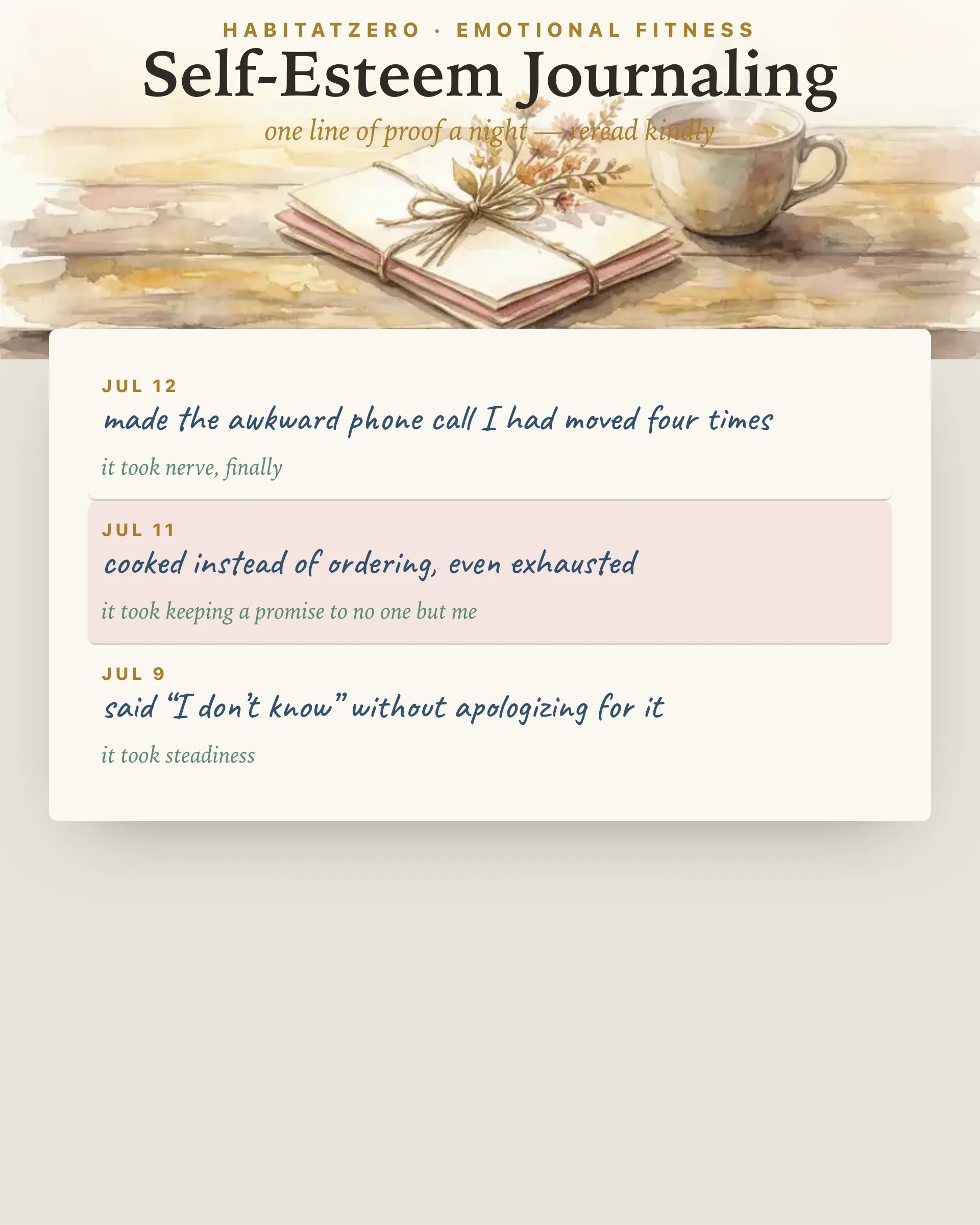
Low self-esteem has an excellent memory for failures and amnesia for everything else. The awkward call you finally made, the dinner cooked while exhausted, the I don't know said without apology — handled, filed as nothing, forgotten by Friday. Self esteem journaling is the discipline of filing those moments where the amnesia can't reach them: one line a night, plus what the moment took, plus — the part most versions miss — a ritual for reading the file back kindly.
Each entry is two short pieces. First, the proof: one thing you handled today, written plainly. Made the awkward phone call I'd moved four times. Not achievements — handlings. The bar is deliberately human: ordinary counts, and done-while-tired counts double.
Second, what it took: nerve, finally. This half is what separates the practice from a to-do list retrospective. A task record says what happened; naming the quality it drew on says something about who was there when it happened. Thirty dated pairs of handled → what it took read less like a log and more like a character reference — written by the only witness who saw every day.
Why proof works where pep talk doesn't: self-esteem responds poorly to being argued with and surprisingly well to being shown records. Affirmations invent a claim and defend it; the file just accumulates specifics until the low-day story — you never manage anything — stops surviving contact with the page.
Once the file holds a few lines, a button offers the actual practice: reread three, kindly. Three past entries light up at random, and the instruction is precise — read them the way a friend would read them to you.
That framing is borrowed from the research on self-compassion, which finds that relating to yourself with the warmth you'd offer someone you care about supports a steadier sense of worth than self-evaluation does — less contingent on the latest result, less propped up by comparison (DOI: 10.1080/15298860309032). Writing kind material turns out to be the easy half; receiving it from yourself is the trained skill. The ritual trains it in about ninety seconds, and the journal counts your rereads the way other pages count entries — because here, the rereading is the repetition that matters.
The file caps at thirty lines. Full is a feature: a bounded file gets reread, an endless one gets scrolled. When you hit thirty, the practice inverts — reread freely, let lines go when they've done their work, and make room for new proof. Letting go of an old entry isn't deleting history; it's acknowledging the deposit cleared.
If you already keep a gratitude page, the two stack without overlapping: gratitude notices what reached you, this file notices what came from you. And if the sit-down version appeals — mapping values and answering your harshest inner sentence on one page — the Self-Esteem Worksheets template is the workshop to this page's daily walk.
One line: what you handled. One more: what it took. That's the whole entry. Come back tomorrow, and the night after, and when three lines exist, do your first kind reread. A month from now the file will say something no affirmation can — because you'll have receipts, in your own hand, and you'll have practiced believing them.
One plain note: this is a journaling practice, not treatment. If feeling low about yourself is constant or getting heavier, bring a mental-health professional into the picture — the file will keep, and it reads even better with support behind it.
A short nightly practice of recording moments you handled — one line for the moment, one for what it took — and periodically rereading the collection with a kind eye. Over weeks the file becomes something a low day cannot argue with: a dated record, in your own handwriting, of you managing your life.
Because the practice lives or dies on repetition, and one line survives tiredness. A single specific sentence — made the awkward call, cooked anyway, said I don't know without apologizing — captures the moment completely, takes under a minute, and leaves you willing to come back tomorrow.
It converts storage into practice. Three random past lines light up and your only job is to read them generously — no editing, no ranking. Recognizing your own steadiness in old entries is a different skill from recording it, and it is the one that changes how you speak to yourself.
Close cousins, different lenses. A gratitude journal notices what reached you from outside — kindnesses, luck, good weather. This practice notices what came from you: things handled and the qualities they drew on. Many people run both; if you keep a gratitude page already, this one fills the half it leaves open.
The worksheets are a sit-down exercise — a one-page pair for mapping what you value and answering your harshest inner line. This journaling page is the ongoing habit that follows: a line a night, a growing file, a reread ritual. The worksheet is the workshop; this is the daily walk.
Then the bar is set too high, not the day too empty. Getting up when the alarm was cruel, replying to the message you dreaded, ending the day without the errand done and letting that be okay — handled does not mean heroic. On genuinely heavy days, reread instead of writing; and if most days feel that way, a mental-health professional is the right support alongside any page.
By the team behind Fabulous, the science-based self-care app used by over 30 million people.