ADHD Daily Task OrganizerFocus & ADHD · ~10 min
About this template · Updated September 2026
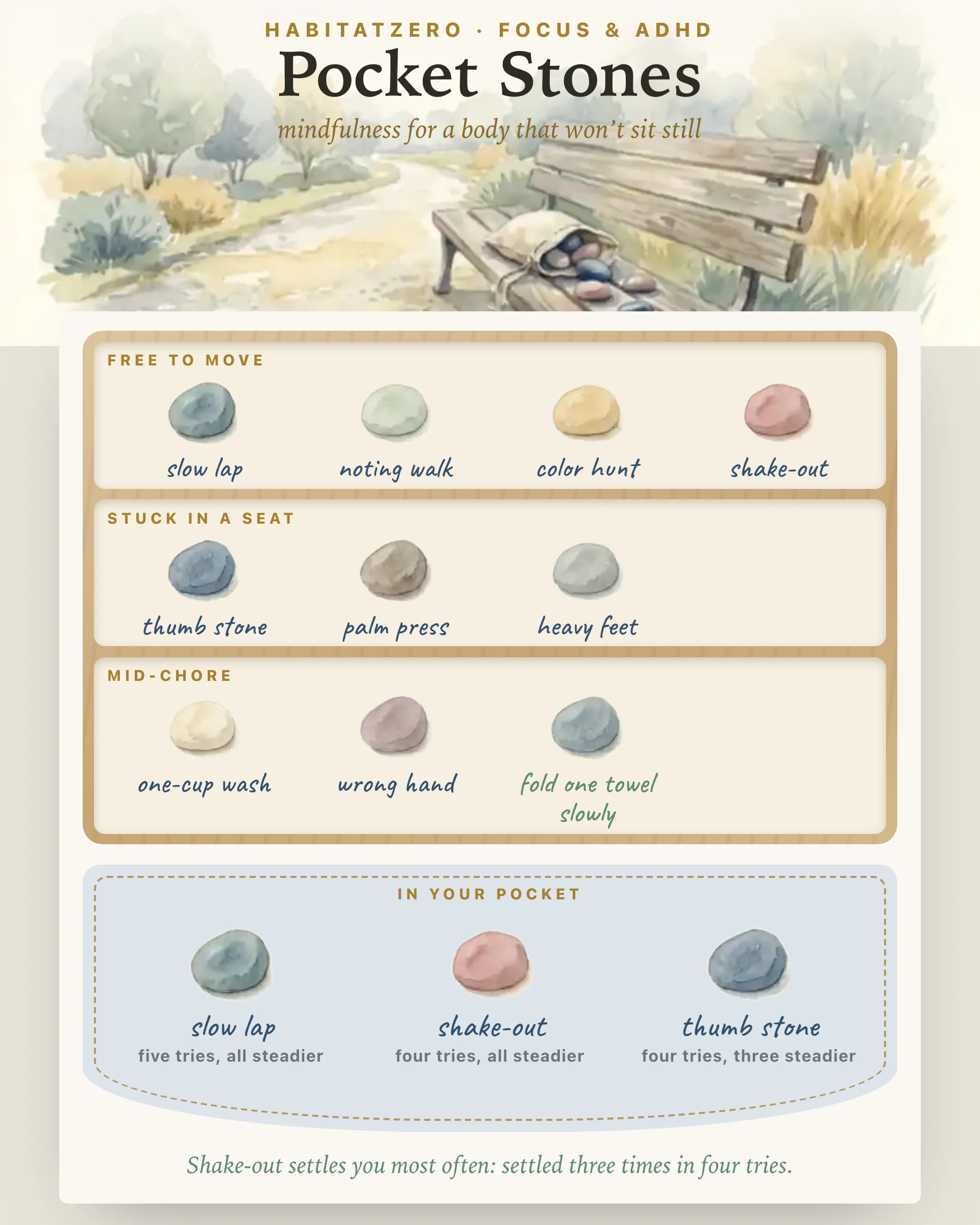
The classic mindfulness instruction goes something like this: sit still, close your eyes, follow your breath for twenty minutes. With ADHD, that can feel like a test designed for you to fail. Your knee starts bouncing by minute two, your head has drafted three emails, and the quiet conclusion is that mindfulness must be meant for other people.
It isn't, because mindfulness was never really about stillness. It is a loop: pay attention to something on purpose, drift, notice that you drifted, come back. That loop can ride on almost anything. Your feet on a hallway floor. The edges of a key. Warm water in a sink. When your body is restless, giving attention something that moves puts the spare energy to work, so you practice noticing instead of wrestling your own legs.
The page is a small wooden tray with three compartments, because with ADHD the first question is rarely which practice is best. It is usually what you can actually do in the next two minutes.
Each takes one to three minutes. None of them needs a quiet room, a cushion or a closed door.
Tap the stone that fits and it leaves a dent in the tray and lands in your palm: three short cues, how long it takes, and a clock you can start if you want one. The clock is silent. It draws a ring around the stone and says how far in you are, so you can leave the phone on the desk for a walking practice.
When you finish, answer one question: how settled do you feel now? Still buzzing, a bit steadier, or settled. The stone goes back into the tray a little more polished, and after a week or two the tray shows you something you could not have guessed on the first day, namely which stones have worn smooth from use.
The pocket underneath does the sorting. A stone moves in once you have tried it at least twice and walked away steadier most of those times, and the pocket holds three. The reading below it names the stone that settles you most often and, just as usefully, any stone that has left you buzzing more often than not. That is not failure. It is information: maybe the color hunt is not your stone, and heavy feet is.
If something already steadies you, a flight of stairs or a stress ball, give it a stone of your own. The tray keeps room for three.
Studies of mindfulness for ADHD are promising but mixed. A 2020 meta-analysis of mindfulness-based therapies for ADHD found moderate drops in inattention (across ten studies) and in hyperactivity and impulsivity (across nine), and its authors described the benefits as possible rather than proven. In a randomized trial of mindfulness-based cognitive therapy with 120 adults, adding eight weekly group sessions to usual care lowered clinician-rated ADHD symptoms more than usual care alone, and the gap held at six months. Still, only about a quarter of that mindfulness group saw their symptoms fall by 30 percent or more.
A third study is a useful brake on enthusiasm. In a trial comparing a mindfulness program with structured psychoeducation among 81 adults who were not taking medication, both groups improved and neither did better than the other.
Two limits matter for this page in particular. Both trials tested structured eight-week programs with guided group sessions, not one-minute exercises picked from a tray. And none of these studies compared moving practices with sitting ones. So treat this page as a place to practice, not as a treatment. It does not replace medication, therapy or coaching, and it sits comfortably alongside all three.
Pick up a stone when your leg is bouncing before a meeting, in the gap between two tasks, when you notice you have read the same paragraph three times, or halfway through a chore you keep walking away from. One minute counts.
If a stone settles you enough to work, go straight into a short sprint with Sand Timer Sprints. If the trouble is a strong pull toward your phone or the fridge, Urge Surfing walks you through riding it out. And when the short stones start to feel easy, The Meditation Timer will keep time for a longer sit.
It can, though the evidence is mixed. Pooled studies show moderate improvements in attention and restlessness, and one trial found a mindfulness course helped no more than structured education about ADHD. It works best as a skill practiced alongside your usual care, not as a stand-in for it.
Try a slow lap of the room while you feel each step, a walk where you label whatever grabs your attention, turning a small object slowly in your hand, pressing your feet into the floor, or washing a single cup with full attention. Each one uses movement as the thing you keep coming back to.
Start with one to three minutes. Finishing a short practice teaches your attention more than abandoning a long one halfway, and short practices are easier to repeat. Stretch the time only when the short version starts to feel easy.
Yes, as long as the fidget is what you pay attention to. Slowly turning a key and noticing its edges is a practice; clicking a pen while you plan dinner is just clicking a pen. The test is whether you keep returning to the sensation.
No. Every practice on this page can be read and tried right now. Opening it in HabitatZero, which costs nothing, is what keeps your tries, the polish on each stone and your pocket from one day to the next.
By the team behind Fabulous, the science-based self-care app used by over 30 million people.