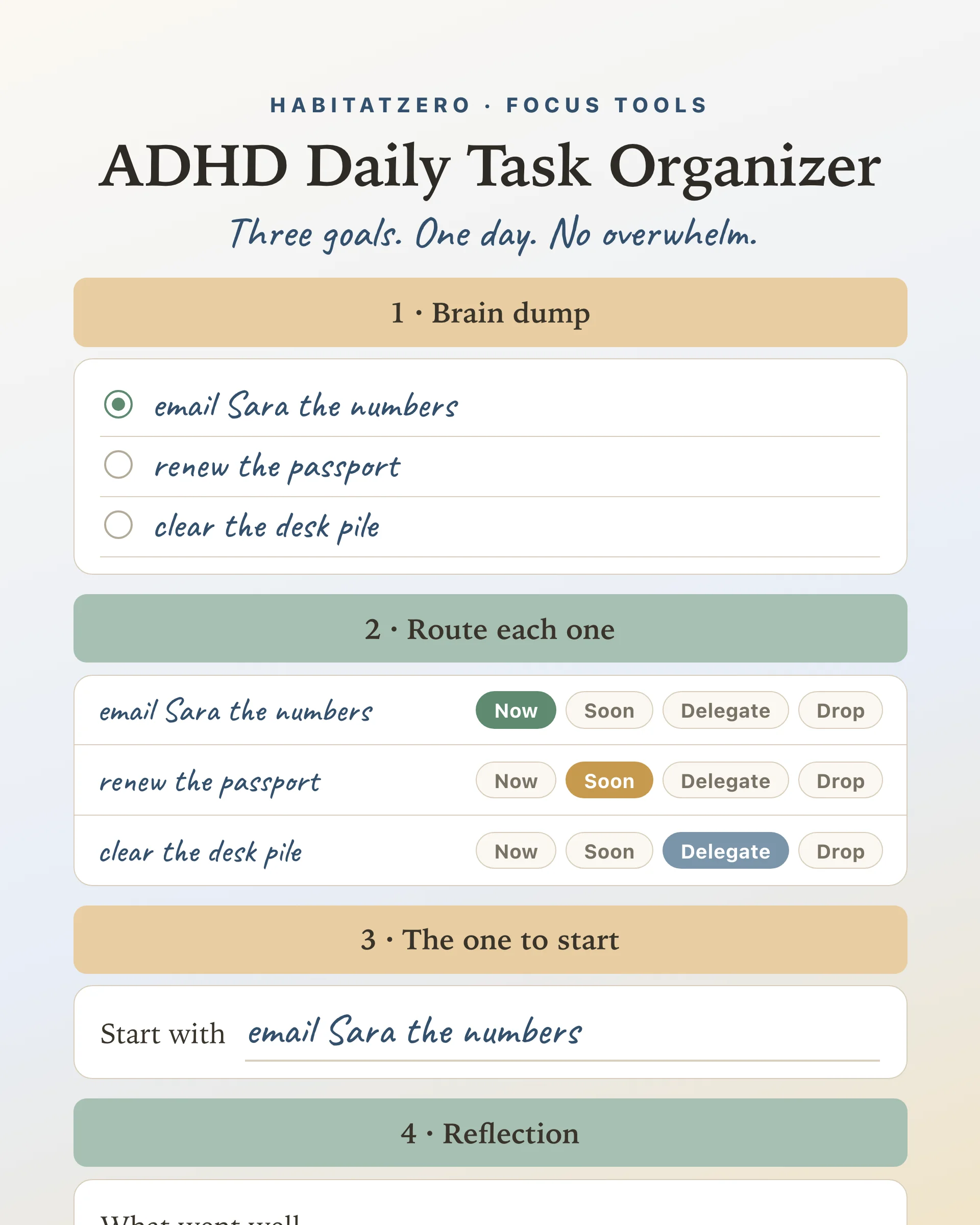
ADHD Daily Task OrganizerFocus & ADHD · ~10 min
About this template · Updated September 2026
The mind sweep belongs to David Allen's Getting Things Done, the method he set out in Getting Things Done: The Art of Stress-Free Productivity (2001, revised 2015). The Getting Things Done site counts it among the core practices of the method, and the David Allen Company gives away its own Incompletion Trigger List. This floor of piles is an independent practice sheet built for HabitatZero. Allen and his company had no hand in making it and have not endorsed it, every prompt on it was written from scratch, and Getting Things Done and GTD are registered trademarks of the David Allen Company.
The quarry is the open loop: anything you have agreed to, even halfheartedly, that is neither finished nor parked somewhere you trust. The dentist you meant to call. The refund that never showed up. The shelf still in its box. None of them is urgent, which is exactly why they linger, and each keeps a small claim on your attention while you try to think about something else. A sweep hunts for all of them at once, area by area, so a vague sense of too much becomes something you can count.
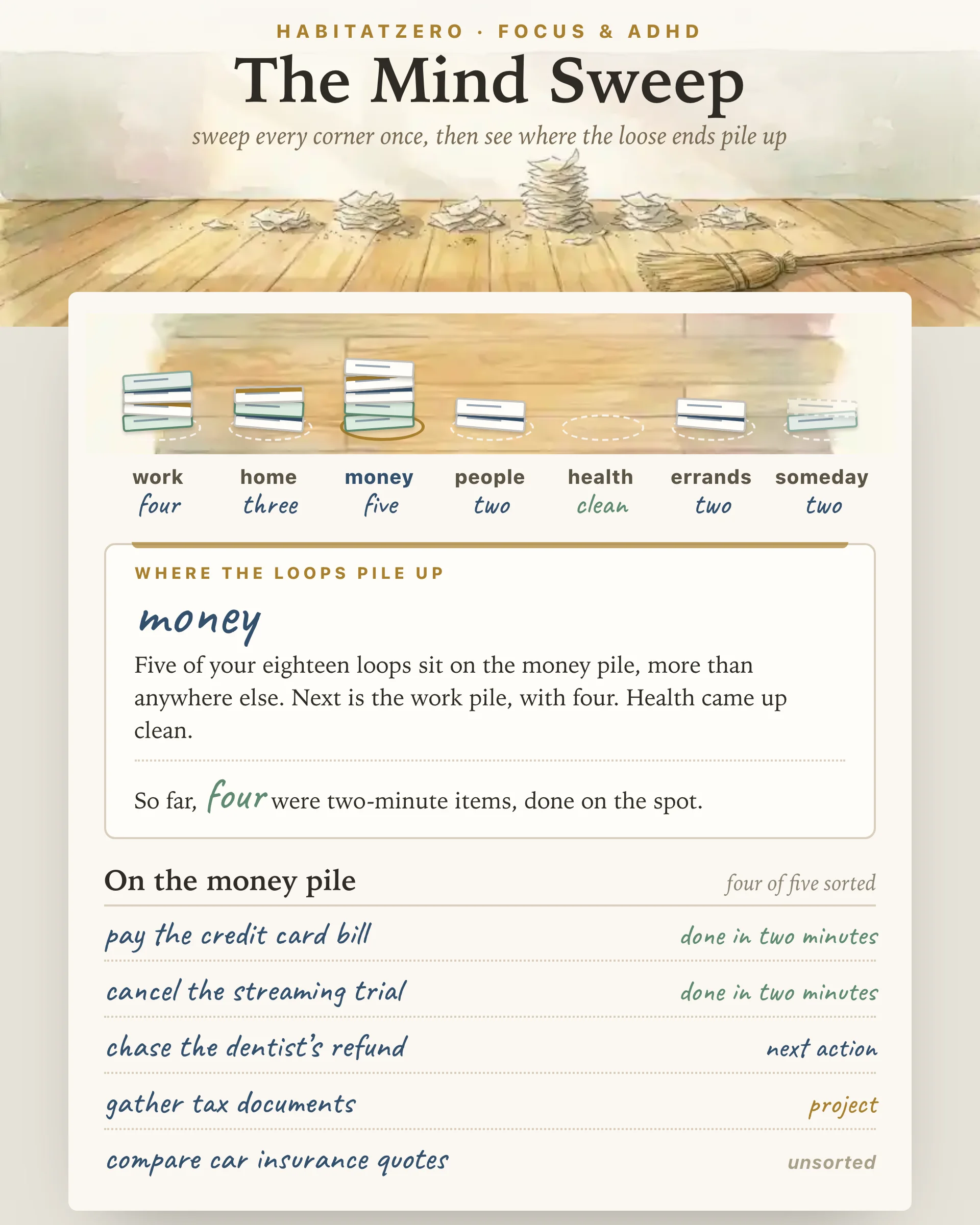
The worksheet lays your life out as seven spots on a painted floor: work, home, money, people, health, errands and someday. You sweep them in that order. Each area opens with a plain question, and a fresh prompt is one tap away when the first stops turning things up. Below it sit a few common loops. Tap the ones that are true for you and write the rest on the line in a handful of words. Each loop drops a paper scrap onto its area's pile. A pile holds ten, which keeps the floor readable at a glance. When an area has nothing open, say so; it counts as swept and the sweep moves along.
Then you sort. Tap any loop and give it one stamp. Done in two minutes is for the quick ones you just finished, following Allen's rule that an action you could complete in under two minutes is better done right away than written down and reread later. If you want to test how long your quick jobs really take, The Two-Minute Rule puts them on a stopwatch. Next action means you know the very next physical step. Project means it needs more than one step. Someday parks it without a promise, and let it go releases it. After each stamp the page moves on to the next unsorted loop by itself.
The reading is the part a paper list can't do. As the floor fills, it names the pile where your loops gather, the pile that comes next and the areas that came up clean. Once you start stamping, it counts how many loops were two-minute items. Move a loop to another area, change its stamp or reword it, and the reading redraws straight away. Rewording clears a loop's stamp, because new words deserve a new decision.
Nobody has tested the mind sweep itself in a trial, so treat it as a practice worth trying rather than a proven fix for a busy head. The nearest evidence comes from Masicampo and Baumeister, whose 2011 experiments found that unfinished goals produced intrusive thoughts and hurt performance on an unrelated task, and that making a specific plan for those goals removed the interference, even though the goals were still unmet. That speaks for the sorting half of this page: in their studies, a goal with a concrete plan attached stopped crowding in. It is one team's laboratory work, though, and a search of the papers that cite it found no independent replication, so hold the result loosely.
The popular story about open loops needs a correction too. It usually leans on the Zeigarnik effect, the claim that interrupted tasks stay in memory better than finished ones. A 2025 meta-analysis of the Zeigarnik and Ovsiankina effects found no memory advantage for unfinished tasks, but it did find a general tendency to go back and resume them. That pull to return, more than any sharper memory, is the honest description of why a loose end keeps tugging at you.
Heylighen and Vidal's review of the Getting Things Done method argued that research on situated and distributed cognition supports its habit of moving commitments out of your head and into trusted outside lists, where your surroundings act as a memory and as a cue to act. It is a thoughtful argument, not an experiment.
Sweep when your head feels crowded, before planning a new week or month, or after time away when everything feels half-remembered. Stay with each area until two prompts in a row bring up nothing new, then sort in the same sitting, since an unsorted pile is only a longer to-do list. If emptying your head against a clock suits you better than going area by area, the Brain Dump Worksheet does exactly that. And once the first full sweep is behind you, a lighter pass fits neatly inside a Weekly Review.
A mind sweep is a sitting in which you write down every commitment, errand and half-finished task that is taking up room in your head, one line each, until nothing new comes up. In David Allen's Getting Things Done it is one of the core capture practices, done before you decide what each item needs.
Questions that walk you past every corner of life where commitments hide: replies you owe, repairs at home, bills and renewals, favors and birthdays, appointments, errands, and the someday ideas you keep circling. This page asks questions instead of listing headings, because a question such as who is waiting to hear back from you points your memory at something specific.
Run a full sweep whenever your head feels crowded, when you start a new system for your lists, or before planning a busy month. A lighter pass fits inside a weekly review. On this page a first sweep takes about fifteen minutes, and later ones tend to go faster, since fewer loops have piled up in between.
No. The prompts on this page were written for it, and the page is an independent worksheet that David Allen and the David Allen Company did not create, review or endorse. Getting Things Done and GTD are registered trademarks of the David Allen Company, which offers its own Incompletion Trigger List as a free download on the Getting Things Done website.
Looking through the example sweep takes no account at all. To sweep your own seven areas, stamp every loop and find the floor waiting for you next time, open it in HabitatZero, where it is free.
By the team behind Fabulous, the science-based self-care app used by over 30 million people.