Leaves on a StreamEmotional Fitness · ~3 min
About this template · Updated August 2026
Most guides to journaling for manifesting explain the theory and leave you alone with a blank notebook. This page inverts that: it is one manifesting session, with a worked example standing beside every step, and you learn the method by running it once — from a named want to a sealed page to a move made in the world.
The register stays grounded on purpose. Writing doesn't place orders with the universe; it reorganizes the writer — attention, plans, and follow-through. Those are the levers this session pulls, and each has receipts.
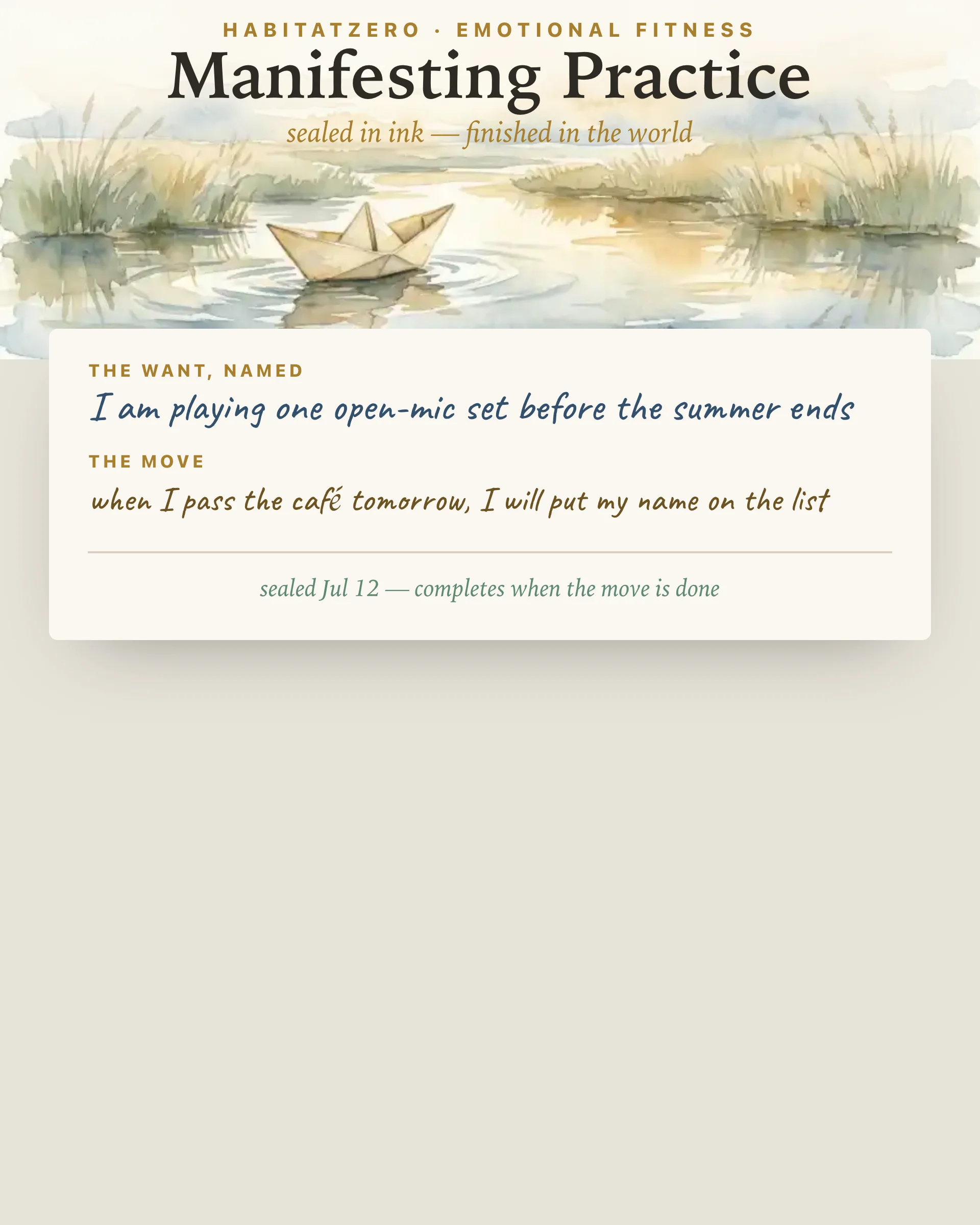
Step one — the want, named. Present tense, specific enough to recognize on arrival. I am hosting Sunday dinners again — monthly, starting small. Not "more connection." A named want gives the coming weeks something to catch on; an unnamed one slides past every opportunity dressed as an ordinary Tuesday.
Step two — why it's in reach. Two or three true things that make the want plausible: the table seats six; Ana keeps asking when. This is the step most manifesting formats skip, and skipping it is why they curdle into wishful thinking. Grounding the want in evidence converts it from fantasy to project — and projects are the genre where writing helps.
Step three — the doing, seen. You write the scene of yourself working at it — the Saturday list on the fridge, the one pot that forgives mistakes — not the candlelit triumph. The distinction is empirical: in the well-known experiment on mental simulation, rehearsing the route outperformed savoring the destination, producing better planning and less anxiety along the way (DOI: 10.1177/0146167299025002010). Destination imagery feels wonderful and moves nothing; route imagery is quietly load-bearing.
Step four — the move. One committed step inside two days, written as when X, I will Y: when I finish work Friday, I will text three people a date. Plans in this shape — implementation intentions — reliably multiply the odds that intention becomes behavior (DOI: 10.1037/0003-066X.54.7.493). The move is deliberately small; its job isn't to achieve the want but to make the want a thing that is happening.
When all four steps are written, you seal the session and the ink locks. No more editing — the want is allowed to stand still while you move. It's a small mechanical constraint with a sharp point: endless rewriting is the most comfortable way to never begin.
And the page refuses to call itself complete until you return and confirm the move actually happened. That's the whole philosophy in one interaction — a manifesting practice that could be finished entirely on paper would be rehearsing the wrong skill.
Run this page once and you own the method. If you then want several wants in motion at the same time — with a running tally of actions on each — the Manifestation Journal template is the keeper version of the same grounded approach: many intentions, tended over weeks. This page is the lesson; that one is the notebook.
Read the worked example top to bottom once. Then write your own four steps in its shape, seal the page, and go make the move before the two days are up. Come back, tap done, and notice the order everything happened in: ink first, world second, and the second one is the one that counts.
A writing session that walks a want from fog to motion: you name it in present tense, ground it in real reasons it is reachable, picture the working-at-it in detail, and end with one committed step. The page treats the want as a direction to move in, not a wish to wait on.
The page itself does — a full worked example runs through every step. The want: I am hosting Sunday dinners again, monthly, starting small. In reach because: I cook fine when nobody is watching, the table seats six, Ana keeps asking when. The doing: Saturday list on the fridge, one forgiving pot, phone in the drawer. The move: when I finish work Friday, I will text three people a date.
Because endless re-editing is how a want stays a draft forever. Once sealed, the words stand still and the pressure transfers to where it belongs — the move. You can always start a fresh session, but you cannot fiddle with a sealed one, and that constraint is doing real work.
The session has two finish lines: sealing the writing and confirming the committed step actually happened. The second one is the point. A manifesting practice where the page can be finished without anything happening in the world would be teaching the wrong lesson.
This page is the single-session lesson — one want, one worked example, one sealed page, one move. The Manifestation Journal is the ongoing version: a plot that holds up to twenty intentions with an action tally on each. Run this practice once to learn the shape; keep the journal if you want several wants in motion.
Nothing here requires it. The session runs on three well-studied levers — specific goals aim attention, mentally rehearsing the process improves follow-through more than savoring the outcome, and when-then plans make action far more likely. Whatever your metaphysics, the ink and the move both work.
By the team behind Fabulous, the science-based self-care app used by over 30 million people.