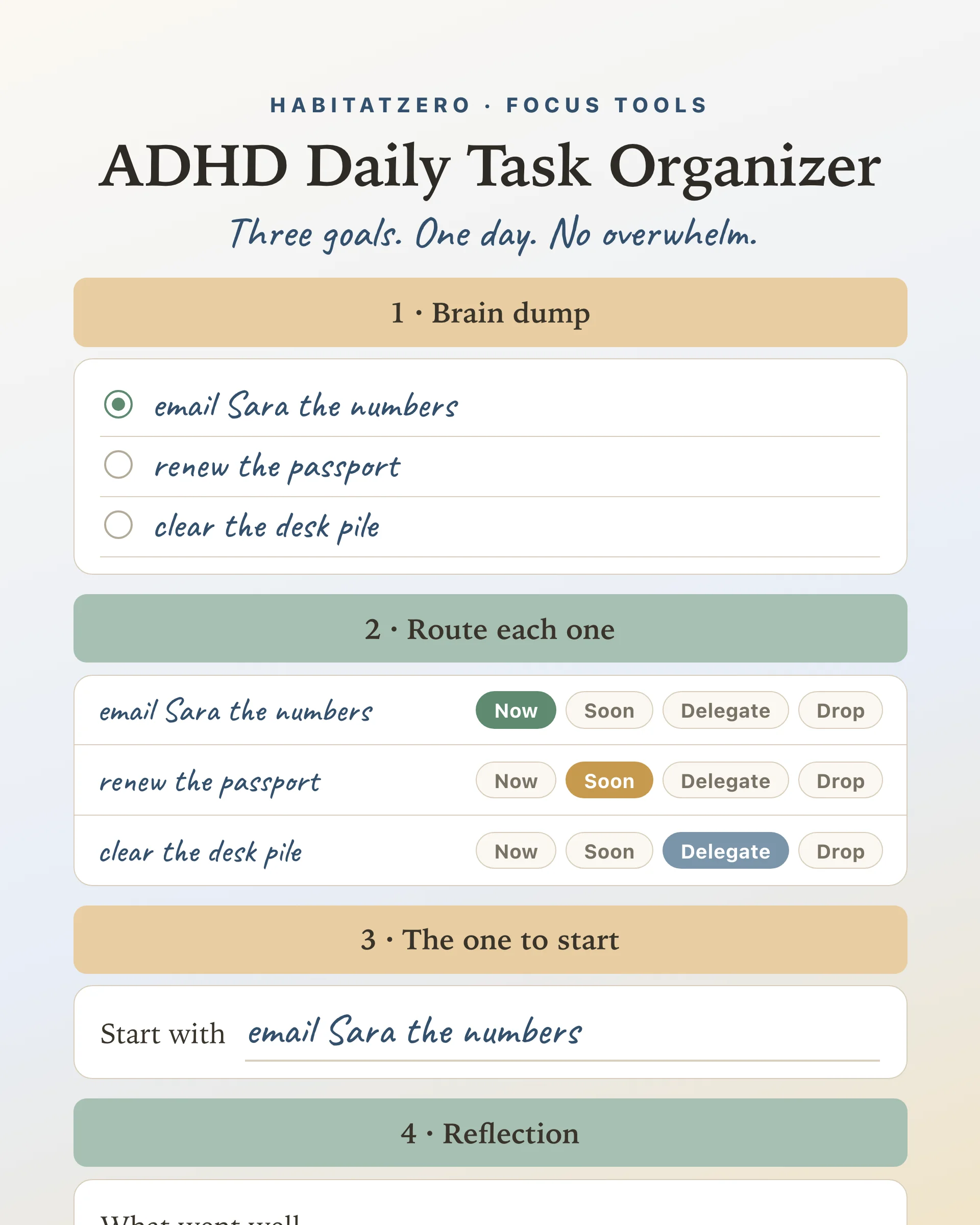
ADHD Daily Task OrganizerFocus & ADHD · ~10 min
About this template · Updated September 2026
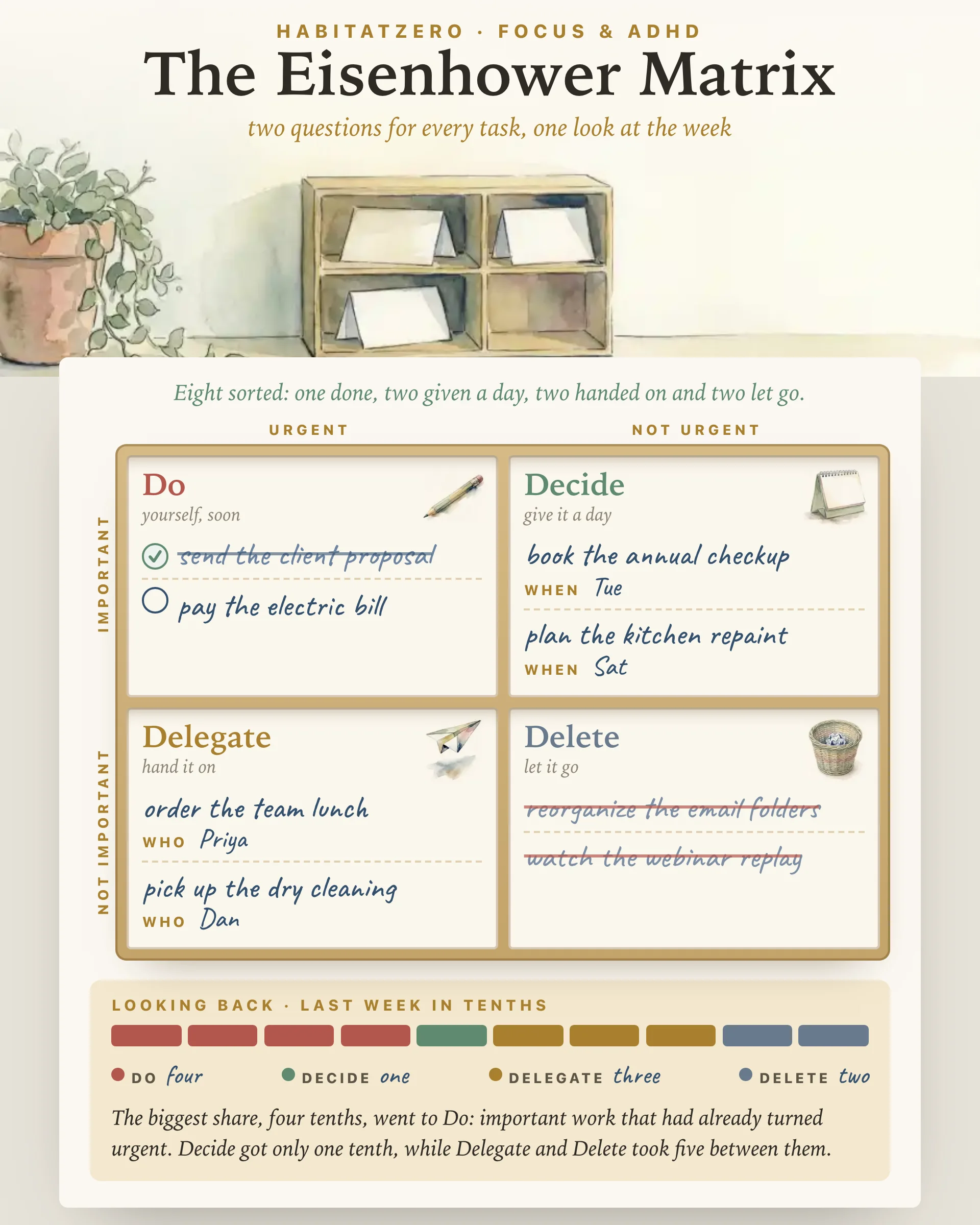
The grid on this page carries Dwight D. Eisenhower's name because of a line he borrowed. Addressing the World Council of Churches in Evanston, Illinois, on August 19, 1954, he repeated a remark from "a former college president": "I have two kinds of problems, the urgent and the important. The urgent are not important, and the important are never urgent," a passage the American Presidency Project keeps in its full text of that address. The speech has no grid in it. Stephen R. Covey made the four-box version famous as the time management matrix in The 7 Habits of Highly Effective People (1989), and FranklinCovey's page on Habit 3, Put First Things First, still lays out its four quadrants. What you are using here is HabitatZero's own take on the grid, built without FranklinCovey and carrying no endorsement from that company or from anyone connected to Eisenhower.
Most lists get sorted by one feeling: how loudly each item calls. The matrix splits that feeling in two.
Important? Does the task serve something you care about: a goal, a value, a person? Covey's definition is close: important things feed your mission, values and high-priority goals.
Urgent? This one only asks about the clock. Does it need doing within a day or two? A text asking for a quick favor can be urgent and still matter very little.
Crossing the two answers gives four boxes:
Covey numbered the boxes as quadrants one to four and argued that the second, Decide on this page, gives the best return on your time, because it holds the planning, learning and renewal that no deadline ever forces onto the calendar.
Write a task on the index card at the top, or tap a suggestion, and the two questions open beneath it. As you answer, the organizer lights the row or column you have chosen; with both answers in, a single cubby glows and the button names it. Filing drops the task into that cubby in your own handwriting.
Each box then asks for one small thing. A Do task gets a check when it is finished. A Decide task gets a day, from Monday through Sunday or next week. A Delegate task gets the name of whoever takes it. A Delete task stays on the board crossed out, a record of what you chose to drop. Every cubby holds six, and a seventh is turned away until you clear one out, because a box crammed with ten fires has stopped being a plan. Removing anything takes two taps, so nothing disappears by accident.
At the end of the week, the look back asks where the time actually went, not what you meant to do. You spread ten tenths across the four boxes, and once all ten are placed, the page reads the split back to you, naming the biggest share and what the Decide box received.
The matrix pushes against a documented bias. Across five experiments, Zhu, Yang and Hsee (2018) found that people were more likely to choose a task with only spurious urgency, such as an illusion of expiration, over one that paid objectively more, even with the sensible reasons for doing urgent work first controlled for. Urgency pulls on its own. Asking the importance question before the clock question is a way of noticing that pull before it chooses for you.
The wider evidence on time management is encouraging but modest. A meta-analysis by Aeon, Faber and Panaccio (2021) found time management moderately related to job performance, academic achievement and wellbeing, and tied more closely to wellbeing, life satisfaction in particular, than to performance. Expect a steadier week rather than a transformed career.
Treat the grid as a thinking aid. Those studies concern its ingredients, the pull of deadlines and the habit of planning, not four boxes drawn on paper, and whether a given task is important remains your call.
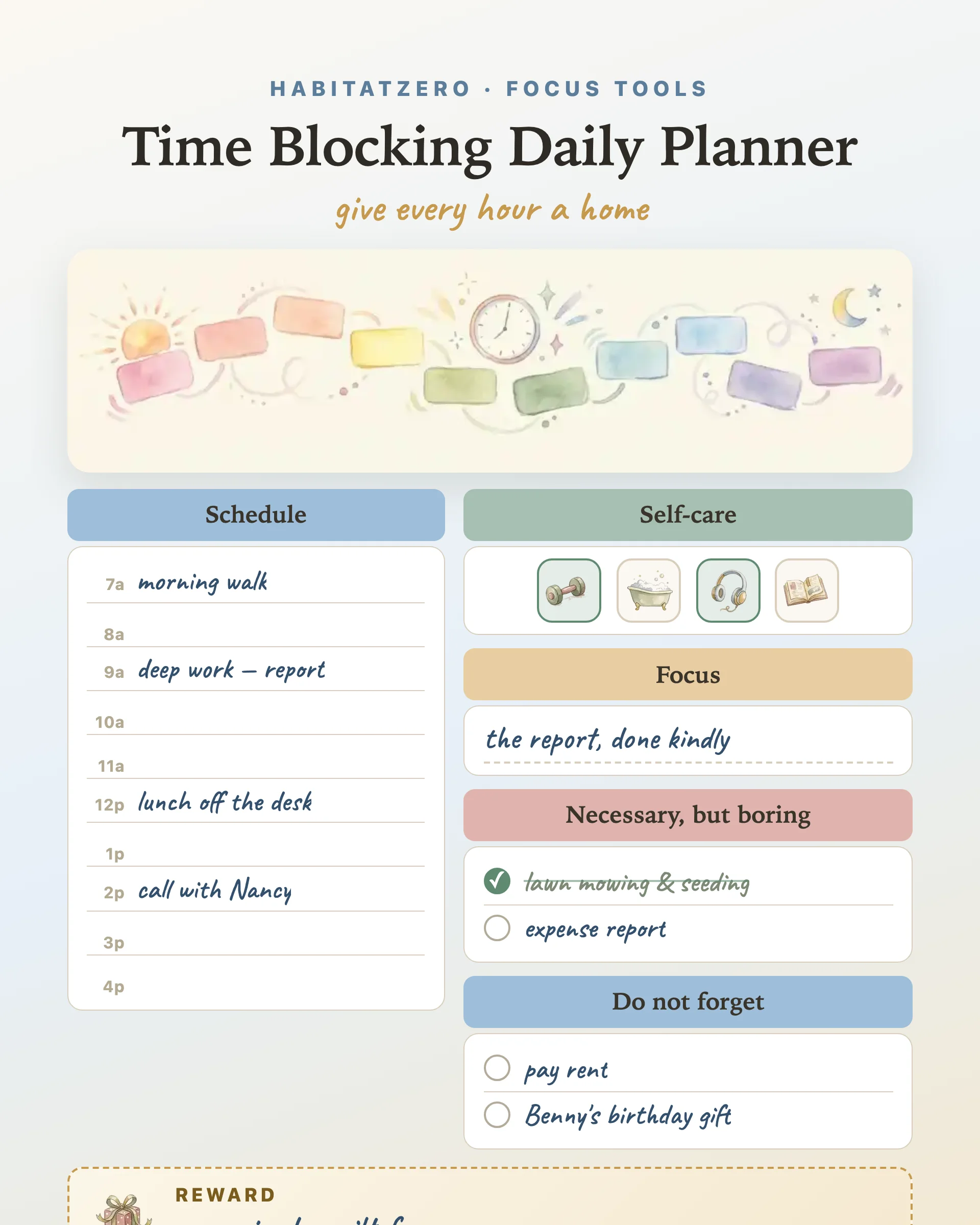
Sort on a Monday morning, or whenever the list starts to shout, and do the look back on Friday while the week is still fresh. If weighing two questions at once feels impossible on a scattered day, the ADHD Priority Matrix deals one card at a time into boxes built for that. To give your Decide tasks real hours, carry them into the Time Blocking Daily Planner. And if the ten tenths leave you unsure where the week went at all, Where the Hours Go accounts for every hour of it.
It is a two-by-two grid that sorts tasks by two separate questions: is it important, and is it urgent? The pair of answers places each task in one of four boxes, usually called do, decide, delegate and delete, and each box comes with its own next step.
Not as a grid. In a 1954 speech in Evanston, Illinois, he repeated a former college president's line that the urgent are not important and the important are never urgent. The four-box layout became famous decades later as Stephen Covey's time management matrix.
Do holds tasks that are important and urgent, like a deadline this week. Decide holds important work with no deadline pressure, such as health, planning or relationships, and gives it a day. Delegate holds urgent tasks that serve someone else more than you. Delete holds whatever is neither, so you can drop it on purpose.
They ask the same two questions and draw the same four cells. Covey numbered the cells as quadrants one to four and put his weight on quadrant two, the important work that is not yet urgent. The Eisenhower box usually names each cell by its action instead: do, decide, delegate, delete.
You can look through the filled-in example board on this page without an account. Sorting your own tasks and keeping the board from one week to the next happens in HabitatZero, which costs nothing to use.
By the team behind Fabulous, the science-based self-care app used by over 30 million people.