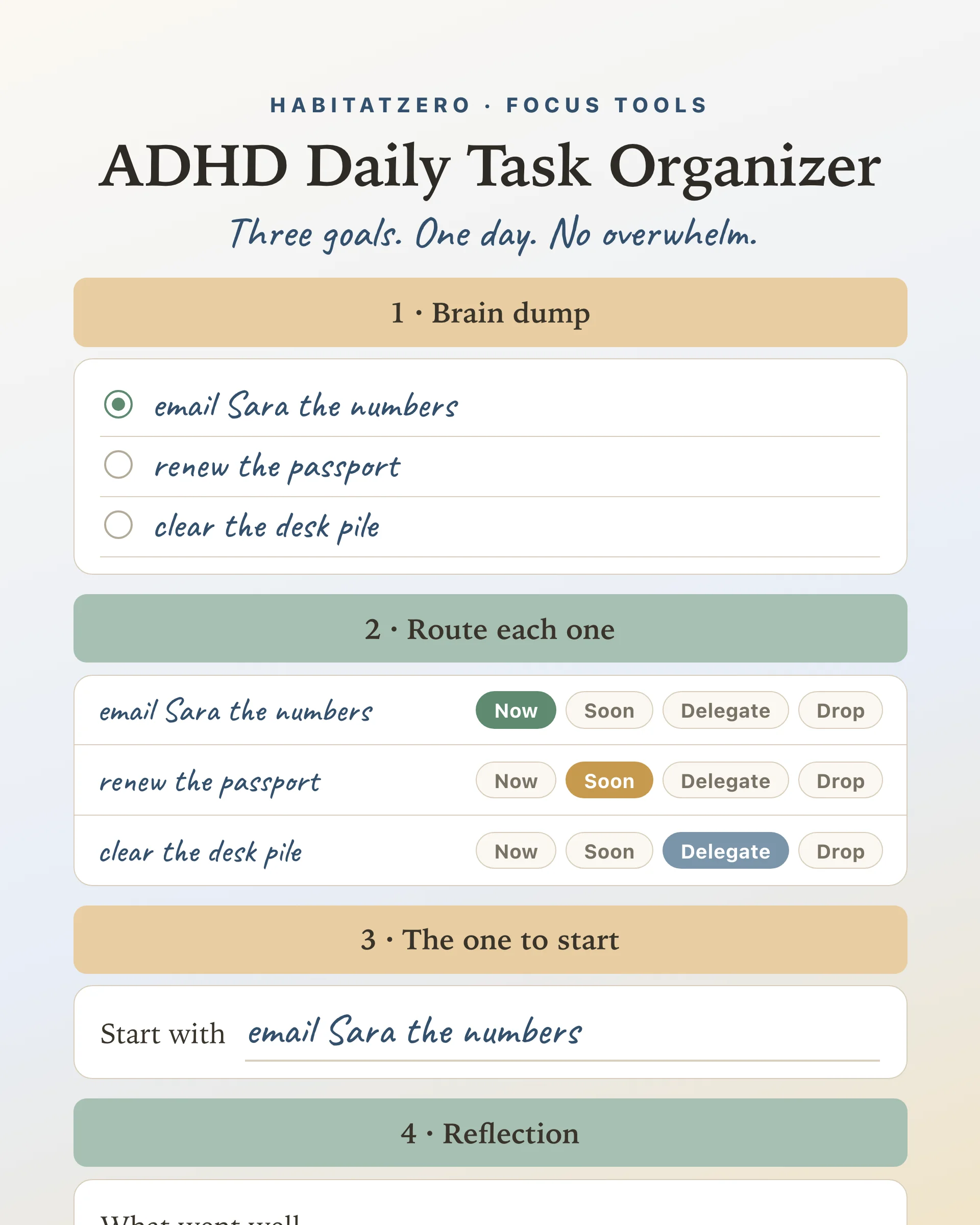
ADHD Daily Task OrganizerFocus & ADHD · ~10 min
About this template · Updated September 2026
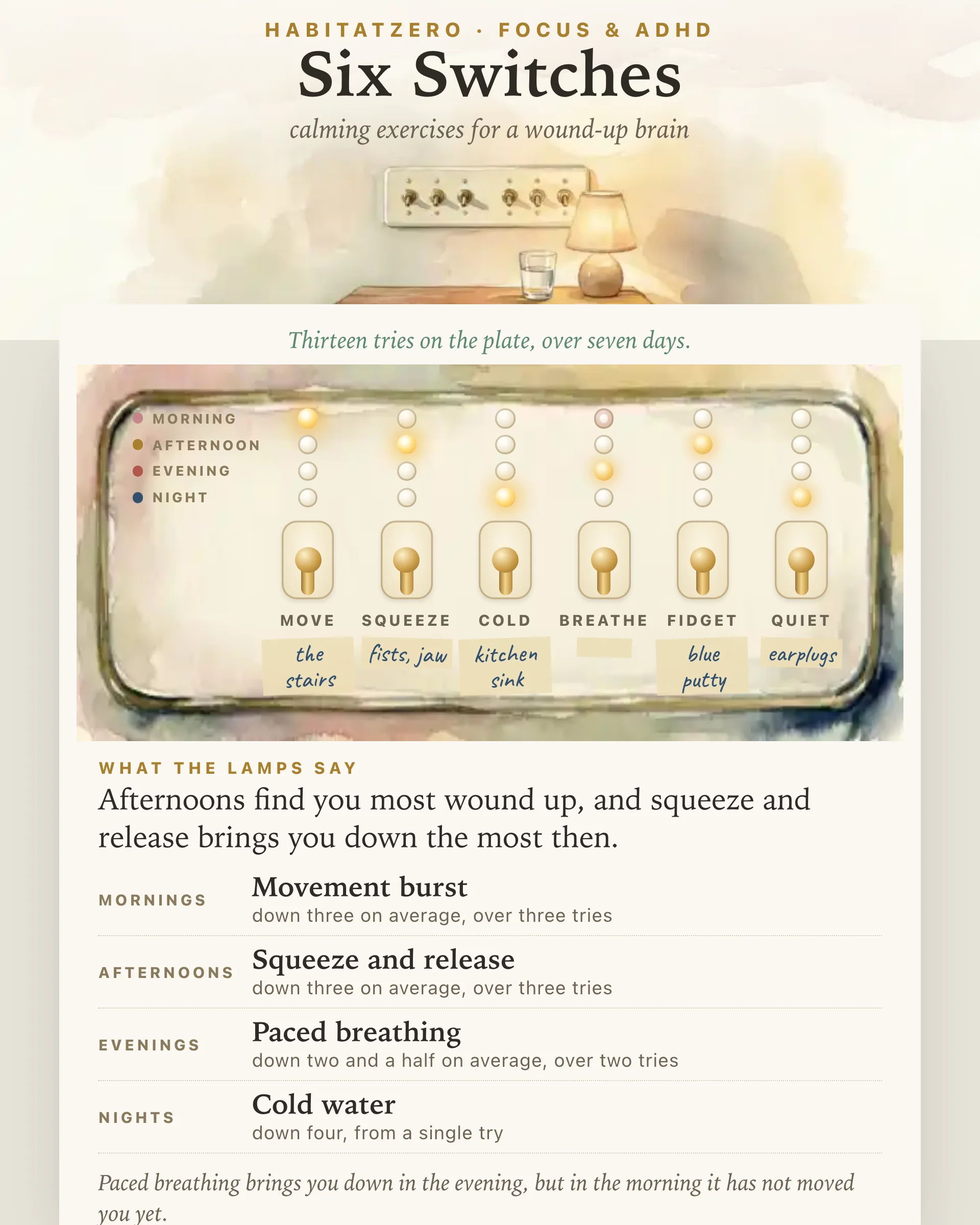
Your knee is bouncing under the desk, you have read the same paragraph three times, and every small noise in the room lands like a shove. Being told to relax, or to sit still and clear your mind, asks for the one thing restless attention finds hardest. The calming exercises on this page go through the body first: six short moves for adults and older teens with ADHD, one to three minutes each, judged by your own before and after ratings rather than anyone's promise.
When sitting still feels out of reach, begin on the left, and save the quieter moves on the right for when the edge is off.
Flip a switch and its card opens with the steps. Rate how wound up you are, from zero for settled to ten for climbing the walls, then start the timer. The countdown runs on the real clock, so switching to another tab loses nothing, and a soft chime tells you when time is up unless you mute it. Rate yourself again and log the try.
Each switch carries four small lamps, one for each part of the day, and the right one lights when a move brings you down, brighter for a bigger drop. Write your own version on the tape under a switch, like the stairs or the kitchen sink, and fix a mistaken rating any time; the lamps and the reading follow.
Your wound-up moments may follow a pattern of their own: after a long stretch of sitting, in a late-afternoon slump, or at night when the house goes quiet and your head does not. A move that settles you at ten in the morning can do nothing at eleven at night, and no generic list can tell you which. Your own numbers can: after a week or so, the reading names the move that brings you down most in each part of the day, and flags any move that works at one hour and not another. Log the tries that did nothing, too. A lamp that stays dark is information.
Physical exercise has the strongest research behind it. A meta-analysis of twenty-two randomized trials published in Pediatrics found that regular exercise programs gave children and teens with ADHD a small improvement in core symptoms and a moderate one in executive function. The median session in those trials lasted fifty minutes, so the one-minute burst here borrows the idea rather than the dose, and your ratings are the test. For adults the research is thinner. A 2026 systematic review found fourteen studies, could pool only eight of them, and reported that single exercise sessions had a moderate effect on inhibitory control, the ability to hold back a response. Its authors call the evidence preliminary.
Mindfulness and breathing have a smaller record in ADHD. A 2023 meta-analysis of mindfulness, yoga, tai chi and qigong trials found small effects on inattention and on hyperactivity and impulsivity, and called for more research. The other moves are everyday practices rather than tested ADHD treatments, which is why the page asks you to measure them.
These moves are for a wound-up few minutes. They do not treat ADHD. Standard ADHD treatment includes medication and psychosocial care such as cognitive behavioral therapy, planned with a clinician. If restlessness is running your days, bring a week of lamps to your doctor or therapist. "I get wound up most afternoons, and only hard movement touches it" gives them far more to work with than "I feel restless a lot."
Cold water on the face can slow your heart rate. Skip that switch, or ask your doctor first, if you have a heart condition, tend to faint, have an eating disorder or take a medicine that lowers your heart rate; cool water on the wrists is the gentler version. Treat the movement burst with the same care if hard exercise is risky for you.
Flip a switch when you first notice the signs building, before the restlessness claims the next hour. For everyday fixes that keep an ADHD day from snagging, see the coping strategies in The Fitting Room. Once you are settled enough to sit, Pocket Stones holds short mindfulness practices built for ADHD. And when what you feel is closer to an emotional flood than restlessness, The TIP Level walks through the DBT skills made for that moment.
It differs from person to person, which is why this page asks you to test rather than trust a list. Of the six moves here, physical exercise has the strongest research behind it for ADHD symptoms, while the others are practical habits worth measuring for yourself.
Choose something short that does not depend on sitting still: take a flight of stairs at a run, clench and release your fists, or hold your wrists under cold running water. Rate how wound up you feel before and after, and within a week you will know which of them earns a place in your day.
The evidence is encouraging but modest. Pooled trials in children and teens show small gains in core symptoms and moderate gains in executive function from regular exercise, and the adult research is thinner and still called preliminary by the people doing it.
No. They are tools for a wound-up few minutes, not a treatment for ADHD itself. Decisions about medication or therapy belong with a doctor or other clinician, and these moves can sit alongside whatever care you already have.
The page shows a filled-in switch plate you can look through. Personalize it in HabitatZero, free of charge, to get a plate of your own that keeps every try you log, so the lamps can fill in over the weeks.
By the team behind Fabulous, the science-based self-care app used by over 30 million people.