ADHD Daily Task OrganizerFocus & ADHD · ~10 min
About this template · Updated September 2026
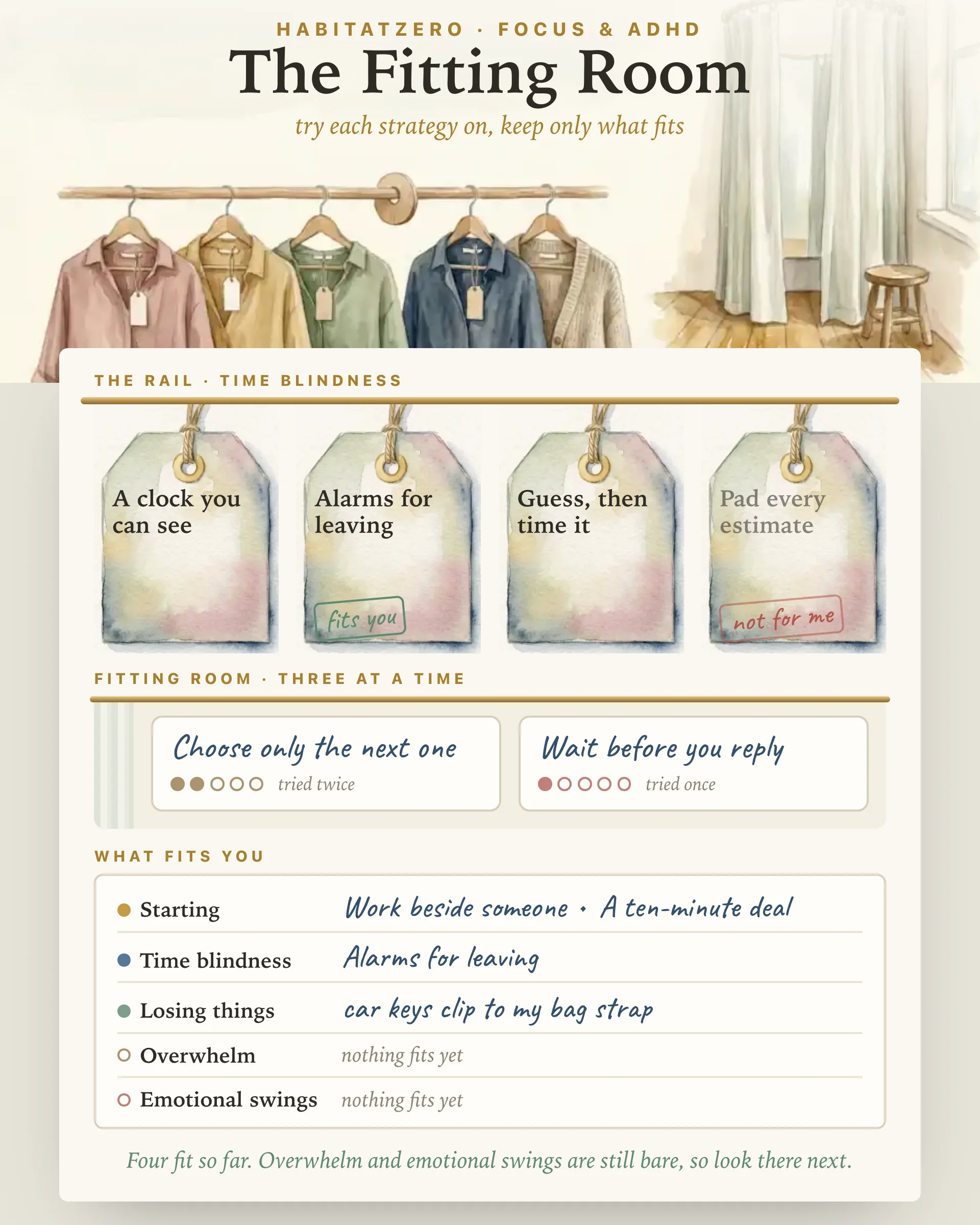
Most lists of ADHD coping strategies read like a catalog: forty tips, all sensible, and no way to tell which ones will work for you. So you try a planner because someone swore by it, drop it by Thursday, and file the whole episode as proof that you are bad at this. Usually the problem is not you. Nobody suggested trying strategies the way you try on clothes: one at a time, in your real life, with permission to hand back whatever does not fit.
That is the idea behind this page. It hangs thirty practical strategies on a rail, sorted by the five places adult ADHD tends to snag, and gives you a fitting room where you test a few at a time and then decide.
Tap the divider for the snag that cost you most this week, and that rail's tags appear. Each tag says what the strategy is and how to do it. Take one into the fitting room, which holds three at a time. The limit is deliberate: change five habits at once and you will never know which one helped.
Then use it for real. Every time you do, come back and add a try. The keep and return buttons stay closed until the first try, because a strategy you have only read about has not been tested yet. After a handful of tries, you decide. If it fits, it moves into your set. If it does not, it goes back on the rail marked not for me, and you can take it in again later if your life changes.
The set is where the page earns its keep. It sorts what you kept by snag and writes a short reading: how many strategies fit, which snags they cover, and which snags are still bare, so you know where to look next. You can also hang up to three strategies of your own on any rail, since you have probably invented a few that already work.
None of these strategies were invented for this page. They come from the same families of skills that structured programs for adult ADHD teach. CHADD explains that some cognitive-behavioral programs for adults with ADHD focus on managing time, organizing and planning, while others work on emotional self-regulation, impulse control and stress.
The strongest trial evidence is for those full programs, delivered by a therapist over about twelve sessions. In a randomized trial of adults whose symptoms persisted despite medication, cognitive behavioral therapy improved symptoms more than relaxation training with educational support, and the gains held a year later. A group program built around time management, organization and planning beat supportive therapy on inattention. A Cochrane review that pooled fourteen trials is more cautious: it rates the evidence as low quality, concludes that these treatments may help, and notes how little data exists on whether the benefit lasts.
Two limits follow from that. First, nobody has tested this worksheet, and trying strategies on your own is practice, not therapy. Second, the programs above pair the skills with a person who helps you apply them, spots what gets in the way, and adjusts the plan. If one snag keeps winning after honest tries, that is useful information to bring to a professional. Questions about ADHD care, diagnosis or medication belong with a doctor.
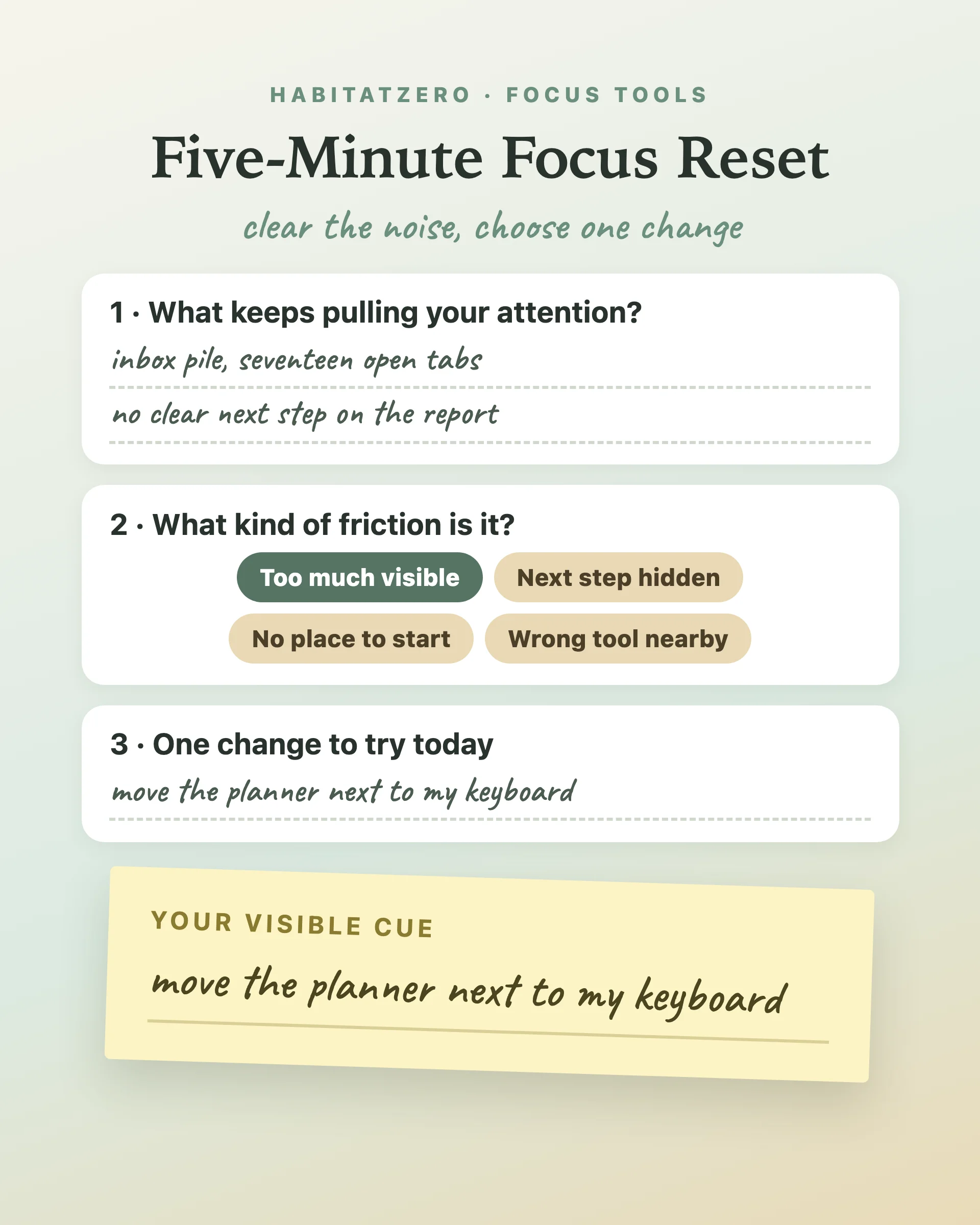
Open the page at the end of a week when one snag cost you more than it should have. Pick one or two strategies, not five. Add each try on the same day, while you still remember it. After two weeks or so, make your calls and read what your set says.
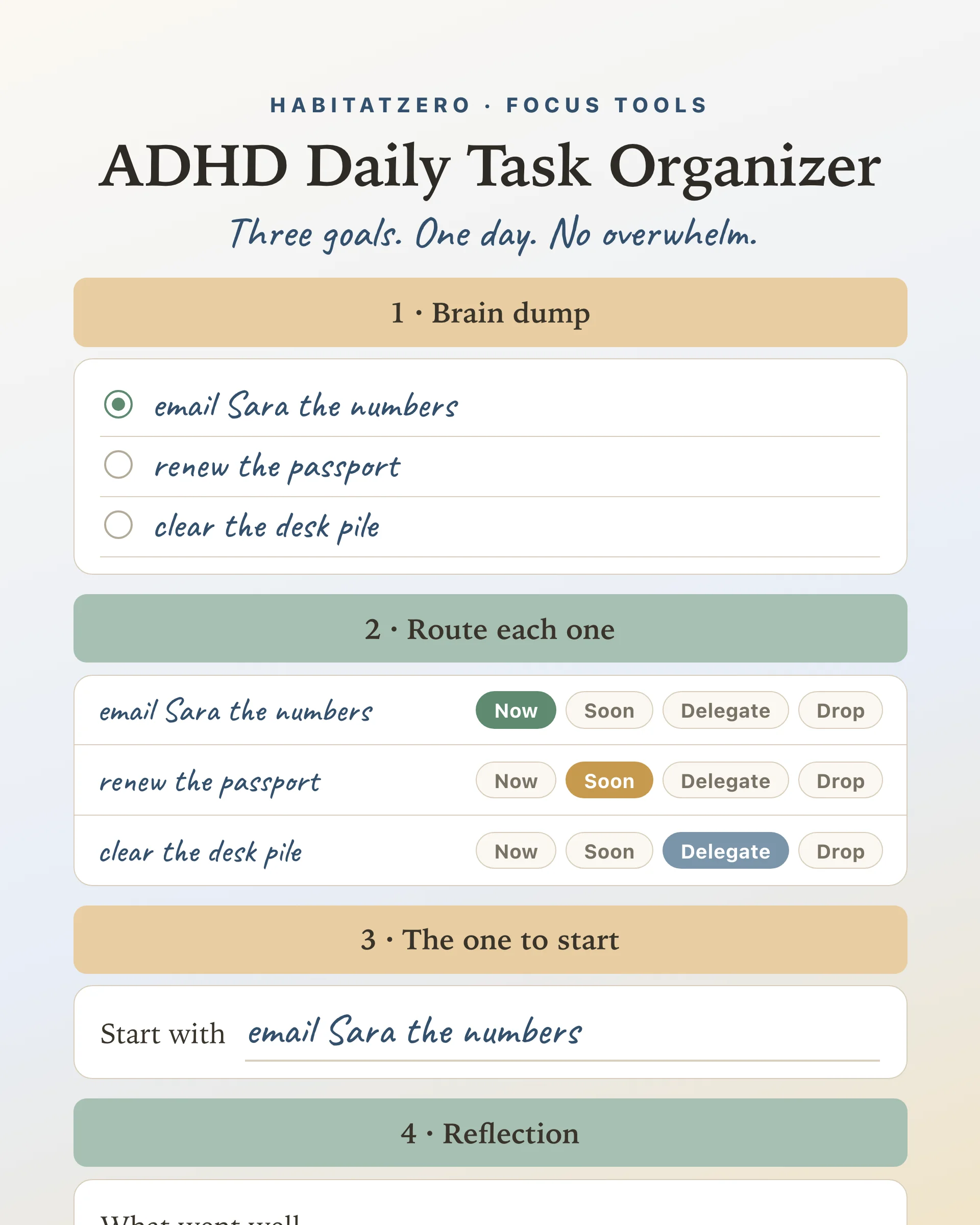
If starting is your biggest snag, The Shrinker goes further on a single stuck project. If overwhelm wins most days, sort the pile first with the ADHD Priority Matrix. And if the ten-minute deal fits you, Sand Timer Sprints turns it into a proper focus timer.
Your set will not look like anyone else's, and it is not supposed to.
The best ones fit your particular snag and cost little to repeat. Good candidates include a two-minute first move for getting started, alarms set for leaving rather than arriving, one fixed spot for keys and phone, picking only the next task when everything piles up, and waiting an hour before answering a message that upset you.
Techniques that put time where you can see it. An analog clock in the room, a countdown timer on the desk, alarms for the moment you must walk out, and padding each estimate by half again all move the passing of time out of your head and into view.
Long enough to meet the snag several times, which for most people means a handful of real attempts over a week or two. One rough day is not a verdict. The fitting room counts up to five tries and then asks you to choose.
No. These are practice skills, close to what cognitive behavioral therapy programs for adult ADHD teach, and they work alongside care rather than instead of it. Diagnosis, therapy and every medication question belong with a doctor.
You can browse the filled-in example on this page without signing in. To keep your own rail, your tries and your set from one visit to the next, personalize it in HabitatZero, which costs nothing.
By the team behind Fabulous, the science-based self-care app used by over 30 million people.