ADHD Daily Task OrganizerFocus & ADHD · ~10 min
About this template · Updated September 2026
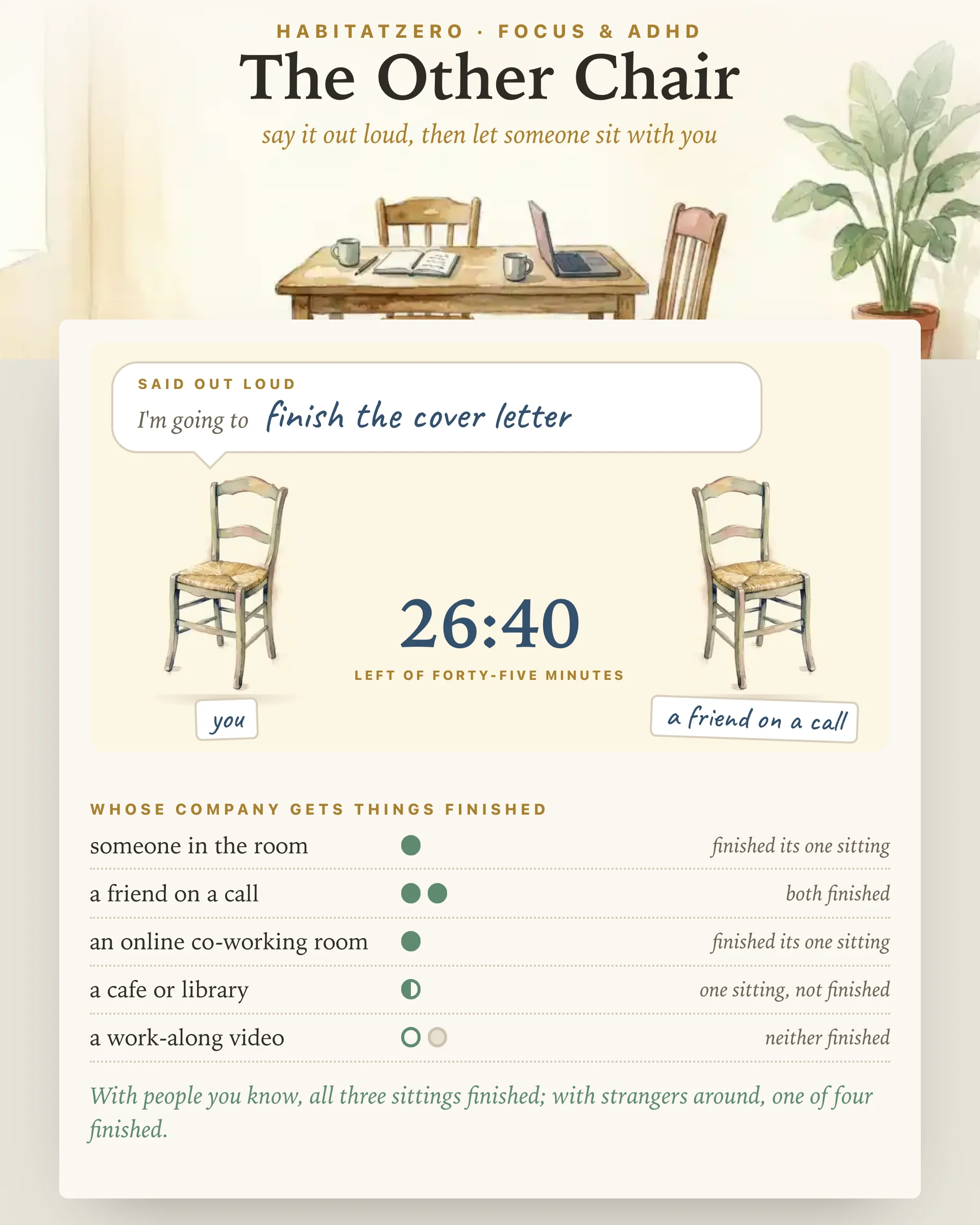
Some tasks only get done when someone else is in the room. You have probably seen it happen: the tax forms that sat for a month get finished in one afternoon because a friend came over with a book, or the laundry finally gets folded while your sister talks on speaker. Nobody helped. They were just there, and that was enough to get you started and keep you in the chair. That is body doubling.
The practice grew up in neurodivergent communities rather than in a lab, and it covers more than one setup. Your double can sit across the table, stay quietly on a call, work on camera in an online co-working room, be the strangers around you at a library, or be someone in a recorded work-along video who will never know you were there.
The page is built around two chairs: yours, and the other one.
Pick who is in the other chair. Five cards cover the usual kinds of company, from someone in the room to a work-along video. Pick a friend and the sheet drafts the ask for you, with your task and your length already in it, because asking is often the hardest part.
Say the task out loud. Finish the line I'm going to with one concrete thing, typed into the speech bubble, and say it to your double if they can hear you. A named task gives the sitting a finish line. "Work on stuff" never ends.
Sit down. Choose half an hour, forty-five minutes, an hour or ninety minutes. The clock runs between the two chairs, and a soft chime sounds at the end if the page is still open and the chime is on. Standing up early takes two taps, so a stray one never ends a sitting by accident.
Check in. When the time is up, say how much got done: all of it, most of it, made a start, or not this time. Anything short of finished stays on the line, ready for the next sitting.
Every check-in lands in the book with who sat with you, for how long, and how it went. Above the list, each kind of company gets a row of dots, one per sitting: full for all of it, half for most, a ring for a start, gray for not this time. A second set of rows does the same for length.
From the fourth sitting on, the book writes its reading in plain sentences: which company finishes the largest share of its sittings, which length finishes most often, and, once you have sat a couple of times with each, whether people you know get more done beside you than strangers do. Twenty sittings fill the book. That is enough to see a pattern and few enough that a habit from last season does not drown out what works now. When it is full, let the oldest sitting go to make room for the next.
The evidence for body doubling is thin, and it is better to know that going in. One of the few studies is a 2024 survey of two hundred and twenty people, most of them neurodivergent. The researchers summed up the community's own definition as using the presence of others to start, stay focused on, or accomplish a task. Many respondents recognized it as something they had done for years, once someone gave it a name. Their doubles were in the room or remote, live or recorded, known or strangers, and those contrasts are where this page's five cards come from.
Controlled tests are rare. In a small 2025 study, twenty-six people took reading comprehension tests twice, once beside a body double and once alone, while EEG recordings tracked focus and calm. It found no statistically significant difference between the two conditions, no consistent harm, and some encouraging trends among participants with ADHD who were not taking medication.
Older research on working in front of other people points the same cautious way. A meta-analysis of two hundred and forty-one studies found that the mere presence of others had small effects: it sped up simple tasks, while complex tasks got slower and less accurate. So bring the dull, well-worn jobs to your first sittings, such as bills, forms, dishes and a cluttered inbox, and test separately whether company helps with hard, unfamiliar thinking.
None of this makes body doubling a treatment, and this page does not diagnose or measure anything about your brain. It lets you run a small experiment on yourself and keep honest notes while you do.
Use the other chair when a task has sat untouched and you suspect you would start it if someone were nearby. If the job is too big to say in one line, cut it down first with The Shrinker. If you would rather work alone in short bursts, Sand Timer Sprints is made for that. And when you need to decide where a sitting fits in the day, the Anchored Day Planner can give it a slot.
Body doubling means working on a task while another person is present, so their company helps you begin and keep going. The other person does not help with the task itself. They might share the room, stay on a call, work on camera in an online session, or simply be strangers at a nearby table.
Nobody knows for sure yet. People who rely on it say it helps them build momentum and stay on task. Older research on working in front of others found small effects that favor simple, familiar jobs, and the studies of body doubling itself are still few and small.
Yes. Virtual body doubling includes a friend on a phone or video call, online co-working rooms where people work on camera together, and recorded work-along videos. Surveyed users described doubles who were remote or in the room, live or recorded, friends or strangers.
There is no standard length. A sitting can be as short as half an hour or run through an afternoon at a library. What works is personal, so this page records the length of every sitting and shows which lengths end with the task done.
The public page shows a finished book from a sample week so you can see how the readings look. Running your own sittings, with the chime and a book that remembers them, happens when you personalize it in HabitatZero, which costs nothing.
By the team behind Fabulous, the science-based self-care app used by over 30 million people.