ADHD Daily Task OrganizerFocus & ADHD · ~10 min
About this template · Updated July 2026
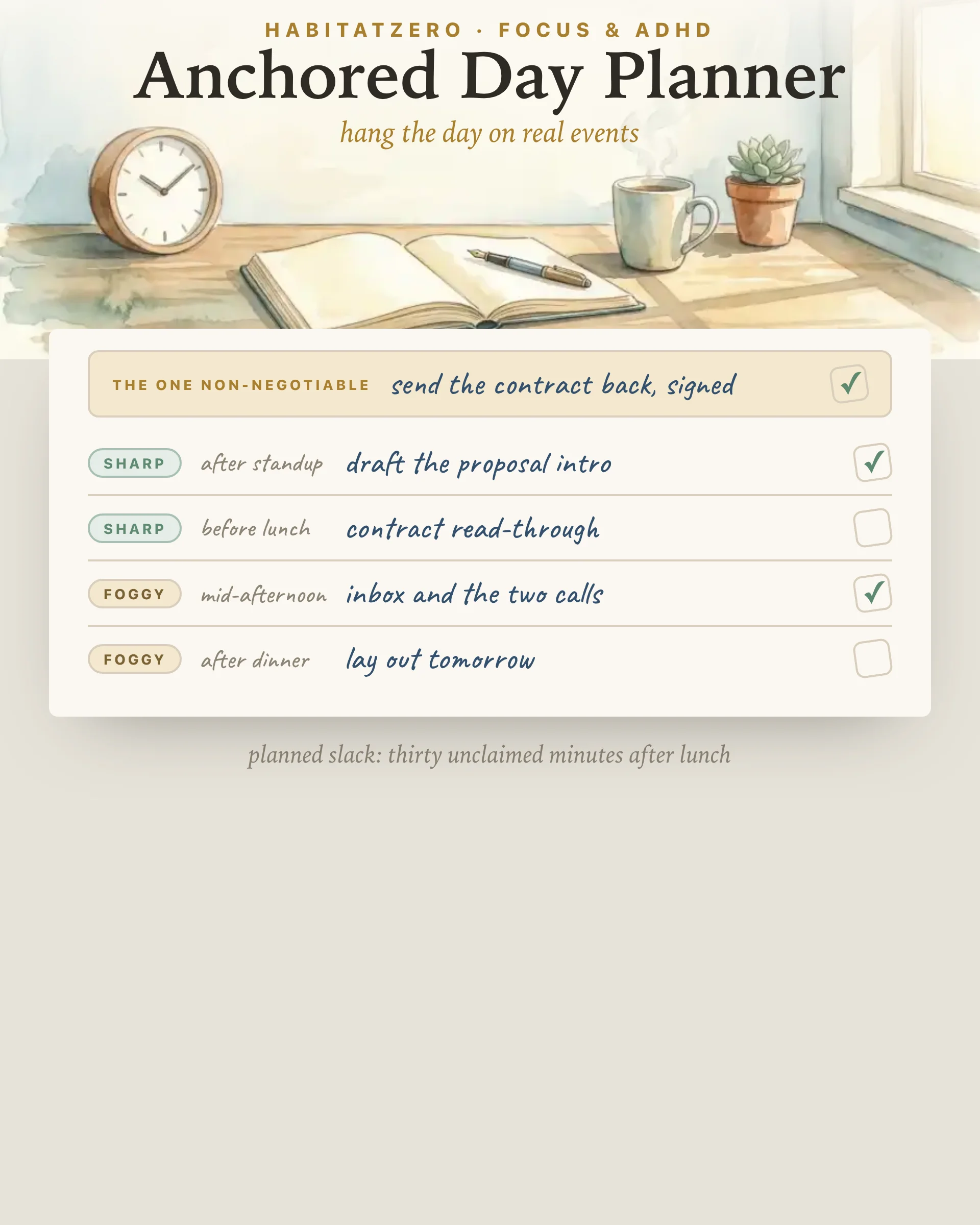
Most day planners are grids of hours waiting to be believed in. For an ADHD brain the belief is the broken part: 2 pm does not announce itself, the afternoon evaporates between two tabs, and the beautiful color-coded schedule becomes Tuesday's small shame. This planner starts from the day as it actually behaves — and shapes it with four moves that work with the brain in the room.
The sheet opens with a single wheat-colored box: the one thing that makes today count, even if everything else wobbles. One, deliberately — not a top three. When working memory is expensive, a single named priority is the difference between a day with a spine and a day of busy circling. Time-management guidance for adults with ADHD keeps arriving at the same first step: decide what actually matters before the day starts deciding for you. Stamp it when it lands; the day already counts.
Under it, three lines — morning, midday, evening — for the day's real fixed points: the 9:30 standup, lunch, the school pickup. These are borrowed structure. A block that starts "at 2 pm" requires you to notice 2 pm; a block that starts "after standup" is triggered by an event that ends in front of you. That is an implementation intention wearing work clothes — the if-then form of planning whose meta-analysis across nearly a hundred studies shows a substantial boost to follow-through, precisely because the trigger fires in the world instead of in your attention.
Four blocks, tagged honestly: two SHARP, two FOGGY. The sharp hours — whenever yours actually occur — get the deep work that needs a real brain. The foggy hours are not a failure to be scheduled around; they are working hours for fog-proof work: inbox, errands, the folding. Writing the when beside each block in your own hand keeps the plan concrete without pretending the day is a spreadsheet.
And then the line most planners forget: planned slack. Thirty unclaimed minutes, written down, where the overflow lands when a call runs long. Slack is not laziness budgeted in — it is the structural difference between a plan that survives contact with the day and one that shatters at the first slip.
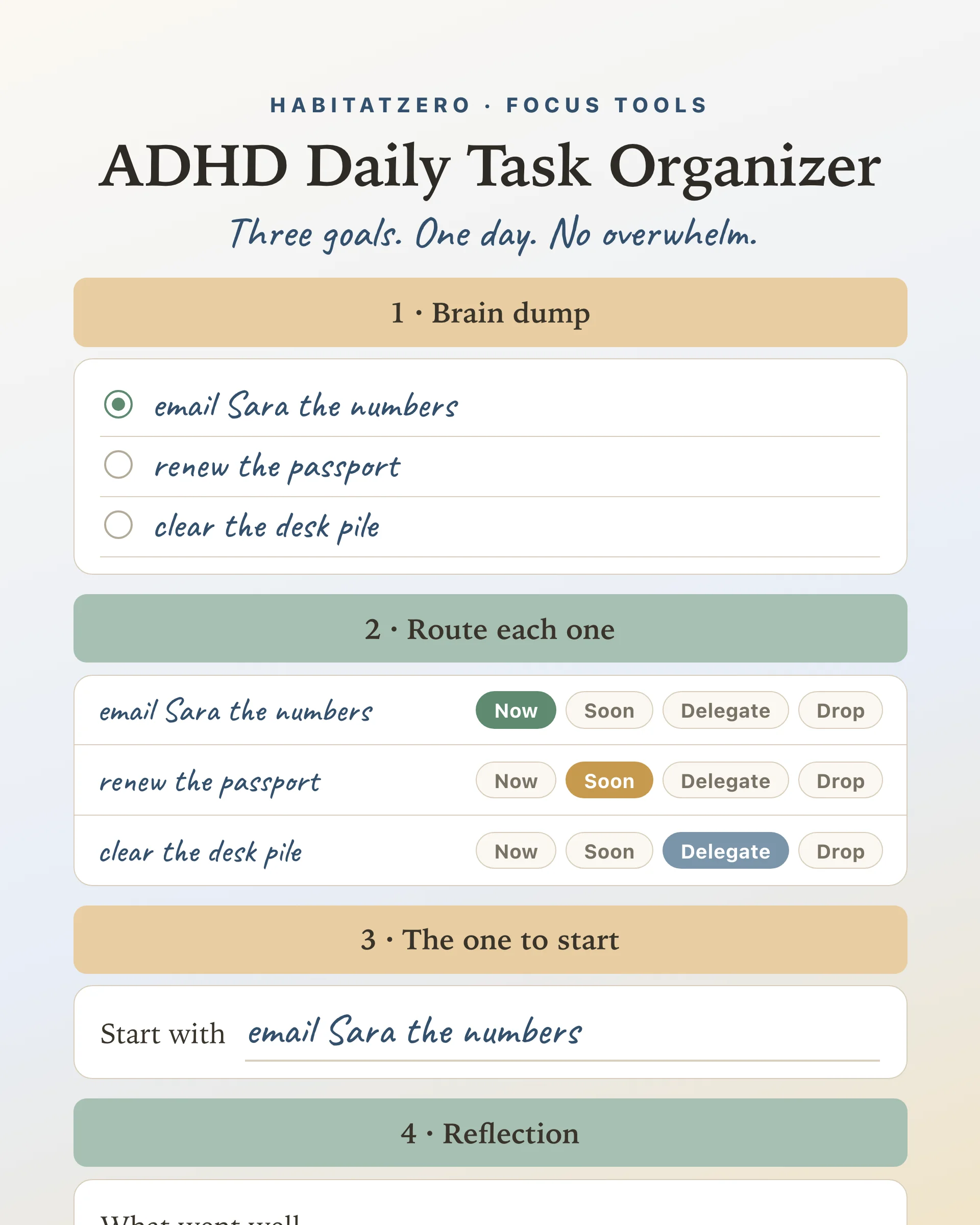
This page shapes a day. When the problem is a pile of competing tasks rather than the day's shape, the ADHD priority matrix sorts the pile and the ADHD daily task organizer routes it into buckets. When one loud room is the whole problem, the room reset planner takes over. And if the morning itself keeps dissolving before the first anchor, the ADHD routine builder holds that sequence steady.
One non-negotiable. Three real anchors. Blocks that respect the battery. Slack on purpose. That is a day with a shape.
Three things, in this sheet's experience: shrink the day's success condition to one named non-negotiable, attach time to real events instead of raw clock numbers, and route work by energy rather than by ambition. A planner that assumes steady focus from nine to five is a planner designed for someone else's brain.
Because time blindness rarely misses events. You may not feel 2 pm arriving, but the standup ends, lunch happens, the pickup cannot be ignored — external structure does the noticing for you. Hanging a block on the far side of a real event gives it a trigger that fires without your attention, which is the core trick behind if-then planning.
Your own daily energy weather, named honestly. Sharp hours are when a real brain shows up — that is where the proposal draft and the contract read belong. Foggy hours still exist and still count, so they get the work that survives fog: inbox, errands, the folding. Planning the fog instead of fighting it is what keeps the afternoon from becoming a guilt exhibit.
Because every plan meets a day that produces overflow — the call that runs long, the task that grows a second half. Written slack gives that overflow a landing strip so it displaces thirty spare minutes instead of the evening. A day with slack in it is a plan; a day without slack is a bet.
Using the sheet in the browser costs nothing. With a HabitatZero account you can personalize the blocks, keep each day's plan, and print the sheet if paper is where your planning sticks.
By the team behind Fabulous, the science-based self-care app used by over 30 million people.