ADHD Daily Task OrganizerFocus & ADHD · ~10 min
About this template · Updated September 2026
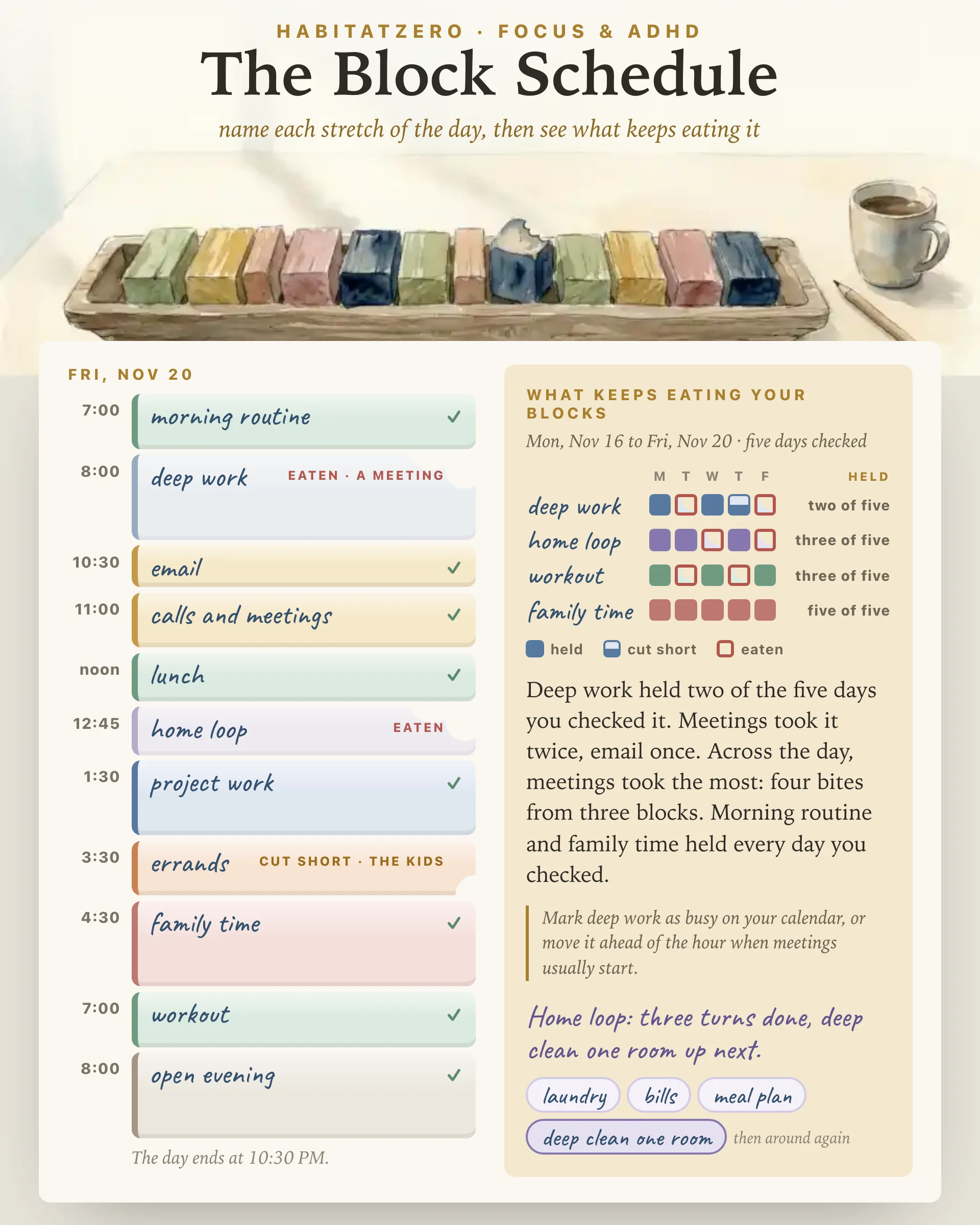
Credit where it belongs: Cal Newport, the author of Deep Work, gave this way of planning its best-known name. In his 2013 post on planning every minute of the workday, he describes splitting each day into labeled blocks, leaving room beside them to redraw the plan when the day goes sideways, and calling the method time blocking. This block schedule is a separate worksheet made by HabitatZero. Newport has not reviewed or endorsed it, and it has no tie to his books or his planner.
A to-do list says what. A block schedule says when, and how much of the day each thing gets. You chunk the day into named stretches (deep work, admin, meals, family, errands) and give each one a single job. In a high school the phrase means something else, a class schedule with fewer and longer periods, but the idea underneath is the same: fewer switches, longer runs at one thing.
The quiet benefit is arithmetic. Blocks laid end to end have to fit inside twenty-four hours, so a day that asks for nine hours of work, an hour of driving and a full evening with the family shows its shortfall on the page, instead of at eleven at night.
Set the hour your day starts, then tap blocks in. Each one lands at the end of the day so far, and the minus and plus buttons change its length in fifteen-minute steps. Every block after it moves to its new start time, and a day that starts in the afternoon and runs past midnight keeps counting correctly. The line at the top tells you how many hours are left before the next day begins, which is often the first plain look at how much room the plan leaves for sleep.
Each evening, switch to checking. Mark every block held, cut short or eaten, and tap what took it: a meeting, email, your phone, someone else's urgent thing, the block before running over, low energy, the kids, a surprise errand, or your own words. You can check yesterday too, for the nights you fall asleep first.
A small grid shows each block across the days you checked. From the third evening on, the sheet also names the block that loses out most, what usually takes it, and the steady ones that held every time, then suggests one change aimed at whatever takes that block most often. The log keeps your fourteen most recent checked days, so the reading follows the life you have now rather than the one you had in spring.
A loop schedule is a favorite of homeschool planners. Instead of giving art to Tuesday and music to Thursday, you list the subjects and do the next one whenever the slot comes around. Nothing falls behind, because a missed day leaves the same item waiting instead of skipping it.
Here, a loop block holds up to six items. It moves on when its turn held or was cut short, and waits when the turn was eaten. It suits bills, laundry, one room to deep clean, a rotation of lessons, or the admin that never belongs to any particular day.
Time blocking itself has had very little direct study, so be wary of anyone quoting productivity gains for it. The parts it is built from have better support.
Deciding in advance when and where you will act helps people follow through. A meta-analysis of ninety-four tests found that these if-then plans had a medium-to-large effect on reaching goals (Gollwitzer and Sheeran, 2006). A block on the page is that kind of decision, made once.
Plans also tend to be hopeful. In a set of studies on the planning fallacy, people's predictions of how long their own tasks would take were too optimistic, and the bias disappeared when they were asked to tie the forecast to how similar tasks had gone before (Buehler, Griffin and Ross, 1994). The nightly check is that past record, written down. After two weeks you know how long a deep work block really survives on a Tuesday.
Interruptions cost something even when the work still gets done. In one experiment, people who were interrupted finished in less time with no drop in quality, but reported more stress, frustration, time pressure and effort (Mark, Gudith and Klocke, 2008). A block that keeps getting eaten is worth fixing for how the day feels, not only for what gets finished.
What a schedule cannot do is give you control you don't have. If someone else owns your calendar, the most useful move may be a conversation about one protected block, and two weeks of checks give you something concrete to bring to it.
Build it on a calm evening, for an ordinary weekday, and check it for a week or two before you change much. If you are not yet sure where your hours go, spend a week with Where the Hours Go first. When you only need a single day planned hour by hour, the Time Blocking Daily Planner is lighter, and once a deep work block starts holding, the Deep Work Planner helps you spend it well.
In a high school, a block schedule means fewer class periods a day, each running longer. For your own day, it means giving every stretch of time one named job, such as deep work from 8:00 to 10:30, and keeping that stretch for that job alone.
Start from the hour you actually get going, lay down the fixed pieces first (meals, school runs, standing meetings), then fit focus work into the longest open stretch left. Keep one open block for surprises, and resize after a week of honest nightly checks.
A loop schedule is a list of tasks worked in order, with no weekday assigned to any of them. Each time the loop slot comes around you do the next item, and a missed day simply leaves that item waiting. Homeschool families use it for subjects, and it suits chores and admin just as well.
No. Cal Newport, the author of Deep Work, named time blocking and sells his own Time-Block Planner. This block schedule is an independent HabitatZero worksheet, made without his input and with no tie to him or his publisher.
The filled-in example on this page is open to anyone. Laying out your own blocks and keeping a log of nightly checks happens inside HabitatZero, which costs nothing.
By the team behind Fabulous, the science-based self-care app used by over 30 million people.