ADHD Daily Task OrganizerFocus & ADHD · ~10 min
About this template · Updated September 2026
Credit first. The Pomodoro® Technique, working in timed stretches with short breaks between them, was created by Francesco Cirillo, and Pomodoro® is his registered trademark; his official site teaches the complete method. Animedoro is a variation that grew up in online study communities rather than coming from Cirillo. This page is an independent tool built around that community rhythm: Cirillo and his company had no part in making it, and they have not reviewed or endorsed it.
The classic pomodoro pairs short sprints with five-minute pauses. Animedoro stretches both ends. You work for forty to sixty minutes, watch one episode of an anime, which runs about twenty minutes, and then go back to work. Anyone who has tried to stop after one episode can see the appeal. The show you were going to watch tonight becomes the reward for the block, and the episode's own running time becomes the length of the break. When the credits roll, the break is over.
The hard part is just as plain. Streaming apps are built to keep you watching, so the natural end of your break is also the moment the next episode starts its countdown. The method only works if one episode really means one.
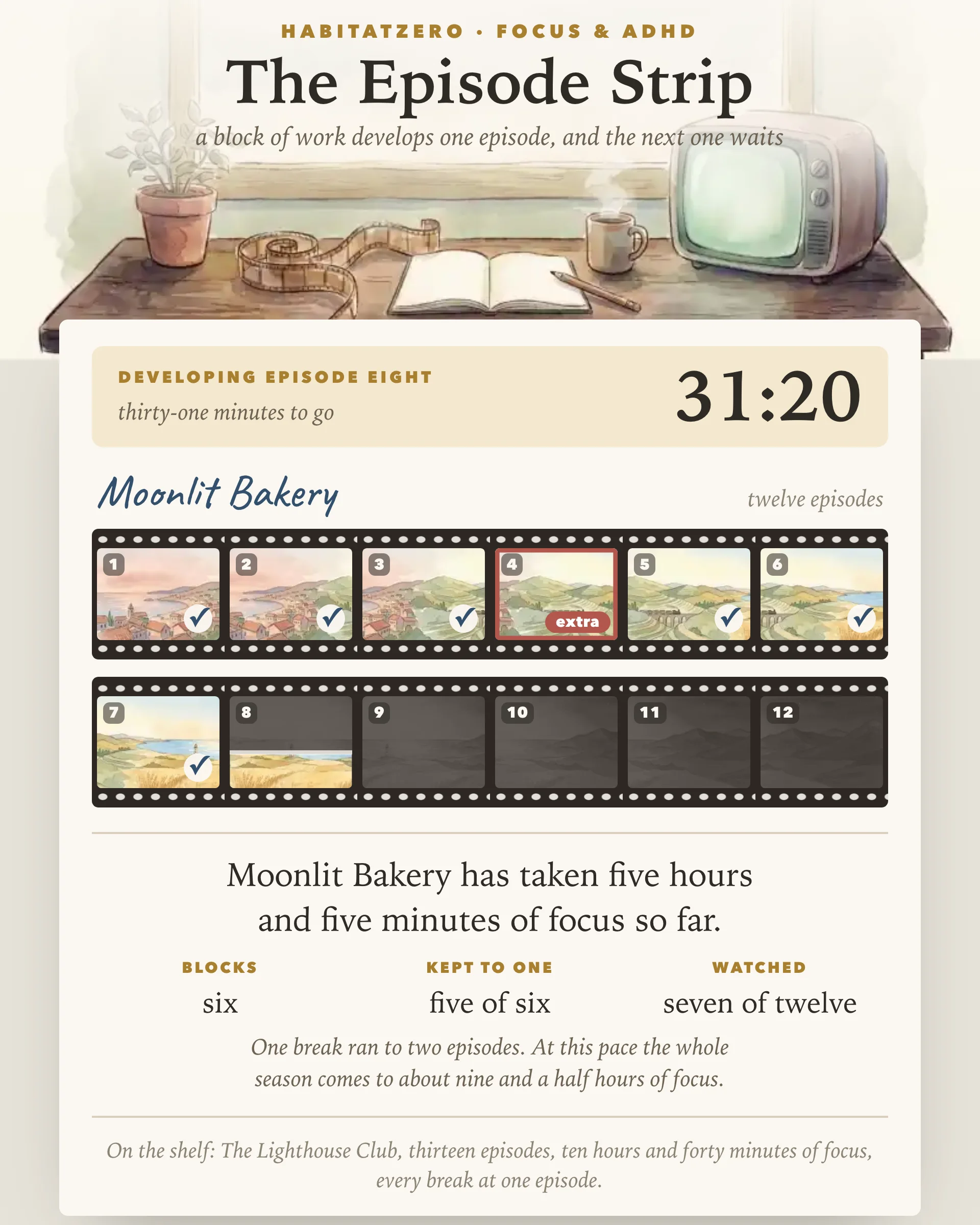
The page treats your season as a strip of film. Name the show, slide the season to its episode count, and each episode gets a dark frame. Start a work block and the next frame begins to develop from the bottom up, in step with real minutes on the clock; pause the block and the frame holds still. When the block ends, the frame is developed and ready. Play it, and the timer switches to the episode's running time. When that runs out, the episode is marked watched and the frame after it stays dark until you finish another block.
If you watch a second episode anyway, tap watched one anyway. Nothing scolds you. The frame is marked extra, and that break is counted as one that ran long. Stopping a block early counts nothing, and a mistaken mark can be taken back with two taps.
Below the strip, the credits keep the reading that matters. They total the hours of focus the season has taken so far, count how many breaks stayed at one episode, and estimate what the whole season will cost if the rest of it goes like the blocks so far. When a show is finished, or dropped, shelve it: the shelf keeps each season's name, its hours of focus and its record for breaks.
The timer reads the clock rather than counting seconds one at a time, so it stays right in a background tab or after a reload. A soft two-note chime can mark the end of each block and each episode, but it stays silent until you switch it on.
Nobody has run a trial on anime breaks, so the evidence here is borrowed from neighboring questions. A 2022 meta-analysis of micro-breaks found that pauses of ten minutes or less gave a small boost to vigor and a small drop in fatigue, while their effect on overall performance was not significant and showed up only on less demanding tasks. Longer breaks went with bigger performance gains, and the authors suggest that recovering from draining work may take more than ten minutes. That is a fair case for a longer break after a longer block of hard study, though it proves nothing about twenty minutes of television in particular.
The reward half has a cousin with real data. In Katherine Milkman's temptation bundling study, people who could hear their gripping audiobooks only at the gym went 51% more often than a control group at first, but the effect faded over time, most of all after the Thanksgiving break. Tying a pleasure to a chore can get you started; it does not stay powerful on its own.
The risk half is documented too. A study of how YouTube's design shapes users' sense of agency found that autoplay and recommendations were what mostly undermined people's sense of control, while playlists and search supported it. That is why this page counts episodes per break instead of trusting good intentions: the count makes a slow slide visible.
Animedoro suits long study days, exam review and any stretch where you would watch the show in the evening regardless. It works best for people who can stop at one episode, or who want an honest way to learn whether they can.
It is a poor match when a single episode tends to swallow the whole night, or when forty minutes of focus feels out of reach right now. For shorter sprints with a gentler start, try Sand Timer Sprints. If you would rather enjoy the show while doing a dull chore than after it, The Temptation Lockers is made for that kind of pairing. And if an episode is only one of the rewards that recharge you, write the others on The Dopamine Menu.
Animedoro is a study rhythm that trades the short pomodoro pause for a single anime episode. You work for forty to sixty minutes, watch one episode of roughly twenty minutes, and then begin the next block. The method grew up in online study communities rather than coming from one author, so people tune the numbers to suit themselves.
Most people settle between forty and sixty minutes, long enough that the episode feels earned. If long stretches are new to you, begin at forty and lengthen the block once forty feels easy. Whatever you choose, the credits add up the minutes, so you can see what a whole season really cost you.
Decide before you press play, because autoplay decides for you once the credits start. This timer runs for the length of one episode and, if you switch the chime on, sounds a soft tone as it ends. If you keep watching anyway, log it honestly: the strip marks the extra frame, and the credits count how many breaks held at one.
No. Francesco Cirillo created the Pomodoro Technique, and Pomodoro is a registered trademark of his. Animedoro is an informal variation that students passed around online, and this episode strip is an independent tool that neither Cirillo nor his company made, reviewed or endorsed.
On this page you can look over a sample season, frames and credits included, but not run it. Timing your own blocks, keeping the strip and shelving finished shows all start once you personalize it in HabitatZero, which is free.
By the team behind Fabulous, the science-based self-care app used by over 30 million people.