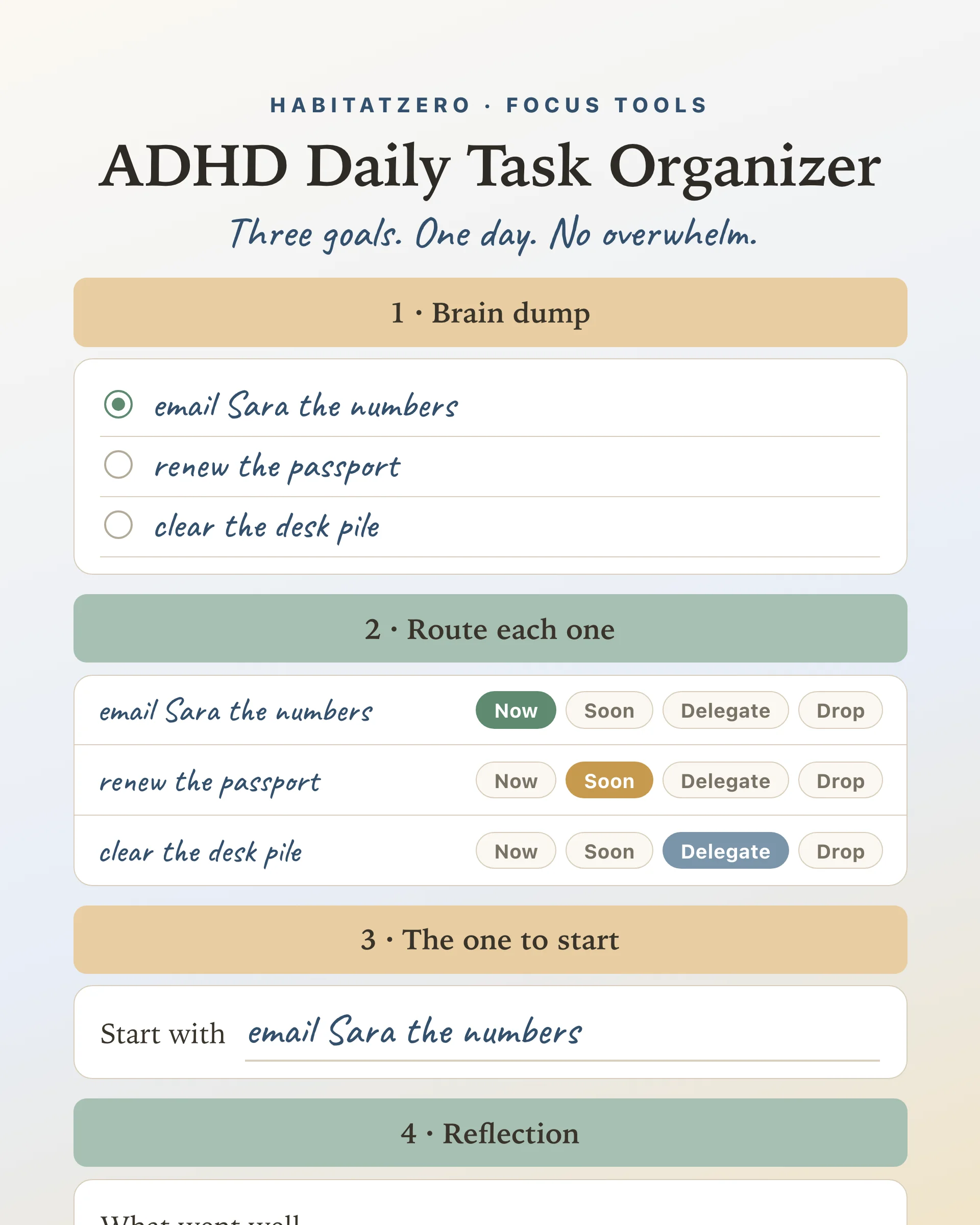
ADHD Daily Task OrganizerFocus & ADHD · ~10 min
About this template · Updated September 2026
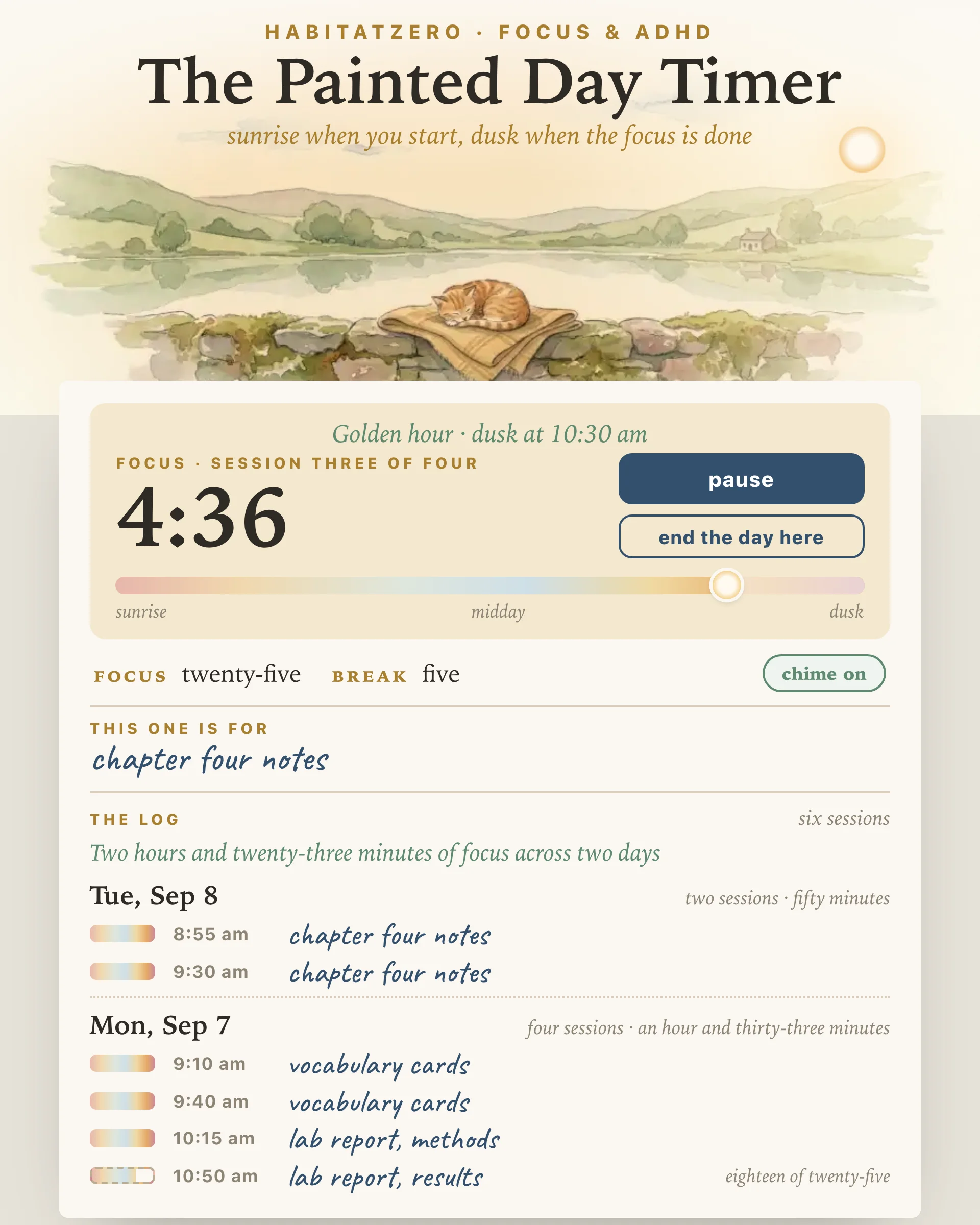
Francesco Cirillo created the Pomodoro Technique, and the word Pomodoro is his registered trademark, so the credit belongs up front. His official site teaches the whole method, which reaches well past a countdown into planning the day, estimating effort and handling interruptions. This painted timer borrows only the rhythm of focused stretches and short breaks. It was built on its own, has no tie to Cirillo or his company, and neither of them has reviewed or approved it.
Most timers show you a number getting smaller. For some people that number is the whole problem: every glance turns into a little audit of how much is left and how little got done. An aesthetic pomodoro timer puts something gentler in front of you. Here it is a watercolor lake valley with a ginger cat asleep on a stone wall, and the time lives in the light.
Press start the day and the valley begins at sunrise, rosy and pale. As the session runs, the sun climbs over the hills, stands clear at midday, sinks into a golden hour and sets. When your focus is done, it is dusk. A ribbon under the clock paints the same day from left to right, so you can read what is left without doing any math.
Take the break and the scene turns to evening: the sky goes blue, the stars come out and a thin moon crosses the lake. Every fourth break is a long evening, three times your short one and never more than half an hour. Skip it, or cut it short with morning now, and the next session starts at sunrise.
You choose the lengths: fifteen, twenty-five, thirty-five or fifty minutes of focus, and five, ten or fifteen minutes of break. Pause holds the light exactly where it is. Ending a session early takes two taps, so a stray click never costs you anything, and every full minute you did put in still goes on the log.
The clock works from timestamps instead of counting seconds one by one, which means a hidden tab, a busy computer or a reload cannot make it drift. The soft chime stays off until you switch it on, and once it is on, it is set to ring at the exact end of each focus and each break. A laptop that falls asleep or a phone that locks can still swallow the sound, so keep a phone alarm as the backup whenever missing the end would really matter.
Each finished session lands in the log as a small strip of painted sky, with its start time and the line you wrote for it, if you wrote one. A session you ended early gets a strip that stops where its light stopped, beside the minutes you gave it. Every day shows its own total, and the top of the log adds up your focus across all the days it holds. It keeps your latest sixty sessions, and past that, the oldest one slips away as each new one arrives.
Planned breaks are the part of this rhythm with the most behind them. In a study of eighty-seven university students working through a real study day, the students who took breaks on a fixed schedule reported less fatigue and distraction and more concentration and motivation than those who decided for themselves when to stop, and they finished the same amount of work in less time. A meta-analysis of twenty-two study samples found that short breaks bring small but real gains in vigor and a drop in fatigue. Their effect on performance was not significant overall, longer breaks helped performance more, and the authors suggest that draining work may need more than ten minutes of rest.
Scenery has a thinner but intriguing record. In one experiment with a hundred and fifty students, forty seconds spent looking at a city rooftop planted as a flowering meadow was followed by fewer missed responses on an attention task, compared with students shown a bare concrete roof. That study showed a real rooftop meadow, not a painting, and nobody has tested whether a watercolor valley on a timer helps anyone concentrate. Use this page because it makes the minutes easier to sit with, not because it promises better grades.
A cute pomodoro timer can sound like a gimmick, but the cat has a job. A calm animal fast asleep in the middle of the screen is a quiet cue to settle, and it never asks anything of you. When the clock starts to feel loud, look at the cat instead.
Reach for it when you sit down to study or work and want the time to feel softer around the edges. If you would rather plan the whole day in sessions first, the Pomodoro Planning Worksheet handles the estimates and your daily capacity. If twenty-five minutes keeps slipping away from you, the shorter glasses in Sand Timer Sprints may fit better. And when the work needs one long, unbroken stretch, block it out in the Deep Work Planner and let the painted day keep you company through it.
It is a focus timer that is calm to look at while it runs, a scene or a soft palette in place of a bare red countdown. Here a watercolor lake valley carries the time: its light moves from sunrise to dusk over each focus session, and the break turns it into a starry evening.
This one has a small ginger cat asleep on a blanket on a stone wall, right in the middle of the painting. It naps through every session and every break, which makes it the least demanding study partner you will ever have.
Yes. It works out the time left from the moment you pressed start, not from a running count, so a tab left in the background or a page you reload still shows the right minute. The optional chime is booked for the exact end of each session, although a sleeping laptop or a locked phone can still keep it quiet.
Francesco Cirillo devised it, and Pomodoro is a registered trademark of his. His full method also covers daily planning, estimating and handling interruptions, not only the timer. This painted timer was made independently of Cirillo and his company, and neither has looked it over or backed it.
No. The Pomodoro Technique belongs to Francesco Cirillo, and this painted timer was made separately, without his review or approval. It uses only the rhythm of focused stretches and short breaks; his official site and his book teach the complete method.
The page shows a sample golden-hour session with its controls at rest, so you can see how the light and the log look. Running your own sessions, keeping your lengths and building your log happen once you personalize it in HabitatZero, which is free.
By the team behind Fabulous, the science-based self-care app used by over 30 million people.