ADHD Daily Task OrganizerFocus & ADHD · ~10 min
About this template · Updated September 2026
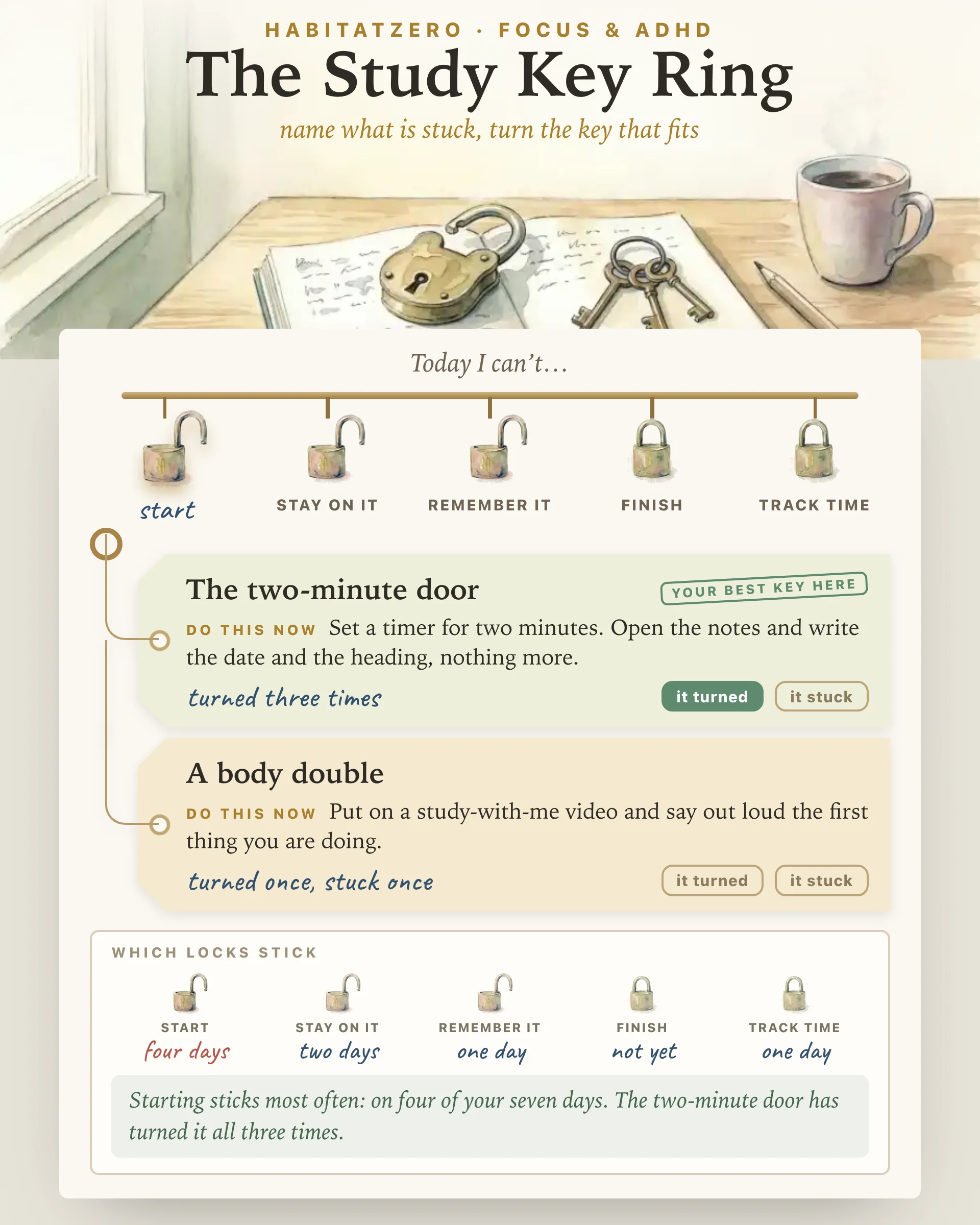
Most ADHD study advice arrives as a list of twelve tips, each one sensible and none of them chosen for tonight. Studying with ADHD rarely breaks down in the same place twice. Some evenings the book never opens. Some evenings it opens and you are elsewhere ten minutes later. Some weeks nothing stays, the essay sits at ninety percent for days, or the distant exam is suddenly on Thursday. Those are five different locks, and a key cut for one of them does nothing for the others.
That is the idea behind this page: choose the technique by what is stuck, not by what you are studying.
Under Today I can't, tap the lock that matches this moment: start, stay on it, remember it, finish, or track time. Three keys drop down for that lock. Each has one line on why it can help and one step marked do this now that you can begin inside a minute.
After you try it, mark it. It turned means it helped; it stuck means it did not. Keys that turn for you move to the front, keys that keep sticking drift to the back, and a lock is painted open once one of its keys turns it more often than it sticks.
Below the ring, the record holds twelve tries. It counts the days each lock has stuck, shows each key you tried as a row of dots, and sums it up in a sentence such as Starting sticks most often: on four of your seven days. After a week or two you stop guessing which kind of stuck you are, and which keys actually open it.
Can't start. The two-minute door shrinks the first step to almost nothing: open the notes, write the date and the heading, and you are free to stop. The body double puts someone nearby while you begin, in the room, on a call or in a study-with-me video. Body doubling grew up in neurodivergent communities rather than in clinics, and research on it is still at the stage of describing what people do. The fullest description so far comes from a survey of two hundred and twenty people about body doubling, in which it was roughly defined as using another person's presence to start, stay focused on, or finish a task. Studying and working were among the jobs people named.
Can't stay on it. The ten-minute sprint puts the phone in another room and a timer in charge. The walking lap and the fidget in hand suit the restless kind of drifting. In a lab study of boys aged eight to twelve, moving more during working-memory tasks went with better scores for the boys with ADHD and slightly lower scores for the boys without it. Movement made no difference to how attentive either group was, and these were children, so read it as a reason to stop fighting your feet, not as proof that pacing will make you focus. If you want timed blocks with a memory, Sand Timer Sprints logs which sprint length you actually finish.
Can't remember it. The blank page is retrieval practice: close everything, write what you can remember, then check. Testing yourself is one of the strongest learning strategies known, and ADHD does not appear to cancel it out. When college students with and without ADHD learned word lists with practice tests mixed in rather than by studying them over and over, both groups recalled more two days later, by a similar margin. The return visit adds spacing, and the empty chair has you explain the idea aloud to find where it falls apart. The Active Recall Deck turns the first key into a box of question cards.
Can't finish. The progress strip, the done list and the finish line all make the end visible: what is left, what is already done, and what done actually means. These are practical habits rather than tested techniques, so your own marks are the evidence that counts.
Can't track time. The paper countdown turns the days before a test into boxes you cross off, the clock with a face shows time left as a shrinking shape, and the estimate check sets your guess beside the real duration. A meta-analysis of twenty-seven studies of children and teenagers found that those with ADHD judged time less accurately than their peers and were more likely to overestimate it. That review covered young people only, so it says nothing firm about adults, but the fix costs one sticky note.
It does not diagnose anything, and it is not a treatment for ADHD. The keys are study habits, and the record is a notebook that counts. A key that sticks is information, not a failure, and the record shows a pattern across weeks rather than grading one evening.
Open it the moment a session stalls, and try one key before anything else. If the problem is choosing a method for the material itself, the Study Techniques Cabinet matches techniques to the subject, the deadline and the time you have. The cabinet decides how to study the subject; the ring gets you moving when your brain will not cooperate with the plan.
The best one is whichever is aimed at the part that is stuck right now. For trouble starting, shrink the first step to two minutes or begin beside another person. For drifting, use ten-minute blocks and let your body move. For material that will not stay, test yourself from memory and come back on separate days. For work that never quite ends, make the remaining pieces visible. For a deadline that sneaks up, turn the days into boxes you can see.
Make the start so small it barely counts: set two minutes, open the notes, write the date and the heading, and let yourself stop when the timer rings. Many people also find it easier to begin with someone nearby, whether a friend in the room, a video call or a study-with-me video. Doing the easiest question first is another way in.
Plan for shorter blocks instead of more willpower: ten minutes with the phone in another room, a one-minute stretch, then decide on another round. Pacing while you say answers out loud, or keeping something quiet in your spare hand, helps some people stay with the page. Moving to a different room for the next block is worth a try too.
Close the notes and pull the material out of your own memory, then check what you missed. In one study, college students with ADHD recalled more two days later after learning with practice tests mixed in than after studying the same words over and over, and the gain was about the same size as it was for students without ADHD. Short return visits on separate days help it last.
You can explore the ring on this page as it looks after a week of use. Naming your own lock, marking keys as they turn or stick, and keeping the record of what works happens once you personalize it in HabitatZero, at no cost.
By the team behind Fabulous, the science-based self-care app used by over 30 million people.