ADHD Daily Task OrganizerFocus & ADHD · ~10 min
About this template · Updated September 2026
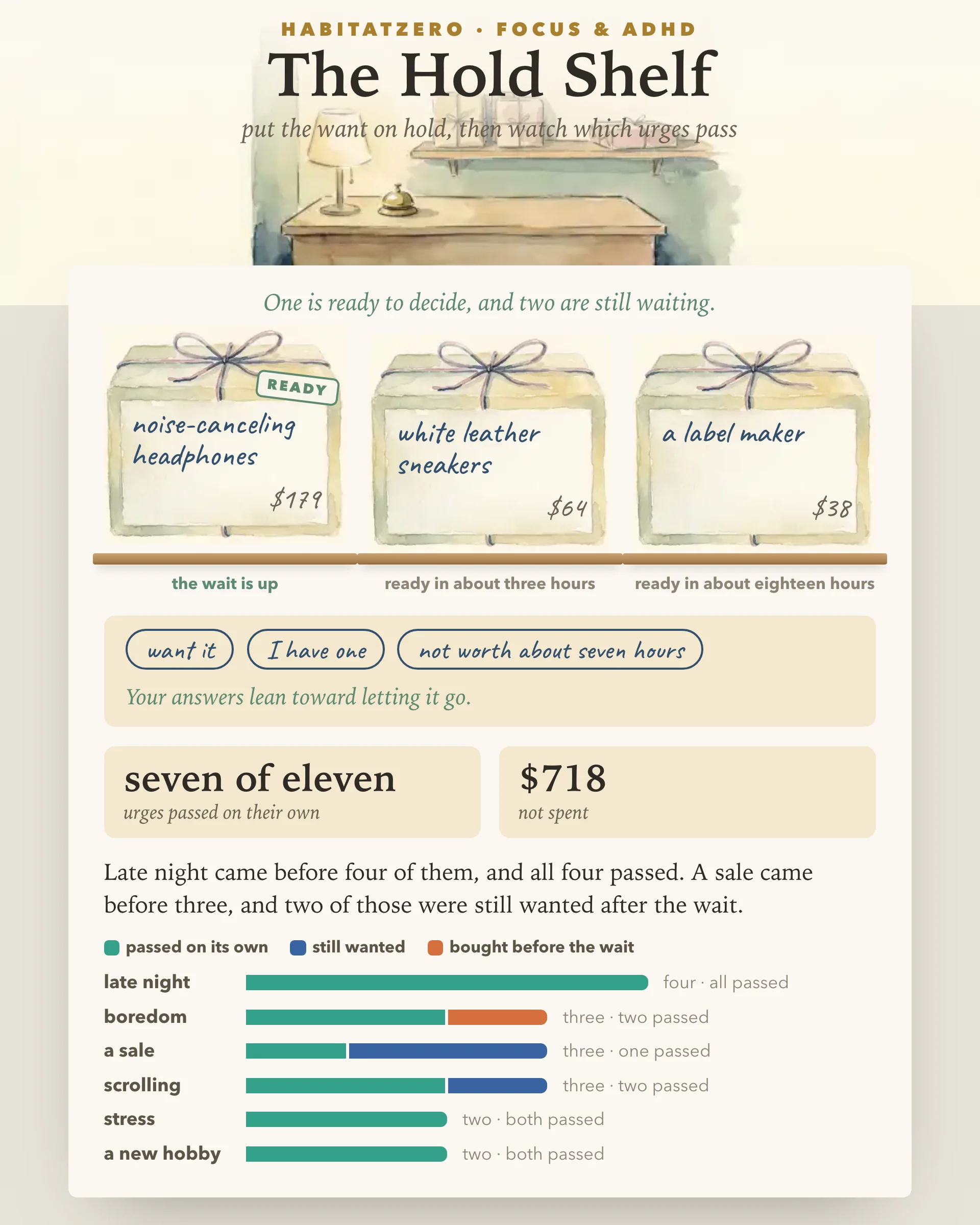
It is 11:40 at night, the cart is full, and a banner says the sale ends at midnight. Nothing about the purchase is urgent, yet it feels urgent, and one tap is all that separates wanting it from owning it. With ADHD, that tap can be the shortest distance in your day. The hold shelf puts a deliberate gap there: one day, or three, between a want you could live without and a charge on your card.
The link between ADHD and impulsive buying is real, but it is smaller and messier than social media makes it sound. In an Icelandic study of 225 adults diagnosed with ADHD, participants reported buying on impulse more often than a comparison group of 121 university students, and they also reported a harder time putting off rewards. Their analysis suggests that trouble with waiting helps explain the extra impulse buying. The authors name their limits plainly: diagnoses were self-reported by people recruited online, the two groups differed in age and education, and the design cannot show cause.
A Dutch community study of 1,292 adults found the same raw gap. People reporting many current ADHD symptoms bought on impulse more and saved less often. Once personality, symptoms of depression and demographics were taken into account, though, ADHD symptoms no longer predicted impulsive buying on their own. ADHD is part of the picture, alongside mood and temperament, rather than the whole explanation.
The steadiest finding sits one step back. A meta-analysis of 25 case-control comparisons covering about 3,900 people found that people with ADHD discount delayed money more steeply than controls do: a reward that arrives later loses more of its pull. That is the pressure point this page leans on, since an urge that insists on now tends to weaken once now becomes later. Nobody has tested a waiting list like this one for ADHD, so the most honest evidence you will get is your own log.
When something tempts you, put it on the shelf instead of in the cart. Name it, add the price, and tap what came right before it: boredom, stress, late night, a sale, a new hobby or scrolling. Choose a wait of one day or three days. Each package shows how long is left.
The shelf has six spaces. When it is full, you settle one before holding another, because a shelf that takes everything becomes a second cart.
Tap a package for three questions. Do you need it, or only want it? Do you already own something that does the job? Is it worth the hours of work its price stands for? Enter what an hour of your work brings home and the card turns $179 headphones into about seven hours. Your answers lean one way or the other, but they never make the call for you.
When the wait is up, you choose. Let it go and it counts as passed. Mark it as still wanted and it becomes a decision you can act on with a clear head. You can let an urge go before its wait ends, and if you bought something early, the log records that honestly instead of pretending it passed.
Once a few urges have come off the shelf, the page reads them back. It gives the share that passed on their own, adds up the money that stayed in your account, and draws a bar for each trigger, split into urges that passed, urges still wanted after the wait, and urges bought early.
The pattern usually teaches more than the total. If late-night urges are nearly always gone by morning, a one-day wait handles them. If sale urges keep outlasting the wait, the fix sits upstream: unsubscribe from the emails that start them.
Why offer three days? US consumer law already builds in a pause of that length. The FTC's Cooling-Off Rule gives you three days to cancel certain sales made at your home or at a seller's temporary location, but it does not cover sales made entirely online. The longer wait here borrows that idea for the purchases the rule leaves out.
Keep the shelf closer than the store. Put it where your thumb goes when a sale notification lands, and remove saved card details from the shops you visit most, so buying takes more steps than holding. When boredom is the trigger that keeps turning up, The Dopamine Menu gives you something else to reach for, and Urge Surfing helps you ride out the first minutes of a strong pull. For a run of days with no spending at all, The No-Spend Challenge works the same muscle harder.
Use the shelf for wants, not needs: groceries, medicine and bills do not belong on it. It is a pause, not financial advice, and it will not shrink debt that is already there. If shopping feels driven rather than tempting, carries on despite real harm, or has left you with debt you cannot see a way through, bring it to a clinician or a nonprofit credit counselor. Help with ADHD and with money is easier to use than it looks from inside the problem.
Studies point that way, with caveats. Adults diagnosed with ADHD in an Icelandic study reported more impulsive buying than a group of university students, along with a harder time putting off rewards. A Dutch community study saw the same gap, but it faded once personality, low mood and demographics were counted, so ADHD is one part of the picture rather than a verdict.
It is a promise to let a full day pass between wanting something and paying for it, unless the purchase truly cannot wait. The thinking behind it is that the pull of the moment tends to soften overnight, so a calmer version of you makes the call. This page keeps the clock for you and offers three days for bigger buys.
Put distance between the urge and the checkout button. Park the want somewhere you can see it instead of in a cart, give it a set wait, and decide only when the wait is over. Noticing what came right before each urge, such as boredom, stress, a late night or a sale, helps too, since those moments tend to come back.
Nobody has run a trial of a waiting list like this one for ADHD. The reasoning comes from studies showing that, for people with ADHD, a reward that arrives later tends to lose more of its pull, so an urge built for right now weakens once now turns into later. Your own log is the fairest test, because the sheet shows what share of your urges passed.
The stocked shelf on this page is a sample to look through. Keeping your own shelf, with waits that count down between visits and a reading that grows with every decision, happens in HabitatZero, which is free.
By the team behind Fabulous, the science-based self-care app used by over 30 million people.