ADHD Daily Task OrganizerFocus & ADHD · ~10 min
About this template · Updated September 2026
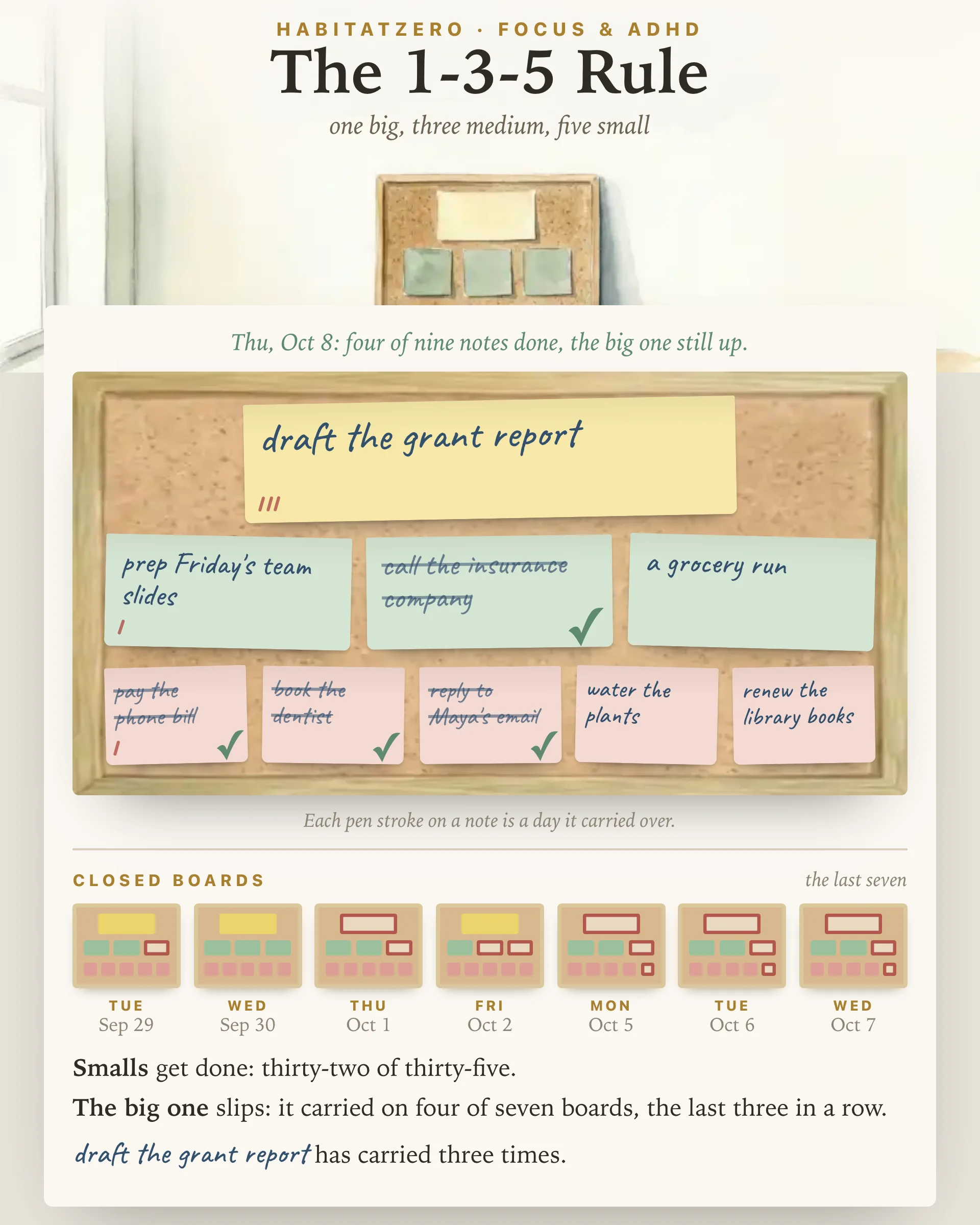
The 1-3-5 rule was popularized by Alex Cavoulacos, co-founder of the career site The Muse, who set it out as the second tip in Why You Never Finish Your To-Do Lists at Work. This board is an independent way to practice her rule. Neither Cavoulacos nor The Muse made it, reviewed it or endorsed it.
Her version fits in a breath. On any given day, assume you can finish one big thing, three medium things and five small things, and put only those nine on the list. She suggests writing the next day's nine before you leave work, so the morning opens on a plan instead of an inbox. Two adjustments come with it: on days crowded with meetings, use smaller numbers, and if your job throws surprise requests at you, leave one medium and two small slots empty to catch them.
Most daily methods sort tasks by importance. The Ivy Lee Method has you rank six tasks and work them strictly from the top. The 1-3-5 rule asks a different question: how big is each thing? That is usually the harder call. A task like "sort out the taxes" reads as one line and behaves like a week. Giving every task a big, medium or small slot makes you size it before the day does it for you, and the fixed slots mean nine is the whole day, not the first nine of forty.
The board has one wide spot at the top, three below it and five across the bottom. Tap a spot, write the task in a few words, and it sticks there as a note: yellow for big, green for medium, pink for small. Small notes hold fewer characters than big ones on purpose. If a task needs a paragraph, it was never small. Each size has a few tap-to-add ideas for when you want a nudge.
You can write the board for today or for tomorrow. On the board's own day, tap a note when it is done. Before you stop, close the day. Checked notes come down; unchecked ones move to the next board in the same size, and each move adds a pen stroke to the note, so a task that has slipped three times looks like it.
Every closed board shrinks into a small copy in a row underneath, up to the last seven. After three closed days, the board reads that row back to you: which size you reliably finish, which one keeps carrying over, and one thing to try. A big note that moves every day usually needs splitting into a first piece. Smalls that always get done while mediums wait may be crowding them out, simply because they are quicker to start.
We could not find a study that tests the 1-3-5 rule itself, so treat it as a sensible structure rather than a proven one. Three lines of research sit close to it.
First, people tend to be too hopeful about their own tasks. In a well-known set of studies on the planning fallacy, people's predictions of when they would finish their own work were too optimistic across academic and everyday tasks, and in one study the bias disappeared when people were asked to connect the prediction to relevant past experience. Your row of closed boards is that past experience, sorted by size and sitting right under tomorrow's plan.
Second, a popular claim says unfinished tasks stick in memory better than finished ones, which is known as the Zeigarnik effect. A 2025 meta-analysis of the Zeigarnik and Ovsiankina effects found no memory advantage for unfinished tasks, though it did find a general tendency to go back and resume them. A carried note gives that pull a place to land: the task waits on the next board, at its size, instead of circling.
Third, planning seems to settle unfinished business. Across several experiments, unfinished goals produced intrusive thoughts and hurt performance on unrelated tasks, and letting people make a specific plan for those goals removed the interference. Closing the day and writing the next board is a small, daily version of that plan.
Reach for the board on days that mix one demanding piece of work with a scatter of errands, which describes most workdays. It works best at the end of the day, while you still know what is open. On a day that is one long project, a single hard first task may serve you better, and Eat the Frog is built for exactly that. If your trouble is fitting tasks into hours rather than choosing them, pair the board with the Time Blocking Daily Planner and give the big note the first block.
Keep the numbers honest. If the board reads that every size keeps carrying, the answer is a smaller board for a week, not a longer list.
It is a way to plan a workday by size: one big task, three medium tasks and five small ones, nine in all. A big task fills a good part of the day, a medium one takes about an hour, and a small one takes minutes. Deciding the nine in advance means what gets done is what you chose, not whatever arrived loudest.
The same rule, used as structure outside your head. A capped list with sizes you can see helps when every task feels equally urgent or lists tend to sprawl, and carrying unfinished notes forward keeps them from quietly vanishing. Treat it as a planning habit to try, not as a treatment.
Shrink the board rather than drop it. Cavoulacos suggests lower numbers on days packed with meetings, and leaving one medium and two small spots open when your job brings last-minute asks. Empty spots are fine here: a closed board records them as left empty, never as missed.
No. This board is an independent practice tool made by Fabulous. It credits Alex Cavoulacos and The Muse for the rule, but neither of them built, reviewed or endorsed it, and her own write-up lives on The Muse.
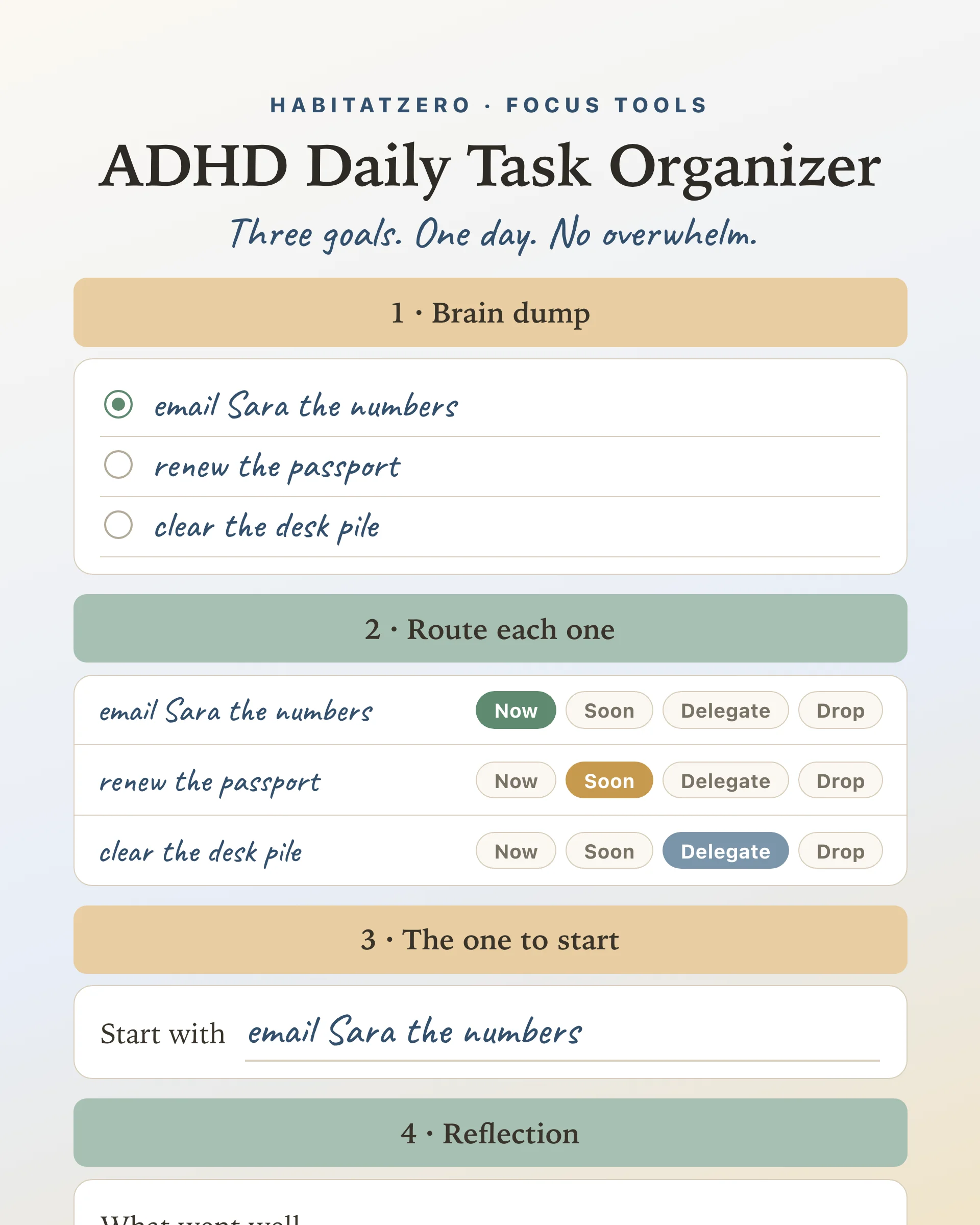
The filled-in board on this page is a sample to look over. To write your own notes, check them off through the day and let a week of closed boards show you your pattern, open it in HabitatZero, which is free.
By the team behind Fabulous, the science-based self-care app used by over 30 million people.