
Turning Career Failure Into Success
#881: Tales of Overcoming The Odds, and How to Turn Losses Into Wins — Tim McGraw, Terry Crews, Dax Shepard, and More
The brief
Five high achievers, actor Terry Crews, singer Tim McGraw, writer Jessica Lahey, actor Dax Shepard, and former DC police chief Kathy Lanier, tell Tim Ferriss how a missed shot, a scrapped album, a rejected book, a canceled movie, and a teenage pregnancy became the material for later success.
BJ Miller is a triple amputee, and for years afterward no motorcycle shop would take his idea of riding again seriously. Mechanics looked at him, made an excuse, and sent him home. Then he found a machinist named Mert Lawwill, who had built a prosthetic attachment for handlebars, and a young man named Randy, who spliced the front and rear brakes on an Aprilia Mana, a clutchless motorcycle, into a single lever and moved the other controls into a separate box, so Miller's one working hand could do the work of two. "It works great," Miller says (04:14). The bike is not proof that he beat his disability. It is proof of what happens when someone keeps asking the same inconvenient question until a person says yes.
That persistence opens a run of conversations Ferriss has pulled from his archive, all circling one question: what do you do with a failure that looks, at the time, like the end of something. The people in this hour do not argue that the setback was secretly good. They argue that it became raw material, and that the work of turning it into something useful started almost immediately, usually before the sting wore off.
Take Terry Crews, the actor known for Brooklyn Nine-Nine. In 1986, as the starting center for his Michigan high school team, he intercepted a pass with five seconds left in a district championship game his team was losing 47 to 45 (07:34). He drove the length of the court, went up for the layup that would have won it, and missed. His coach told him in the locker room that he had no business taking the shot. The local paper printed it the next day. Crews describes sitting alone on his bed a few nights later, replaying the moment, until a second thought arrived to argue with the first.
"I learned always to kinda reframe things so that it's to your advantage. You look at these things like, wait a minute, you took the shot, man." — Terry Crews (10:48)
Nobody remembers the game, Crews says. What stayed with him is the habit it taught him: judge yourself by whether you acted, not by whether the shot went in. He later applied a harder version of the same logic to his own life, noticing that if he showed up late for something twice, it usually meant he did not actually want it (11:56), a small, uncomfortable piece of self-audit that follows directly from the missed layup.
Ownership as the Actual Skill
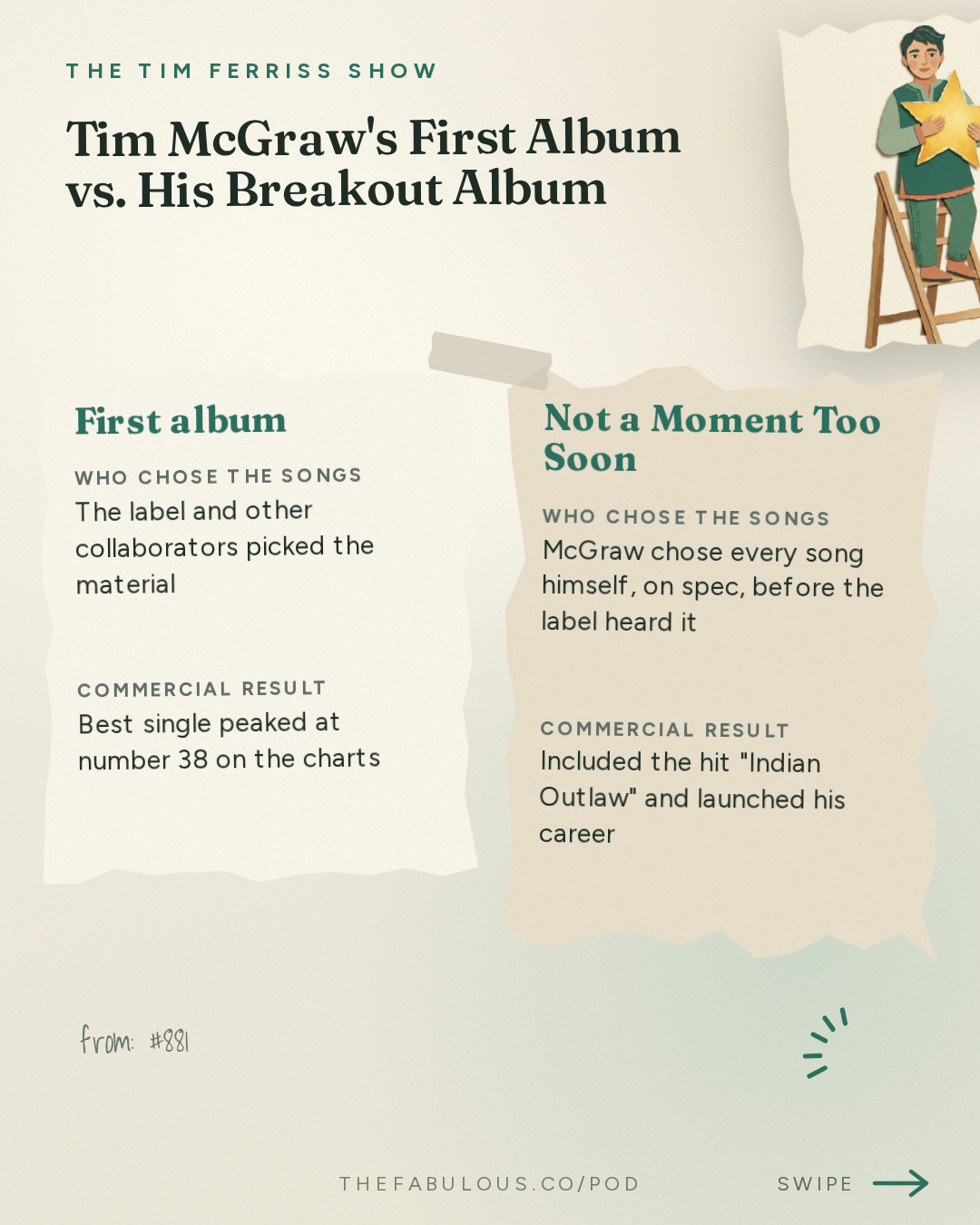
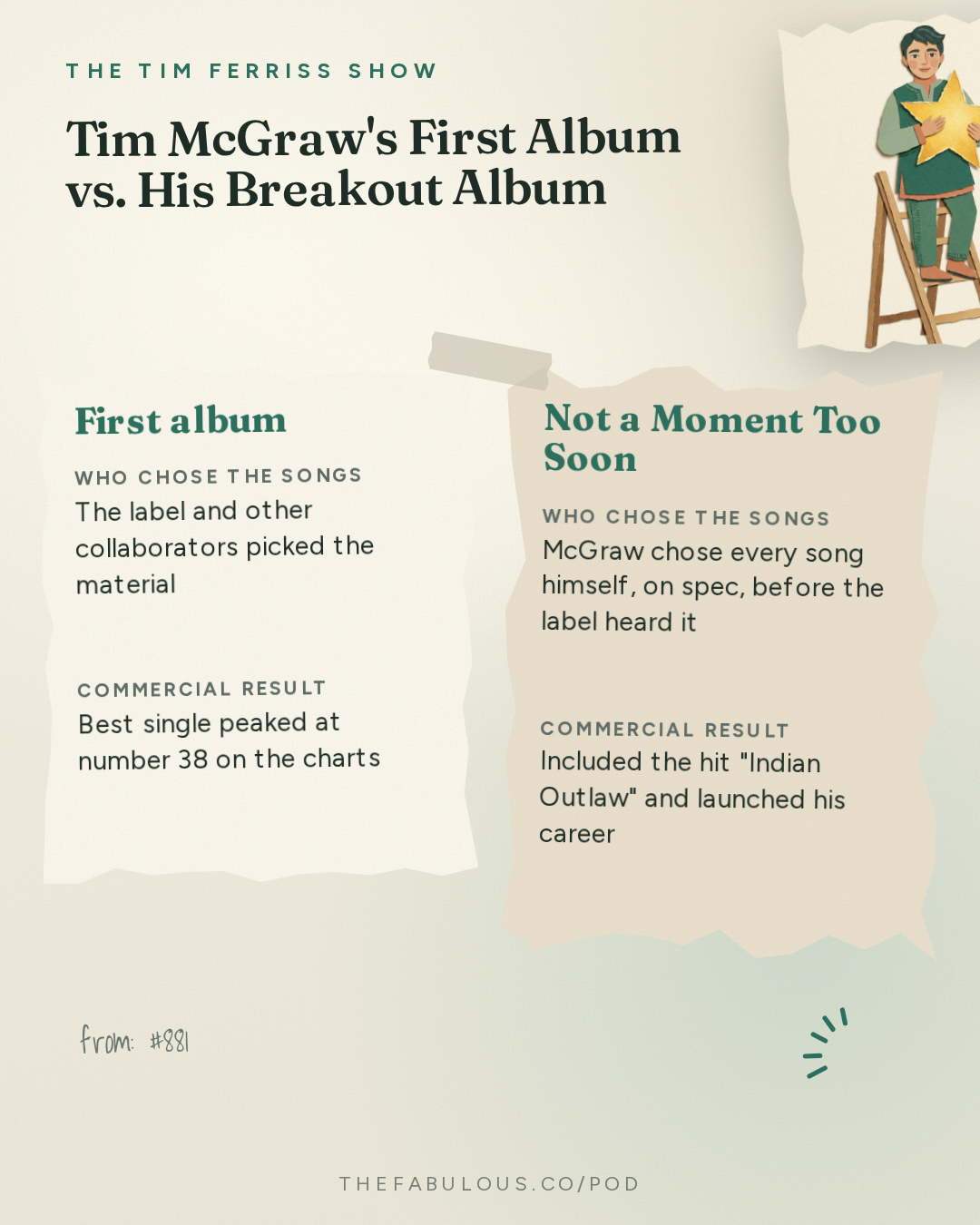
Country singer Tim McGraw's first album barely registered. Its best-performing single peaked at number 38 on the charts (17:38), and the label, Curb Records, stopped calling him. Rather than wait for another chance to be handed to him, McGraw spent months collecting songs from friends who wrote music, then booked studio time and recorded a full album on spec, without asking Curb's permission first. The label was furious when they found out, and then they heard it. That record, Not a Moment Too Soon, included "Indian Outlaw" and became the hit that his first album was not. "I'm gonna do the songs I want to do," McGraw says of the decision (18:41). "If it fails, it fails on my terms this time."
The lesson generalized. Years later McGraw fought a multi-year legal battle to get out of his Curb Records contract, after the label extended it by releasing roughly ten greatest hits albums that did not count against his commitment (21:44). He compares the fear of losing career momentum to a rodeo image from the show Landman: a monkey riding a border collie who cannot let go without falling off. "There's something in you that keeps it driving," he says, "'cause you're scared if the ball stops rolling you'll never get it rolling again" (23:16). His advice to younger artists, distilled, is to take charge of every decision, because a career run by committee works for a while and then stops working at all (19:02).
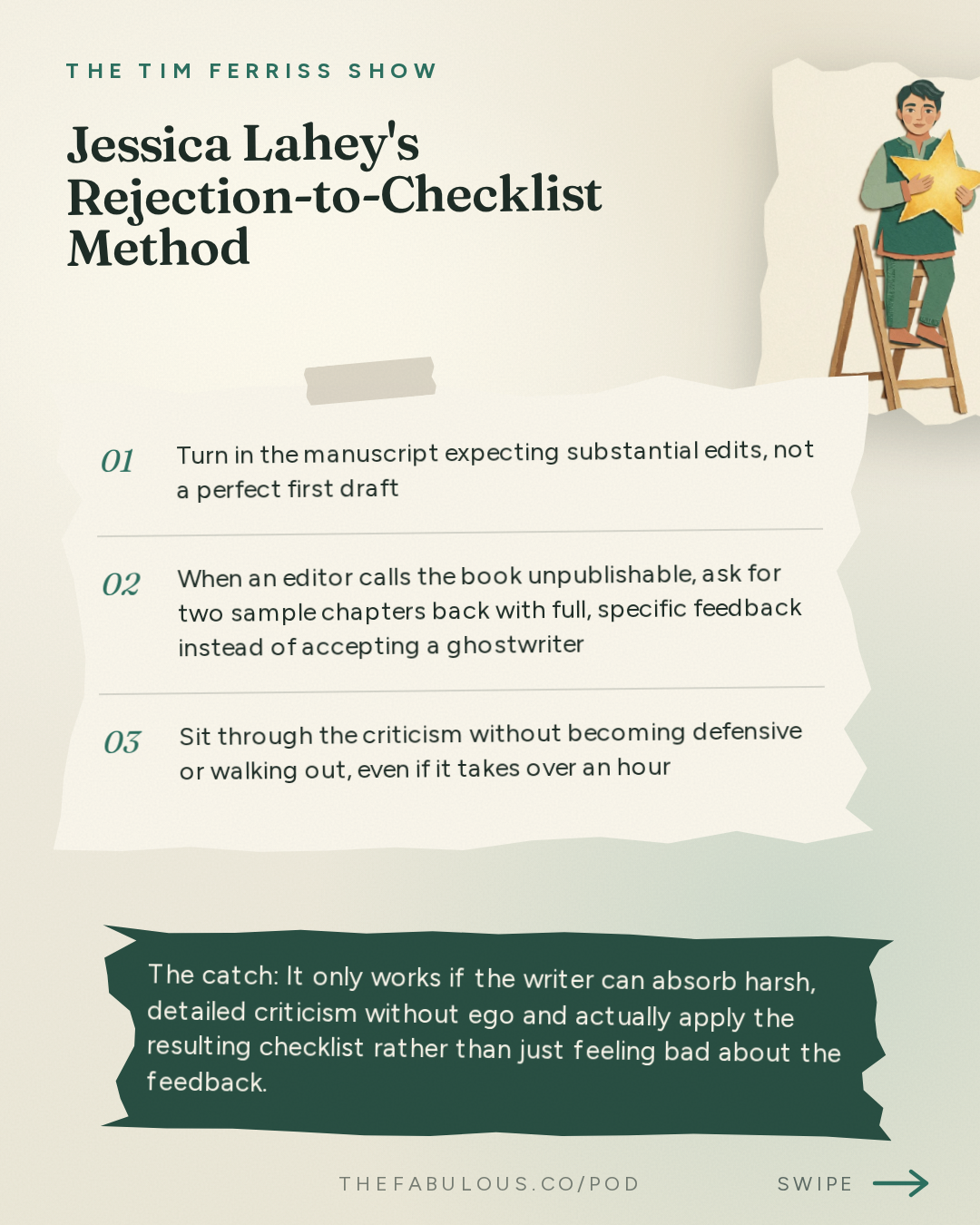
Writer Jessica Lahey ran into a version of the same problem from the other side of the desk. Her editor called the first draft of The Gift of Failure unpublishable and suggested bringing in a ghostwriter (28:56). Instead of accepting the verdict, Lahey asked for two sample chapters back with full, detailed notes on everything wrong with them. She sat through more than an hour of criticism, took no offense, and turned every note into a written checklist of what not to do again (30:23). She applied the checklist to the rest of the book, then to her next one, which she turned in so clean that her editor moved up the publication date. The mechanism is not talent. It is a willingness to convert someone else's harsh read into a system she could reuse.
Actor Dax Shepard's failure looks less like a system and more like a mercy. He had decided, for a three-year stretch, that he was a writer-director rather than an actor, right up until the sequel to his film CHiPs was quietly shelved. He spent months doing retirement math instead of working, and started a podcast partly to sit with the question of what had just collapsed. On the show, he says he learns more from other people's mistakes than their trophies.
"I have nothing to learn from someone holding a Emmy over their head. I'll never be holding an Emmy over my head. But I can relate if that person cheated." — Dax Shepard (34:05)
In hindsight, Shepard says, the failed sequel likely saved him from a decade of bigger movies and less time with his young children. The identity he lost was never replaced. It was outgrown.
Learning to Read the Ground
Kathy Lanier's version of failure started earlier and cut deeper. A straight-A student, she became chronically truant in seventh grade, married at 14 after becoming pregnant, and by her late teens was raising a son on a ninth-grade education (39:10). She got her GED by exactly one point, scoring 256 against a passing threshold of 255 (43:23). At 23, she saw a newspaper ad for the Metropolitan Police Department offering tuition reimbursement, took the entrance exam against a thousand applicants, and ranked 60th (46:44). She was hired in 1990, during the height of Washington's crack-era violence, when the city averaged about 500 murders a year and had earned the nickname murder capital of the world (46:24). She eventually became the department's longest-serving chief. Her account has none of the varnish of a triumph story. It is closer to an itemized list of narrow margins that happened to work in her favor, because she kept moving toward the next credential rather than the next excuse.
Physicist Janna Levin frames the whole pattern more abstractly. She used to resent the obstacles in her career, she says, as interruptions to a path that should have been smooth.
"I used to resent obstacles along the path. Then I suddenly realized life IS the obstacles. There is no underlying path." — Janna Levin (48:15)
The shift matters because it changes what an obstacle means. If a smooth path was owed to you, a blocked path is an injustice. If the obstacles are the actual terrain, a blocked path is just the next thing to solve. Levin extends the point to what she calls a boot in the face, the kind of barrier, structural or personal, that people run into no matter how capable they are. Her advice is not to push against it out of principle. It is to route around it.
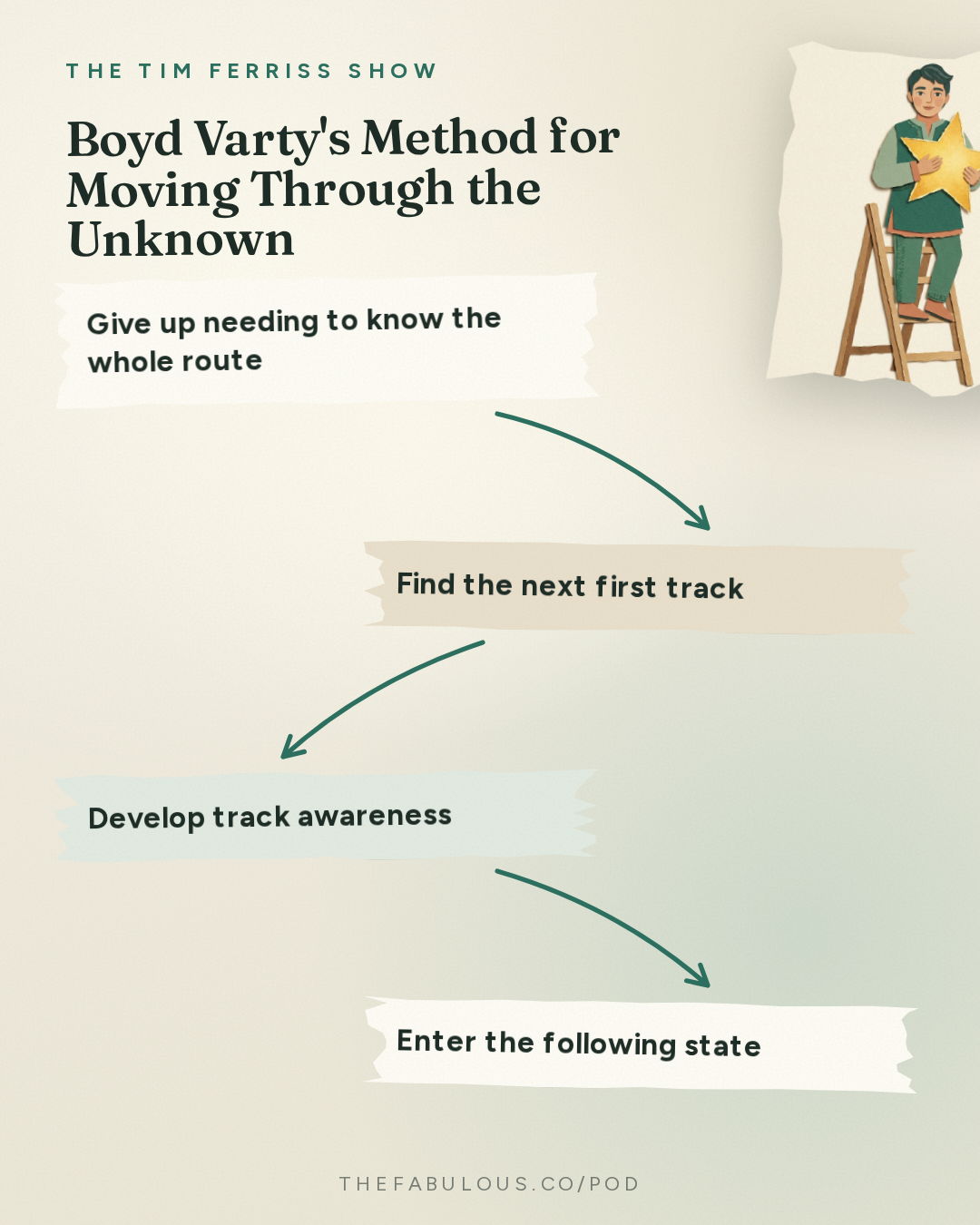
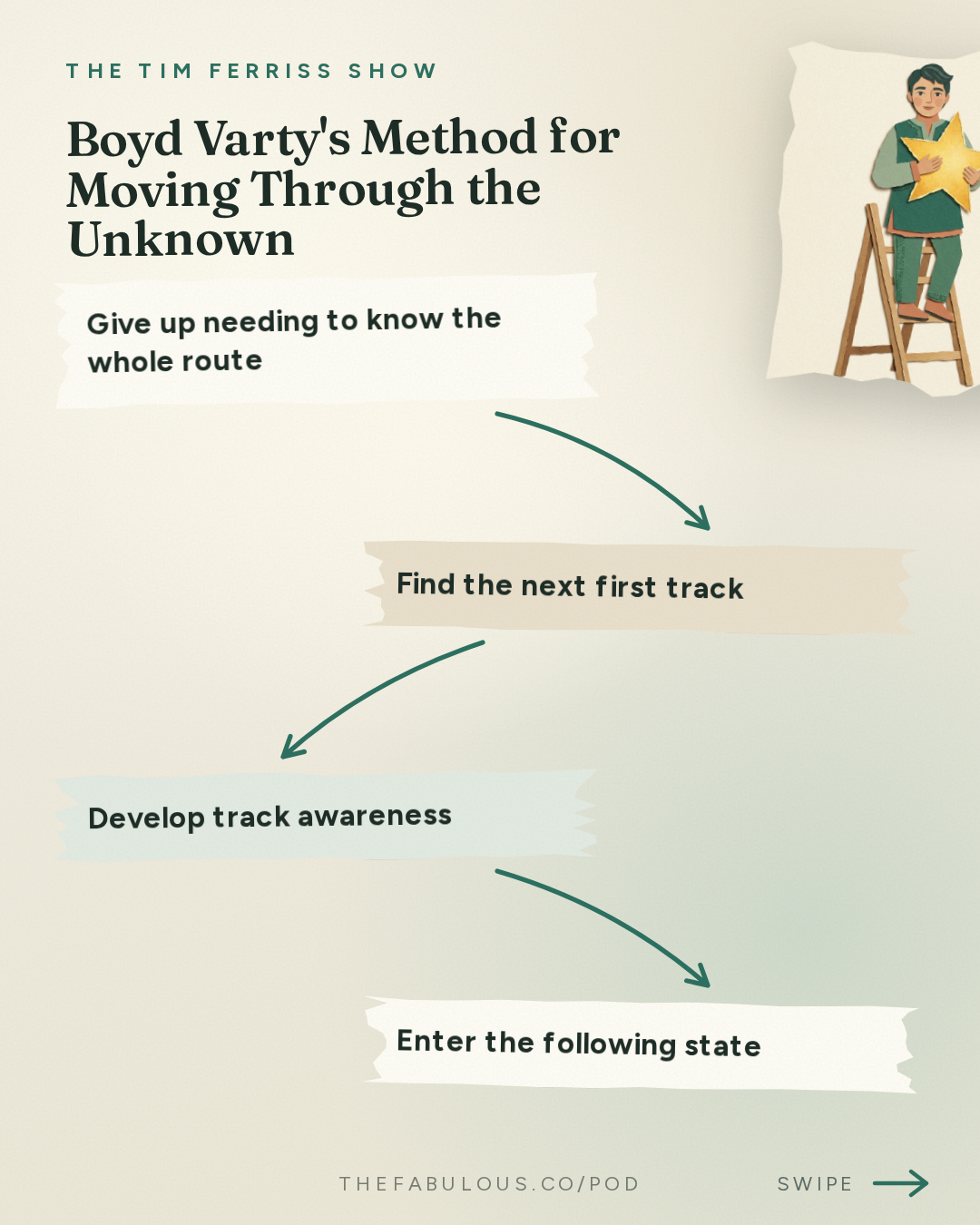
Lion tracker Boyd Varty ends the hour with the most literal version of the same idea. His mentor, a tracker named Renias, had a phrase for entering unmapped terrain: "I don't know where I'm going, but I know exactly how to get there" (55:23). Varty explains that a good tracker never tries to hold the whole route in mind. He looks for the next first track, a single fresh sign in three hundred and sixty degrees of open ground, then the next one after that (56:18). Varty calls the resulting rhythm the following state, which he defines as constant creative response to what is actually occurring, rather than to a plan (62:23). He first understood this, he says, while recovering from years of trauma, guided by a mentor named Martha Beck who saw what he was carrying before he could name it himself. Healing, in his account, meant learning to notice which activities made him feel expansive and alive, then following that thread the way a tracker follows a broken twig (61:48).
None of these stories argue that failure is secretly a gift. A missed layup, a canceled contract, a teenage pregnancy: none of it feels good going through it. What each person eventually built was a method for using the wreckage, whether that meant a checklist, a renegotiated contract, a single fresh track in open ground, or just the decision to stop being late for the things that supposedly mattered. The setback was never the end of the story. It was the point where the actual work started.
Ask this episode anything
Pod's AI answers from the episode itself, with the minute mark so you can hear it yourself.
Or start with one of these
Ask this episode
Pod's AI listens to the whole episode to answer, and points you to the minute it comes from.
The rest of this answer, and any question after it
Answers come from the episode itself, never from a summary of it.
ContinueKey takeaways
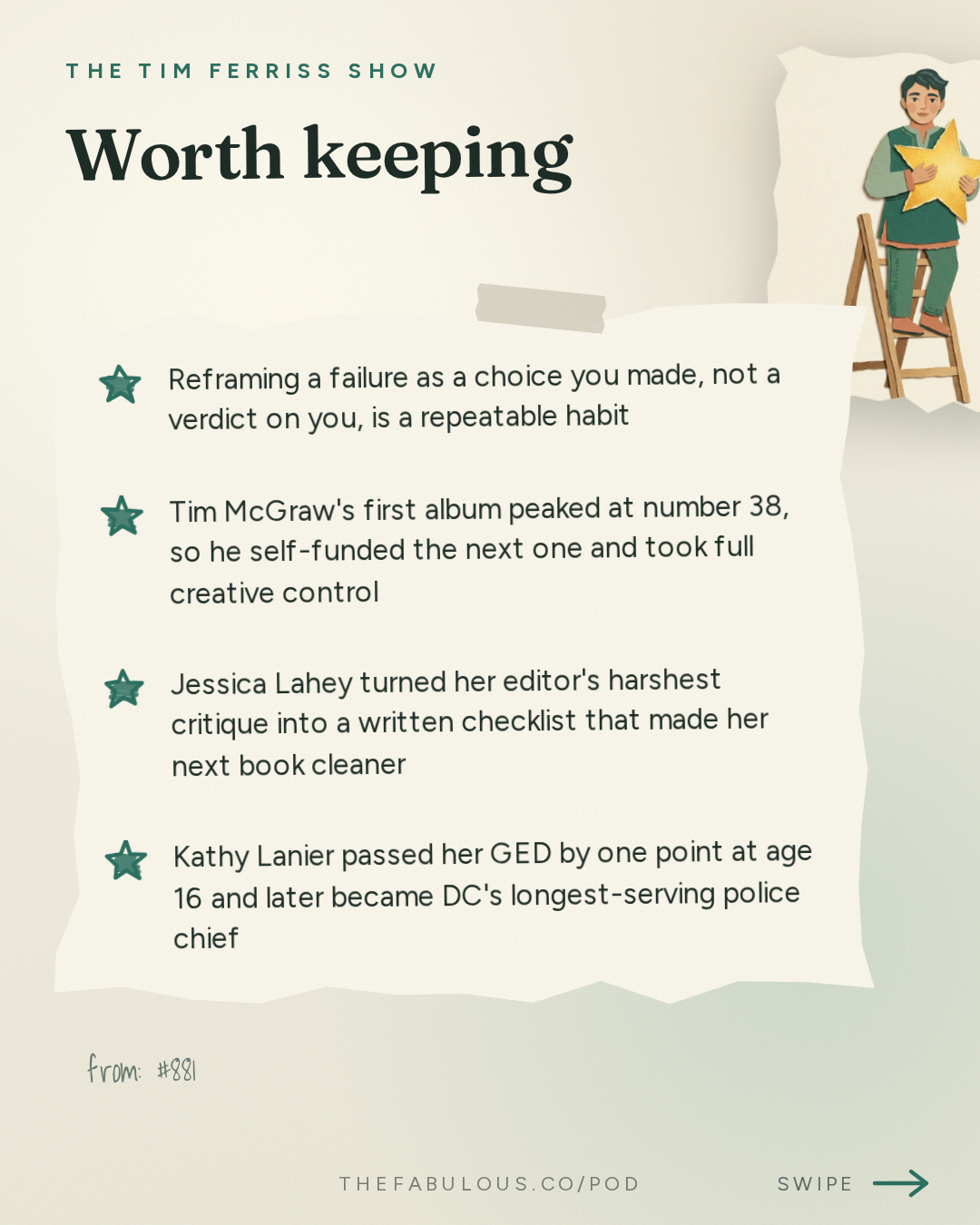
- Reframing a failure as a choice you made, not a verdict on you, is a repeatable habit
- Tim McGraw's first album peaked at number 38, so he self-funded the next one and took full creative control
- Jessica Lahey turned her editor's harshest critique into a written checklist that made her next book cleaner
- Kathy Lanier passed her GED by one point at age 16 and later became DC's longest-serving police chief
- Boyd Varty's tracking method says to find only the next sign, not the whole path, when facing uncertainty
The episode in cards

By the numbers
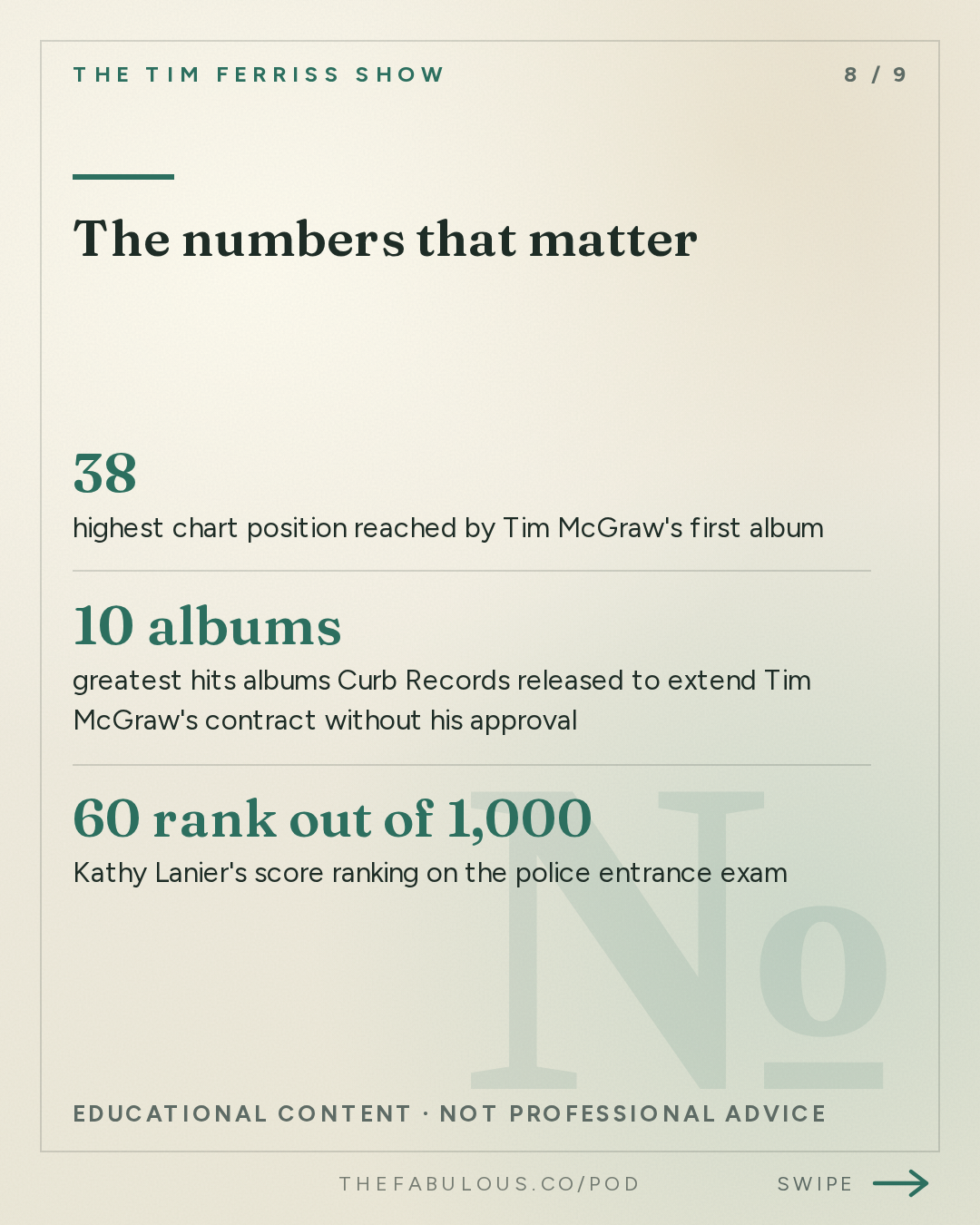
- 38 highest chart position reached by Tim McGraw's first album
- 10 albums greatest hits albums Curb Records released to extend Tim McGraw's contract without his approval
- 60 rank out of 1,000 Kathy Lanier's score ranking on the police entrance exam
In their words
“I have nothing to learn from someone holding a Emmy over their head. I'll never be holding an Emmy over my head. But I c- I can relate if that person”
“I don't know where we're going, but I know exactly how to get there.”
Protocols
-
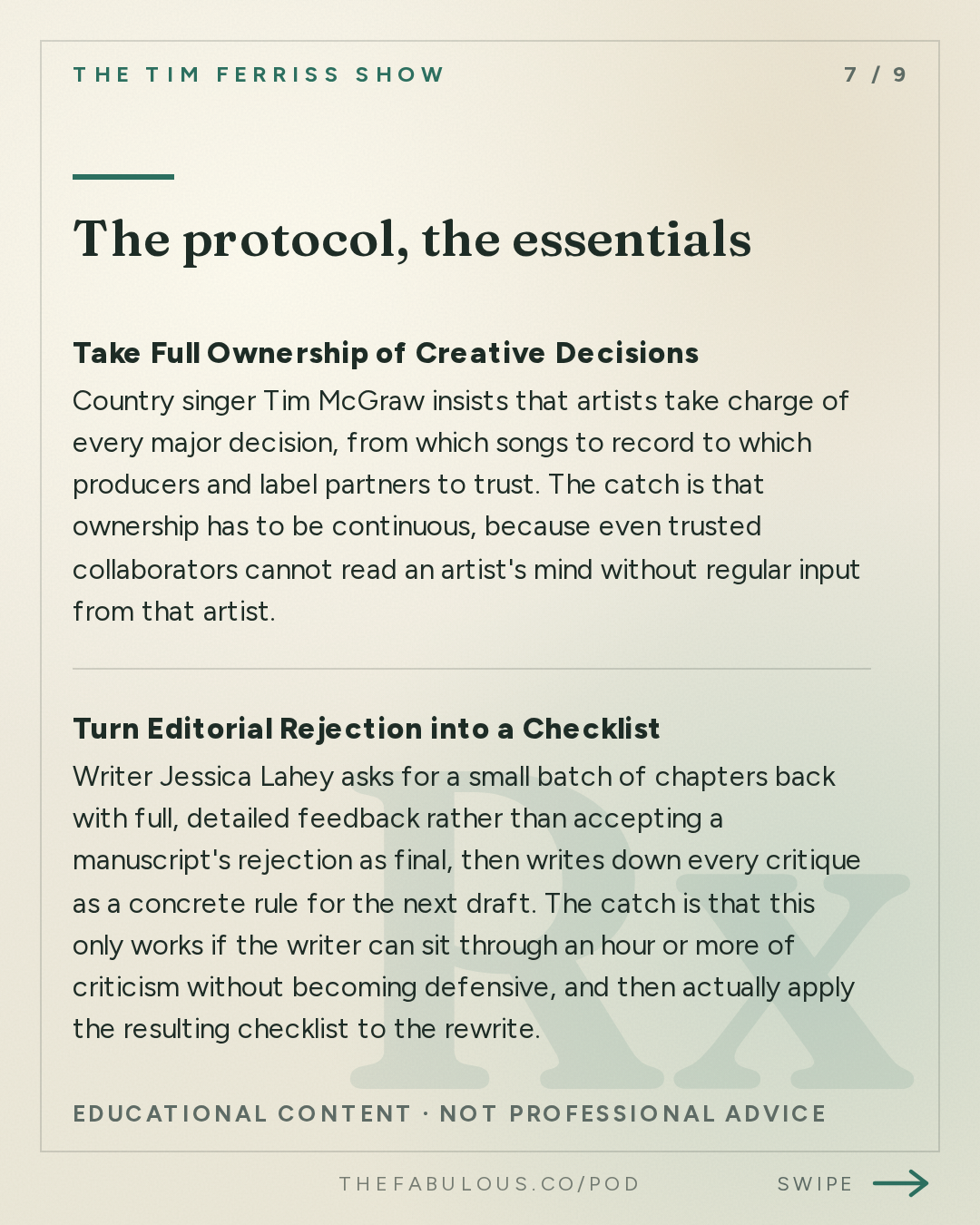
Take Full Ownership of Creative Decisions
Country singer Tim McGraw insists that artists take charge of every major decision, from which songs to record to which producers and label partners to trust. The catch is that ownership has to be continuous, because even trusted collaborators cannot read an artist's mind without regular input from that artist.
Ongoing, reinforced at the start of every new project
-
Turn Editorial Rejection into a Checklist
Writer Jessica Lahey asks for a small batch of chapters back with full, detailed feedback rather than accepting a manuscript's rejection as final, then writes down every critique as a concrete rule for the next draft. The catch is that this only works if the writer can sit through an hour or more of criticism without becoming defensive, and then actually apply the resulting checklist to the rewrite.
Once per major manuscript, reused on later books
-
Track One Step at a Time in Uncertainty
Lion tracker Boyd Varty advises looking only for the next immediate sign, what trackers call the first track, rather than trying to map the whole route in advance. The catch is that this requires becoming comfortable with not knowing the destination, which is the part most people resist.
Moment to moment, whenever facing an unclear path
Questions this episode answers
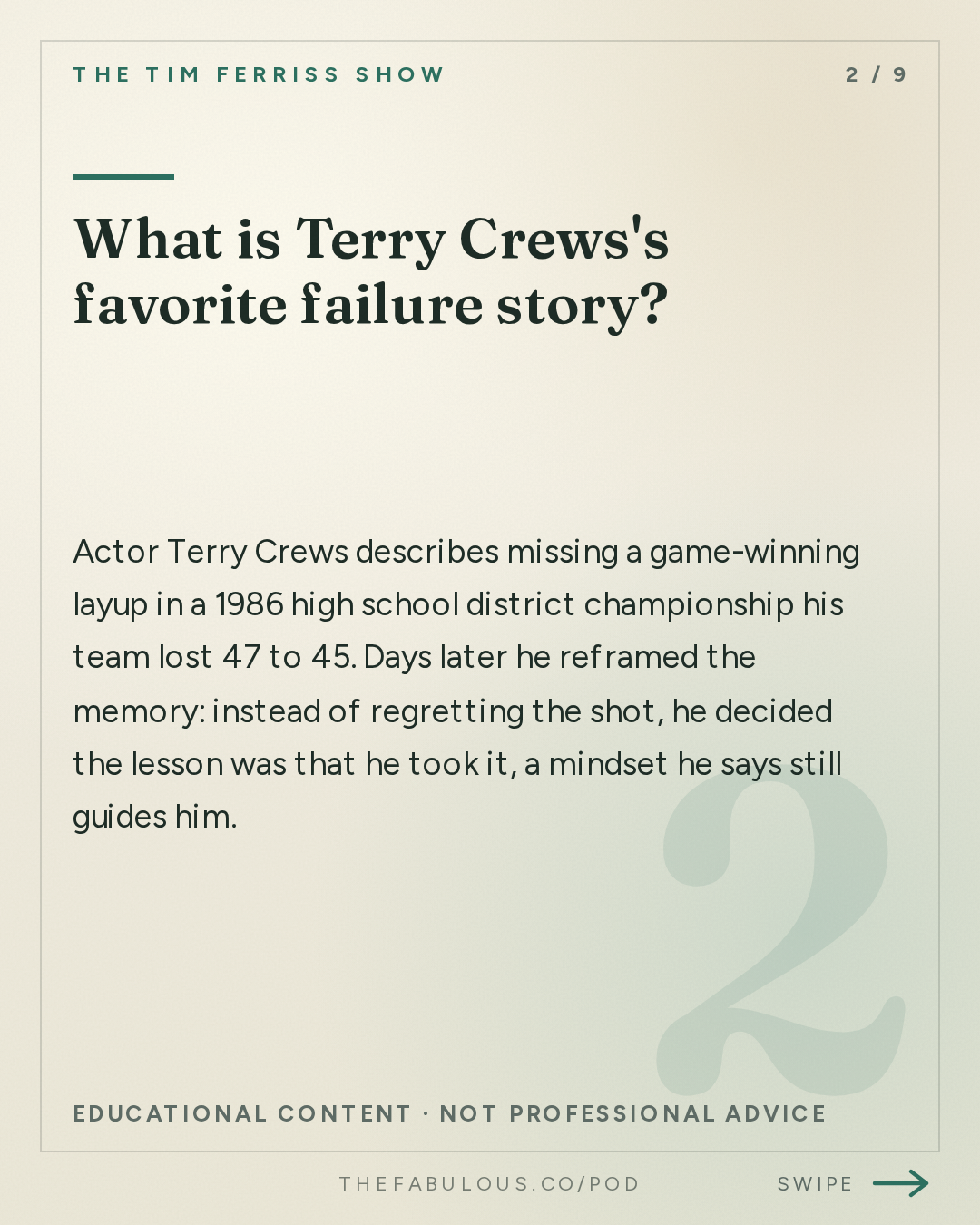
What is Terry Crews's favorite failure story?
Actor Terry Crews describes missing a game-winning layup in a 1986 high school district championship his team lost 47 to 45 (07:34). Days later he reframed the memory: instead of regretting the shot, he decided the lesson was that he took it, a mindset he says still guides him (10:48).
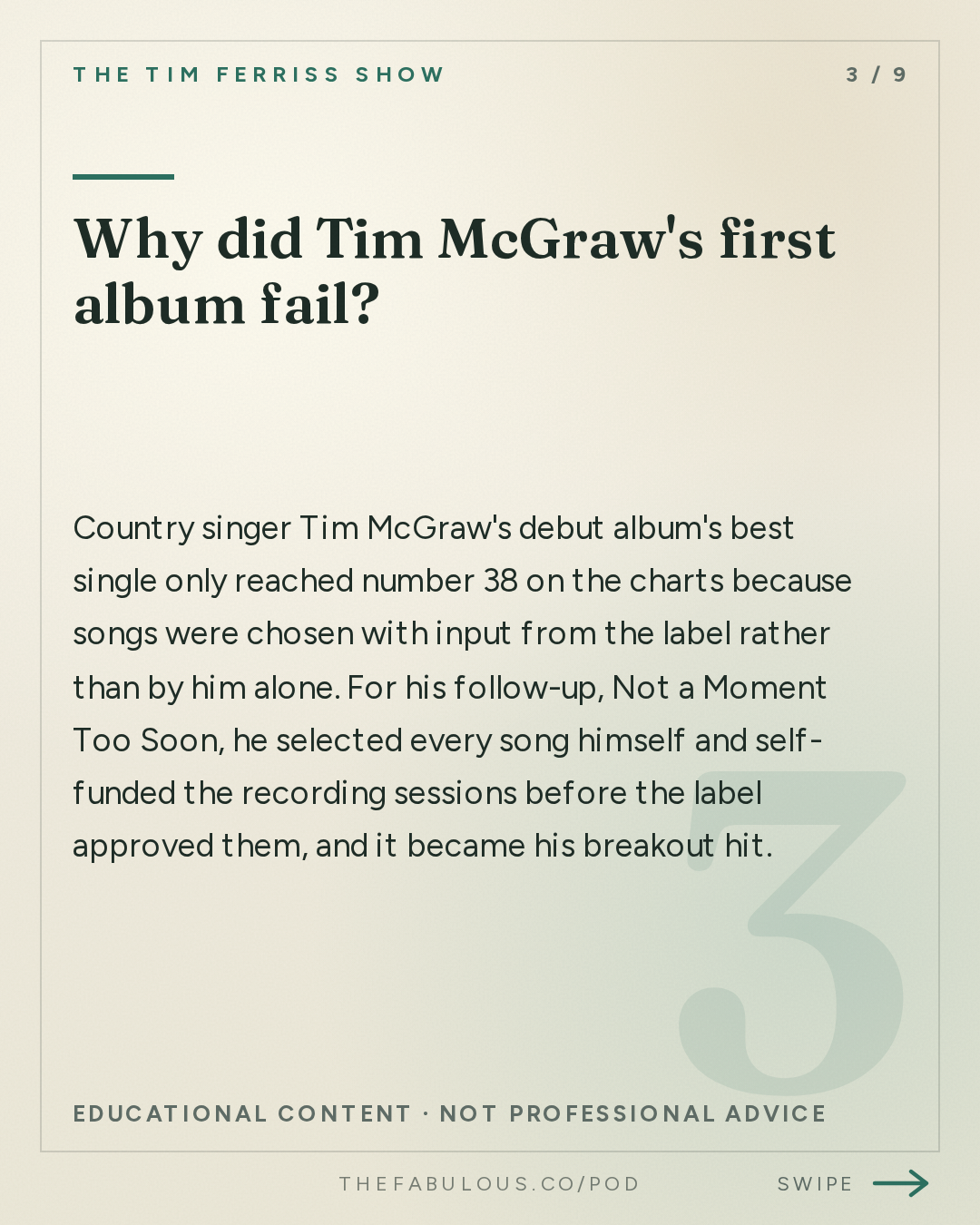
Why did Tim McGraw's first album fail?
Country singer Tim McGraw's debut album's best single only reached number 38 on the charts (17:38) because songs were chosen with input from the label rather than by him alone. For his follow-up, Not a Moment Too Soon, he selected every song himself and self-funded the recording sessions before the label approved them, and it became his breakout hit (18:41).
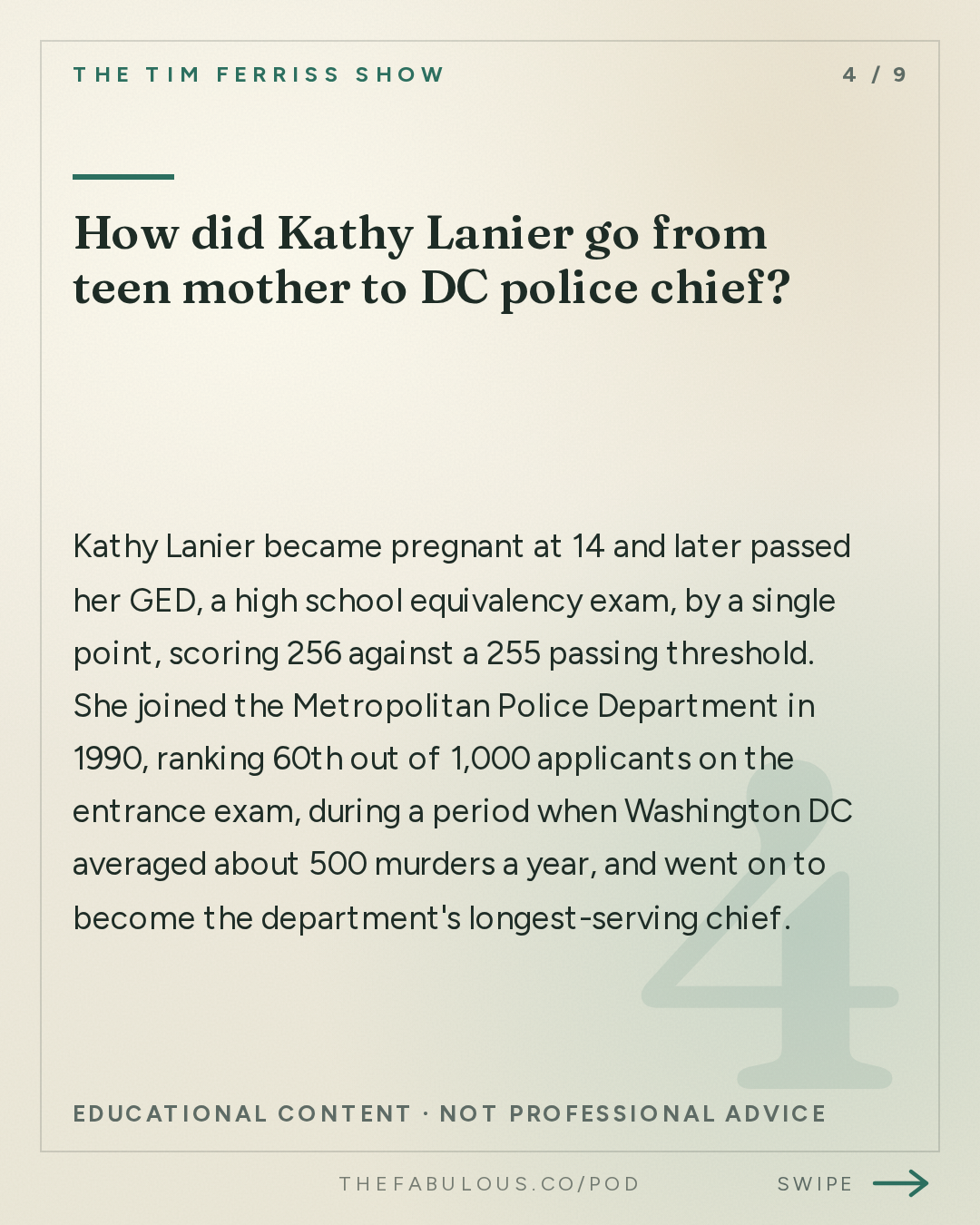
How did Kathy Lanier go from teen mother to DC police chief?
Kathy Lanier became pregnant at 14 (39:10) and later passed her GED, a high school equivalency exam, by a single point, scoring 256 against a 255 passing threshold (43:23). She joined the Metropolitan Police Department in 1990, ranking 60th out of 1,000 applicants on the entrance exam (46:44), during a period when Washington DC averaged about 500 murders a year (46:24), and went on to become the department's longest-serving chief.
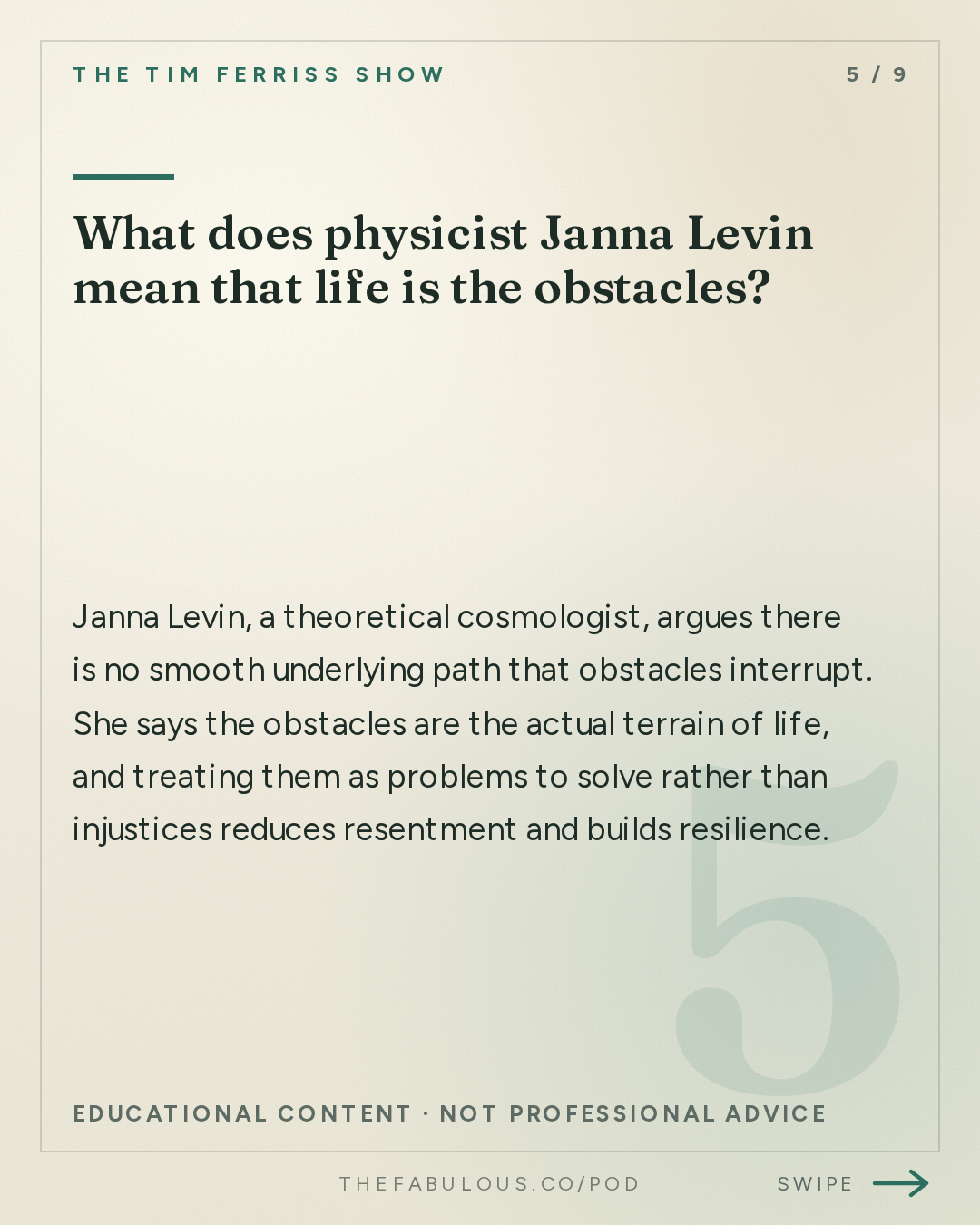
What does physicist Janna Levin mean that life is the obstacles?
Janna Levin, a theoretical cosmologist, argues there is no smooth underlying path that obstacles interrupt. She says the obstacles are the actual terrain of life, and treating them as problems to solve rather than injustices reduces resentment and builds resilience (48:15).
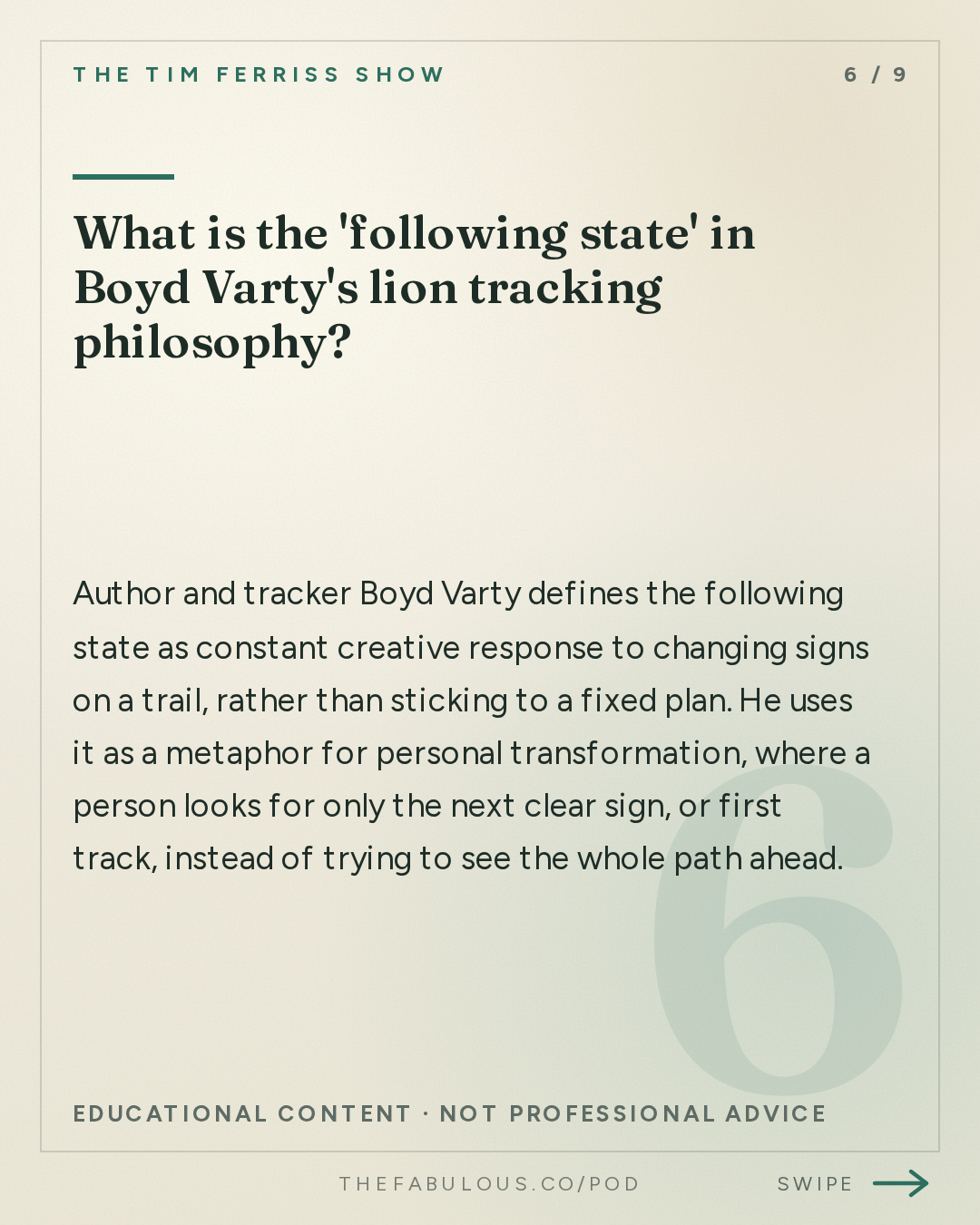
What is the 'following state' in Boyd Varty's lion tracking philosophy?
Author and tracker Boyd Varty defines the following state as constant creative response to changing signs on a trail, rather than sticking to a fixed plan (62:23). He uses it as a metaphor for personal transformation, where a person looks for only the next clear sign, or first track, instead of trying to see the whole path ahead (56:18).
The full read, in cards
Go deeper
- The Gift of Failure — Jessica Lahey's book, rejected by her editor as unpublishable before she rebuilt it using a self-made checklist
- The Lion Tracker's Guide to Life — Boyd Varty's book using lion tracking as a metaphor for navigating uncertainty without a fixed plan
- Tribe of Mentors — Tim Ferriss's earlier book, where Terry Crews and Janna Levin first shared the reframing stories discussed here
Mentioned
BJ Miller · Terry Crews · Tim McGraw · Jessica Lahey · Dax Shepard · Kathy Lanier · Janna Levin · Boyd Varty · Martha Beck · Aprilia Mana · Curb Records · Metropolitan Police Department
More from this show and category
How to Simplify Your Life: 5 Expert Tips
Five longtime guests explain how to cut overwhelm: release the identity you've outgrown, question what you only value because you own it, write down every open task before sorting it, and decline requests without an excuse. Oliver Burkeman adds that real simplicity is an attitude, not a new system.
Kevin Ryan on Spotting 10-Year Trends
Kevin Ryan, the New York investor behind DoubleClick, MongoDB, and Business Insider, says he only bets on trends built to last ten years, not passing hype. His firm AlleyCorp co-founds companies with its own $500,000 stakes, starts narrow, and now leans into deep tech like nuclear energy and psychedelic medicine, including a compound called methylone for PTSD.
How Australia Legalized Psychedelic Therapy
Australia became the first country to let doctors prescribe MDMA and psilocybin for PTSD and depression, after a five-year campaign led by two entrepreneurs with no medical background. Tania de Jong and her husband built an advisory panel, trained 750 clinicians, and drove 13,000 public submissions, pushing the regulator to reclassify both drugs in February 2023.
Mentava Reading App: Does the $500 Method Work?
Niels Hoven's startup Mentava teaches two- to five-year-olds to read using phonics and game-style motivation design, and this coaching session with Tim Ferriss becomes a working seminar on pricing, messaging, and finding uncrowded marketing channels (01:29).
