
The Psychology of Career Jolts and Quitting
Blowing Up Your Life
The brief
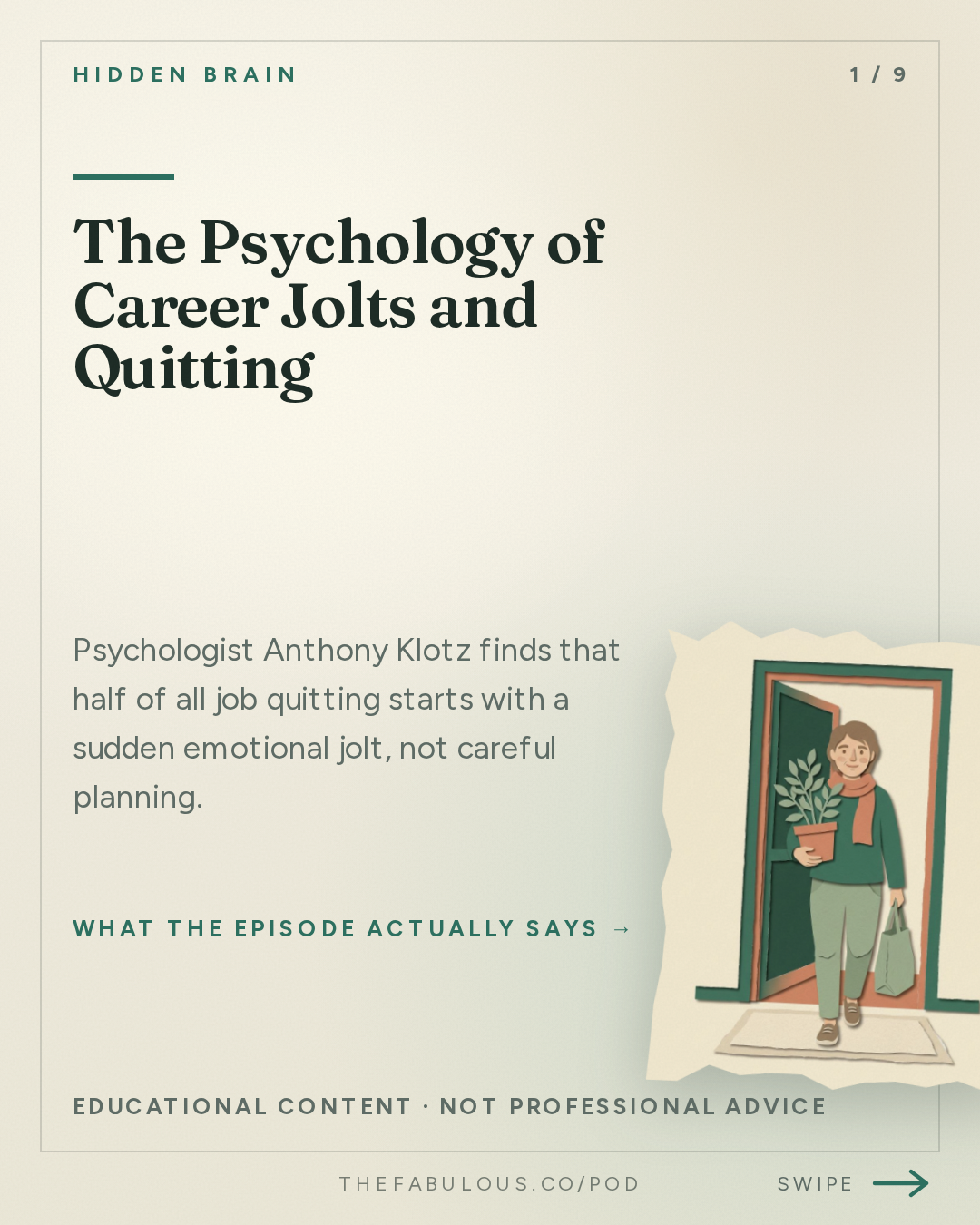
Psychologist Anthony Klotz finds that half of all job quitting starts with a sudden emotional jolt, not careful planning. Psychologist Ap Dijksterhuis adds that sleep, meditation, and walking help the unconscious mind solve problems willpower alone cannot crack.
A few weeks before his public announcement in November of 2024, Jurgen Klopp sat in a routine planning meeting for Liverpool Football Club, talking through which players to buy and sell for the following season, when an unwelcome thought arrived uninvited: I'm not sure I will be here then. Klopp was one of the most successful managers in English soccer, and Liverpool sat atop the league table. He could have brushed the thought aside. Instead he sat with it and asked himself why it had come at all (11:37). Within weeks he told the world he was stepping down at the end of the season, a decision that stunned a sport used to seeing him win.
"I know that I cannot do the job again and again and again and again, and the least thing I owe you is the truth." Jurgen Klopp, [14:52]
Psychologist Anthony Klotz, of University College London, tells Klopp's story as an example of what he calls a jolt: a sudden event, remark, or stray thought that knocks a person off autopilot and forces a reconsideration of work and life (17:22). Klotz has spent years studying why people quit their jobs, and what he found upends the tidy story most of us tell ourselves. We like to imagine that people weigh costs and benefits and arrive at decisions the way an accountant balances a ledger. In fact, Klotz says, about half of all quitting does not work that way. It starts with one sharp moment, an insult from a boss, a diagnosis, a remark overheard at a conference, and the deliberation happens after the fact, not before it (16:25).
Klotz has lived this pattern himself. As a teenager working at a lumberyard, he and a friend both asked for the same week off. When their boss accused them of colluding, both young men took off their hard hats and quit on the spot (06:59). Years later, running short on flour as a supply planner for the cereal maker General Mills, he shut down an entire production plant through an inventory mistake, an error that cost tens of thousands of dollars and left him questioning whether logistics was the right career at all (09:52). Neither event was really about the plant or the boss. Each one cracked open a question that had been sitting, unexamined, underneath a normal working life.
What makes jolts interesting is that they rarely stay in their lane. A jolt in one part of life spills into another. The actor Chris Hemsworth took a DNA test for a television show and learned he carries genes linked to a higher risk of Alzheimer's disease. The news did not make him quit acting, but it made him rebalance how much of his life went to work and how much to his family (22:16). Pat Tillman was a star safety for the Arizona Cardinals when the September 11 attacks made him feel that professional football was suddenly, unbearably small; he finished the season, walked away from a contract worth roughly four million dollars a year, and joined the Army, where he was later killed in Afghanistan (28:12). The traffic runs the other direction too. Klotz's research shows that a bad day at work, especially one involving mistreatment, tends to follow people home: they arrive more withdrawn, quicker to anger, and more likely to fight with the people they love (25:03).
The Trouble With Acting on a Jolt Alone
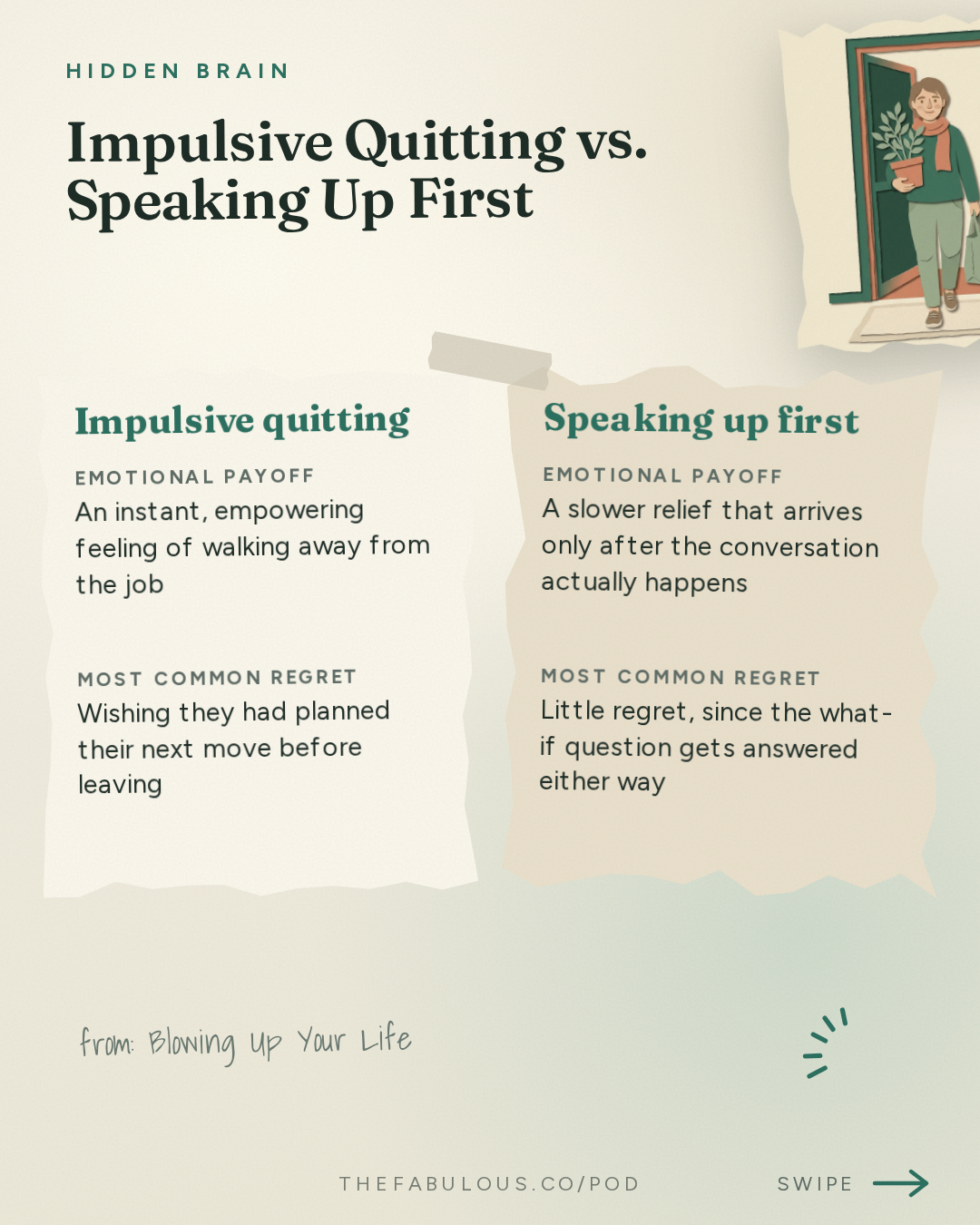
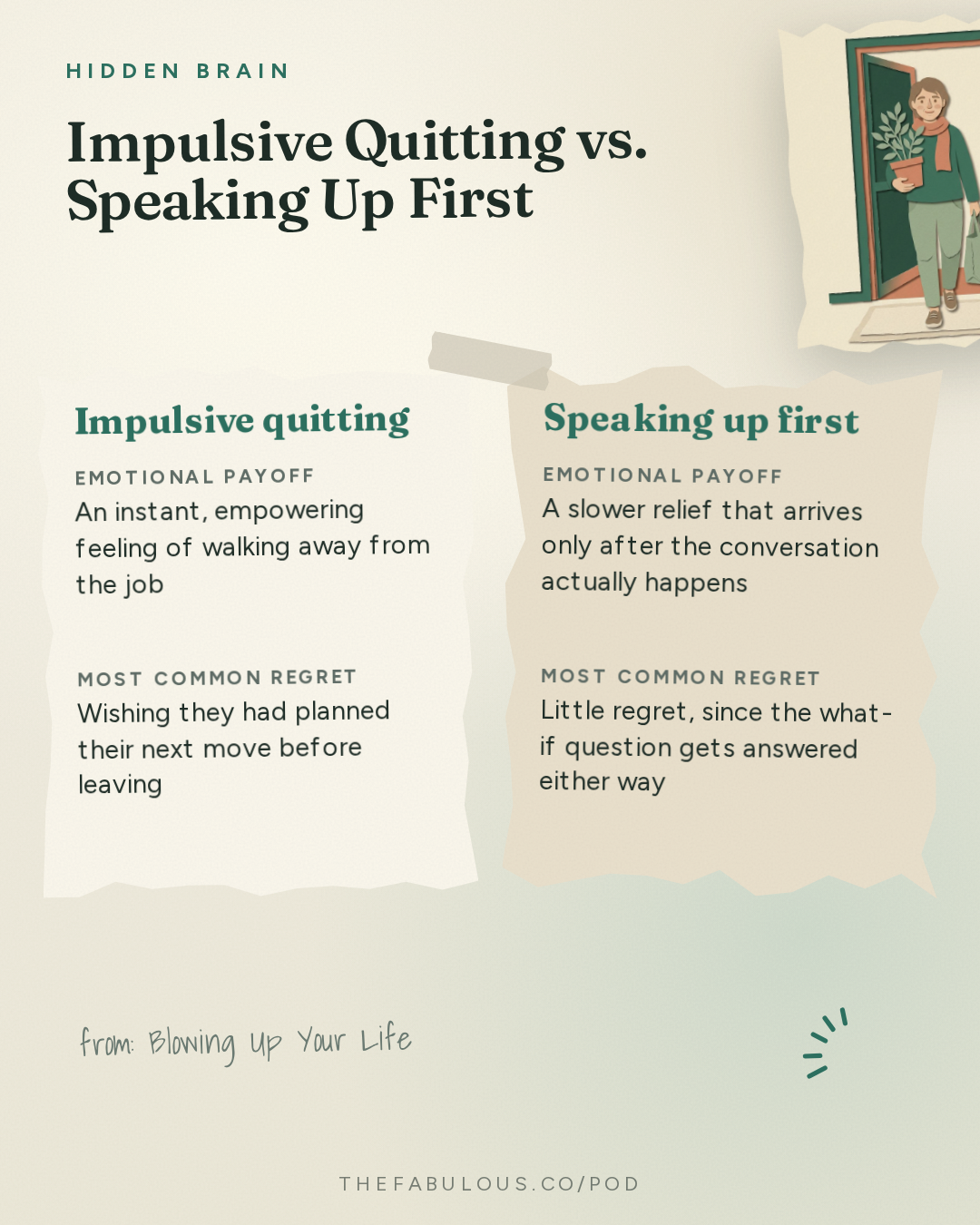
The natural response to a jolt is to act on the emotion immediately, and there is something deeply satisfying about that. Quitting on the spot flips the usual power balance: for a moment, the organization needs the worker more than the worker needs the paycheck (34:38). But Klotz's research finds that impulsive quitting usually leads to regret, and the regret rarely comes from the leaving itself.
"The regret really doesn't necessarily stem from walking away from the prior job. Often the regret comes from, 'I probably should have taken my time and figured out what I'm going to do next.'" Anthony Klotz, [35:29]
Quit without a plan, and the pressure to find income quickly often pushes a person into the next available job, which can turn out to be the same problem with a different logo (35:29). The opposite mistake, ignoring a jolt entirely, carries its own cost: a real problem with the job goes unaddressed and unrepaired (38:44). Klotz points to Bob Iger, later the chief executive of Disney, who was tempted to quit ABC Sports when a frugal new owner bought the network and several close colleagues left for flashier jobs. Human resources asked him to slow down and think it through; he did, stayed, and built the career that eventually made him CEO (42:53). Sometimes the smartest response to a jolt is to do nothing.
Between quitting and doing nothing sits a third option Klotz recommends more often than either: speaking up. His friend Jenny, worn down by a toxic coworker in a shared hospital office, did not quit and did not suffer in silence. She found an empty office elsewhere in the building, proposed the move to her boss along with a way to divide the work so the two colleagues barely had to interact, and her job satisfaction recovered (45:59). Klotz's advice for these conversations is specific. Bring a solution, not just a complaint, and make sure the solution benefits the organization or its customers, not only the person raising it (47:51). Skip the "sandwich" technique of burying bad news between compliments; the research shows it does not work when the issue is serious (48:13). And speaking up before quitting closes off the regret of wondering what might have happened.
"The nice thing about speaking up is you get rid of these what if scenarios, and you find out what is." Anthony Klotz, [49:58]
Not every jolt announces itself as clearly as Klopp's did. A listener named Eileen described feeling a jolt of intuition, "like a bolt of lightning," the night before a cross-country move with her partner, a clear signal that he had not kept a promise. She ignored it, made the move, and spent the next three and a half years in a relationship she eventually left at 62 with no income and nowhere to live (54:15). Her story is a hinge into the second half of the episode: what do we do with signals that arrive not from a dramatic external event, but from somewhere inside the mind we cannot fully see?
What the Unconscious Is Doing While We Sleep, Walk, and Sit Still
Psychologist Ap Dijksterhuis, author of the book Inspiration: Where the Best Ideas Come From, studies exactly that question. His central claim is that pushing harder on a problem often backfires, because focused conscious thought narrows attention like a bright, narrow light, while the unconscious mind works more like a light that wanders and finds connections a fixed spotlight would miss (59:50). Sleep is where much of that wandering happens. During REM sleep, the stage of sleep in which most dreaming occurs and which recurs five or six times a night, the brain builds the new associations that later surface as an idea or a solution (62:57). An automobile technician wrote in describing exactly this: falling asleep stuck on a wiring problem and waking with the fix already worked out (61:30).
Dijksterhuis also studies why some people seem to lose the knack for these breakthroughs as they age. A classic creativity test asks people to list uses for a paper clip; young children vastly outscore adults, because divergent thinking, the freewheeling, associative kind of thought, comes naturally to children, while convergent thinking, the internal editor that asks whether an idea is practical or affordable, is learned over a lifetime and gets applied earlier and earlier (67:51).
"Divergent thinking is the gas pedal in the car, and convergent thinking is the brake." Ap Dijksterhuis, [68:12]
Because the brake gets applied too soon in adulthood, Dijksterhuis looked for ways to loosen it deliberately. In one of his experiments, participants who meditated for twenty minutes became far more likely to use an answer that had been subliminally flashed on a screen before a question, evidence that a short period of Zen meditation makes it easier for information to move from the unconscious into conscious awareness (76:39). Outside the lab, he points to the classic "three Bs": bed, bus, and bath, plus, a listener named Polly's story of walking the five-hundred-mile Camino de Santiago in silence, after which she said her conscious and unconscious mind began to feel "cohesive" (79:22). Walking, meditating, and sleeping all seem to do the same underlying job: they lower the wall between the parts of the mind that talk to each other freely and the parts that usually keep quiet.
None of this works without wanting something badly enough. Dijksterhuis argues that inspiration favors people with a strong, specific goal, because a powerful goal recruits more of the brain's capacity toward solving it.
"Inspiration favors the people who really want to solve something or make something or create something." Ap Dijksterhuis, [85:41]
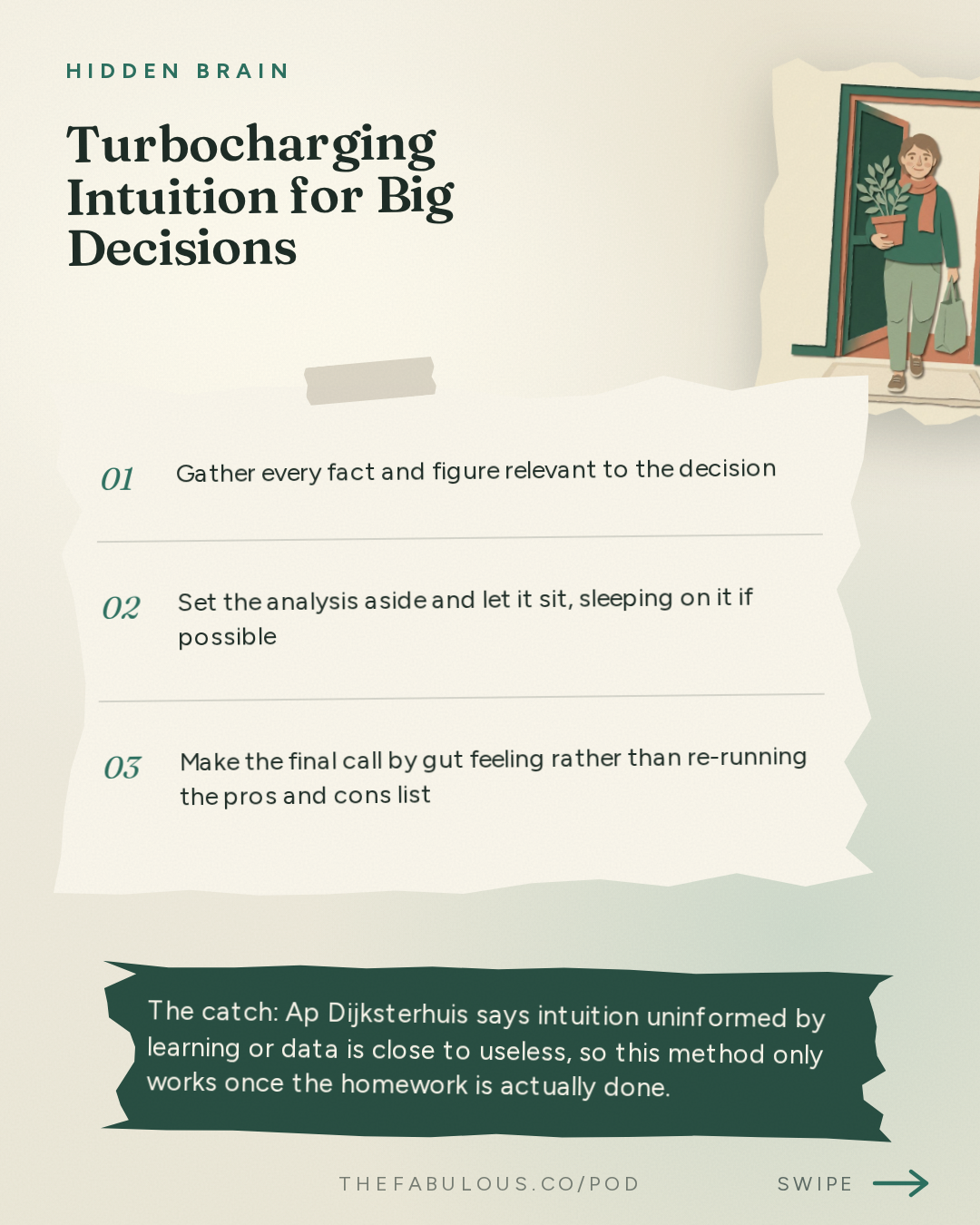
That is also why intuition works better for some decisions than others. Dijksterhuis says a purely technical choice, like which washing machine to buy, is fine to settle with a list of pros and cons. A complex, emotionally loaded decision, like buying a house or leaving a job, is a different animal, one where intuition needs to be involved (89:30). Host Shankar Vedantam recounts a conversation with the Nobel laureate economist Daniel Kahneman, whose insight he calls the cleanest version of how to combine the two: gather every relevant fact, then deliberately set the analysis aside, sometimes literally sleeping on it, and let the final call come from intuition rather than from re-running the list, a description Dijksterhuis says he completely agrees with (91:01). Intuition on its own, Dijksterhuis says, is neither reliable nor unreliable. It becomes powerful only after it has been fed by learning, discipline, and data, at which point, in his phrase, it is turbocharged.
Klopp's midmeeting thought and Eileen's bolt of lightning and the technician's solved wiring problem are all, in the end, the same kind of event: a signal from a part of the mind that has been doing quiet work the conscious mind never asked it to do. The lesson running through both halves of this conversation is not that reason should be abandoned for gut feeling, and not that intuition should be trusted blindly. It is that the two need each other, and that a life spent only reacting to jolts, or only suppressing them, misses what each is built to offer.
Ask this episode anything
Pod's AI answers from the episode itself, with the minute mark so you can hear it yourself.
Or start with one of these
Ask this episode
Pod's AI listens to the whole episode to answer, and points you to the minute it comes from.
The rest of this answer, and any question after it
Answers come from the episode itself, never from a summary of it.
ContinueKey takeaways
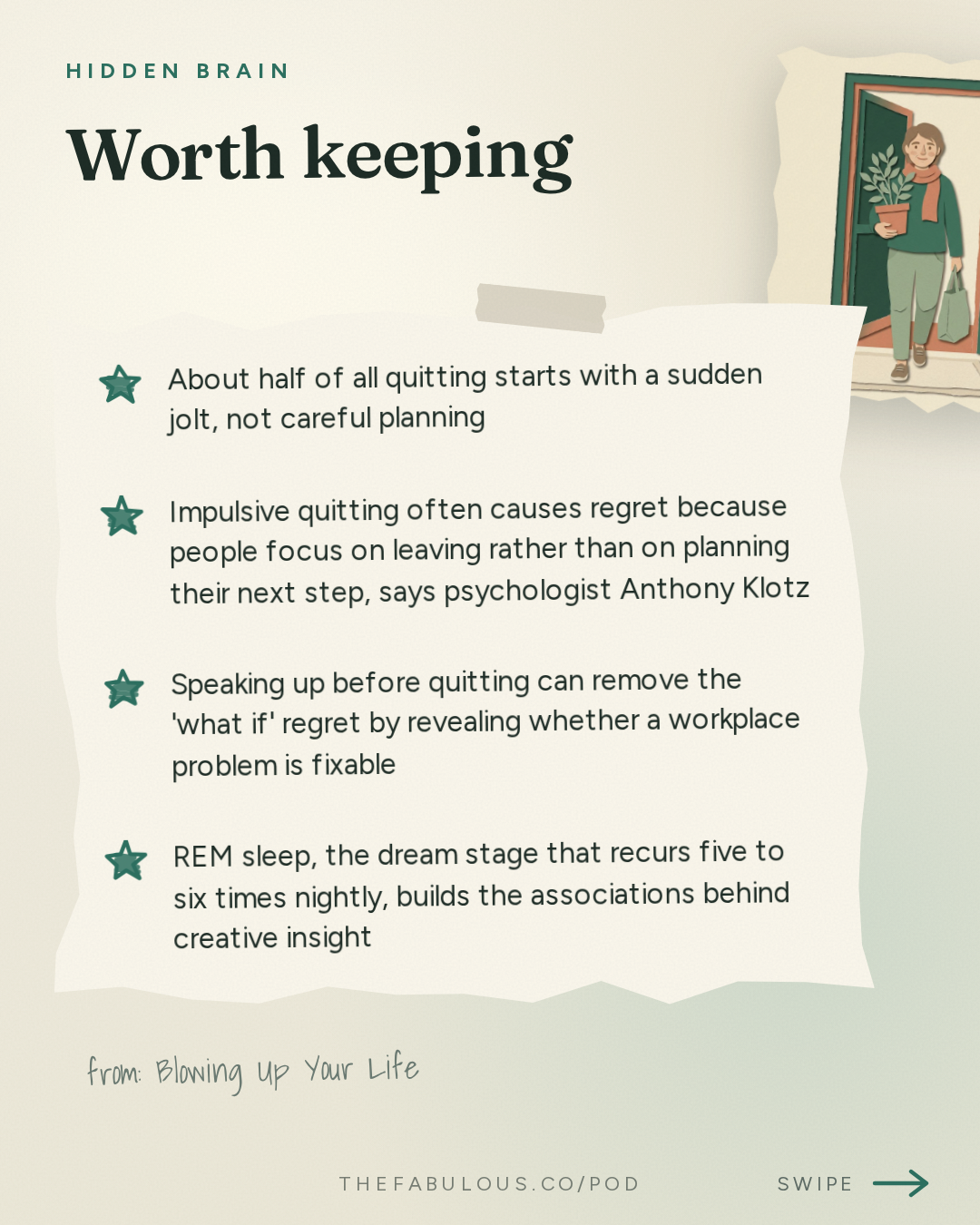
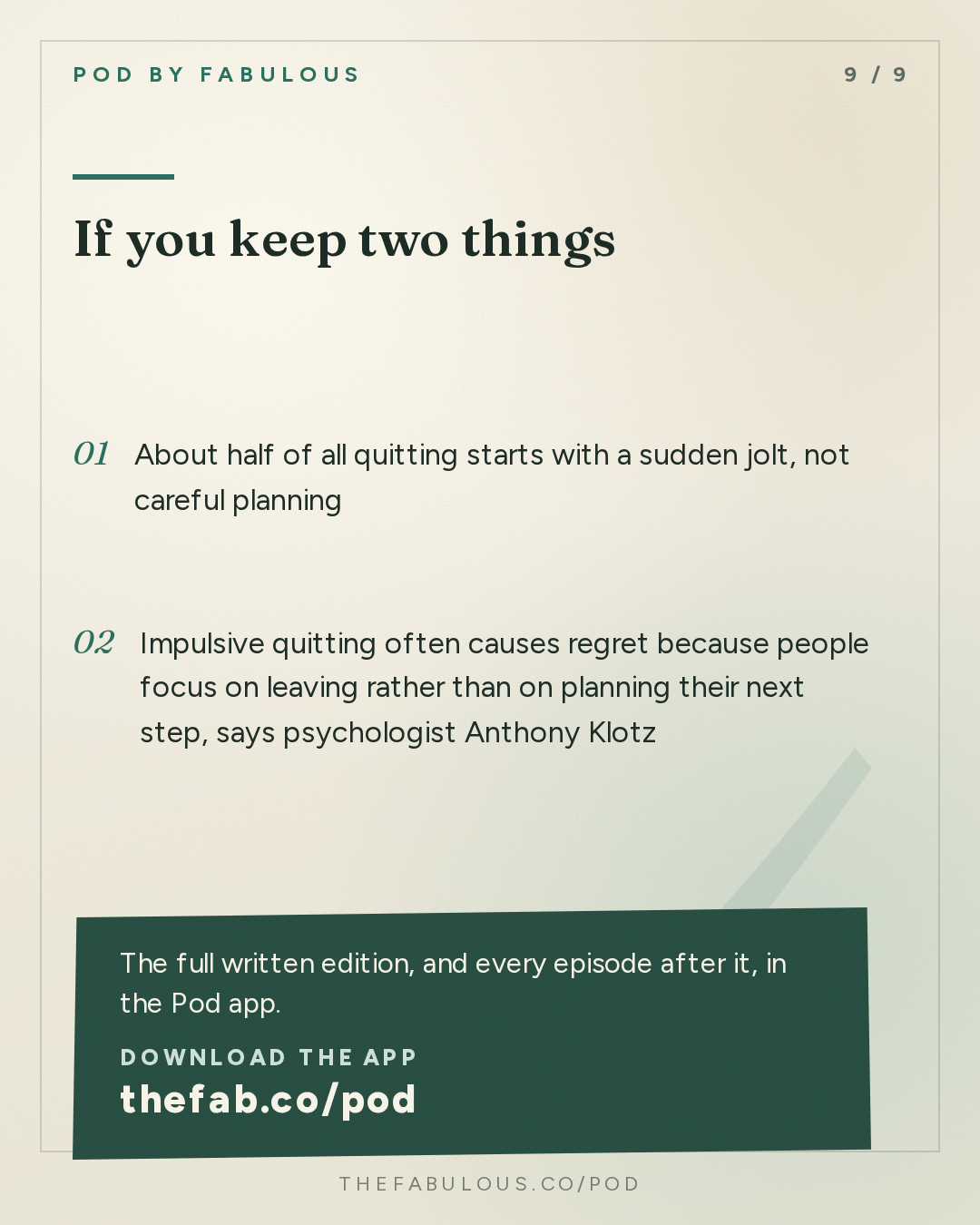
- About half of all quitting starts with a sudden jolt, not careful planning
- Impulsive quitting often causes regret because people focus on leaving rather than on planning their next step, says psychologist Anthony Klotz
- Speaking up before quitting can remove the 'what if' regret by revealing whether a workplace problem is fixable
- REM sleep, the dream stage that recurs five to six times nightly, builds the associations behind creative insight
- Twenty minutes of Zen meditation made unconscious information easier to bring into conscious awareness in Ap Dijksterhuis's study
The episode in cards
By the numbers
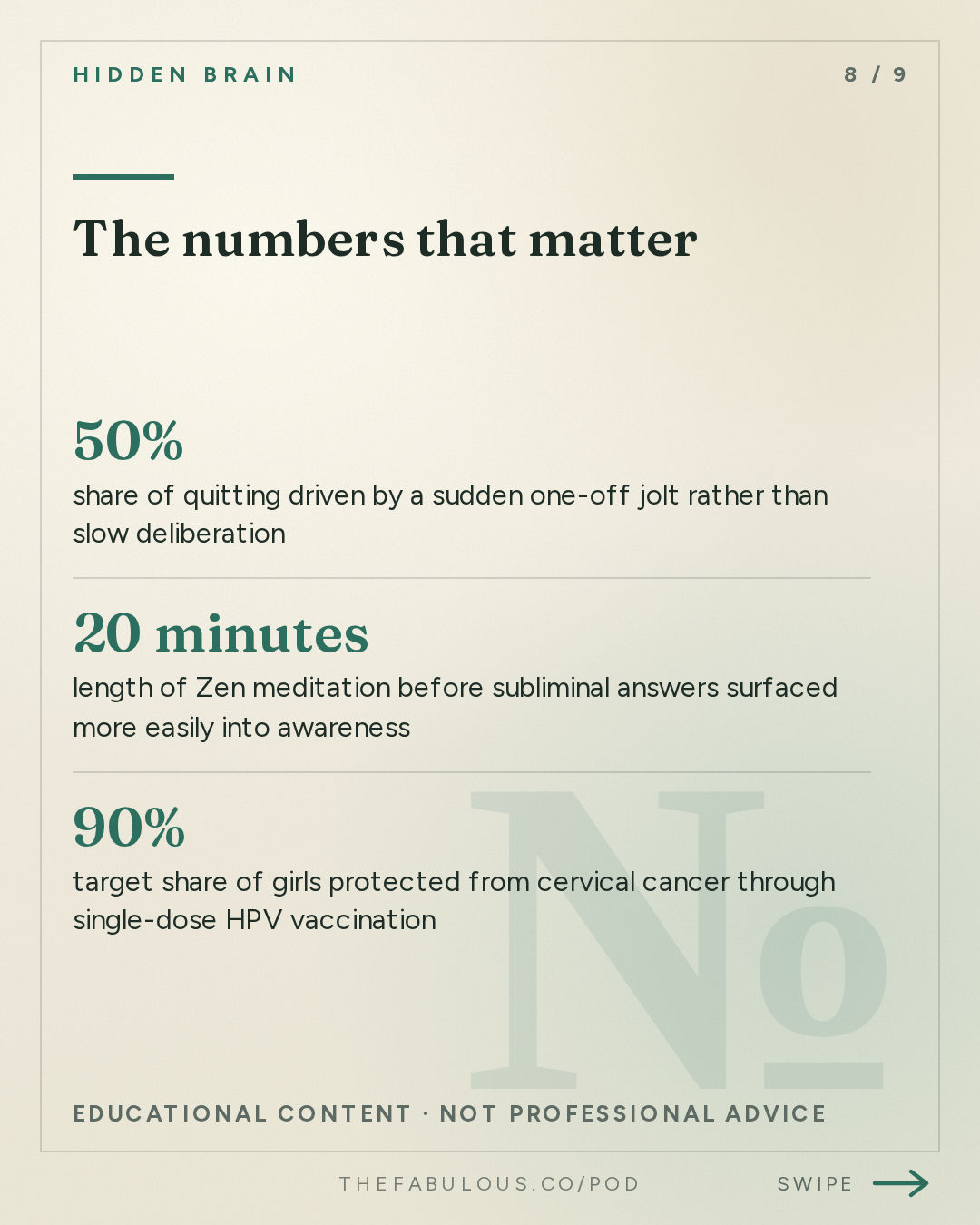
- 50% share of quitting driven by a sudden one-off jolt rather than slow deliberation
- 20 minutes length of Zen meditation before subliminal answers surfaced more easily into awareness
- 90% % target share of girls protected from cervical cancer through single-dose HPV vaccination
In their words
“I, um, know that I cannot do the job again and again and again and again, and the least thing I owe you is the truth”
“The nice thing about speaking up is you get rid of these what if scenarios, and you find out what is.”
“Divergent thinking is the gas pedal in the car, and convergent thinking is the brake.”
“Inspiration favors the people who really want to solve something or make something or create something.”
Protocols
-
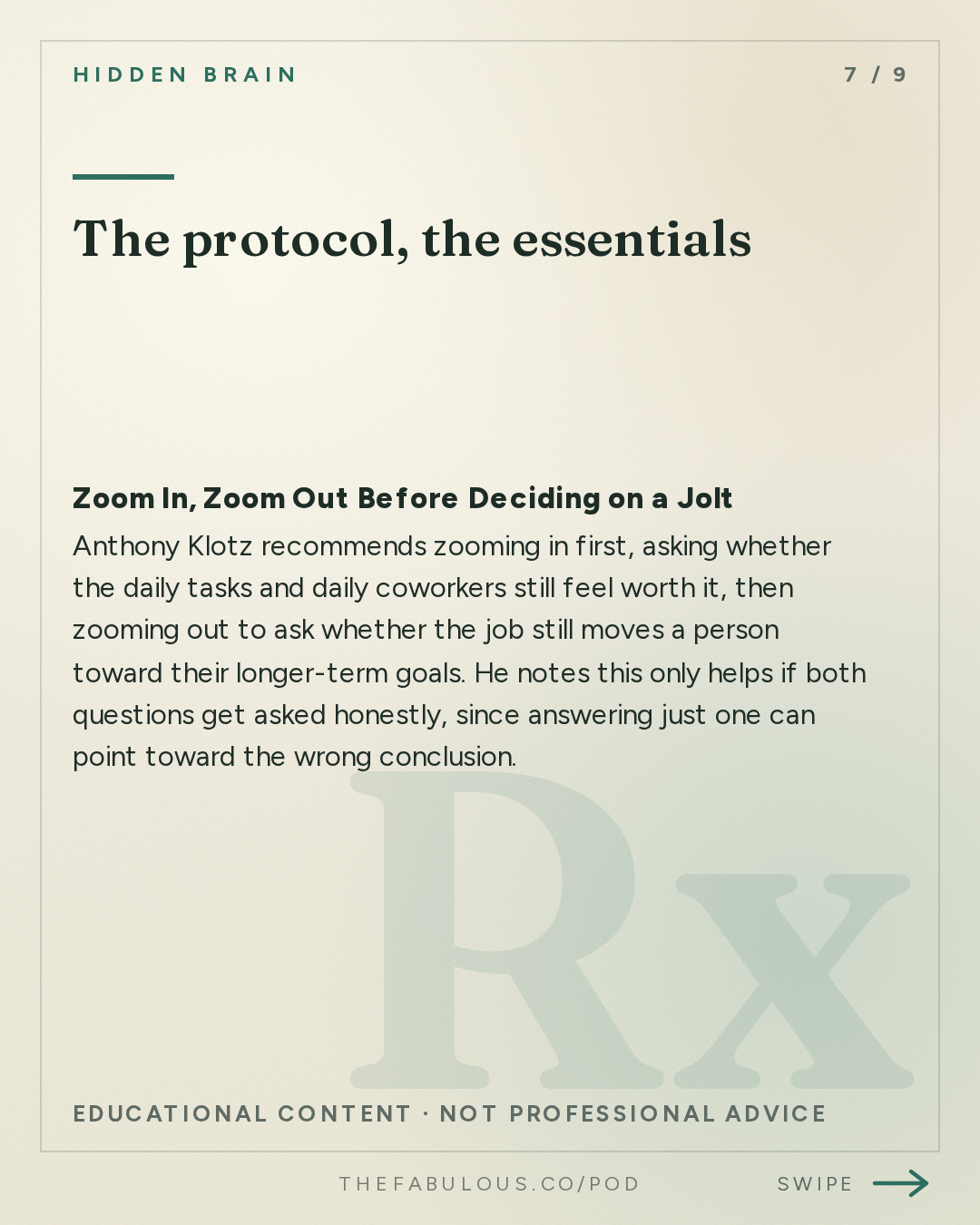
Zoom In, Zoom Out Before Deciding on a Jolt
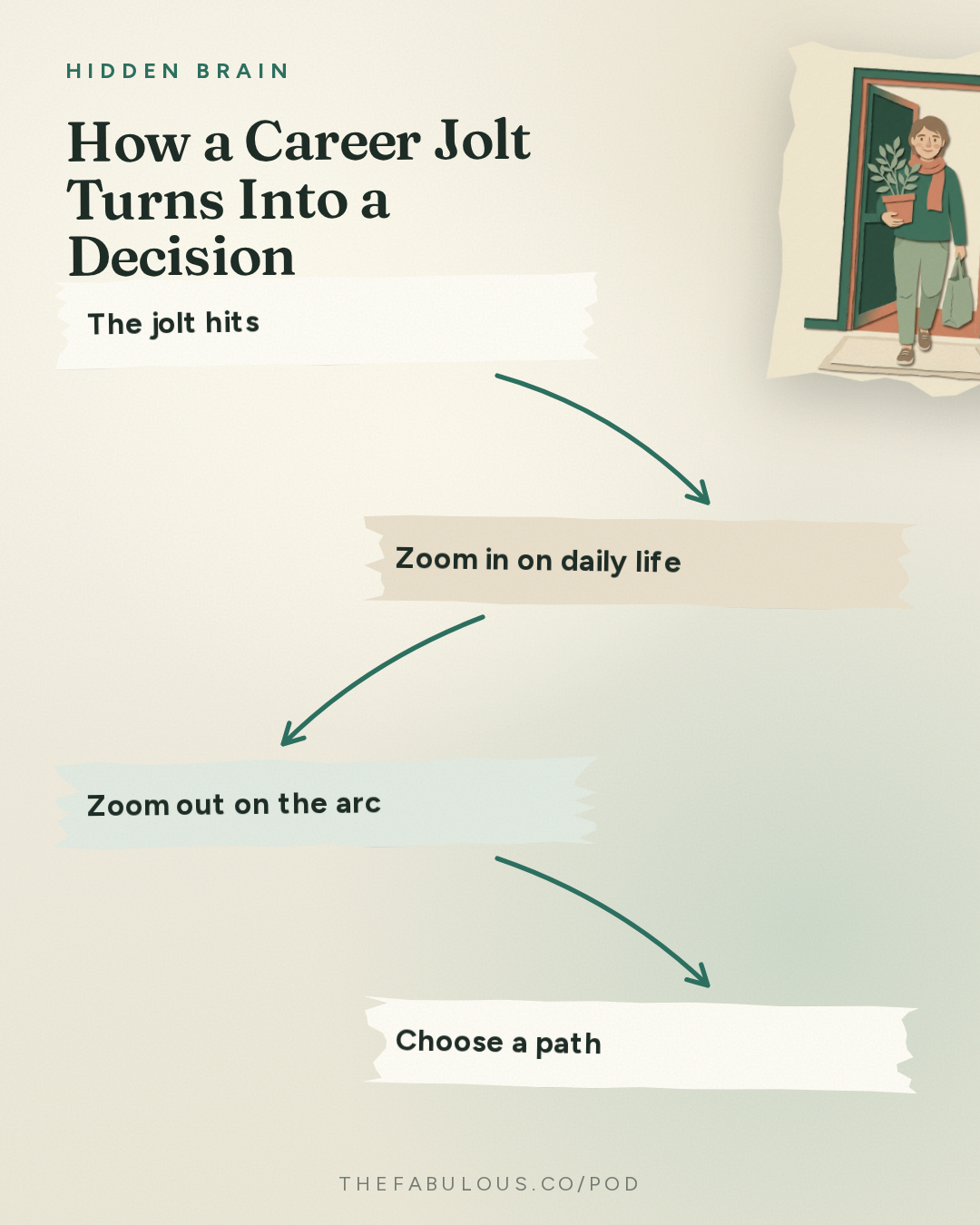
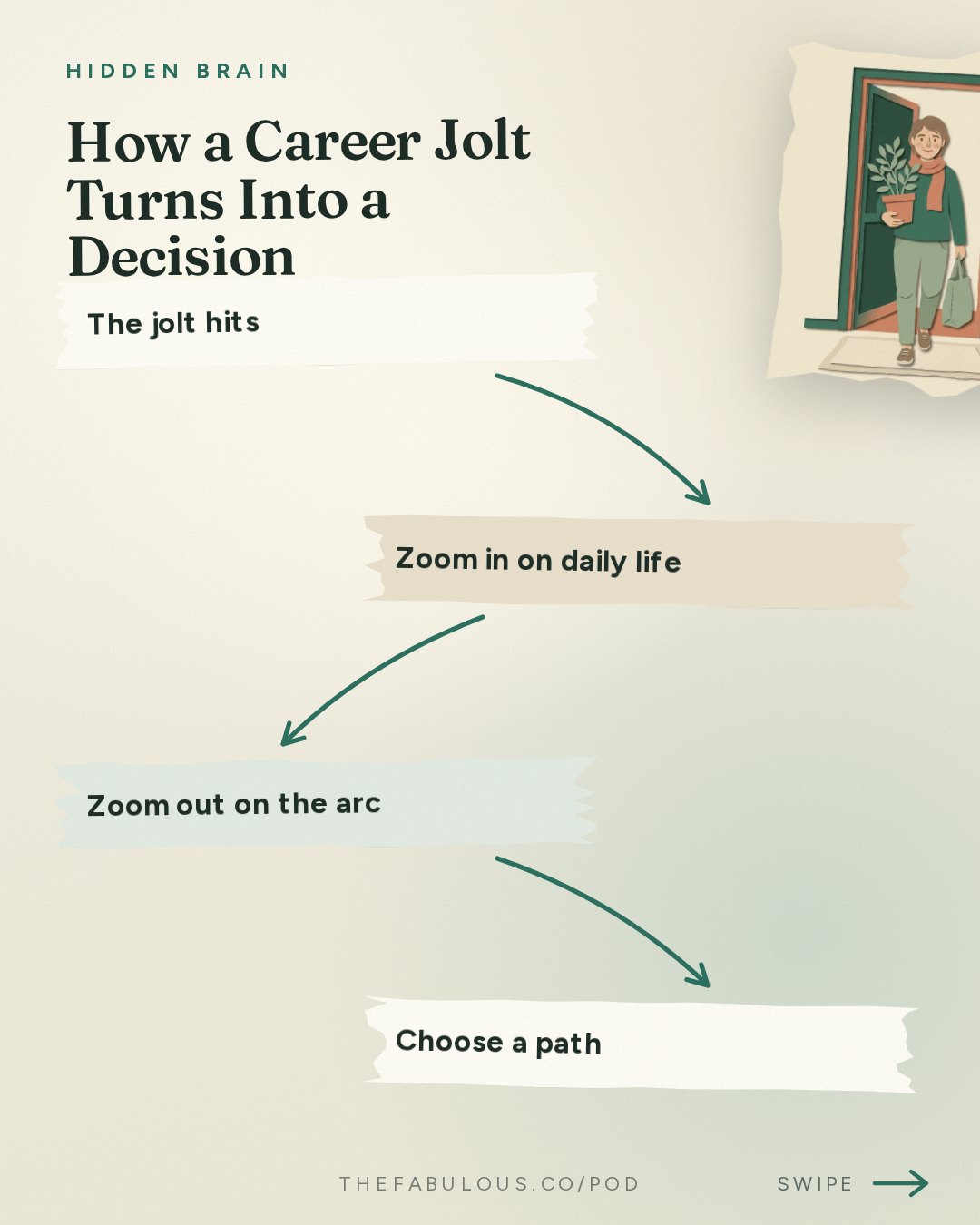
Anthony Klotz recommends zooming in first, asking whether the daily tasks and daily coworkers still feel worth it, then zooming out to ask whether the job still moves a person toward their longer-term goals. He notes this only helps if both questions get asked honestly, since answering just one can point toward the wrong conclusion.
After any workplace jolt, before deciding to quit, stay silent, or speak up
-
Raise a Problem Before Deciding to Quit
Anthony Klotz advises bringing a proposed solution along with any complaint, and framing that solution so it benefits the organization, its customers, or coworkers, not only the person raising it. He warns that the 'sandwich' technique of hiding bad news between compliments backfires on serious issues, so the problem should be stated plainly, phrased as a question if the boss tends to be domineering.
Whenever a jolt reveals a fixable problem at work
-
Gather Data, Then Decide by Gut
Ap Dijksterhuis, citing economist Daniel Kahneman, describes gathering every relevant fact and figure for a complex decision, then deliberately setting that analysis aside, sometimes sleeping on it, before making the final call by intuition rather than by re-running the pros and cons. He cautions that this only works for complex, emotionally loaded choices like a house or a career move, since a simple technical decision is better left to the numbers alone.
For major, emotionally complex decisions
Questions this episode answers
What is a career jolt and how common is it?
A jolt is a sudden event, remark, or thought that knocks someone out of routine and forces a rethink of their job, a concept from psychologist Anthony Klotz's research. About half of all quitting starts this way rather than through slow, rational planning (16:25).
Does quitting a job impulsively lead to regret?
Anthony Klotz's research finds that impulsive quitters usually do feel regret, but it rarely comes from leaving itself. It comes from not having planned a next step, which often pushes people into taking the next available job out of urgency (35:29).
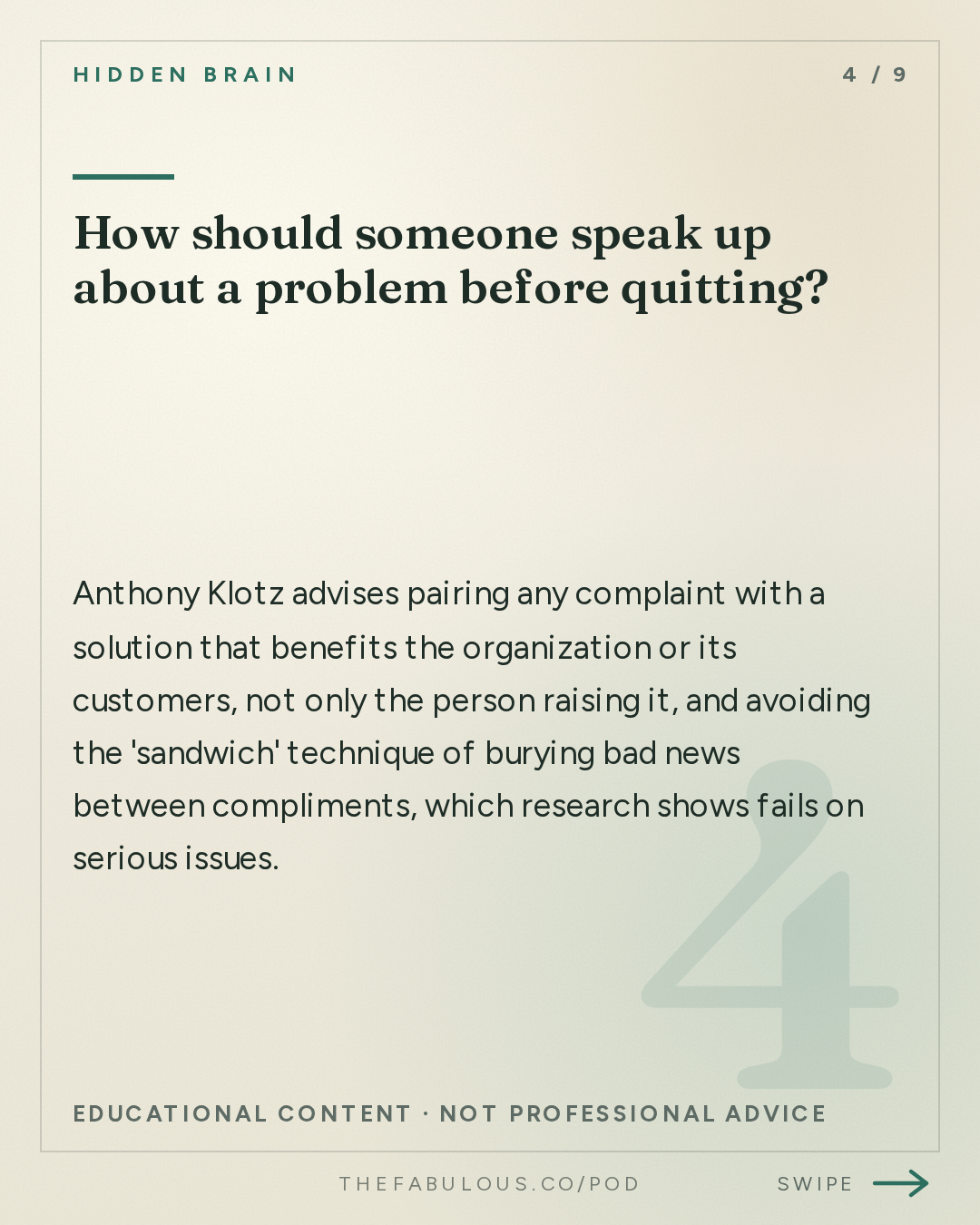
How should someone speak up about a problem before quitting?
Anthony Klotz advises pairing any complaint with a solution that benefits the organization or its customers, not only the person raising it, and avoiding the 'sandwich' technique of burying bad news between compliments, which research shows fails on serious issues (47:51, 48:13).
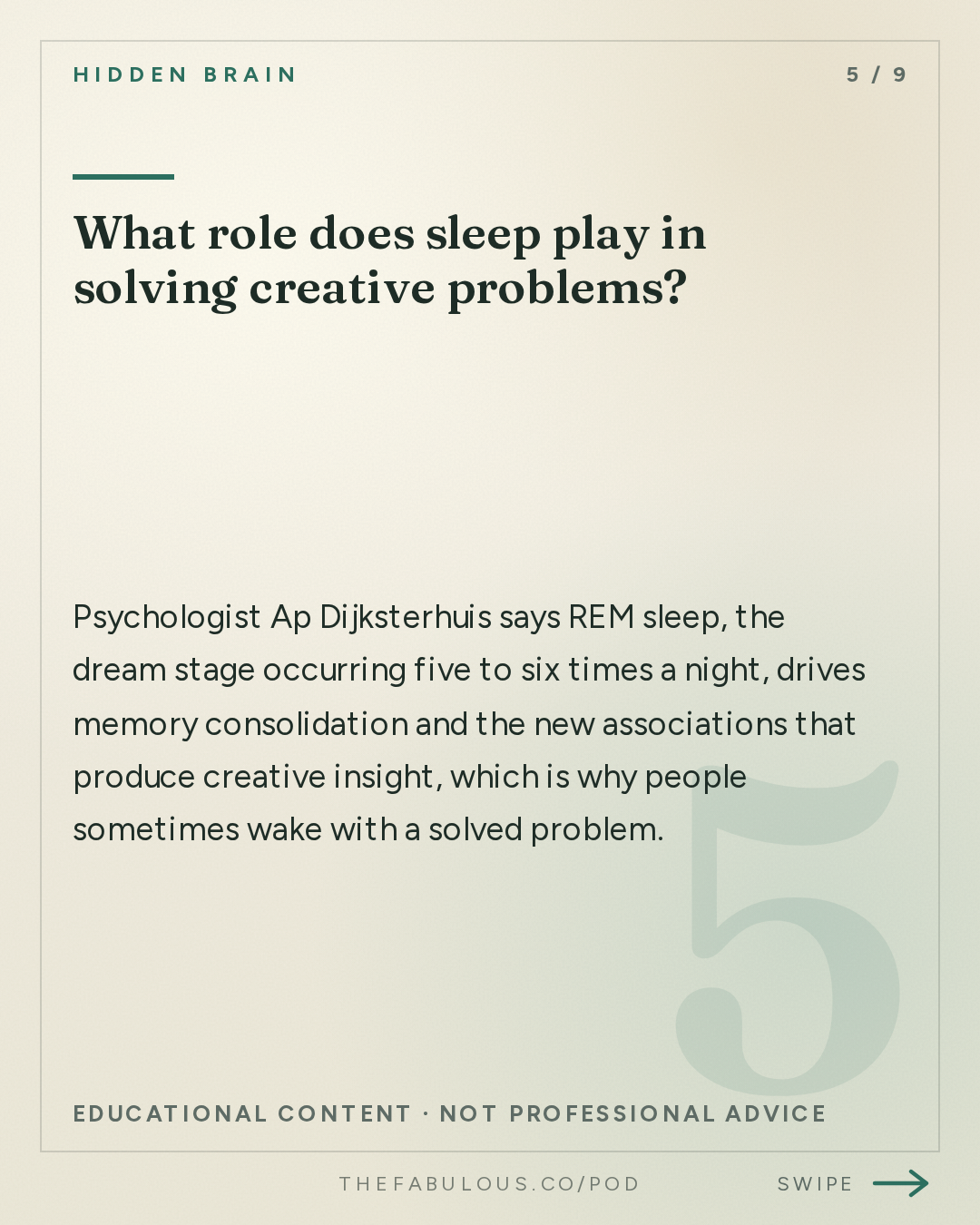
What role does sleep play in solving creative problems?
Psychologist Ap Dijksterhuis says REM sleep, the dream stage occurring five to six times a night, drives memory consolidation and the new associations that produce creative insight, which is why people sometimes wake with a solved problem (62:57).
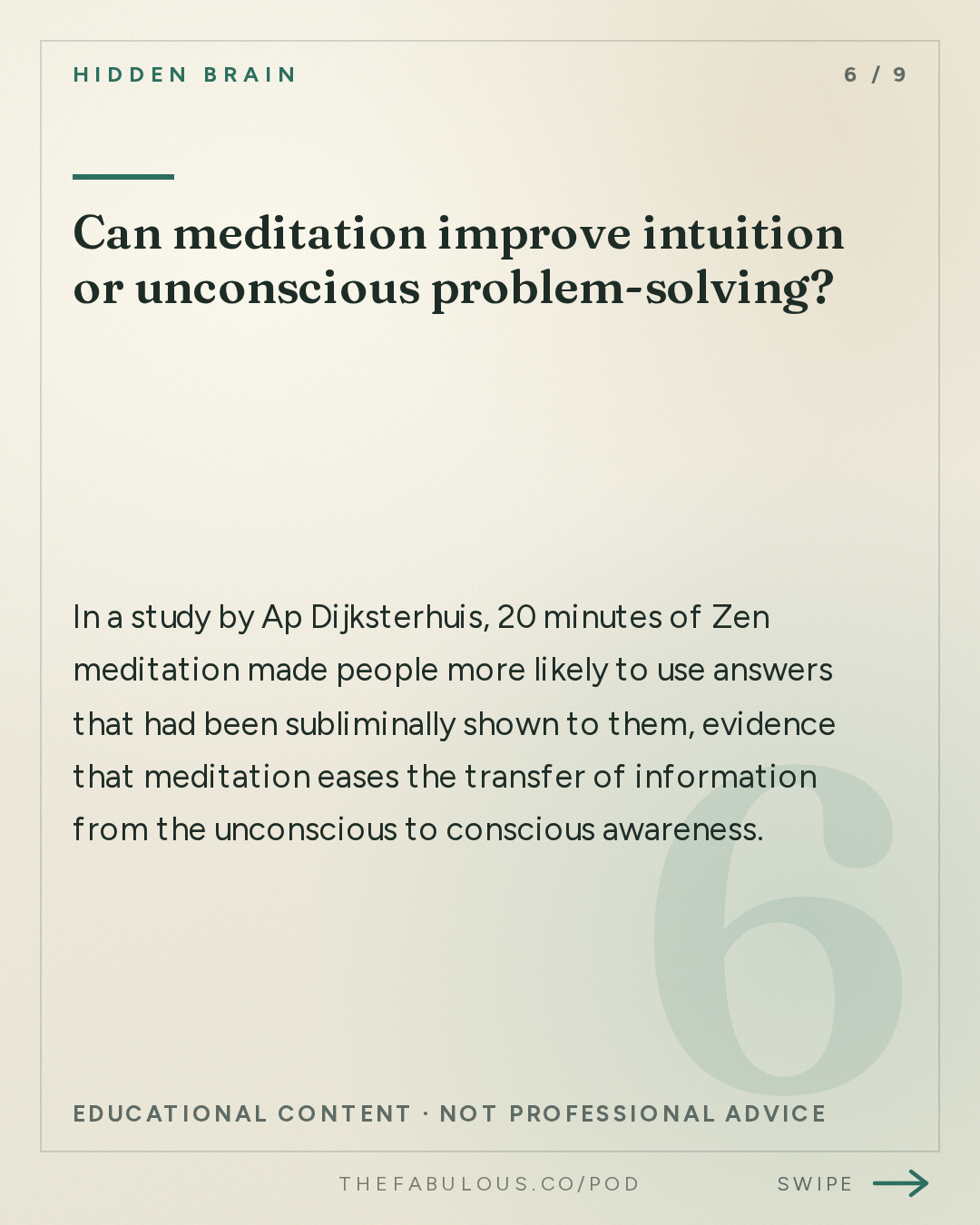
Can meditation improve intuition or unconscious problem-solving?
In a study by Ap Dijksterhuis, 20 minutes of Zen meditation made people more likely to use answers that had been subliminally shown to them, evidence that meditation eases the transfer of information from the unconscious to conscious awareness (76:39).
When is it better to trust intuition over data?
Ap Dijksterhuis says technical decisions, like choosing a washing machine, are best settled with data alone, while complex, emotionally loaded decisions, like a house or a career move, benefit from gathering the data first and then deciding by intuition, a method he attributes to economist Daniel Kahneman (89:30, 91:01).
The full read, in cards
Go deeper
- Jolted: Why We Quit, When to Stay, and Why It Matters — Anthony Klotz's research on career jolts, quitting, and how to respond to them
- Inspiration: Where the Best Ideas Come From — Ap Dijksterhuis's synthesis of research on unconscious thought and creativity
- Classic paper clip creativity study — Found young children score far higher than adults on divergent-thinking tests like listing uses for a paper clip
- Dijksterhuis Zen meditation priming study — Found 20 minutes of Zen meditation increased use of subliminally primed answers, showing easier unconscious-to-conscious transfer
Mentioned
Anthony Klotz · Ap Dijksterhuis · Jurgen Klopp · Chris Hemsworth · Pat Tillman · Bob Iger · Daniel Kahneman · Dan McAdams · University College London · General Mills · Jolted: Why We Quit, When to Stay, and Why It Matters · Inspiration: Where the Best Ideas Come From
More from this show and category
How Sleep Deprivation Affects Decisions
Sleep deprivation degrades ethical judgment and decision-making in novel situations, contributing to disasters from train crashes to BP's 2005 explosion. Chronic pain, meanwhile, is reshaped by fear, relationships, and mindset as much as by tissue damage, per sleep researcher Chris Barnes and pain psychologist Rachel Zoffness.
Why Am I Unhappy? The Psychology Behind It
Psychologists George Loewenstein and Alison Ledgerwood argue that most unhappiness starts inside the mind, not from outside events. Loewenstein traces it to the hedonic treadmill and guilt over our own feelings; Ledgerwood traces it to a negativity bias built to spot threats. Their shared fix: notice good moments without suppressing bad ones, and ask whether a reaction fits now or an old pattern (96:51).
How to Build Agency: Martin Seligman's Method
Martin Seligman argues that agency, the belief that our actions can change outcomes, is a skill built through specific exercises, not an inherited trait. He describes three tools, disputing catastrophic thoughts, graded task assignment, and writing about a best possible self, backed by decades of research on optimism and helplessness.
Seligman on Learned Helplessness and Optimism
Psychologist Martin Seligman found that helplessness is learned, and so is optimism. His research links explanatory style to depression risk, predicts success at West Point and in sales, and traces a psychological theory of human progress from ancient Greece to St. Augustine to modern China.
