
Claude Hopkins' Advertising Principles Explained
#430 How to Write Ads That Sell
The brief
Claude Hopkins, an early 1900s copywriter, built advertising on service, proof, and precise headlines instead of boasting. Drawing on his own 16-hour workdays (04:47) and case studies from Schlitz beer and Pepsodent, he showed that demonstrations beat claims, specific numbers beat superlatives, and a single headline can multiply an ad's returns five to ten times (56:37).
In the early 1900s, a copywriter named Claude Hopkins handed his employer a manuscript that explained, in plain language, exactly how he made advertising work. The employer, Albert Lasker, an advertising executive who made more money in the trade than anyone before him, read it and said no. Lasker locked the manuscript in a safe and left it there for twenty years, because he judged the ideas too valuable to give away while he was still using them to get rich (02:22). When Hopkins finally published that manuscript, called Scientific Advertising, it went on to sell close to eight million copies (01:59) and became required reading for a generation of admen, including David Ogilvy, who said he built his own agency on Hopkins' ideas.
That story is a fair test of whether an idea is worth stealing: someone tried to keep it locked away for two decades. What follows is not really a history lesson. It is a set of habits, mostly about attention and honesty, that one man arrived at by working an extreme number of hours and writing down what he learned. Hopkins is blunt about the method. He worked roughly sixteen hours a day for sixteen straight years as an adult, rarely taking an evening or a Sunday off, after supporting himself since age nine as a child (04:47). "I am not advising others to follow my example," he writes, "but the man who works twice as long as his fellows is bound to go twice as far, especially in advertising." He insists the gap was not talent. It was hours.
That claim is easy to wave off as workaholic mythmaking, except the book keeps circling back to something more useful than hustle: attention paid closely enough, for long enough, turns up things casual effort never finds. A railroad section foreman taught Hopkins this as a boy, arguing that work and play are the same activity wearing different names, separated only by whether the result is useful (09:13). Hopkins never let go of the idea. Decades later he still called business "the most fascinating game" he knew (10:36).
The clearest early lesson in the book has nothing to do with copywriting technique. As a child, Hopkins sold his mother's homemade silver polish door to door. Describing the product converted about one woman in ten. Getting inside the house to demonstrate it converted nearly everyone (13:02). "A good product is its own best salesman," he concluded. "It is uphill work to sell goods without samples." That single ratio, one in ten against nearly all, is the whole case for proof over persuasion. Decades later the cosmetics entrepreneur Estee Lauder ran her business on almost the identical insight, handing out free lipstick and perfume on the street rather than spending the same money on advertising claims, betting that a good product plus a customer's instinct to reciprocate a gift would sell more than any slogan. Hopkins would have approved, with one condition he insists on: sampling only works when the customer asks first. Handing products to people who never requested them, he warns, is "a very bad plan indeed," because unearned things get no respect (37:53).
Tell the Truth, Loudly
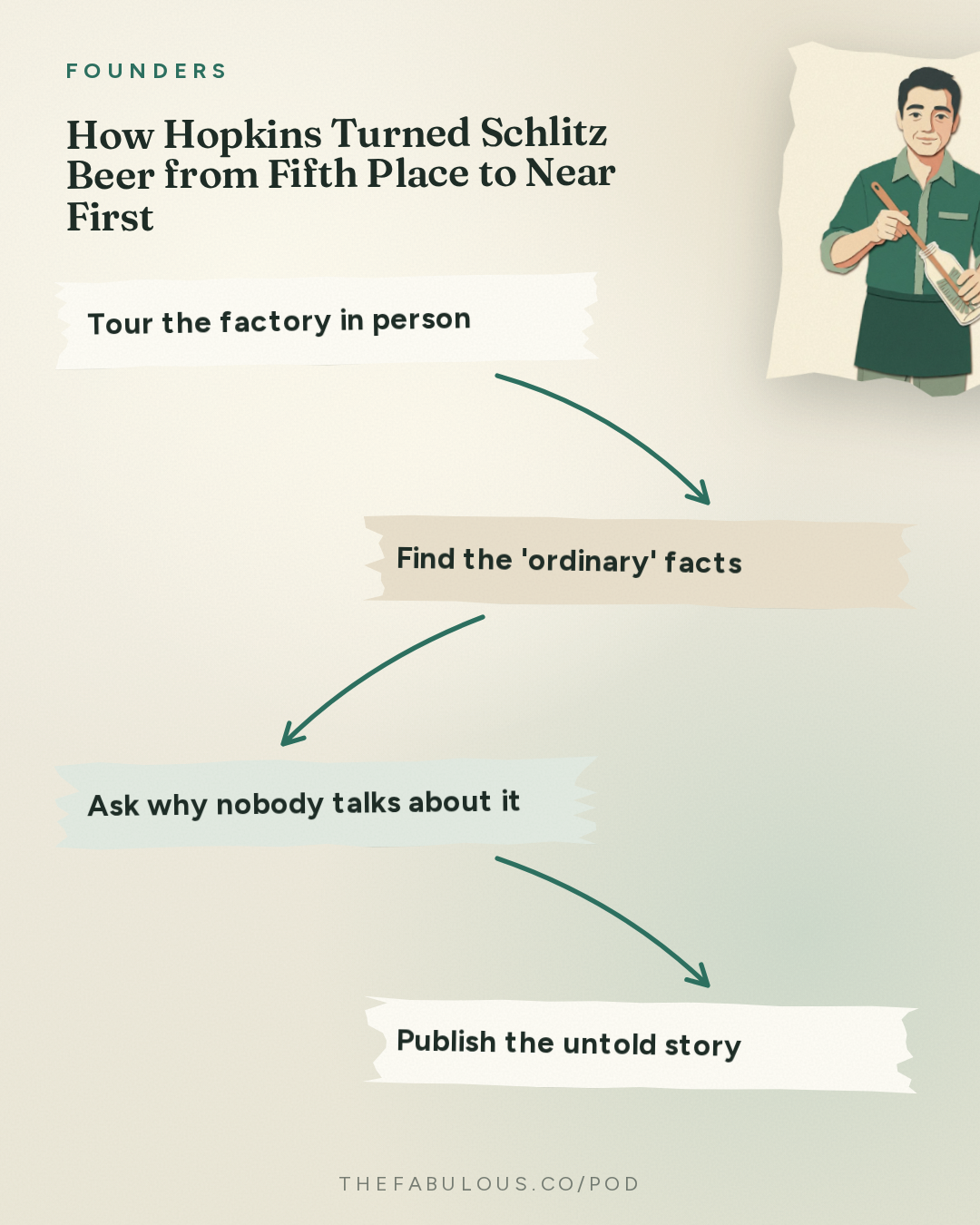
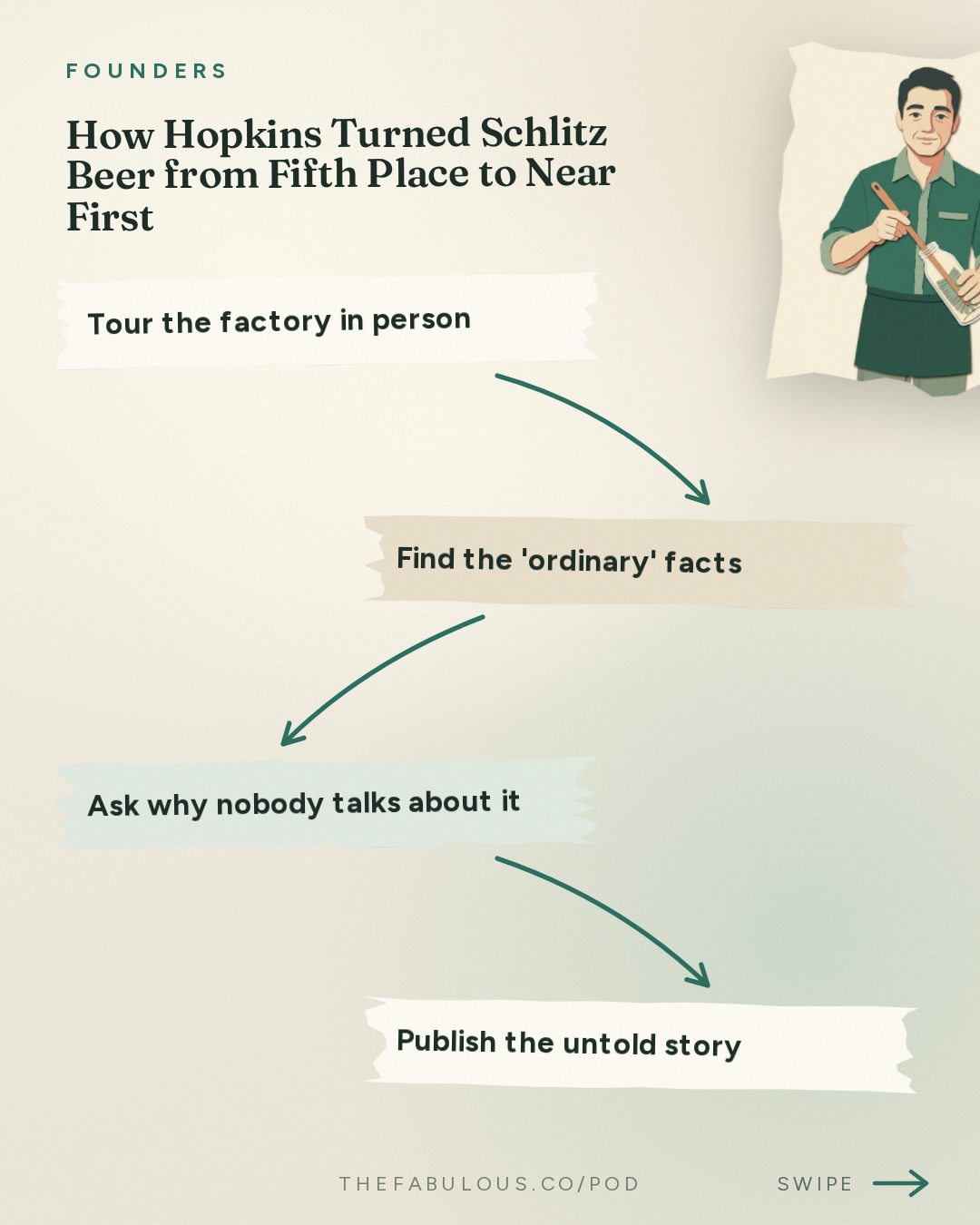
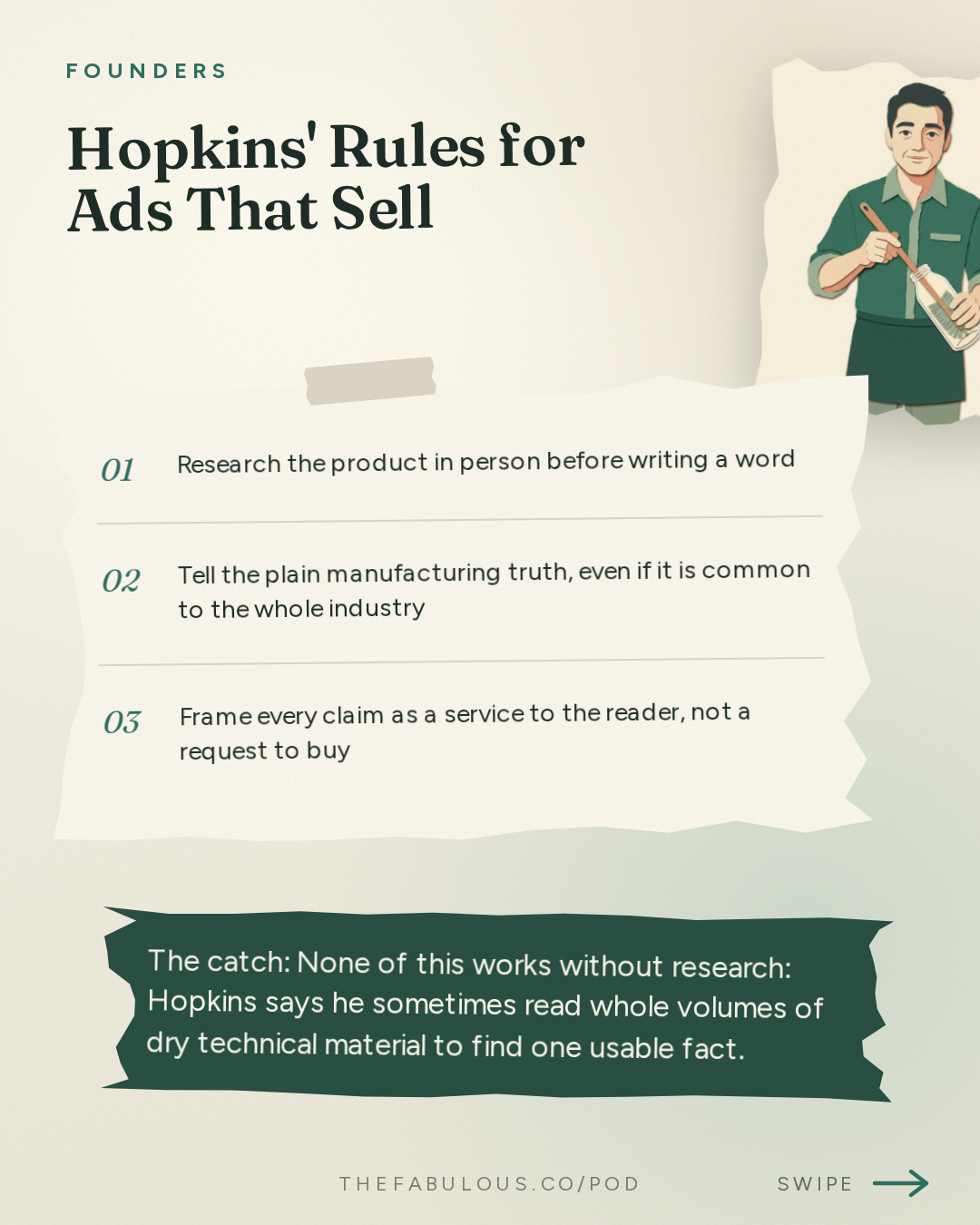
Hopkins' favorite case study is Schlitz Beer, hired when it sat in fifth place in a five-way market. He toured the brewery and found nothing remarkable to an insider: filtered-air cooling rooms, pipes cleaned twice daily, bottles washed four times by machine, wells drilled 4,000 feet down for pure water, a mother yeast cell refined through 1,200 separate experiments (30:30). None of it was unique to Schlitz. Every serious brewer did the same things, which is exactly why nobody had ever thought to mention it. Hopkins disagreed with that logic and put every one of those "ordinary" details into print.
"I told a story common to all good brewers, but a story which had never been told. I gave purity a meaning." (Claude Hopkins, [31:06])
Schlitz moved from fifth place to running even with the market leader within months (31:06). The mechanism is not secrecy. It is that manufacturers stand too close to their own factories to notice what a stranger would find remarkable, and Hopkins treats it as the advertising person's job to notice on the customer's behalf (34:42). The same principle shapes his account of John Powers, an earlier copywriter paid $12,000 a year, an enormous salary for the early 1900s, to write for the department store Wanamaker's (20:43). Facing a client on the edge of bankruptcy, Powers refused to soften anything: the ad admitted the company owed $125,000 more than it could pay and asked customers to buy tomorrow or watch the business fail. The blunt honesty created what Hopkins calls a "sensation," and the store was saved (21:04, 20:25).
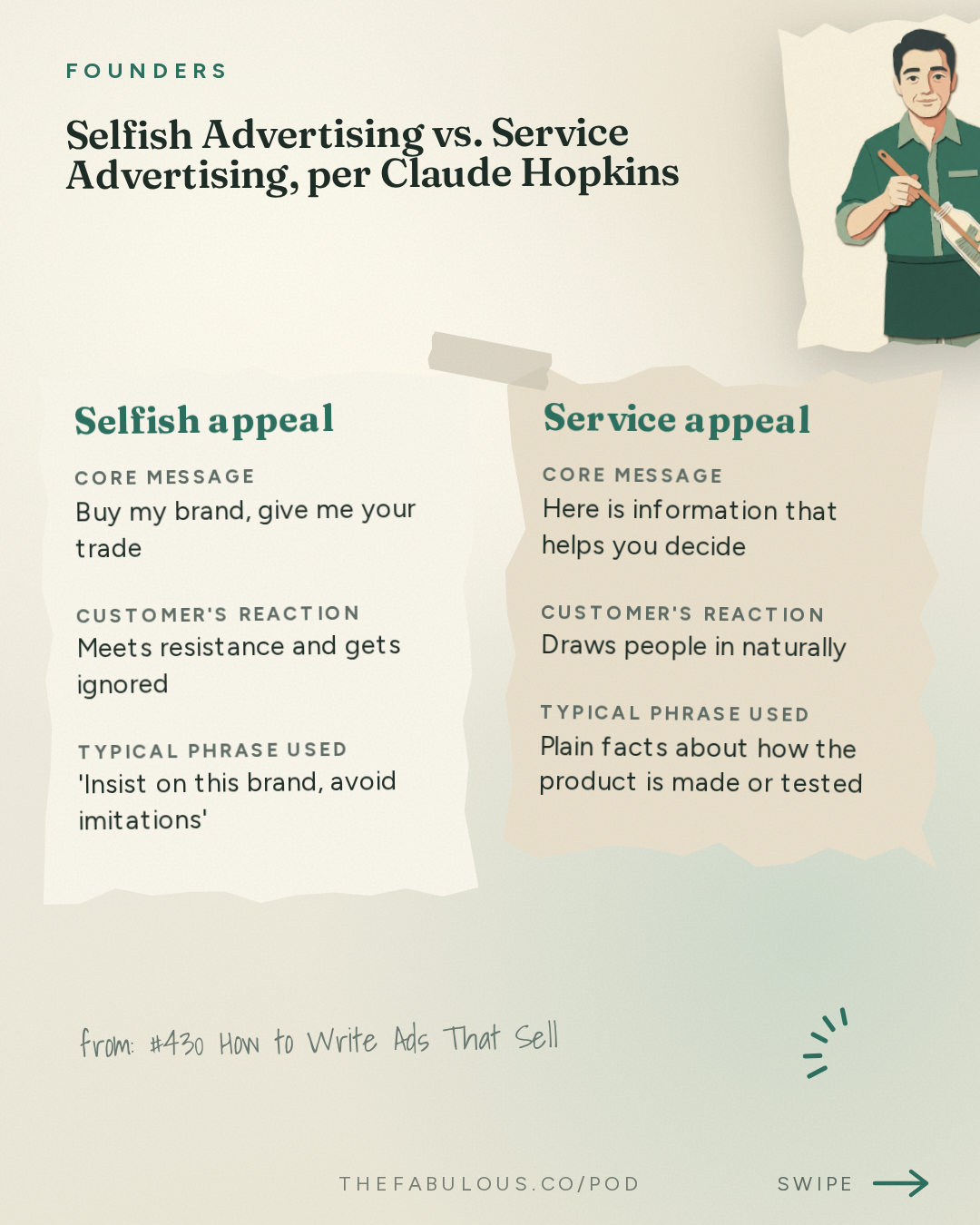
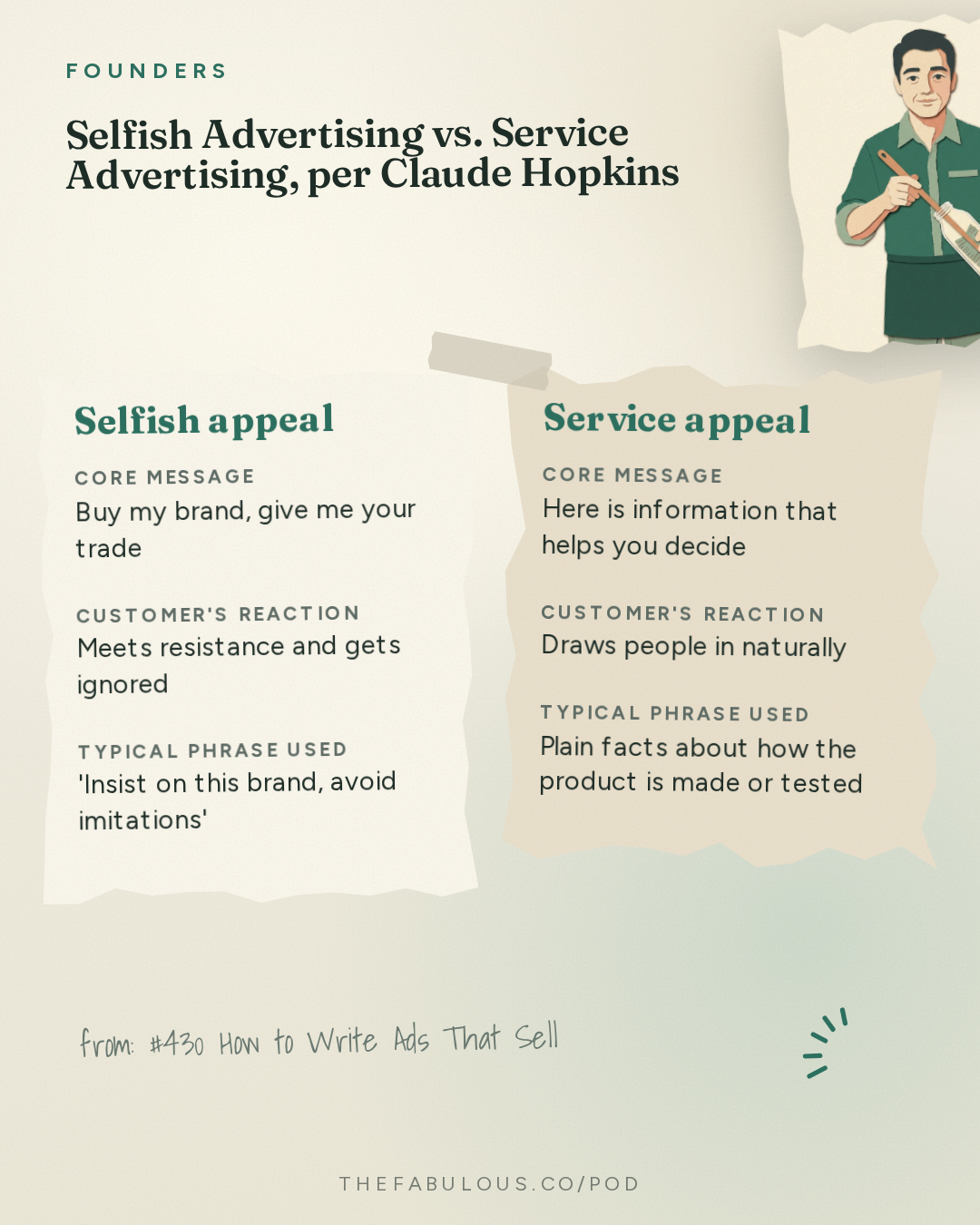
Underneath both stories sits a rule Hopkins repeats so often it starts to sound like a chant: sell service, not yourself. "The average salesman seeks favors," he writes. "His plea is buy my goods. He makes a selfish appeal to selfish people, and of course he meets resistance" (26:43). Ads built around a company's own pride, its size, its history, meet the same wall. Ads built around what the reader personally gets tend not to. That rule also explains one of the stranger claims in the book: that fear does not sell as well as reward. Hopkins says he made roughly a million dollars advertising Pepsodent toothpaste, and he never once pictured decayed teeth or warned of disaster. He sold beauty instead, because he found that people will do almost anything to fix a problem already in front of them and almost nothing to head one off in advance (41:37, 41:57).
The Words That Open the Door
All of this converges on the skill Hopkins clearly rates highest: the headline. He calls advertising "multiplied salesmanship," meaning one ad has to do a salesman's job for thousands of strangers instead of one (46:46). Since most readers only ever see the headline, Hopkins says he sometimes spends hours on a single line, discarding dozens of drafts, because the whole return on an ad depends on it (53:26). His own estimate is that changing a headline alone, with everything else in an ad left the same, can multiply its returns by five to ten times (56:37).
The tool he leans on hardest is specificity. Vague superlatives, "best in the world," "lowest prices," slide off a reader without leaving a mark, he argues, while a concrete number lands. One clothing retailer dropped "lowest prices in America" for a plainer, checkable claim: a 3 percent net profit margin, which did the persuading the slogan could not (59:48). A razor maker who advertised a tested 78-second shave saw a comparable jump (60:08). Neither number describes something rare. What makes them work is that neither can be shrugged off as marketing talk.
Hopkins ties all of it back to research, which he treats as unglamorous and unavoidable. He describes reading entire volumes of dry technical material to surface one usable fact, and closes with a line worth keeping.
"Genius is the art of taking pains." (Claude Hopkins, [61:28])
It is worth noticing how small the actual toolkit is here. Hopkins never mentions targeting software, focus groups, or brand systems, because none of that existed yet. What he has instead is a habit of watching how real people respond to real claims, and the patience to sit with one sentence until it earns its place. Decades later, Apple co-founder Steve Jobs did something structurally identical when he introduced the iPod with four words: a thousand songs in your pocket. It names a concrete benefit, states it as a number, and gets out of the way. Hopkins would have recognized it instantly, and probably would have wanted to know how many drafts it took.
Ask this episode anything
Pod's AI answers from the episode itself, with the minute mark so you can hear it yourself.
Or start with one of these
Ask this episode
Pod's AI listens to the whole episode to answer, and points you to the minute it comes from.
The rest of this answer, and any question after it
Answers come from the episode itself, never from a summary of it.
ContinueKey takeaways
- Ad pioneer Claude Hopkins sold service, not self-promotion, in every ad
- Hopkins worked roughly 16-hour days for 16 years, crediting hours over raw talent (04:47)
- A specific number, like a 3% profit margin, beats a vague claim like 'lowest prices' (59:48)
- Changing just a headline can multiply an ad's returns by 5 to 10 times, per Hopkins (56:37)
- Hopkins says free samples should go only to people who ask for them first (37:53)
The episode in cards
By the numbers
- 16 hours Claude Hopkins' daily work schedule for 16 years as an adult
- 3% percent Net profit margin used as a specific claim instead of 'lowest prices'
In their words
“The man who works twice as long as his fellows is bound to go twice as far, especially in advertising.”
“A good product is its own best salesman. It is uphill work to sell goods without samples.”
“I told a story common to all good brewers, but a story which had never been told. I gave purity a meaning.”
“The purpose of a headline is to pick out people you could interest.”
“Genius is the art of taking pains.”
Protocols
-
Demonstrate before you claim
Claude Hopkins recommends showing a product working instead of just describing it, because he converted only one in ten prospects by talking about his mother's silver polish but nearly all of them once he demonstrated it in person.
Whenever launching or pitching a new product
-
Only sample people who ask
Hopkins advises offering a free sample only after a customer takes a small step to request it, such as filling out a form, because he found that products sent to people who never asked lose their value and read as disrespectful.
Every sampling campaign
-
Lead with service, not the brand name
Hopkins tells advertisers to write every ad as an offer of help to the reader rather than a request to buy, because appeals built around the company's own interest meet resistance while appeals built around the customer's interest draw people in.
Every ad and every headline
-
Sell the reward, not the warning
Hopkins built his Pepsodent toothpaste campaign entirely around beauty and confidence rather than the fear of cavities, because he found that people act to fix a problem already in front of them but rarely act to prevent one that has not happened yet.
Applies to any prevention-type product
-
Use one hard number instead of a superlative
Hopkins replaced vague claims like 'lowest prices in America' with a specific, checkable figure such as a 3 percent profit margin, because he found that concrete numbers land with readers while general superlatives get ignored.
Whenever writing a claim of quality or value
Questions this episode answers
What are Claude Hopkins' main advertising principles?
Copywriter Claude Hopkins argued that ads should sell service rather than self-promotion, prove claims with demonstrations or samples, use specific numbers instead of superlatives, and put the single strongest benefit in the headline (46:46, 52:40). He developed these rules across decades writing for brands like Schlitz beer and Pepsodent toothpaste.
What is the Schlitz beer advertising story about?
Hopkins toured Schlitz's brewery and found standard purification steps, wells drilled 4,000 feet deep, and a mother yeast cell refined through 1,200 experiments, that no brewer had ever advertised because every brewer used them (30:30). Publishing those ordinary facts as a story moved Schlitz from fifth place to near the market lead within months (31:06).
How much can a headline change affect ad performance?
Hopkins says changing only the headline on an otherwise identical ad can multiply its financial returns by five to ten times, because most readers see only the headline and decide from it whether to keep reading (56:37). He reports discarding dozens of headline drafts before settling on one for this reason (53:26).
Why did Claude Hopkins avoid fear-based advertising like cavity prevention?
Hopkins found that prevention messages have little pull because people act to fix a problem already in front of them but rarely act to head one off in advance (41:37). He built his Pepsodent toothpaste campaign around beauty and reward instead of decay warnings and says it made him roughly a million dollars (41:57).
What is Scientific Advertising by Claude Hopkins about?
Scientific Advertising is Hopkins' book distilling decades of copywriting experience into short chapters on headlines, service-based appeals, and specific claims. His employer Albert Lasker kept the manuscript in a safe for about twenty years before it was published (01:59, 02:22), and it later shaped copywriters including David Ogilvy.
How many hours did Claude Hopkins work?
Hopkins says he worked roughly sixteen-hour days for sixteen years as an adult, rarely taking an evening or Sunday off, and he credits exceptional hours rather than exceptional talent for his success (04:47, 05:30).
The full read, in cards
Go deeper
- Scientific Advertising — Hopkins' foundational text on copywriting, covering headlines, service-based appeals, and specific claims
- My Life in Advertising — Hopkins' autobiography, the source of most anecdotes on his work ethic and career
Mentioned
Claude Hopkins · Albert Lasker · David Ogilvy · John Powers · Estee Lauder · Steve Jobs · Warren Buffett · Charlie Munger · Les Schwab · Isidor Sharp · Schlitz Beer · Pepsodent · Scientific Advertising · My Life in Advertising
More from this show and category
The Tycoons: How Carnegie and Rockefeller Built America
Charles R. Morris's book The Tycoons compares how Carnegie, Rockefeller, Gould, and Morgan each built the post-Civil War American economy. Carnegie cut costs and scaled steel, Rockefeller out-managed rivals in oil, Gould mastered railroad finance, and Morgan tried to impose order, together creating the infrastructure that let consumer brands like Procter & Gamble emerge.
Ari Emanuel's Roll the Calls, Summarized
Ari Emanuel's memoir Roll the Calls traces his rise from a dyslexic mailroom assistant to the billionaire founder of Endeavor. It shows how rage, relentless phone volume, and a 1994 near-fatal car accident drove him to found Endeavor, merge with William Morris, and buy the UFC and WWE before Endeavor was valued at $13 billion.
Jeremy Stern's Mark Zuckerberg Profile Explained
Mark Zuckerberg has modeled himself on Augustus Caesar for decades, fighting what journalist Jeremy Stern calls the dictator's dilemma. Stern's profile shows how Zuckerberg counters corporate isolation with raw data and MMA training, building a $1.6 trillion empire of 3.6 billion users while insisting he will never stop.
Sam Walton's Core Business Strategies
Sam Walton built Walmart on four simple habits: cost control, copying competitors, small-town focus, and constant willingness to change course. He lost his first store over a missing lease clause, learned to fly a plane to scale faster, and copied ideas from JC Penney and Sol Price on his way to becoming America's richest man.
