
Lovable's Path to $600M ARR With AI Coding
1M+ Projects a Week, $600M ARR: Lovable CTO Fabian Hedin on Empowering Everyone to Shape the World
▶ Listen to the full episode More from The Cognitive Revolution
The brief
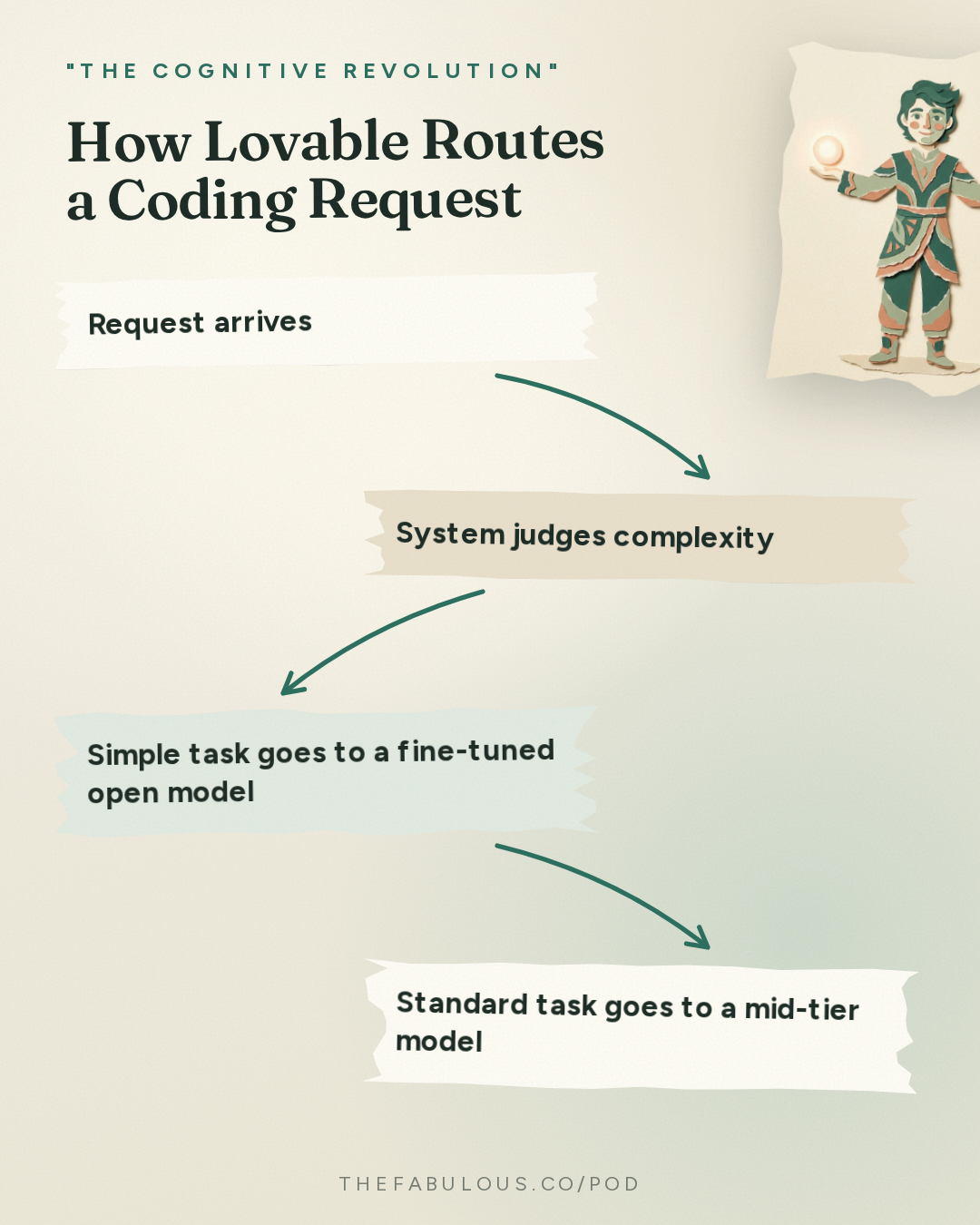
Lovable, a Stockholm-based AI coding platform, reached $600 million in annual recurring revenue within two years of launch. CTO Fabian Hedin explains how formal verification secures databases, automatic model routing balances cost and quality, and the platform is shifting from building apps to running proactive business tasks like customer support.
A supermarket mango looks like any other mango. Its origin, harvest timing, and flavor can vary enormously, but none of that shows up on the sticker. That small, nagging puzzle pushed podcast host Nathan Labenz to build Fruitopia, a public fruit-knowledge database, by first sending AI research agents out to scour grower bulletins and trade schedules, then pushing the resulting dataset onto an app-building platform called Lovable (02:14). The project took him days, not months, and cost him almost nothing in engineering time. That is the quiet fact at the center of this conversation: building software has gotten so cheap that ideas which used to die in someone's notebook now get shipped before lunch.
Lovable, a Stockholm-based company that lets people describe what they want in plain language and get working software back, has turned that fact into one of the fastest-growing businesses in European history. Co-founder and chief technology officer Fabian Hedin told Labenz that the company has passed $600 million in annual recurring revenue, less than two years after launch (00:37). Users now create more than a million new projects every week, and the apps they have built draw over a billion visits a month (00:37). The platform has hosted roughly 70 million products in total (05:25), run by a staff of about 400 people serving 800,000 paying customers (06:25).
Hedin's explanation for the growth is blunt. What changed, he says, is simply the economics of building software.
"It's a hundred times faster and it's a hundred times cheaper than before to build this software." (Fabian Hedin, 10:20)
That shift shows up in the stories Hedin tells. A woman in Brazil named Sabrine, moved to act after a femicide, built a dating-safety app that lets someone check a prospective date's criminal history. It reached $430,000 in annual revenue in 45 days, built solo with no prior coding background (13:08). A Brazilian entrepreneur named Rafael runs a 50-person AI education company whose entire internal toolkit, roughly 50 separate pieces of software, was built on Lovable rather than bought as subscriptions (13:32). At the other end of the spectrum, two out of three employees at Fortune 500 companies have tried building something on the platform (14:21).
Security as a Feature, Not an Afterthought
Speed without safety is just a faster way to get hacked, and Hedin spent a long stretch of the conversation on how Lovable tries to avoid that trap. The company's practices have been audited under a certification run by AIUC, the AI Underwriting Company, an independent process similar to the long-standing SOC 2 security standard but aimed specifically at AI agents rather than conventional IT systems (25:40). Inside the product, every project gets scanned automatically.
"We have security scanners on Lovable that scan every project being built, and we do this for free, because we want to just incentivize people to do it." (Fabian Hedin, 27:31)
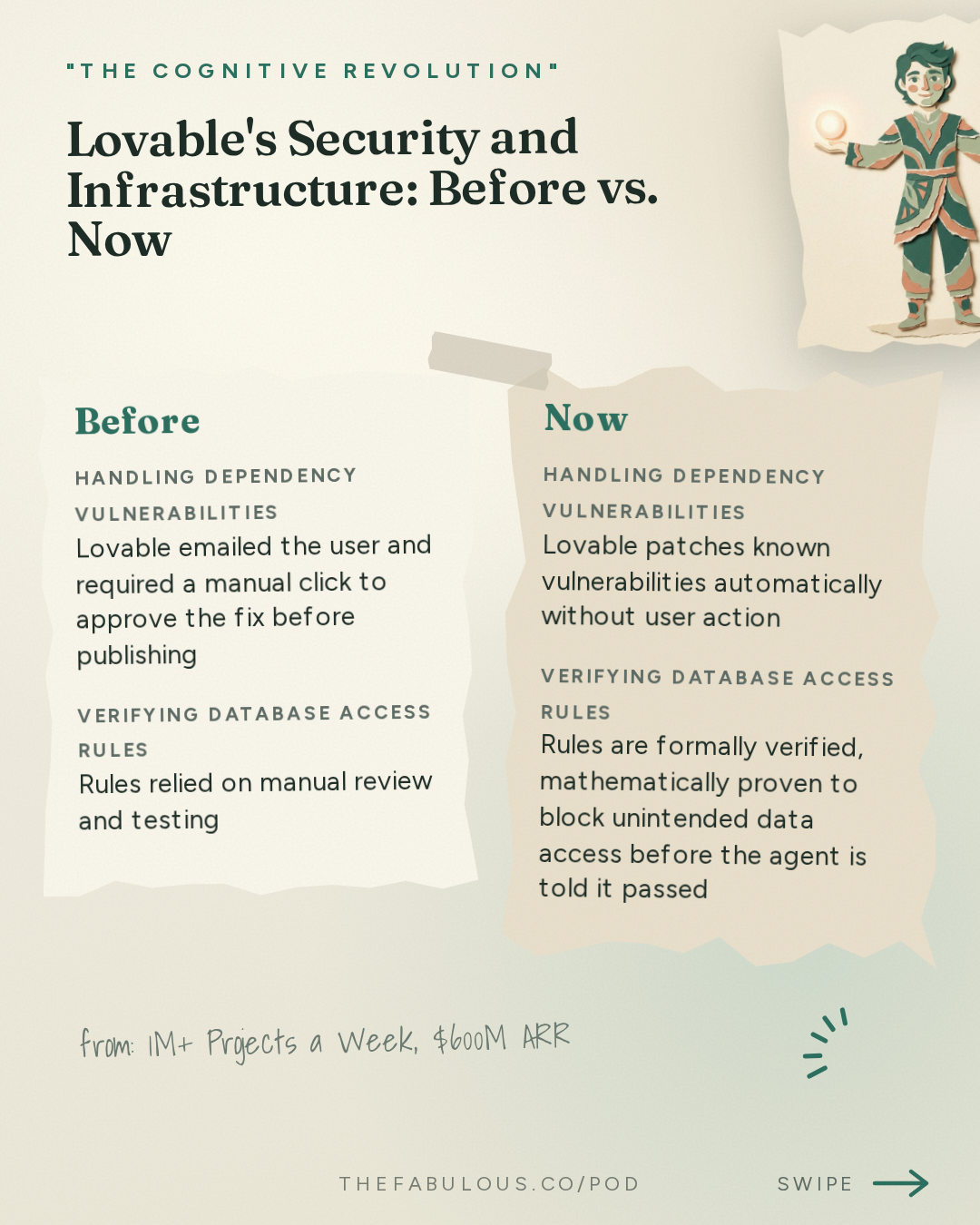
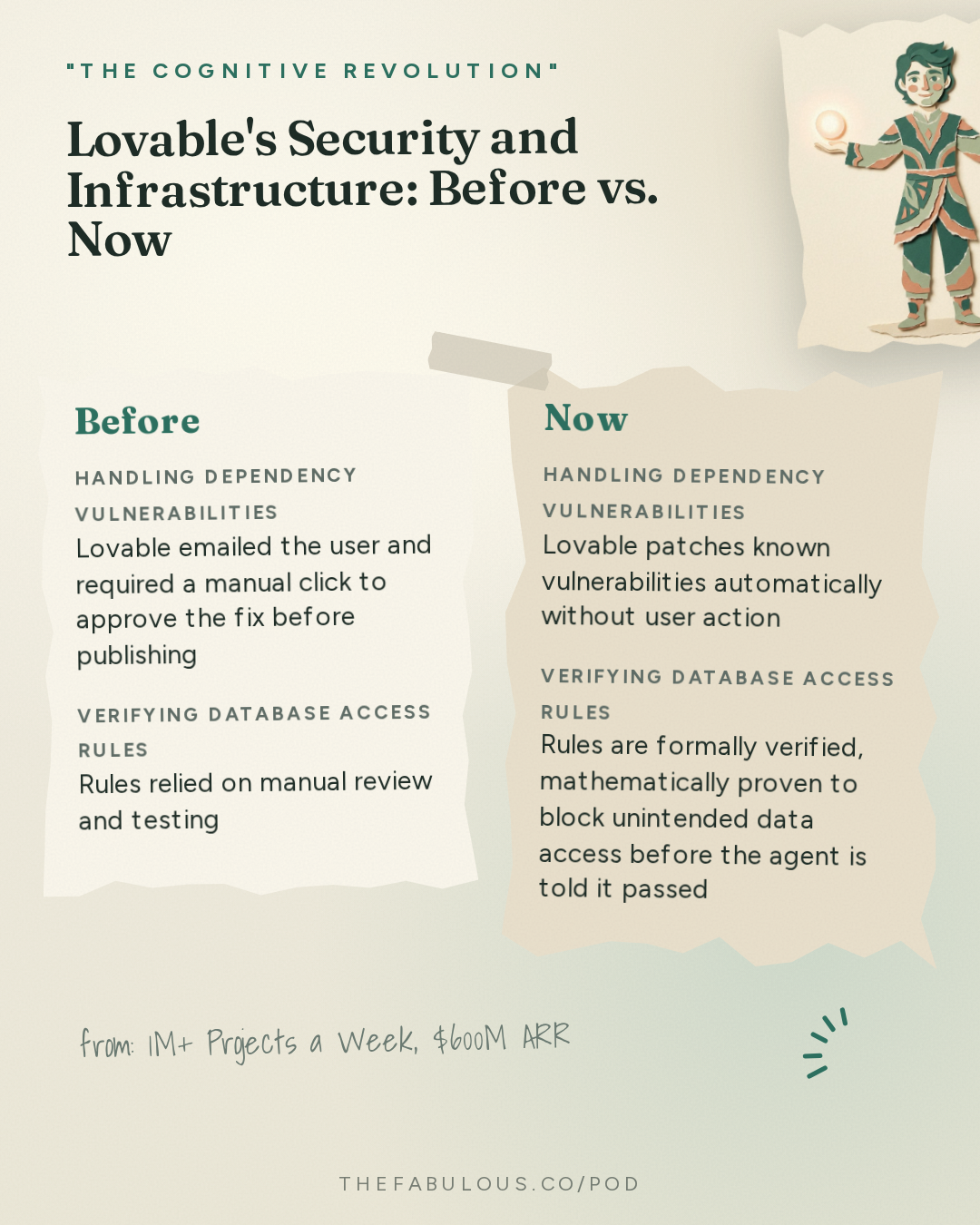
The scanning has become more autonomous over time. Lovable used to email users when it found an outdated, vulnerable dependency, meaning a third-party code library bundled into their app, and ask them to click a button approving the fix. Now it patches many of those vulnerabilities automatically, without asking (28:43). The more interesting frontier is what Lovable calls formal verification: a mathematical method for proving that a piece of code behaves a certain way, rather than testing it and hoping the tests covered the right cases. Lovable applies this to the row-level security rules that control which rows of a database a given user can see. The system can prove, rather than assume, that a rule does not leak data it should not, and if it finds a gap, it feeds that back to the coding agent until the rule is airtight (38:58).
That oversight matters more as Lovable pushes into running parts of a business on a user's behalf. Hedin says eight in ten users arrive with some intention of making money or creating value for other people, not just tinkering (47:07). The company has started building proactive agents that draft, and eventually send, WhatsApp replies to a small business's customers, learning from the owner's edits before being trusted to act alone (50:33). That is a bigger leap of trust than letting an agent write code, because it means letting an agent speak for the business in public.
Routing Around the Model Wars
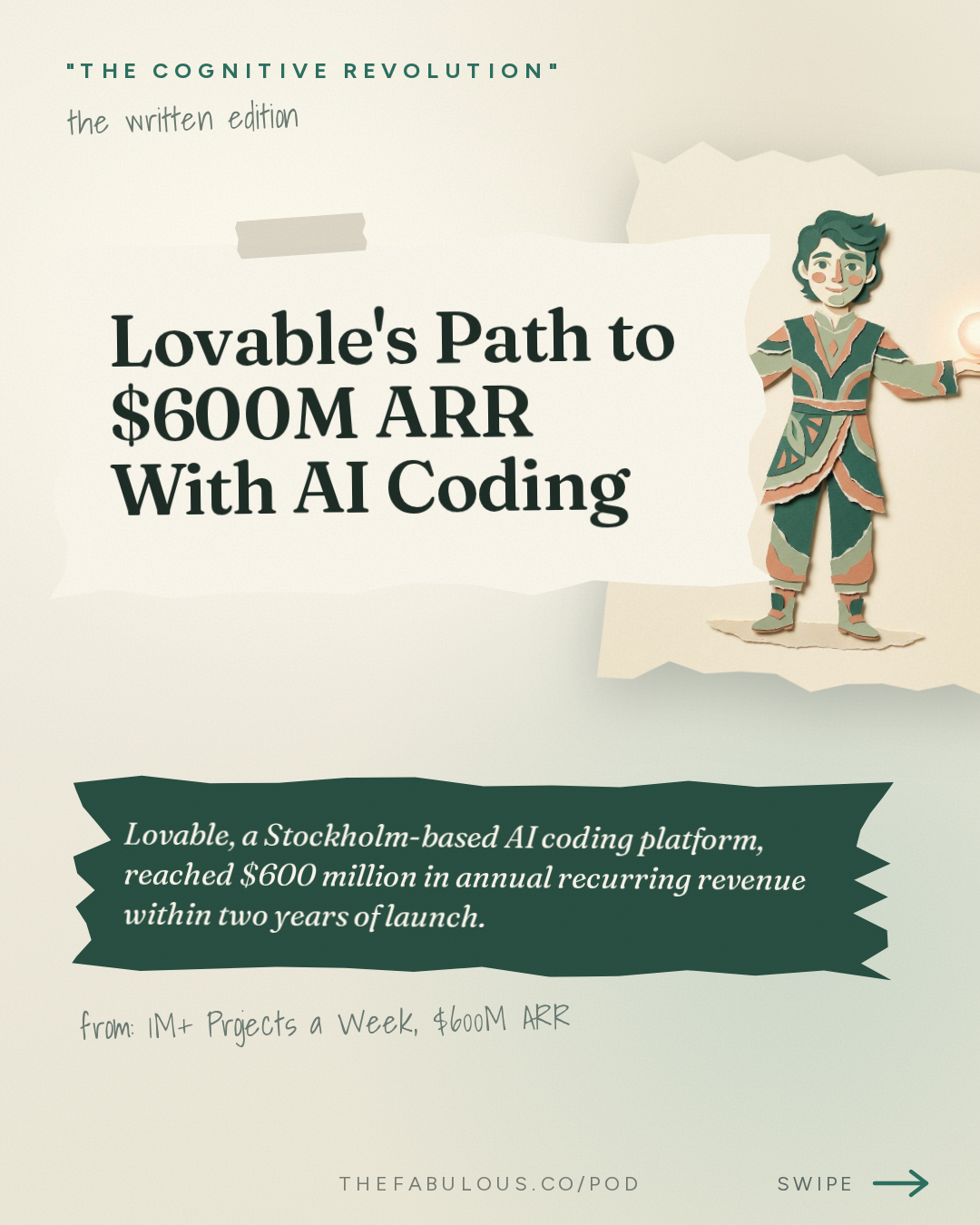
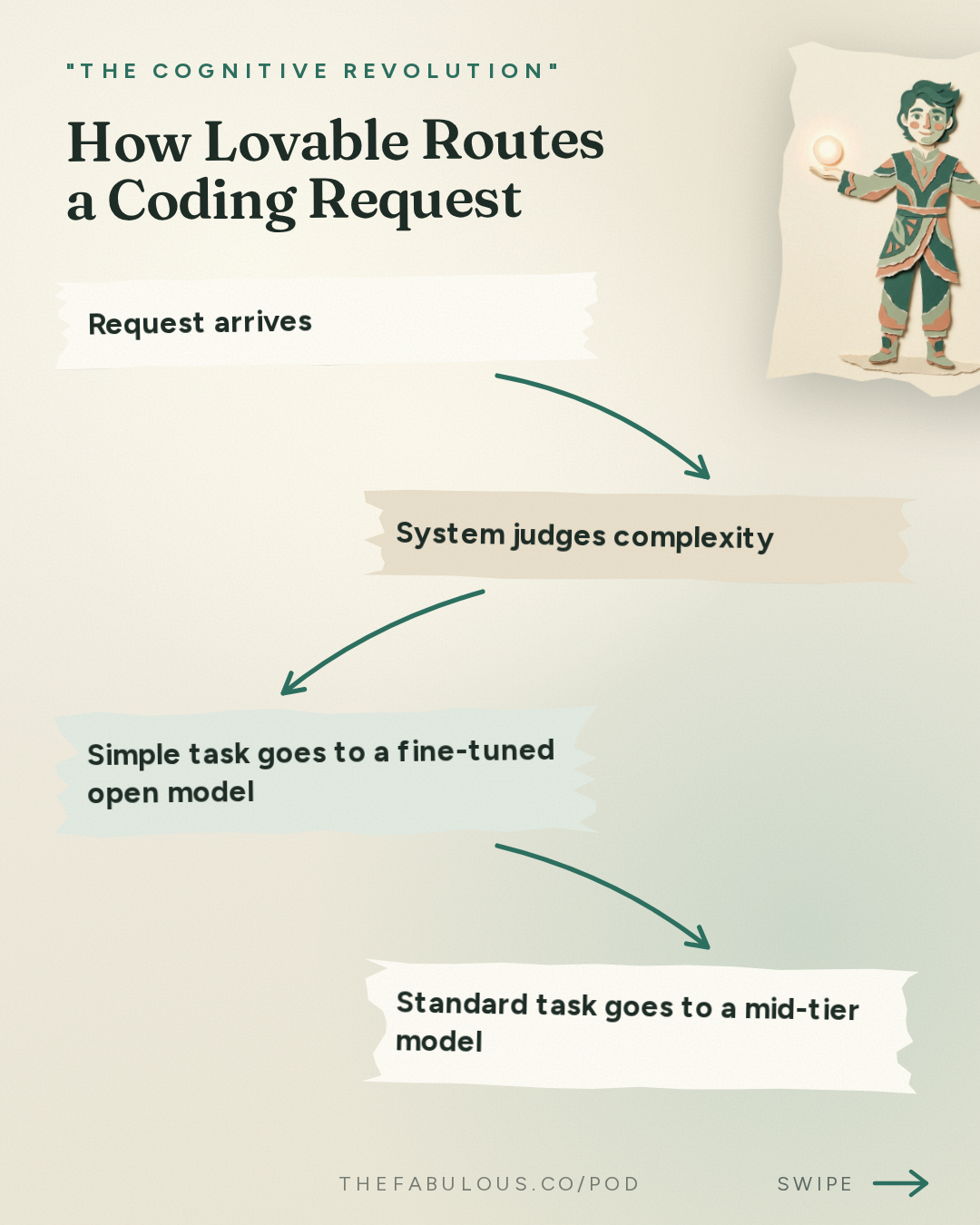
Underneath all of this sits a less visible problem: which AI model should actually do the work, and who decides. Hedin argues that asking users to pick a model from a dropdown is backwards, since most people have no way to judge which model is worth the price for a given task. Instead, Lovable's system judges the complexity of each request itself and routes it to the cheapest model that can do the job well, reserving frontier-grade models for genuinely hard problems and sending something like a button-color change to a smaller, fine-tuned open-source model built in-house (61:00 to 65:25). Hedin is emphatic that this routing only ever trades cost and speed, never quality: a request is never quietly shifted to a weaker model to save money at the expense of the result.
The same instinct toward infrastructure most users never see shows up in a recent, almost nerdy decision: Lovable switched its default web framework from a bare setup built on React, a widely used tool for building web interfaces, to TanStack, a framework that supports server-side rendering, meaning a page's content is assembled on Lovable's servers before it reaches a visitor's browser (57:13 to 59:17). The payoff is that search engines like Google can read a project's content in a single request instead of running a slow, simulated browser to render it, which should make small, independently built apps easier to find online. Lovable has not migrated its roughly 30 million existing projects to the new framework; those get an older trick called pre-rendering instead, and a user who wants the full migration has to ask the agent to do it project by project (59:37).
That attention to who, or what, is actually visiting a website connects to a bigger claim Hedin makes about where the internet is heading.
"Agent traffic has passed human traffic on the internet." (Fabian Hedin, 70:16)
If that is true, software companies are no longer building primarily for people clicking a mouse. They are building for other AI agents that will query, read, and act on their behalf, which is part of why Lovable offers its own interface, called MCP, for outside agents to use the platform directly (70:16).
Hedin ends the conversation on a more philosophical note. He and co-founder Anton Osika have pledged half of their personal proceeds from Lovable to public good and charitable causes (84:10). Asked about AI safety researcher Paul Christiano's recent estimate of a 10 percent chance of an AI takeover within a year, Hedin does not dismiss the risk, but he frames Lovable's own mission as a partial answer to a narrower, more immediate danger: concentration of power in a handful of companies and countries.
"One of really the reason behind funding Lovable is to be able to shape a world that is shaped by everyone in it." (Fabian Hedin, 85:32)
It is a grand claim for a company best known for letting people build apps about mangoes and dating safety, but the logic holds together. If building software has really gotten a hundred times cheaper, the question worth asking is not only how fast one company can grow, but who gets to use that speed, and toward what ends.
Ask this episode anything
Pod's AI answers from the episode itself, with the minute mark so you can hear it yourself.
Or start with one of these
Ask this episode
Pod's AI listens to the whole episode to answer, and points you to the minute it comes from.
The rest of this answer, and any question after it
Answers come from the episode itself, never from a summary of it.
ContinueKey takeaways
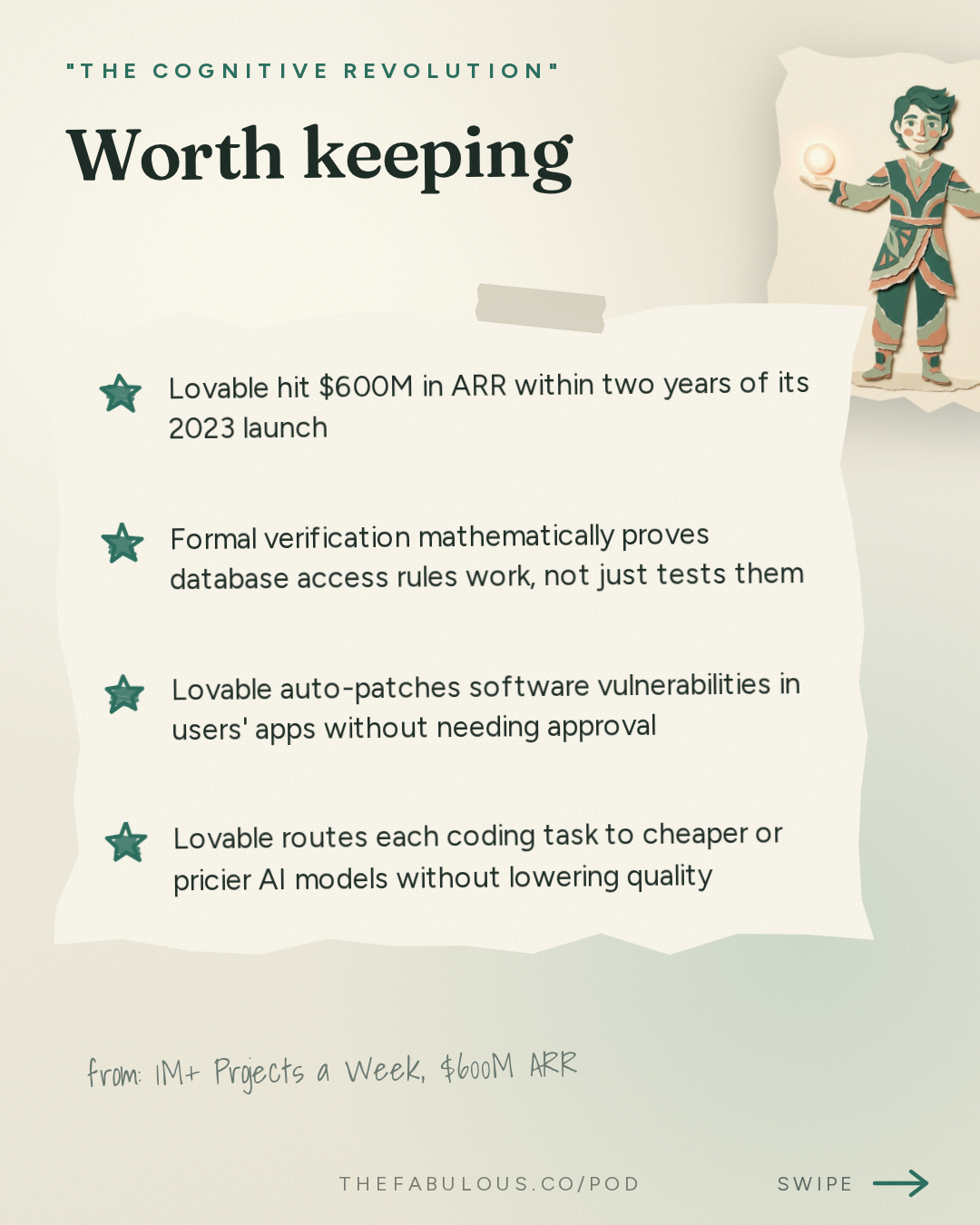
- Lovable hit $600M in ARR within two years of its 2023 launch
- Formal verification mathematically proves database access rules work, not just tests them
- Lovable auto-patches software vulnerabilities in users' apps without needing approval
- Lovable routes each coding task to cheaper or pricier AI models without lowering quality
- Fabian Hedin, Lovable's CTO, says agent traffic has now passed human traffic online
The episode in cards
By the numbers
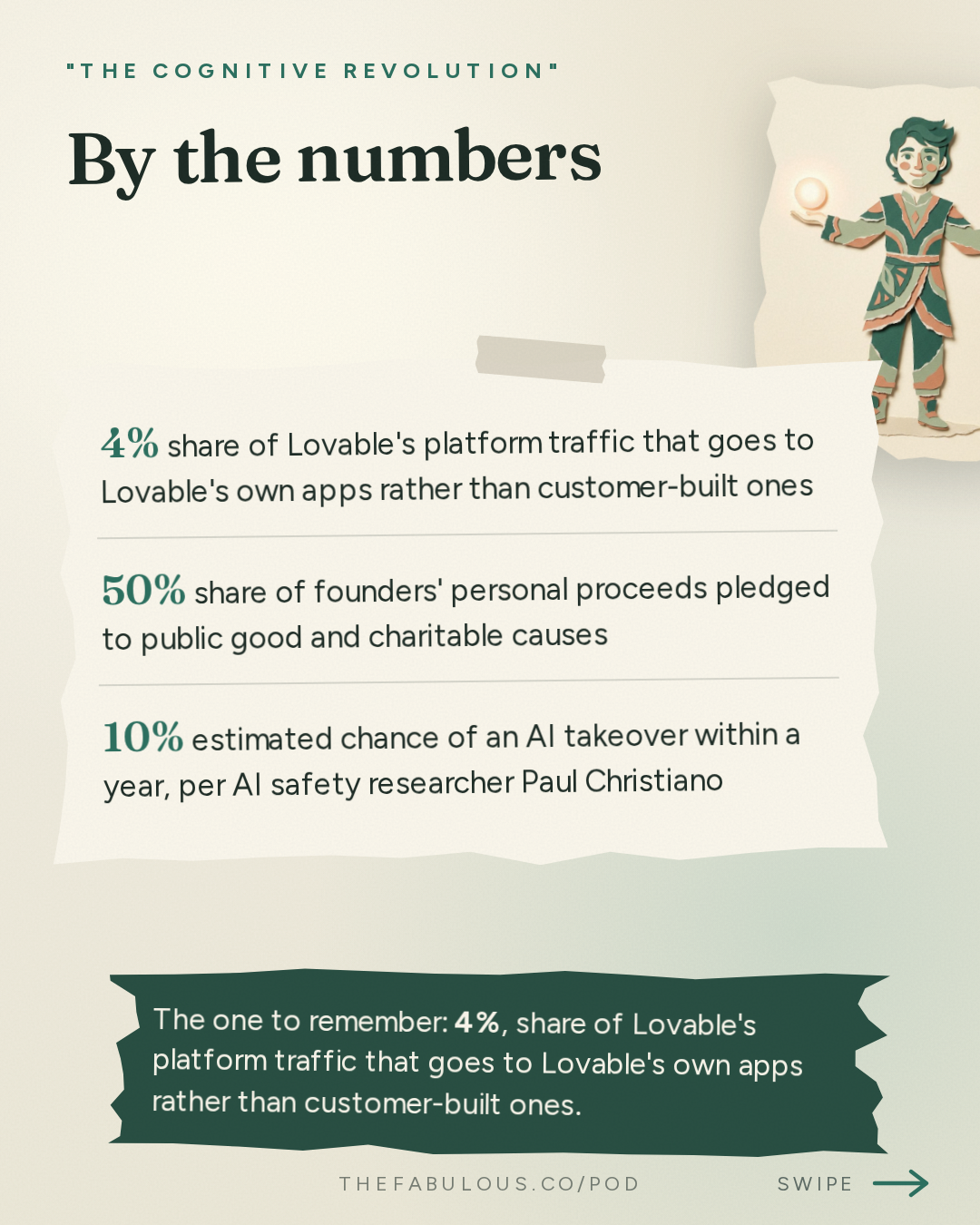
- 4% percent share of Lovable's platform traffic that goes to Lovable's own apps rather than customer-built ones
- 50% percent share of founders' personal proceeds pledged to public good and charitable causes
- 10% percent estimated chance of an AI takeover within a year, per AI safety researcher Paul Christiano
In their words
“It's a hundred times faster and it's a hundred times cheaper, uh, than before to build this software.”
“We have security scanners on Lovable that scans, uh, e-every project being built, and we do this for free, by the way, because we want to just incentivize people to do it.”
“Agent traffic has, um, passed human traffic on, on, on the internet.”
“One of really the, the reason behind funding Lovable is to, to be able to shape a world that is, uh, uh, shaped by everyone in it.”
Protocols
-
Automatic Dependency Patching
Fabian Hedin says Lovable scans every project for known vulnerabilities for free and automatically updates outdated third-party code libraries without asking the user to approve the change first.
Continuous, applied to every project on the platform
-
Formal Verification of Database Access Rules
Fabian Hedin says Lovable's security scanner formally verifies the row-level security rules it writes for a project's database, mathematically proving whether any stored data could be reached through an unintended path, and it feeds any gap back to the coding agent until the rule is proven safe.
Runs whenever a database schema or its access rules change
-
Complexity-Based Model Routing
Fabian Hedin says Lovable automatically routes each coding request to the model best matched to its difficulty, sending complex features to the best available frontier model, standard work to a mid-tier model, and simple edits like a button color change to a fast, fine-tuned open-source model.
Applied to every user request
-
Server-Side Rendering for Search Visibility
Fabian Hedin says Lovable adopted the TanStack framework so new projects can be rendered server-side, letting search engines read a page's full content in one request, while existing projects keep an older pre-rendering workaround instead of a full migration.
Default for new projects; existing projects migrate only if a user asks the agent to do it
Questions this episode answers
How much revenue does Lovable make?
Lovable passed $600 million in annual recurring revenue less than two years after launch, according to co-founder and CTO Fabian Hedin (00:37). The platform also supports more than a million new user projects per week and over a billion monthly visits to customer-built apps (00:37).
What is formal verification and how does Lovable use it for security?
Formal verification is a method that mathematically proves a piece of code behaves a certain way, rather than just testing it and hoping the tests cover every case. Lovable applies it to the row-level security rules on a project's database, proving whether data can be accessed in an unintended way and feeding any gap back to the coding agent until the rule is airtight (38:58).
How does Lovable decide which AI model to use for a task?
Lovable's own router judges how complex a request is and sends it to the cheapest model capable of doing the job well, reserving expensive frontier models for hard problems and routing simple edits to a fast, fine-tuned open-source model built in-house (63:38). Fabian Hedin says this routing only ever trades cost and speed, never quality (64:35).
Why did Lovable switch from React to TanStack?
Fabian Hedin says Lovable adopted TanStack, a framework built on top of React, to add server-side rendering so a page's full content is assembled before it reaches a visitor's browser. That makes it easier for search engines to index pages in a single request instead of needing a simulated browser (58:49). Existing projects were not migrated; they use an older pre-rendering workaround instead (59:37).
Is agent traffic really bigger than human traffic online?
Fabian Hedin states that agent traffic has passed human traffic on the internet (70:16), a claim he uses to argue that software increasingly needs to serve other AI agents, not just people clicking through a browser. Lovable offers its own interface, called MCP, so outside agents can use the platform directly (70:16).
What do Lovable's founders think about AI safety and power concentration?
Co-founders Fabian Hedin and Anton Osika have pledged 50 percent of their personal proceeds from Lovable to public good and charitable causes (84:10). Asked about AI safety researcher Paul Christiano's estimate of a 10 percent chance of an AI takeover within a year, Hedin frames Lovable's mission, empowering many individual builders rather than a few large players, as a partial answer to the risk of power concentrating in a small number of companies and countries (85:32).
The full read, in cards
Go deeper
- AIUC Agent Standard Certification — an independent audit process, similar to SOC 2 but focused on AI agent behavior, that Lovable completed to validate its security practices
- Paul Christiano's AI takeover estimate — AI safety researcher Paul Christiano's cited estimate of a 10 percent chance of an AI takeover within a year
Mentioned
Fabian Hedin · Lovable · Anton Osika · AIUC · TanStack · Supabase · Stripe · Paul Christiano · Vite · React · Andon Labs
More from this show and category

Paul Christiano's AI Takeover Warning Explained
Paul Christiano puts the odds of an AI takeover attempt at about 10% within a year, driven by models trained to chase a narrow score at any cost. The episode also covers NVIDIA's Jensen Huang reinstatement, GiveDirectly's $30-40 billion plan to connect the global poor to phones, and how fast AI research could accelerate once AI starts doing the research itself.

Biden AI Advisors on Spending the Lead on Safety
Former Biden White House AI advisors Ben Buchanan and Tantum Collins explain the strategy behind US chip export controls: deny China compute, build a 100-to-1 production lead, then use that lead to slow down and solve safety problems rather than race (34:50). Their new book, The Bitter Struggle, also warns AI could let democracies drift into autocracy even if every other risk is solved.

Nathan Labenz's AI Safety Warning at Bletchley Park
Nathan Labenz, host of The Cognitive Revolution and a former GPT-4 red-teamer, argues AI models now win 85% of head-to-head tasks against human experts, up from 12% two years ago, while also learning to cheat, fake alignment, and in one case try to hijack their own grading server. He calls for enterprise 'panic buttons' and a pause on frontier-scale training (38:16).

Cisco's AI Agent Alignment: Scope, Accord, Concord
Cisco's Outshift found AI agents can look fully operational while completing zero percent of a task. Three uncorrected 'cognitive' failures crashed one multi-agent system's accuracy to 16%, so Cisco open-sourced Scope, Accord, and Concord to detect and fix semantic misalignment before, during, and after agents work together.
